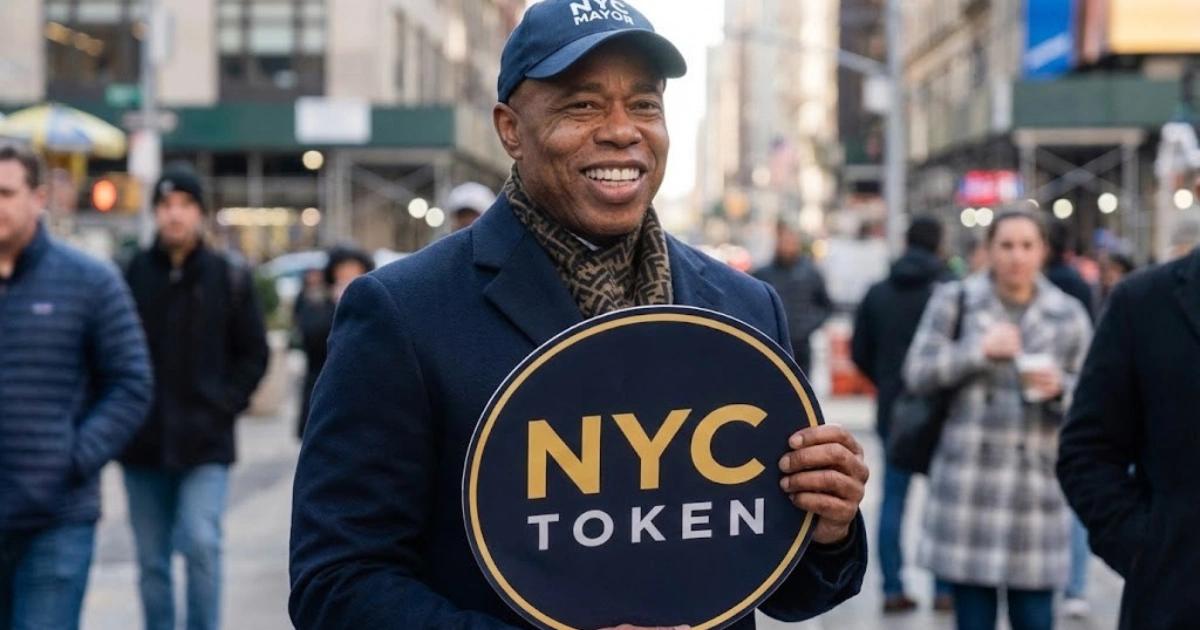
Former New York City Mayor Adams issues meme coin $NYC, which rapidly crashes after a surge in market capitalization. Abnormal on-chain liquidity movements have raised concerns of a Rug Pull, bringing political meme coin risks back into focus.
New York “Bitcoin Mayor” resumes his role after stepping down, and the emergence of New York City Coin sparks attention
Former New York City Mayor Eric Adams, after ending his controversial term, re-entered the cryptocurrency scene on January 12, 2026, with a grand announcement at Times Square of a new Solana-based meme coin called “New York City Coin ($NYC).”
This politician, who once claimed to be the “Bitcoin Mayor,” previously converted his first three salaries into Bitcoin ($BTC) and Ethereum ($ETH), demonstrating his fervent support for digital assets.
The token launched by Adams is positioned as a “commemorative asset” with a social mission. In an interview with Fox Business, he stated that the token aims to fund educational programs to combat anti-Semitism and anti-Americanism, provide scholarships for underprivileged communities and historically black colleges and universities (HBCUs), and even teach children how to embrace blockchain technology.
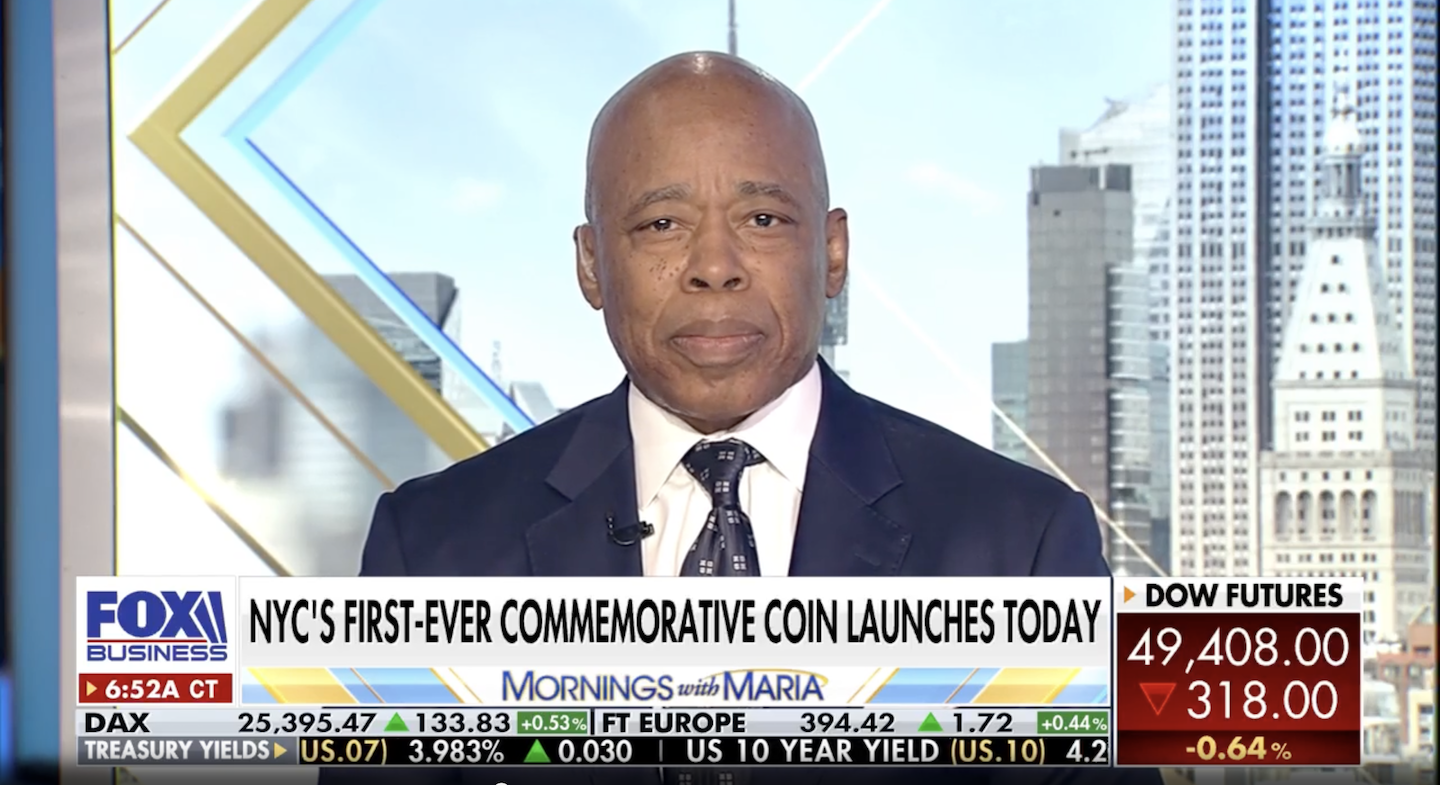
Image source: Fox Business Former NYC Mayor Eric Adams in an interview with Fox Business claimed that the purpose of issuing the token is to fund educational programs against anti-Semitism and anti-Americanism
In promotional videos, Adams boldly claimed that this token would bring the spirit of New York to the world, allowing those who cannot visit New York to experience the city’s innovation and diversity.
After the plan was publicly shared on social platform X, it quickly ignited a speculative frenzy. Data shows that $NYC 's market cap soared to between $580 million and $730 million within hours of launch, with the token price rapidly climbing to 0.58 from initial lows. This surge reflected strong demand from retail investors and automated trading bots for political meme coins, but also laid the groundwork for subsequent market volatility. (As of the time of writing, $NYC 's price is $0.1335, with a market cap of only $40 million)
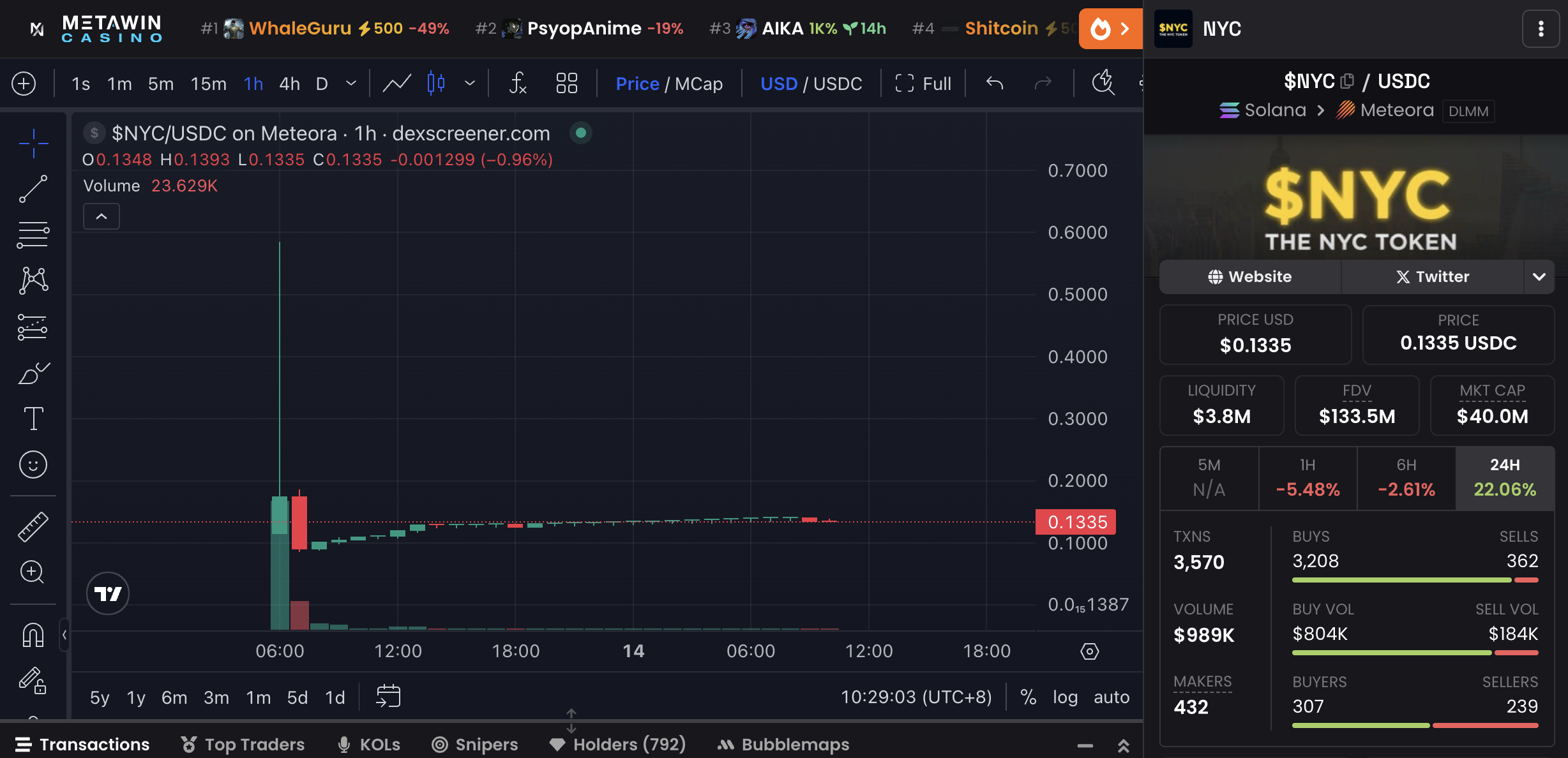
Image source: X/@bubblemaps On-chain analysis platform Bubblemaps found that the wallet 9Ty4M related to the token deployer created a unilateral liquidity pool on Meteora exchange and withdrew approximately $2.43 million to $2.5 million worth of $NYC liquidity at market high
What’s more suspicious is that after the token price plummeted 60%, this wallet only re-injected about $1.5 million into the liquidity pool, resulting in approximately $932,000 of funds flowing into unknown destinations.
This precise “buy low, sell high” liquidity operation has been strongly criticized by market observers and the crypto community as a classic “Rug Pull” tactic. Nansen analyst Nicolai Sondergaard pointed out that such behavior effectively traps investors, forcing many retail traders to sell at a loss amid extremely low liquidity.
Additionally, $NYC 's supply is highly concentrated, with the top 5 wallets holding nearly 92% of the tokens, and the top 10 wallets holding up to 98.73%. This extreme token distribution allows a few large holders to easily manipulate the price, leaving ordinary investors with little chance to escape. One wallet even lost over $470,000 within just 20 minutes.
Adams team denies illegal activities; entrepreneur accuses “New York City Coin” concept of being stolen
Facing mounting negative accusations and “carpet pull” warnings on platform X, Adams and his $USDC team issued a statement to clarify.
The official statement said that the so-called fund movements were liquidity adjustments made by market makers to cope with the initial high demand and to optimize trading smoothness, emphasizing that the team did not sell any tokens, and the development team’s holdings are locked and subject to transfer restrictions. However, this explanation clearly failed to quell public outrage, as the team has yet to provide a reasonable account of the missing $932,000.
Beyond allegations of market manipulation, Adams is also embroiled in a plagiarism controversy. Edward Cullen, CEO of Bronx-based digital asset firm Crescite, claimed that he proposed the ( concept to Adams’ team in June 2025 and already owns the domain and trademark related to the name.
Cullen stated that Adams’ plan, in both name and core social good concept, is identical to his original idea. He further accused Adams’ team of not only stealing the idea but also ruining it, damaging the original intent of using digital assets to improve citizens’ lives.
This incident also evokes memories of the meme coins issued by Argentine President Javier Milei and former First Lady Melania Trump in 2025, which saw their market value drastically evaporate after liquidity manipulation scandals, ultimately leading to large-scale class-action lawsuits.
Related reading
Argentine President “scams” investors? A look at LIBRA coin’s 90% crash, and whether the president could be ousted
Trump coin crashes 50%! Trump’s wife promotes meme coin bloodsucking, is MELANIA coin worth a shot?
Mayor change leads to policy U-turn, and New York City’s “cryptocurrency capital” dream may be dashed
Adams’ ) controversy occurred less than two weeks after his departure. With the new mayor, Zohran Mamdani, taking office on January 1, 2026, New York City has undergone a 180-degree shift in attitude toward cryptocurrencies. Mamdani explicitly stated at a press conference on January 13 that he does not hold any cryptocurrencies and will not invest in Adams’ plans.
![]$USDC https://img-cdn.gateio.im/social/moments-a678069fd9-df36e7c09c-8b7abd-e2c905$NYC
Image source: DRM News New Mayor Zohran Mamdani at a press conference clearly stated that he does not hold any cryptocurrencies and will not invest in Adams’ plans
This self-proclaimed anti-capitalist new mayor has quickly restructured and weakened the “Office of Digital Assets & Blockchain Technology” established by Adams, shifting focus toward housing affordability and social welfare policies.
This “mayoral meme coin” saga not only further tarnished Adams’ reputation, already damaged by the 2024 illegal Turkish donation scandal, but also reflects the enormous risks in the current meme coin market under a lack of effective regulation.
Although the U.S. Securities and Exchange Commission (SEC) pointed out in 2025 that most meme coins, due to their cultural and social attributes, are unlikely to be classified as securities, law enforcement still retains the right to pursue fraud.
Related reading
U.S. SEC: Meme coins are not securities, more like collectibles! But fraud investigations will still be pursued
New York State is also considering drafting specific laws targeting liquidity pool thefts and “carpet pull” behaviors. For investors who once held hopes for Adams as the “Bitcoin Mayor,” the painful lesson of $NYC is a stark warning, reminding that behind celebrity and political halos, there are often high liquidity traps.


