
April 28, according to ZetaChain’s official announcement and its official status page, the Layer 1 interoperability network ZetaChain has suspended cross-chain transactions on the mainnet after discovering that the GatewayEVM smart contract was attacked. In its statement, ZetaChain confirmed that this attack only affected the team’s internal wallets and that, at this time, no user funds have been impacted.
Attack Details and Official Statement
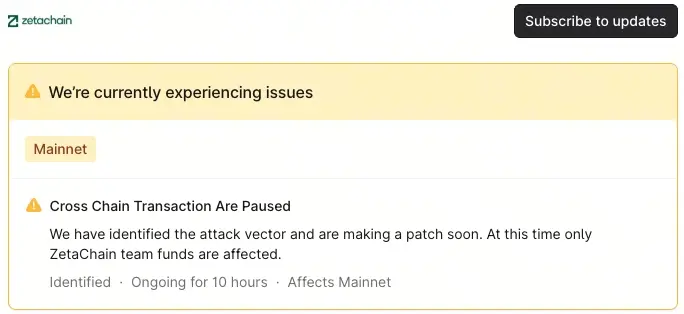
According to ZetaChain’s official announcement, the GatewayEVM contract is the unified entry point for cross-chain interactions between externally compatible EVM chains and applications on ZetaChain. In its statement, ZetaChain directly quoted: “As a precautionary measure, ZetaChain has currently paused cross-chain transactions. The investigation is still ongoing. At this time, no user funds have been affected by this attack.”
ZetaChain said the team has taken steps to mitigate the attack path to prevent further loss of funds and will release a detailed post-incident analysis report. The Block has reached out to ZetaChain for further comment regarding the matter.
Loss Estimate Figures
According to DefiLlama data, this attack resulted in losses of approximately $300k; ZetaChain’s official announcement did not disclose the specific loss amount. ZetaChain mainnet went live in early 2024 and is positioned as an interoperability Layer 1 network for integrating different networks such as Bitcoin, Ethereum, and Polygon.
Background on the DeFi Security Incident
According to DefiLlama data, since the KelpDAO vulnerability incident, there have been more than 10 attacks targeting various DeFi projects. Previously, the cross-chain bridge KelpDAO based on LayerZero technology was attacked, resulting in losses of approximately $292 million and causing a large number of bad debts at Aave; the industry consortium “DeFi United” subsequently stepped in to help restore Aave’s liquidity.
Frequently Asked Questions
What is the scope of the impact of the attack on the ZetaChain GatewayEVM contract?
According to ZetaChain’s official announcement, this attack only affected ZetaChain team internal wallets. As of the time of publication, no user funds have been affected; ZetaChain has taken steps to mitigate the attack path, and will release a post-incident analysis report.
What is the loss amount of this attack, and has ZetaChain officially disclosed it?
According to ZetaChain’s announcement, the team has not disclosed the specific loss amount and will release a detailed post-incident analysis report separately; according to DefiLlama data, the loss caused by this attack was approximately $300k.
What is the timing and current status of the ZetaChain cross-chain transaction suspension?
According to ZetaChain’s official status page, as of 9:00 p.m. Monday, April 27 Eastern Time, cross-chain transactions are still in a paused state. More than 9 hours have passed since the incident was detected; the investigation is still ongoing.
Disclaimer: The information on this page may come from third parties and does not represent the views or opinions of Gate. The content displayed on this page is for reference only and does not constitute any financial, investment, or legal advice. Gate does not guarantee the accuracy or completeness of the information and shall not be liable for any losses arising from the use of this information. Virtual asset investments carry high risks and are subject to significant price volatility. You may lose all of your invested principal. Please fully understand the relevant risks and make prudent decisions based on your own financial situation and risk tolerance. For details, please refer to
Disclaimer.
Related Articles
Robinhood Users Targeted in Phishing Attack Exploiting Gmail Dot Alias Feature
Gate News message, April 28 — Robinhood users have recently fallen victim to a phishing attack that exploits Gmail's dot-ignoring feature and vulnerabilities in Robinhood's account creation process. Attackers registered accounts nearly identical to target email addresses, allowing them to trick Robi
GateNews1h ago
ZachXBT Questions WorldCoin's Low-Circulation, High-Valuation WLD Launch, Flags Insider Selling
Gate News message, April 28 — On-chain detective ZachXBT alleged that WorldCoin (now World), a company founded by Sam Altman, launched WLD tokens with low circulation and high valuation, mirroring the model used by SBF and FTX. According to ZachXBT, the company distributed small amounts of WLD to us
GateNews2h ago
ZetaChain Halts Cross-Chain Transactions After $300K Smart Contract Attack
Gate News message, April 28 — Layer 1 network ZetaChain has paused cross-chain transactions on its mainnet following an attack on its GatewayEVM smart contract. According to DefiLlama data, $300,000 was lost in the incident, though the ZetaChain team did not disclose the amount and stated it will re
GateNews6h ago
Deepfake Call Tricks Cardano Dev, Exposes New Weak Spot
A Cardano developer says a realistic AI deepfake video call led to a laptop breach, a reminder that the next wave of crypto attacks may start with faces and voices rather than smart contracts.
The warning, shared with the Cardano community, describes an incident in which an impostor used
DailyCoin14h ago
French Prosecutors Charge 88 in Crypto Wrench Attack Ring
French authorities have charged 88 individuals, including 10 minors, in connection with kidnappings and extortions targeting cryptocurrency owners, according to a statement from the National Public Prosecutor's Office for Organized Crime (PNACO) released Friday. The charges are tied to 12 ongoing
CryptoFrontier16h ago
When DeFi is too slow for young people and too risky for old money: are we all using Treasury bond interest to shoulder junk bond risk?
DeFi once attracted young people with five-figure APY rates, but it is now seen as overpriced and carrying too much risk. Over the past year, more than $1.62 billion has been stolen, and at one point Aave’s interest rate spiked to 12.4%. The fair yield is about 12.55%, with a retail entry threshold of 18%. Institutional players prefer “strategy-isolated vaults” to reduce tail risk. Conclusion: high leverage is no longer in; in the future, we’ll need higher-risk pricing and insurance tools to accommodate both young people and old money.
ChainNewsAbmedia21h ago


