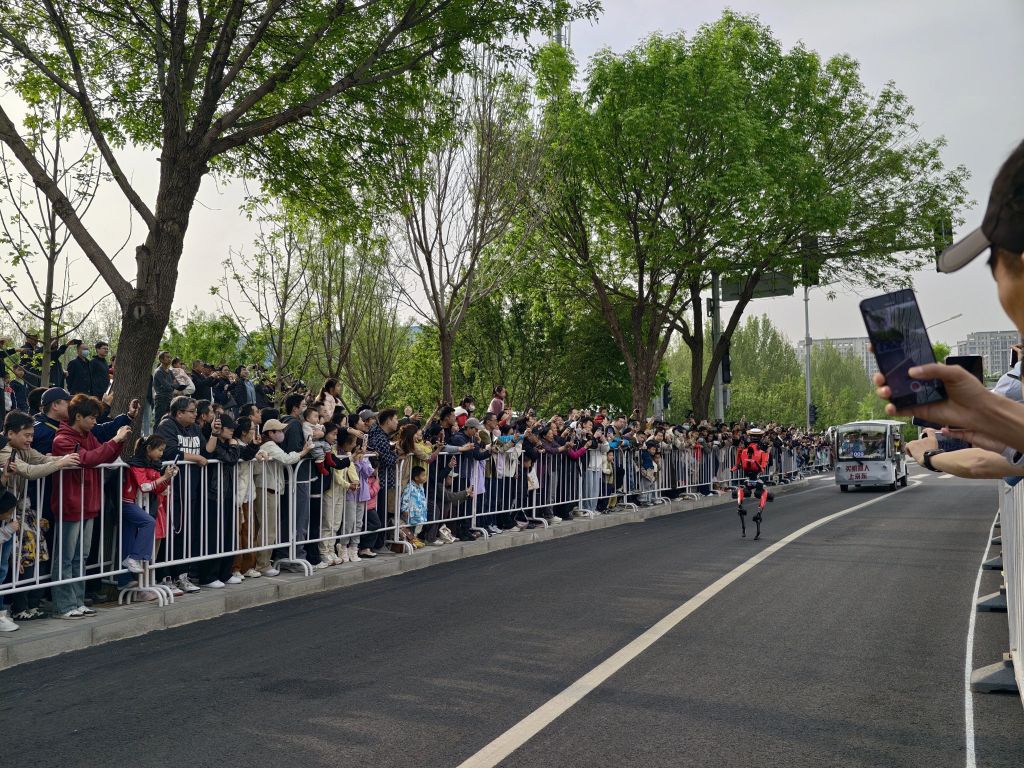
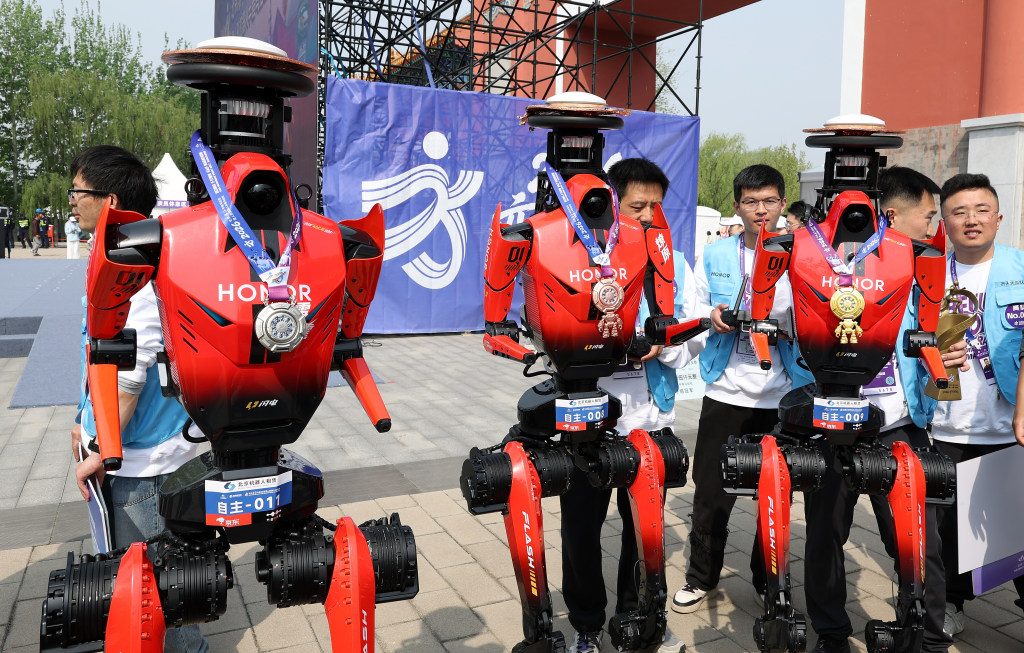
On April 19, 2026, Honor’s humanoid robot ‘Lightning’ won the Beijing Yizhuang humanoid robot half-marathon with a time of 50 minutes 26 seconds, nearly two-thirds faster than the previous year’s champion and exceeding the human best performance, according to the competition results. The event featured over 100 teams from 11 provinces competing, including top enterprises such as Honor, Unitree, and Zhongyan Power, as well as leading universities including Tsinghua, Peking University, and University of Science and Technology of China, plus 5 international teams from Germany, France, Portugal, and Brazil.
Record-Breaking Speed and Competition Scale
The 2026 competition expanded nearly 5-fold compared to the inaugural event, with approximately 40% of participating teams using autonomous navigation methods. The previous year’s champion, Tiangong Ultra from Beijing Humanoid Robot Innovation Center, completed the half-marathon in 2 hours 40 minutes 42 seconds using semi-autonomous mode. In contrast, this year’s completion rate exceeded 45%, with 47 of 102 teams finishing the race. Among completers, 18 teams used autonomous navigation and 29 teams used remote control methods.
Unitree Technology’s H1 humanoid robot completed a 1.9-kilometer multi-curve course section in 4 minutes 13 seconds during the competition’s qualifying round, breaking the human 1500-meter world record, according to the competition records.
Technical Design and Course Complexity
Honor’s chief strategy officer for embodied intelligence, Wang Ai, disclosed that the team conducted extensive daily testing and challenged the robot’s performance limits during preparation. The team performed extreme testing on individual components including screws and bearings under different torque conditions to ensure precision in every detail.
The racecourse incorporated over 10 terrain types including flat sections, slopes, curves, and narrow passages, with maximum 8% uphill and 6% downhill grades plus 100 meters of cumulative elevation gain. The course featured 12 left turns and 10 right turns, including sharp angles approaching 90 degrees, requiring high-precision path planning and dynamic balance. Five narrow sections and one road island obstacle simulated urban road conditions, testing environmental perception and autonomous decision-making capabilities.
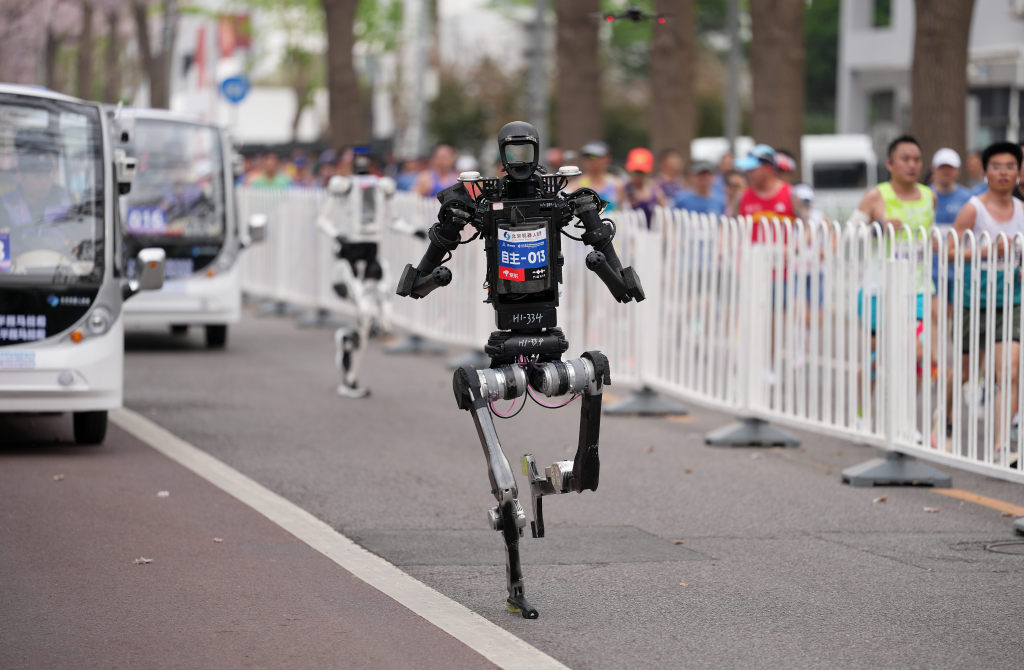
Wang Ai outlined three key design areas for ‘Lightning’: first, the robot’s “muscles” and body structure, including motor and battery systems with continuous power supply and hot-swap battery capabilities, plus robustness and impact resistance; second, stable power and endurance to maintain near-hour-long high-speed running with large-torque key modules requiring back-mounted liquid cooling systems; third, advanced autonomous navigation requiring multi-sensor fusion technology to ensure the robot “sees clearly, recognizes the route, and doesn’t deviate,” incorporating techniques similar to human athletes’ curved-path strategies to maintain optimal trajectory at high speeds while automatically adjusting for unexpected conditions like fallen leaves or wet surfaces.
The remote-control leading team Jueying Chitu used ‘Lightning’ robot and achieved a net completion time of 48 minutes 19 seconds, with the robot maintaining speeds exceeding 7 meters per second throughout most of the course and over 6 meters per second on curves. The robot fell unexpectedly before the finish line but quickly recovered and completed the race.
Expansion Beyond Racing: Real-World Application Testing
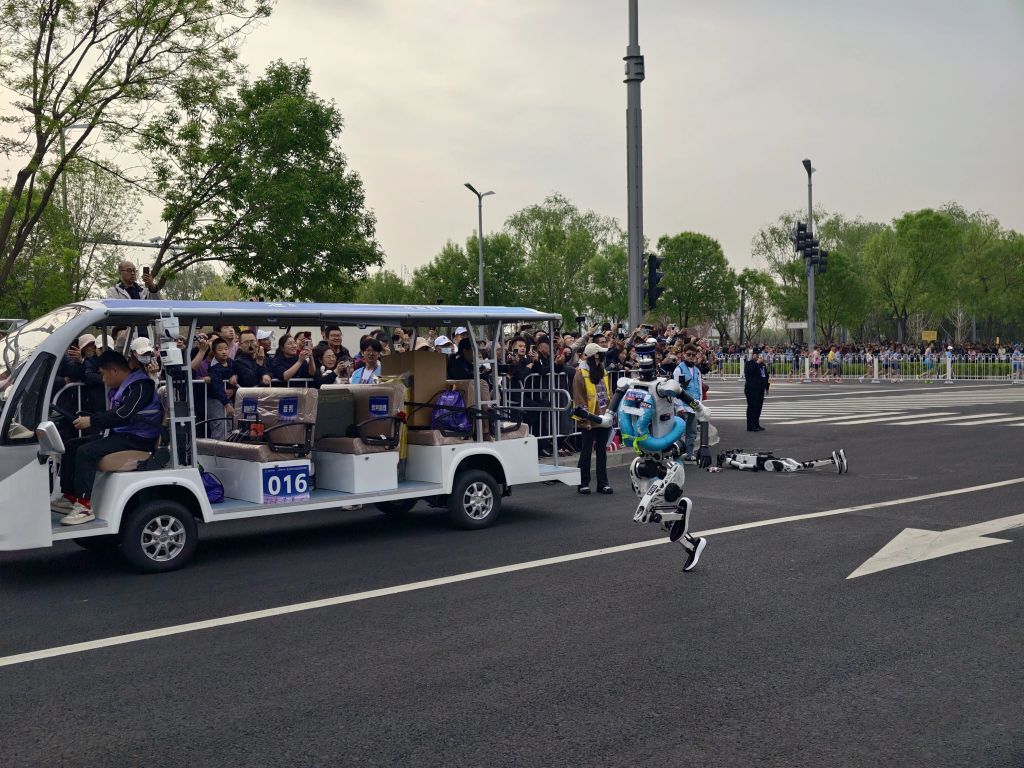
Beyond the speed competition, the 2026 event introduced the “Robot Warrior Challenge” focusing on emergency rescue applications. The challenge included 17 obstacle types divided into general events, specialized events, and ultimate challenge categories, with Beijing Humanoid Robot Innovation Center winning the autonomous category. The center stated these competition experiences help robots enter high-risk operations, 3D scenarios, industrial manufacturing, and commercial service sectors by accumulating critical data, validating core performance, and improving reliability for industry application deployment.
The event also featured real-world application scenarios including robot supply stations and robot guide dogs, providing crucial transition points from laboratory testing to real-world deployment. Participating teams gathered valuable data to accelerate breakthroughs in embodied intelligence and motion control technologies.
From “Can Run” to “Runs Autonomously”
If last year’s event proved humanoid robots “can run,” this year’s core advancement achieved robots that “run autonomously,” according to Beijing Humanoid Robot Innovation Center. With multi-sensor fusion localization and real-time dynamic decision-making algorithms now mature, robots this year identified road conditions and planned routes without human remote control. Technologies developed specifically for running speed—including high-torque integrated joints, liquid cooling systems to prevent motor overheating, and reinforcement learning motion control algorithms—all passed extreme stress testing, accumulating experience for deploying general-purpose robots across diverse industry applications.
Ecosystem Development and Industry Coordination
Beijing Economic-Technological Development Area officials stated this year’s primary objective was to “promote research through competition, promote production through competition, and promote application through competition.” The inaugural event pushed the robot industry from technical verification toward scenario deployment, while this year’s event upgraded to building a complete innovation chain of “technical verification-industry coordination-scenario deployment-commercialization enablement.” The competition used extreme scenarios to drive technology iteration, created a technology testing ground, gathered whole-machine, component, and algorithm teams, and accelerated convergence of humanoid robot technology, capital, and talent through a secondary development community providing end-to-end services.
Many participating robot teams have already open-sourced corresponding modules and algorithms. The Shanghai National-Local Joint Humanoid Robot Innovation Center, participating for the first time, officially open-sourced its Linglong 2.0 humanoid robot’s marathon-level navigation module following successful race completion.
Beijing Humanoid Robot Innovation Center stated plans to break technology barriers and integrate global resources through a “universal platform + open platform + ecosystem co-creation” model, enabling embodied intelligence achievements to benefit more sectors and partners with “shared technology origins and coordinated ecosystem advancement.”
Participating organizations expanded from 5 provinces to 11 provinces, with tighter university-enterprise collaborative innovation and enhanced international competitiveness through overseas team participation.
FAQ
Q: How much faster was the 2026 champion compared to the 2025 champion?
A: Honor’s ‘Lightning’ robot completed the 2026 half-marathon in 50 minutes 26 seconds, compared to Tiangong Ultra’s 2 hours 40 minutes 42 seconds in 2025, representing a reduction of approximately two-thirds according to the competition results.
Q: What percentage of teams used autonomous navigation versus remote control?
A: Among the 47 teams that completed the race, 18 teams used autonomous navigation methods and 29 teams used remote control methods, with autonomous teams representing approximately 38% of completers, according to the competition data.
Q: What was the significance of Unitree’s H1 performance in qualifying rounds?
A: Unitree’s H1 humanoid robot completed a 1.9-kilometer multi-curve qualifying course in 4 minutes 13 seconds, which broke the human 1500-meter world record, demonstrating significant advancement in autonomous robot speed capabilities.


