



#美伊局势和谈与增兵博弈
Markets can outpace reality, especially when geopolitical situations arise. Let's address this clearly and without exaggeration.
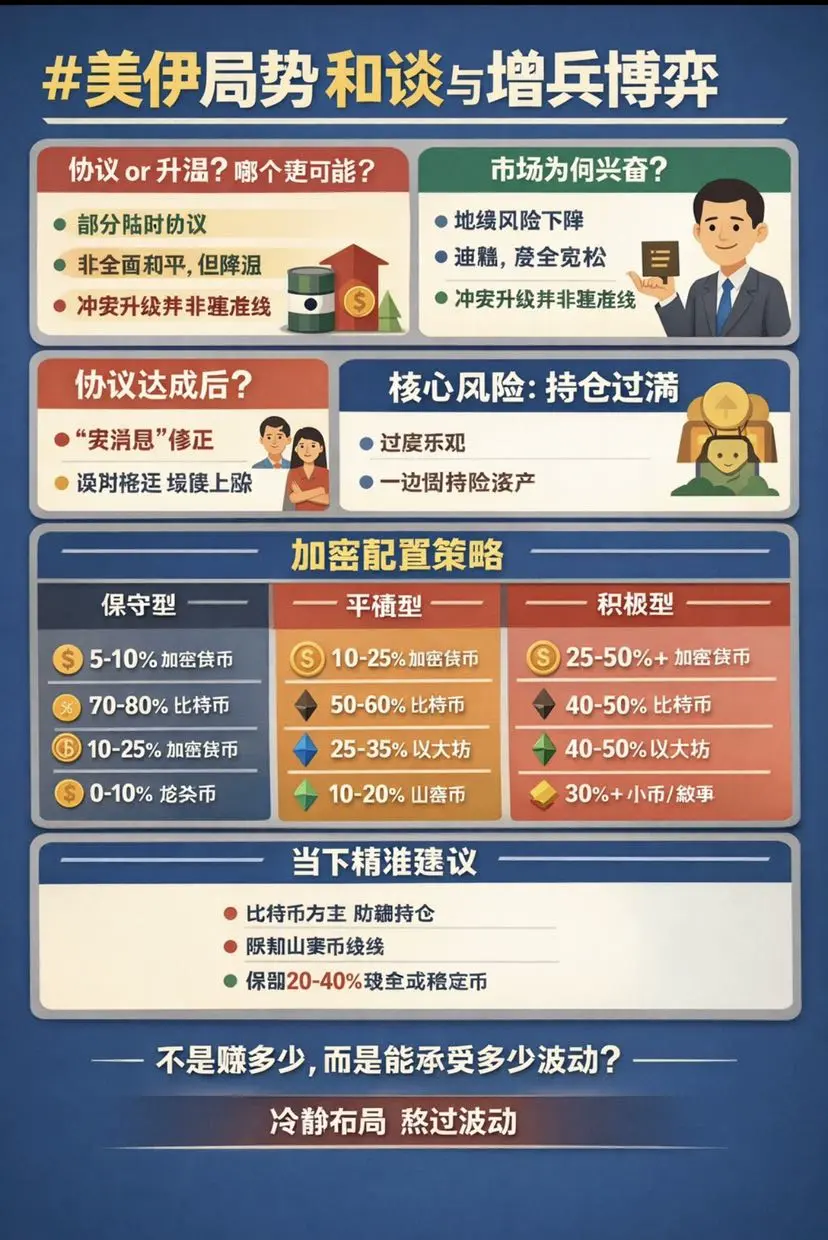
1. Agreement or escalation? What is actually likely?
A full and clean agreement between the US and Iran on uranium enrichment is still structurally difficult. The fundamental issue is not just economics—security, domestic politics, and long-term impact are also at stake. • The US wants tighter restrictions and verification.
• Iran wants sanctions lifted first and guarantees that cannot be easily revoked.
Historically (e.g., the Joint Comprehensive Plan of Action), even agreements are:
• fragile
• revocable
• politically controversial
Therefore, the most realistic baseline scenario is:
• A partial, temporary understanding (informal or phased)
• Not a grand "peace agreement," but enough to reduce immediate tensions
A sudden escalation is always possible—but it is generally not the baseline scenario unless negotiations completely collapse.
2. Why are markets acting so enthusiastic?
The movement in the S&P 500 reflects expectation, not confirmation.
Markets are currently pricing in:
• Lower geopolitical risk
• Stable oil flow
• Continued liquidity and growth
But there's a catch:
Markets are pricing in the initial derivative (the change in expectations), not the reality itself.
That's why you see what you call "blind optimism."
3. If a deal happens: will it rise or sell based on the news?
Not intuitive but important:
• Possible outcome: “Sell the news” or shallow correction
• Optimism is already priced in
• Big players may take profits on the rise
Negotiations drag on but don't collapse
• Outcome: Markets rise slowly
• Why:
• Uncertainty gradually decreases
• No shock = continued risk appetite
Negotiations fail / tensions increase
• Outcome: Sharp increase in volatility
• Oil ↑, stocks ↓ (especially risky assets)
4. Real risk: Positioning, not headlines
The bigger danger right now is not war headlines, but crowded positioning.
When:
• Everyone expects peace
• Everyone is long on the risk
Even neutral news can trigger a downward movement.
5. Asset allocation in the late optimism phase
This is the crucial part for decisions.
At this stage (late optimism/pre-event), the goal is not maximum return, but asymmetric risk control.
A balanced approach might be:
Core (stay invested, but be selective)
• Quality equities (strong cash flow, not overhyped)
• Avoid overly speculative trading
Layer of defense
• Some exposure to:
• Cash/short-term bonds
• Gold (hedging against geopolitical risk)
• On-demand hedging (if volatility increases)
• Energy exposure (benefits from increases)
• Tail risk hedging (if experienced)
6. A realistic conclusion
It's not a "war or peace" question.
It's more like:
Tensions managed by periodic relief rallies
Markets are celebrating the possibility of stability, not its reality.
• A full breakthrough is unlikely; • A temporary easing is more likely
• Markets are ahead of fundamental indicators
• Best-case scenario → slight rise or consolidation
• Worst-case scenario → rapid decline due to excessive optimism
Given the current setup (geopolitical uncertainty + already optimistic risk assets), cryptocurrency is becoming a high-beta expression of your macro outlook—not a fundamental certainty.
What happens if your crypto allocation drops 30-50% in a month?
• If this forces you to sell → you have over-allocated.
• If you can hold on or add to your holdings → you are in the right zone.
2. Three Allocation Frameworks (practical, not theoretical)
Conservative (Capital Protection First)
Crypto: 5-10% of total portfolio
• 70-80% Bitcoin
• 20-30% Ethereum
• 0-10% selective large-cap cryptocurrencies
• You benefit from upside risk without being held captive by volatility
• In a geopolitical shock → downside risk is kept under control
Best for: uncertain macro outlook (like now)
Balanced (Growth + Risk Management)
Crypto: 10-25% of portfolio
• 50-60% Bitcoin
• 25-35% Ethereum
• 10-20% altcoins (layer) (related to 1s, infrastructure, AI) (Tokens)
Behavior in Scenarios:
• If markets rise slowly → strong participation
• If there is pressure to “sell the news” → manageable decline
This is the ideal point for most people
Aggressive (Belief / High Volatility)
Crypto: 25–50%+
• 40–50% Bitcoin
• 20–30% Ethereum
• 30%+ altcoins / narratives
Reality Check:
• This is not “investment”—cycle timing + emotional discipline
• A failed negotiation or macro shock → sharp declines
Only makes sense if:
• You are actively managing your positions
• You are accepting large fluctuations without panicking
3. The mistake most people are making right now
At this stage of the cycle:
• Markets are optimistic
• Volatility is low Suppressed
• Narratives feel “safe”
This is exactly where people:
• Over-invest in altcoins
• He is underestimating the negative effects.
Don't confuse "calmness" with "low risk."
4. Smart Positioning for This Specific Macro Moment
• Partial realization of the geopolitical solution
• Markets are already pricing in the good news
A rational crypto stance is:
A slightly defensive position within cryptocurrencies
• Giving weight to Bitcoin (relative security)
• Neutral investment in Ethereum
• Not giving weight to speculative altcoins
Maintaining cash reserves
• Investing 20-40% of your crypto allocation in stablecoins or cash equivalents
• This allows you to buy on dips instead of chasing peaks
5. Scenario-Based Adjustments
If the agreement is successful (and markets rise briefly)
• Reduce purchases during the strengthening phase
• Switch from altcoins to Bitcoin
If a “sell the news” policy is implemented
• Distribute cash gradually (not all at once)
If a climb occurs
• Expectations:
• Cryptocurrency decline (liquidity shock)
• Then possible (Hedging narrative returns)
6. Time horizon changes everything
• < 6 months:
→ Be defensive, allocate less
• 6–24 months:
→ A balanced approach yields the best results
• 3+ years:
→ Higher allocation is justified, but it should still be structured
Now is not the time to ask:
“How much can I earn?”
Now is the time to ask:
“How much volatility can I withstand without reacting?”
Because in crypto, your allocation doesn’t just determine returns—
It also determines your behavior under pressure.
$BTC $ETH $XRP
Markets can outpace reality, especially when geopolitical situations arise. Let's address this clearly and without exaggeration.
1. Agreement or escalation? What is actually likely?
A full and clean agreement between the US and Iran on uranium enrichment is still structurally difficult. The fundamental issue is not just economics—security, domestic politics, and long-term impact are also at stake. • The US wants tighter restrictions and verification.
• Iran wants sanctions lifted first and guarantees that cannot be easily revoked.
Historically (e.g., the Joint Comprehensive Plan of Action), even agreements are:
• fragile
• revocable
• politically controversial
Therefore, the most realistic baseline scenario is:
• A partial, temporary understanding (informal or phased)
• Not a grand "peace agreement," but enough to reduce immediate tensions
A sudden escalation is always possible—but it is generally not the baseline scenario unless negotiations completely collapse.
2. Why are markets acting so enthusiastic?
The movement in the S&P 500 reflects expectation, not confirmation.
Markets are currently pricing in:
• Lower geopolitical risk
• Stable oil flow
• Continued liquidity and growth
But there's a catch:
Markets are pricing in the initial derivative (the change in expectations), not the reality itself.
That's why you see what you call "blind optimism."
3. If a deal happens: will it rise or sell based on the news?
Not intuitive but important:
• Possible outcome: “Sell the news” or shallow correction
• Optimism is already priced in
• Big players may take profits on the rise
Negotiations drag on but don't collapse
• Outcome: Markets rise slowly
• Why:
• Uncertainty gradually decreases
• No shock = continued risk appetite
Negotiations fail / tensions increase
• Outcome: Sharp increase in volatility
• Oil ↑, stocks ↓ (especially risky assets)
4. Real risk: Positioning, not headlines
The bigger danger right now is not war headlines, but crowded positioning.
When:
• Everyone expects peace
• Everyone is long on the risk
Even neutral news can trigger a downward movement.
5. Asset allocation in the late optimism phase
This is the crucial part for decisions.
At this stage (late optimism/pre-event), the goal is not maximum return, but asymmetric risk control.
A balanced approach might be:
Core (stay invested, but be selective)
• Quality equities (strong cash flow, not overhyped)
• Avoid overly speculative trading
Layer of defense
• Some exposure to:
• Cash/short-term bonds
• Gold (hedging against geopolitical risk)
• On-demand hedging (if volatility increases)
• Energy exposure (benefits from increases)
• Tail risk hedging (if experienced)
6. A realistic conclusion
It's not a "war or peace" question.
It's more like:
Tensions managed by periodic relief rallies
Markets are celebrating the possibility of stability, not its reality.
• A full breakthrough is unlikely; • A temporary easing is more likely
• Markets are ahead of fundamental indicators
• Best-case scenario → slight rise or consolidation
• Worst-case scenario → rapid decline due to excessive optimism
Given the current setup (geopolitical uncertainty + already optimistic risk assets), cryptocurrency is becoming a high-beta expression of your macro outlook—not a fundamental certainty.
What happens if your crypto allocation drops 30-50% in a month?
• If this forces you to sell → you have over-allocated.
• If you can hold on or add to your holdings → you are in the right zone.
2. Three Allocation Frameworks (practical, not theoretical)
Conservative (Capital Protection First)
Crypto: 5-10% of total portfolio
• 70-80% Bitcoin
• 20-30% Ethereum
• 0-10% selective large-cap cryptocurrencies
• You benefit from upside risk without being held captive by volatility
• In a geopolitical shock → downside risk is kept under control
Best for: uncertain macro outlook (like now)
Balanced (Growth + Risk Management)
Crypto: 10-25% of portfolio
• 50-60% Bitcoin
• 25-35% Ethereum
• 10-20% altcoins (layer) (related to 1s, infrastructure, AI) (Tokens)
Behavior in Scenarios:
• If markets rise slowly → strong participation
• If there is pressure to “sell the news” → manageable decline
This is the ideal point for most people
Aggressive (Belief / High Volatility)
Crypto: 25–50%+
• 40–50% Bitcoin
• 20–30% Ethereum
• 30%+ altcoins / narratives
Reality Check:
• This is not “investment”—cycle timing + emotional discipline
• A failed negotiation or macro shock → sharp declines
Only makes sense if:
• You are actively managing your positions
• You are accepting large fluctuations without panicking
3. The mistake most people are making right now
At this stage of the cycle:
• Markets are optimistic
• Volatility is low Suppressed
• Narratives feel “safe”
This is exactly where people:
• Over-invest in altcoins
• He is underestimating the negative effects.
Don't confuse "calmness" with "low risk."
4. Smart Positioning for This Specific Macro Moment
• Partial realization of the geopolitical solution
• Markets are already pricing in the good news
A rational crypto stance is:
A slightly defensive position within cryptocurrencies
• Giving weight to Bitcoin (relative security)
• Neutral investment in Ethereum
• Not giving weight to speculative altcoins
Maintaining cash reserves
• Investing 20-40% of your crypto allocation in stablecoins or cash equivalents
• This allows you to buy on dips instead of chasing peaks
5. Scenario-Based Adjustments
If the agreement is successful (and markets rise briefly)
• Reduce purchases during the strengthening phase
• Switch from altcoins to Bitcoin
If a “sell the news” policy is implemented
• Distribute cash gradually (not all at once)
If a climb occurs
• Expectations:
• Cryptocurrency decline (liquidity shock)
• Then possible (Hedging narrative returns)
6. Time horizon changes everything
• < 6 months:
→ Be defensive, allocate less
• 6–24 months:
→ A balanced approach yields the best results
• 3+ years:
→ Higher allocation is justified, but it should still be structured
Now is not the time to ask:
“How much can I earn?”
Now is the time to ask:
“How much volatility can I withstand without reacting?”
Because in crypto, your allocation doesn’t just determine returns—
It also determines your behavior under pressure.
$BTC $ETH $XRP