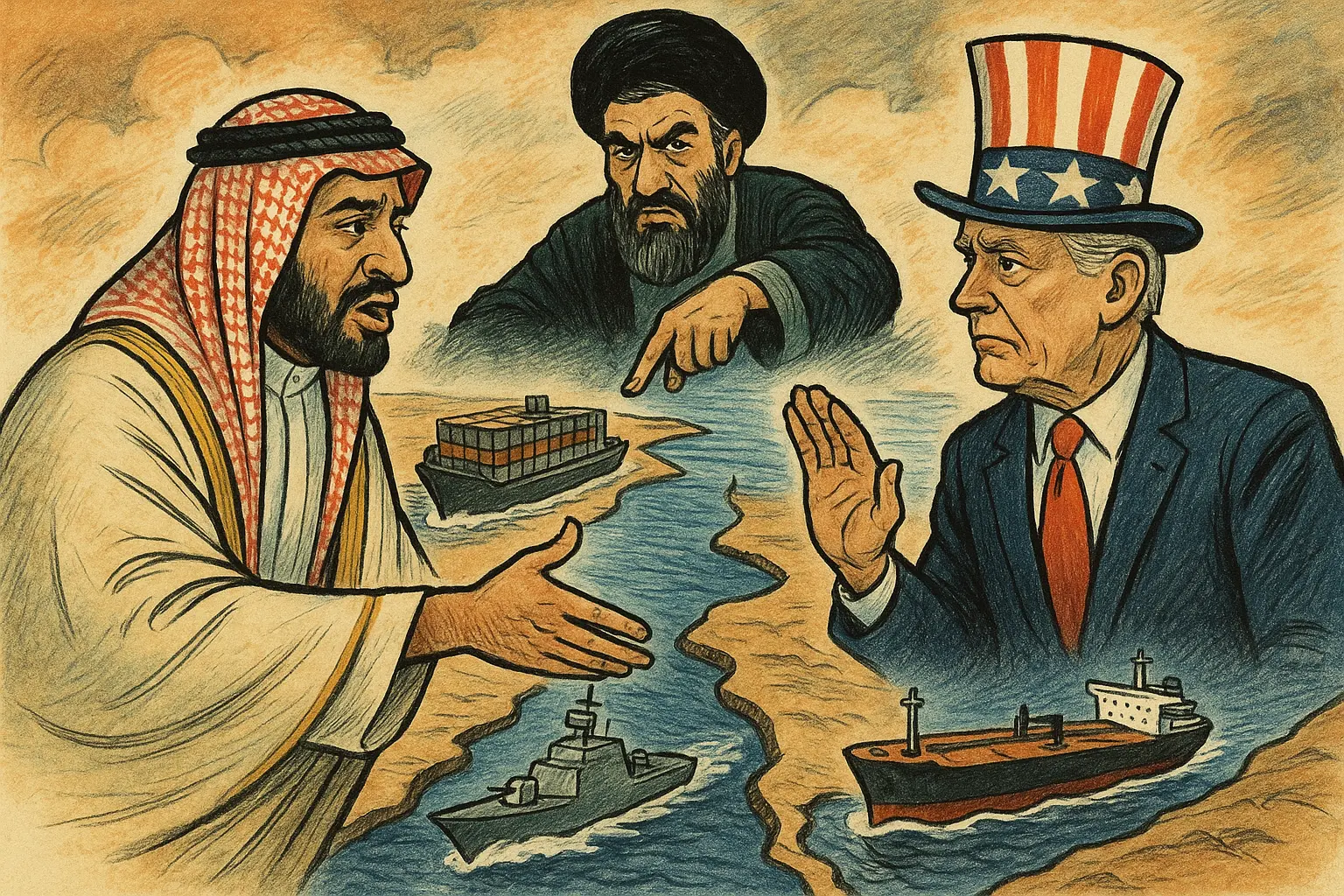
According to a report by The Wall Street Journal on April 14, Arab officials said Saudi Arabia is urgently pressuring the United States to give up its blockade of the Strait of Hormuz and return to the table for negotiations between Iran and the U.S. Saudi Arabia’s core strategic concern is that the U.S. blockade action could encourage Iran to disrupt or blockade the Red Sea’s key chokepoint through the Houthis. Iran’s Supreme Leader’s foreign policy adviser, Velayati, warned on April 5 that global energy and trade flows “can be cut off by a single signal.”
Saudi Arabia’s strategic dilemma: after routing around, the Strait of Mandeb becomes a new high-risk node
Saudi Arabia previously made contingency plans in advance to respond to the blockade of Hormuz, shifting most crude oil exports from the Ras Tanura facilities in the Persian Gulf to the Yanbu port along the Red Sea coast. Currently, the daily export volume is about 7 million barrels, essentially back to the level before the outbreak of the conflict. This route change has allowed Saudi Arabia to temporarily avoid the direct impact of the Hormuz blockade.
However, the safety of this way out is itself facing new threats. Once Iran directs the Houthis to blockade or severely disrupt the Strait of Mandeb, Saudi Arabia’s oil exports via the Yanbu port will be directly affected, creating an energy export dilemma of “the front door is blocked and the back route is also cut off.” This is the core geopolitical logic behind Saudi Arabia’s decision to urgently apply diplomatic pressure on Washington.
Iran’s leverage: clear signals and execution tools already tied to the Mandeb threat
Iran has issued clear threat signals through multiple official channels. Velayati has explicitly said Iran views the Strait of Mandeb “the same way it views the Strait of Hormuz,” and the semi-official media outlet Tasnim News Agency has also directly stated that a U.S. blockade could lead Iran to close the Red Sea passage.
The Houthis as a key capability for executing the threat
Geographical control: The Houthis control large stretches of Yemen’s coastline near the Strait of Mandeb, giving them favorable conditions to interfere with ships transiting through the area
Historical precedent: Since the Gaza war, the Houthis’ involvement has already reduced the amount of crude oil passing through the Strait of Mandeb each day from 9.3 million barrels to about half
Space for escalation: Arab officials have warned that the Houthis may become more actively involved, even beginning to forcibly charge fees to ships transiting through the area
Think tank assessment: A Yemen expert at the Washington think tank “New America” noted: “If Iran truly wants to block the Strait of Mandeb, the Houthis are an available partner—and they already have the capability to prove it.”
Oil market impact and negotiation process: Brent could test $160 to $190
Since the outbreak of the Iran-U.S. conflict on February 28, the global crude oil market has shown signs of a rare structural reshuffling. On April 2, the near-month WTI crude contract for the first time in nearly four years surpassed Brent, reflecting a new logic that “oil you can actually get” commands a higher premium than “oil that represents the global market”—Middle East crude tied to Hormuz carries a war-risk premium, while WTI has become a key competitive advantage thanks to its “land-route advantage,” reaching the Gulf of Mexico directly through mature pipelines; some spot Brent prices have already broken above $140 per barrel.
Stratas Advisors CEO Paszy warned that spot Brent may test the $160 to $190 range in the next few weeks. If oil prices stay high for the long term, it will trigger severe “demand destruction,” forcing consumers to cut back significantly, and potentially leading to a global recession. Analysts say this may also be the biggest external bargaining chip that ultimately pushes both Iran and the U.S. back to the negotiating table.
On the diplomatic front, the Associated Press, citing sources, reported that a second round of direct talks between Iran and the U.S. may be about to take place. Islamabad and Geneva have both been listed as possible locations, with timing around or before Thursday of this week.
Frequently asked questions
Why does Saudi Arabia urgently ask the U.S. to give up the Hormuz blockade?
Although Saudi Arabia has shifted its crude oil exports to Yanbu port on the Red Sea, if Iran blocks the Strait of Mandeb via the Houthis, its daily oil exports of about 7 million barrels will again face a risk of being cut off. Saudi Arabia is therefore actively urging the U.S. to lift the blockade through diplomatic channels, to prevent itself from falling into an energy predicament where “two export routes are blocked at the same time.”
Why are the Houthis the most important tool for Iran to blockade the Strait of Mandeb?
The Houthis control large stretches of Yemen’s coastline. Since the Gaza war, they have demonstrated practical capabilities to disrupt Red Sea shipping, causing the amount of crude oil passing through the Strait of Mandeb each day to drop from 9.3 million barrels to about half. Without deploying troops directly, Iran can upgrade and intensify disruption operations through the Houthis to achieve an effective blockade of the Strait of Mandeb.
What impact does simultaneous threat to Hormuz and the Strait of Mandeb have on global oil prices?
If the two major chokepoints are blocked at the same time, the global crude oil supply chain will face an unprecedented double shock. Analysts warn that spot Brent crude could test $160 to $190. Prolonged high oil prices will trigger “demand destruction,” which could push major global economies into recession, and this pressure itself is also seen as the biggest leverage that could ultimately force both Iran and the U.S. back to the negotiating table.
Disclaimer: The information on this page may come from third parties and does not represent the views or opinions of Gate. The content displayed on this page is for reference only and does not constitute any financial, investment, or legal advice. Gate does not guarantee the accuracy or completeness of the information and shall not be liable for any losses arising from the use of this information. Virtual asset investments carry high risks and are subject to significant price volatility. You may lose all of your invested principal. Please fully understand the relevant risks and make prudent decisions based on your own financial situation and risk tolerance. For details, please refer to
Disclaimer.
Related Articles
Lithium Carbonate Futures Decline 4% Intraday, Trading at 172,100 CNY/Ton
Gate News message, April 21 — Lithium carbonate futures (a key raw material for EV batteries) fell 4% during intraday trading, currently quoted at 172,100 Chinese yuan per ton.
GateNews1h ago
South Korea's Exports Surge 49.4% in Early April, Semiconductor Shipments Lead Growth
South Korea's exports rose 49.4% in early April, driven by strong semiconductor demand and high oil prices, leading to a $10.4 billion trade surplus. However, rising inflation and currency issues pose challenges for future growth.
GateNews2h ago
Whale Deploys $10M USDC on HyperLiquid, Opens Major Oil Short Positions
Gate News message, a newly created wallet address "0xEbE" deposited $10 million USDC into HyperLiquid and opened a 63,000 BRENTOIL short position with 20x leverage. Another wallet "0x9D3", linked to the same whale, holds 20x short positions of 250,000 BRENTOIL (valued at $22.5 million) and 210,000 C
GateNews2h ago
Liquid Capital Founder JackYi: Market in Rally Phase, Major Pullback Expected
JackYi, founder of Liquid Capital, asserts the market is in a rally phase but anticipates a pullback due to potential triggers like declining U.S. equities and inflation data. He advises investors to focus on risk management and capital preservation.
GateNews2h ago
Morocco Extends Safeguard Measures on Imported Hot-Rolled Steel for Three Years
Morocco's Ministry of Industry and Trade has extended safeguard measures on imported hot-rolled steel for three years, with declining tariff rates starting at 19% and covering specific tariff codes.
GateNews3h ago
Bitcoin returns to $76k, and Trump is willing to “directly” negotiate with Iran’s leaders
After experiencing sharp volatility over the weekend triggered by heightened U.S.-Iran tensions, Bitcoin returned near $76,000 on April 21. U.S. President Trump said that any agreement that Iran and the U.S. are currently negotiating will be “better than” the 2015 Joint Comprehensive Plan of Action (JCPOA), and that he is willing to meet directly with Iran’s leadership. The remarks briefly boosted market sentiment. However, Brent crude oil continued to swing around $90 per barrel, keeping Bitcoin under cautious sentiment pressure.
MarketWhisper3h ago


