

Trade
Basic
Futures
Futures
Hundreds of contracts settled in USDT or BTC
TradFi
Gold
Trade global traditional assets with USDT in one place
Options
Hot
Trade European-style vanilla options
Unified Account
Maximize your capital efficiency
Demo Trading
Futures Kickoff
Get prepared for your futures trading
Futures Events
Participate in events to win generous rewards
Demo Trading
Use virtual funds to experience risk-free trading
Earn
Launch
CandyDrop
Collect candies to earn airdrops
Launchpool
Quick staking, earn potential new tokens
HODLer Airdrop
Hold GT and get massive airdrops for free
Launchpad
Be early to the next big token project
Alpha Points
Trade on-chain assets and enjoy airdrop rewards!
Futures Points
Earn futures points and claim airdrop rewards
Investment
Simple Earn
Earn interests with idle tokens
Auto-Invest
Auto-invest on a regular basis
Dual Investment
Buy low and sell high to take profits from price fluctuations
Soft Staking
Earn rewards with flexible staking
Crypto Loan
0 Fees
Pledge one crypto to borrow another
Lending Center
One-stop lending hub
VIP Wealth Hub
Customized wealth management empowers your assets growth
Private Wealth Management
Customized asset management to grow your digital assets
Quant Fund
Top asset management team helps you profit without hassle
Staking
Stake cryptos to earn in PoS products
Smart Leverage
New
No forced liquidation before maturity, worry-free leveraged gains
GUSD Minting
Use USDT/USDC to mint GUSD for treasury-level yields

More






Cobo: How are we using AI to drive transformation?
“Many companies talk about AI + Web3. But if they haven’t completed AI transformation internally, they’re just talking concepts externally.”
Author: alexzuo4, Investment & Custody VP @Cobo
Since the end of 2024, besides our core crypto custody and stablecoin payment services, Cobo has been exploring the integration of AI and blockchain.
Our earliest insight was the potential of MCP to bring standardized skills. In theory, if skills are sufficiently standardized, AI can invoke capabilities like plugins, making blockchain the most natural financial infrastructure for AI.
So we internally incubated an MCP application store. But it was quickly disproven.
At that time, AI barriers were still high, only mature engineers could proficiently invoke it. MCP was not standardized enough; each integration was time-consuming, costly, slow, and the implementation far less effective than expected.
But the AI team was established. It was expensive, hard to recruit, and impossible to easily dismantle.
So we decided to change direction. Since we can’t transform our clients’ worlds yet, let’s first transform ourselves.
First Issue: Security
As an asset custody company, Cobo handles extremely sensitive data and internal technical processes. We have strict data hierarchies internally. But without data or real business input, it’s impossible to develop our own Agent.
Initially, we considered deploying local models. But the reality was that local models didn’t meet the intelligence requirements. They could run, but were not user-friendly; they could answer questions, but weren’t smart enough.
In the end, we chose Claude and Gemini as the main models (with the option to apply for ZDR—Zero Data Retention clauses—to achieve the highest level of isolation).
But large models are just the underlying “brain” of the business. The real complexity lies in data and permissions.
We then developed a comprehensive internal knowledge base and Agent framework.
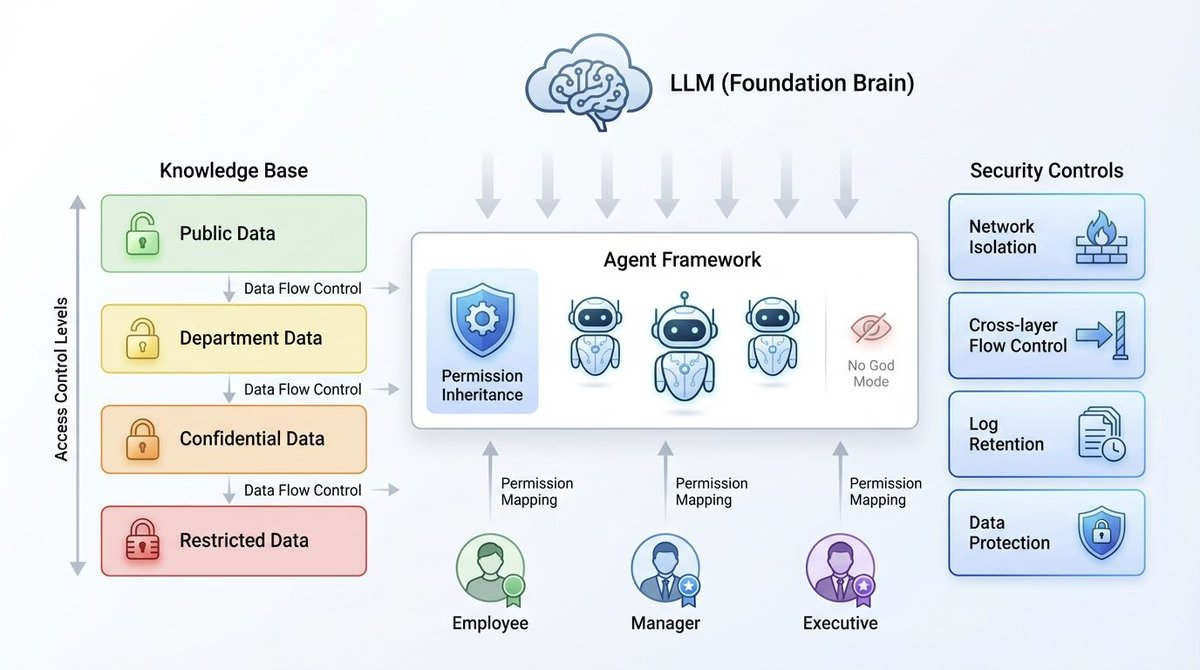
Internal knowledge base + Cobo self-developed agent system
The knowledge base manages internal company data hierarchies, assigning read permissions based on employee roles.
When Agents access the knowledge base, they inherit employee permissions, not a “god view.”
Details include:
These may not be glamorous, but they determine whether this system can run long-term. AI must not become a security vulnerability.
After the architecture was set up: the problem of no users
Even today, the company still faces a reality: many front-end business units are dismissive of AI.
If we only encourage usage, workflow changes won’t happen.
We later realized that we must start from company management.
First breakthrough: OKR Agent
Our first strongly promoted scenario was not customer service or coding.
It was OKRs.
We used AI to decompose company strategy, help set OKRs, track progress, and review milestones.
In other words, transforming company management from human-driven to a co-governance of silicon and carbon. This process is extremely uncomfortable for employees.
In the past, goals could be written more beautifully, and processes explained more reasonably. Now, weekly data is there, and excuses are fewer.
From that moment, goals are no longer just discussed in meetings but are continuously recorded in the system.
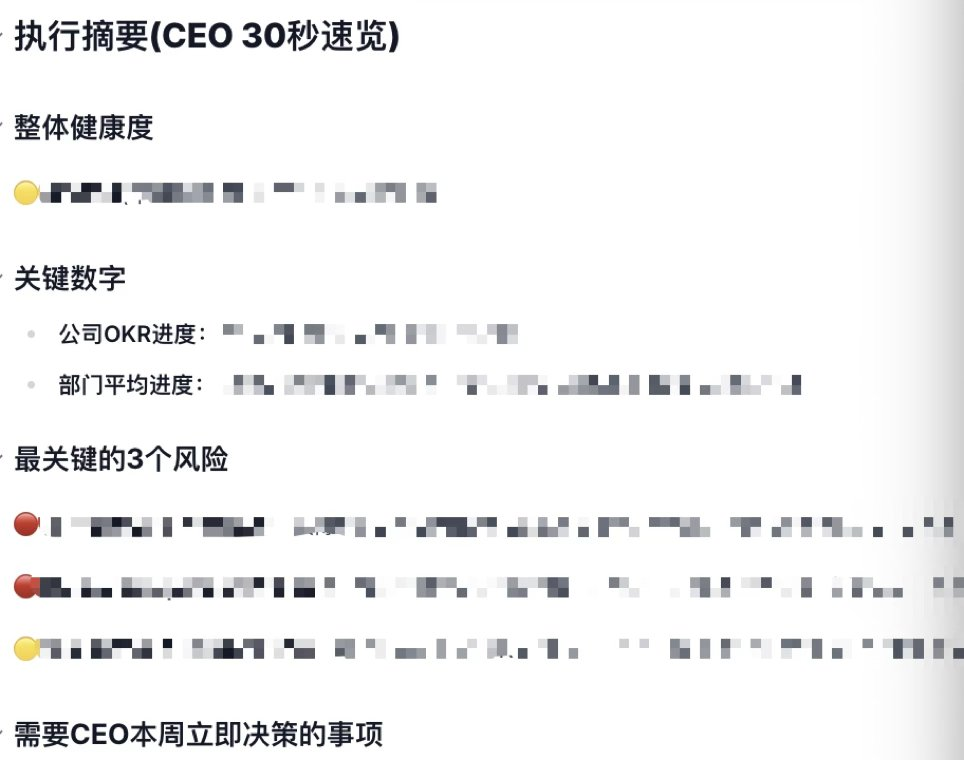
Strategy OKRs weekly monitor business progress
But it was also through performance management that everyone truly became familiar with AI. Because if you don’t participate, it will directly impact your salary.
From performance to business: full Agentization
Once OKRs were running smoothly, we began pushing internal service Agentization. We used competitions + bonuses to enforce each department to establish and operate their own relevant Agents.
Customer service creates customer service Agents. Legal develops contract support Agents. Sales deploys CRM Agents.
Finding the most sarcastic client agent
In total, over 100 Agents were launched.
We can’t precisely quantify the results of “silicon-carbon co-governance.”
But at least one clear change is evident:
Previously, when encountering problems, the first reaction was “should we hire another person?” Now, the first reaction is “can the system participate first?”
This is our understanding of silicon-carbon co-governance. It’s not AI replacing humans, but humans getting used to working alongside systems.
Lessons from this year’s journey
First, maintain healthy cash flow.
If the company’s cash flow isn’t healthy, this transformation can’t reach the end. AI isn’t a cost-saving tool; it’s an upfront investment for long-term structural upgrades. Thanks to Cobo’s main business, we still have healthy cash flow.
Second, top-down push is essential.
Organizations won’t change spontaneously. Without strong management leadership, this effort will naturally fail.
As is well known, Cobo’s founders are heavy AI enthusiasts. CTO Dr. Jiang started AI research during his postdoc at CMU in the early 2000s.
Third, mandatory usage is necessary.
If it’s only encouraged, AI will remain just for writing emails. Real process change must involve some “compulsion.”
Fourth, start with your own business.
Many companies talk about AI + Web3. But if they haven’t completed AI transformation internally, they are just talking concepts externally.
Looking back
We can’t fully quantify this transformation. The company is gradually shifting from “people-driven processes” to “goal-driven systems.”
If a truly “intelligent organization” emerges in the future, it won’t be a natural evolution. It will be pushed out through uncomfortable iterations.
Because with everyone’s participation, the company can better understand the real needs in the AI era.
This is also a byproduct of our internal transformation.
Recently, we launched Cobo Waas Skill. Cobo WaaS Skill is an integrated operational capability layer designed specifically for AI Coding Agents. Through structured knowledge, executable examples, and scenario orchestration, it enables Agents to accurately invoke WaaS APIs. We are upgrading wallet APIs into financial capability modules directly callable by AI Agents. Development cycles are shortened from weeks to dialogue-level.
This isn’t the result of a single product idea. It’s the natural spillover of our internal silicon-carbon co-governance.
We are still exploring.
But at least, today’s Cobo is no longer the same company as in 2024.