Every time you click “Identify Traffic Lights” or “Select All Crosswalks” on a webpage, you think you’re just proving you’re not a robot. But in reality, you’re labeling training data for Google’s AI system for free. This has been going on for over 15 years, involving hundreds of millions of users worldwide, ultimately building Google’s visual recognition capabilities for Google Maps and the now $45 billion autonomous driving company Waymo. Throughout the process, no one asked for your permission, no one told you the truth, and no one paid you a cent.
Original: @sharbel
Translation: Da Qianzi | PANews Lobster
500,000 hours of free manual labor. Every day. Contributed by those who think they’re just logging into their bank accounts.
reCAPTCHA is the most successful covert data harvesting operation in internet history. At its peak, 200 million people completed its verification daily. Few realize what they are actually building.
Waymo—Google’s autonomous vehicle company—now valued at $45 billion. A significant portion of its critical training data comes from you. For free. From every website you visit.
Here’s the full story.
Starting Point: A Clever Idea
In 2000, spam bots were destroying the internet. Forums were flooded, inboxes overwhelmed. Websites desperately needed a way to distinguish humans from machines.
Carnegie Mellon University professor Luis von Ahn solved this problem. He invented CAPTCHA: distorted text that only humans can read. Bots can’t pass, humans can.
But von Ahn saw more possibilities. Millions of people were spending cognitive effort on these verifications. What if that effort could do two things at once?
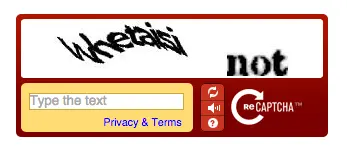
In 2007, he launched reCAPTCHA. The clever part: it displayed not random gibberish, but two words. One known system word, and another from real scanned books that computers couldn’t recognize yet. Your answer helped digitize those texts.
These books came from The New York Times archives and Google Books—covering up to 130 million volumes.
You thought you were logging in; in fact, you were helping Google’s OCR (Optical Character Recognition) process.
In 2009, Google acquired reCAPTCHA.
Google Changed the Game
The era of distorted text ended around 2012.
Google faced a new challenge. Street View cars were capturing every road on Earth, but the images were raw data. To make AI truly useful, it needed to understand what it “saw”: street signs, crosswalks, traffic lights, storefront signs.
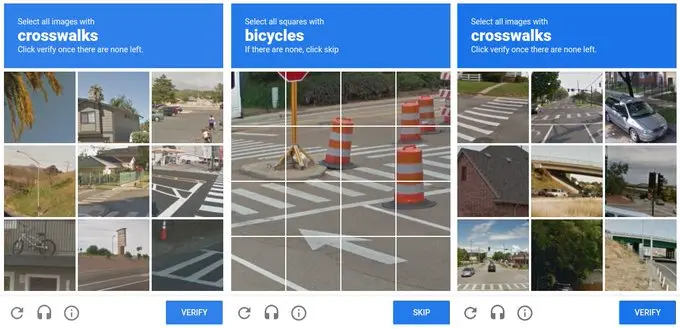
So Google redesigned reCAPTCHA v2. Instead of distorted text, it used image grids: “Click all squares containing traffic lights,” “Select all crosswalks,” “Identify storefront signs.”
These images came directly from Google Street View.
And every click was a label. Every choice told Google’s computer vision model: this pixel block is a traffic light, this shape is a crosswalk.
You weren’t just passing a test—you were building a dataset.
The Unspoken Scale
At its peak, 200 million reCAPTCHAs were completed daily.
Each verification took about 10 seconds, meaning 2 billion seconds of human labor every day—equivalent to 500,000 hours daily.
Professional data annotation services charge $10–$50 per hour. At the lowest rate, that’s up to $5 million worth of free labor every day.
And reCAPTCHA isn’t limited to one app; it’s embedded in every bank, government portal, e-commerce platform, and login page online. You have no choice. Want to access your account? First, label some data.
Google never asked for your opinion, never paid you, and never even told you about this.
What All This Builds
These data directly feed into two products.
Google Maps. The world’s most widely used navigation tool. Its ability to read signs, locate businesses, and understand city geography is partly built on billions of manual labels contributed by people trying to log in.
And Waymo.
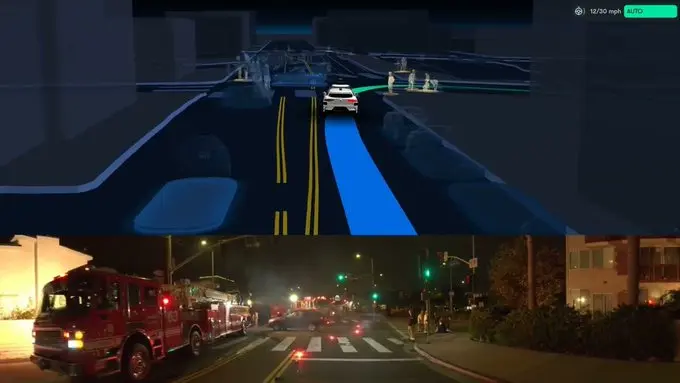
Waymo, Google’s self-driving car project, spun off as an independent subsidiary in 2016. For safe navigation, autonomous vehicles need to recognize thousands of visual patterns with near-perfect accuracy: traffic lights, crosswalks, pedestrians, stop signs.
The real training data for these recognition capabilities? Provided by millions of people completing reCAPTCHA—without their knowledge.
By 2024, Waymo has completed over 4 million paid trips, operating in San Francisco, Los Angeles, and Phoenix, and continues to expand. Its valuation stands at $45 billion.
And the foundation of this empire was built by those internet users who just wanted to send emails for free.
Why No One Can Replicate This
Data annotation is expensive. Companies like Scale AI, Appen, Labelbox exist mainly to solve this problem. They employ hundreds of thousands of workers to label images, sometimes earning less than $1 an hour.
Google took a different approach: they made annotation mandatory. No pay, no consent—just an “entry fee” to access every website.
The result: billions of labeled images, covering the entire globe, in all weather conditions, at all times of day, in every city.
No annotation company can do this. The internet itself is the factory, and everyone inside it is an unpaid, uncontracted worker.
What You’re Still Doing Today
In 2018, reCAPTCHA v3 was introduced. It doesn’t show you any challenges. Instead, it observes how you move your mouse, scroll, hover, and click. Your behavioral fingerprint tells it whether you’re human.
This behavioral data is also fed back into Google’s AI system.
You never opted in; there’s no checkbox. Most websites you visit now still do this.
An Ironic Thought for All
Luis von Ahn’s original idea was brilliant: redirect the cognitive effort people already spend on spam filtering toward something valuable—digitizing the world’s books and solving a real problem.
But Google’s use of this idea is something else entirely.
They took a security mechanism that users had no choice but to use, deployed it across the entire internet, and harvested the results to build billion-dollar products.
Users got nothing in return—no transparency, no compensation.
The deepest irony: you spent years proving you’re human—by doing visual recognition tasks that AI couldn’t do at the time. Once AI learned to do that work, human visual labeling became redundant.
You proved you’re human by making yourself replaceable.
Sources: Carnegie Mellon University, Google Blog (2009), WebProNews, MakeUseOf, MIT Technology Review, Waymo disclosures.


