 Strategy co-founder Michael Saylor hinted on March 15, 2026, at another potential Bitcoin purchase by the company, posting “Stretch the Orange Dots” on X in a recurring pattern that has preceded 11 previous acquisition announcements in 2026.
The hint follows Strategy’s purchase of 17,994 BTC last week and comes as Bitcoin trades at $71,300, up 1.15% over 24 hours . Separately, Saylor joined Tether CEO Paolo Ardoino and Blockstream CEO Adam Back in rejecting former UK Prime Minister Boris Johnson’s characterization of Bitcoin as a “Ponzi scheme” in a March 14 Daily Mail column .
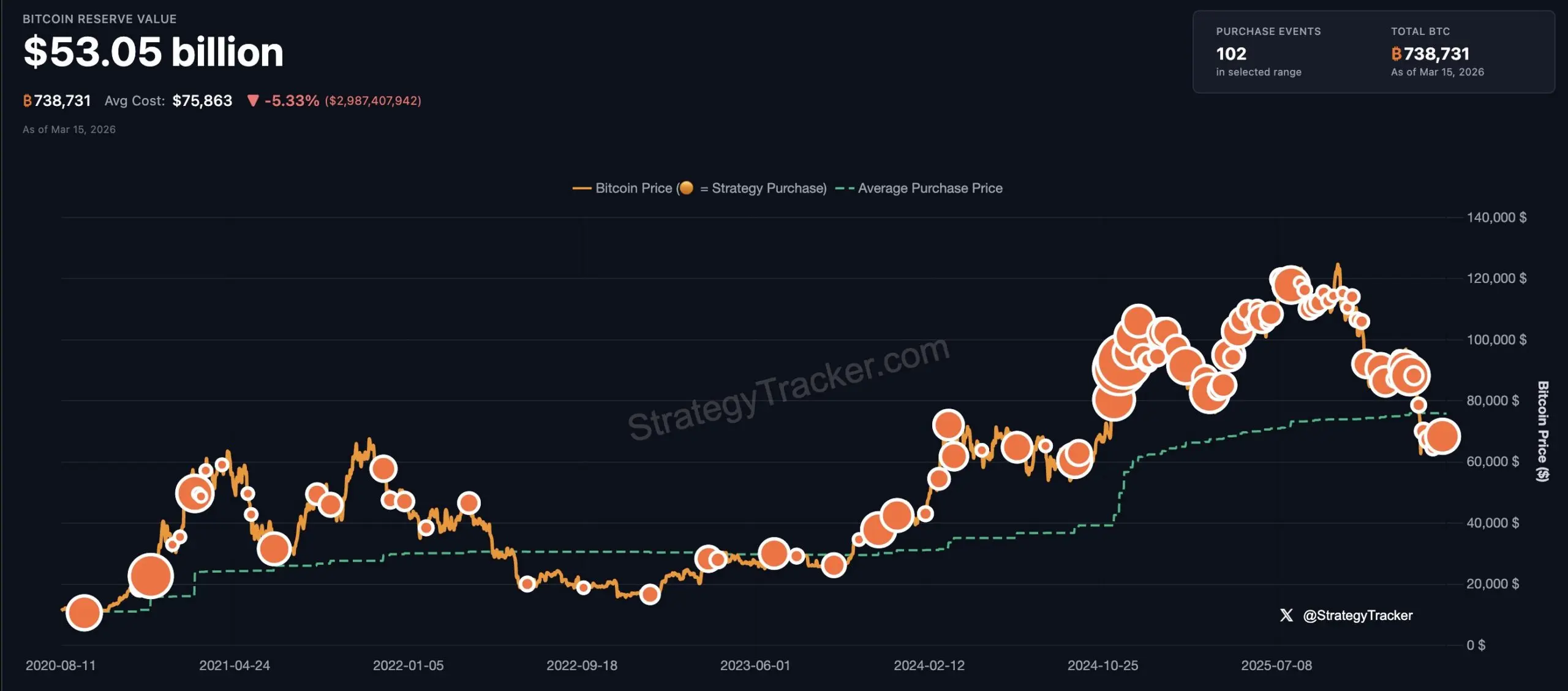
Strategy currently holds 738,731 BTC valued at approximately $53 billion, acquired across 102 purchases since late 2020 at an average entry price of $75,863 per coin, representing a total cost basis near $56.04 billion and an unrealized loss of roughly $3 billion .
Strategy Bitcoin Accumulation Continues
Latest Purchase Hint
 (Source: X)
Saylor’s March 15 post continues a long-standing pattern of Sunday previews preceding formal Monday announcements of Strategy Bitcoin acquisitions. The hint follows the company’s acquisition of 17,994 BTC last week, maintaining its position as the largest public corporate holder of Bitcoin.
(Source: X)
Saylor’s March 15 post continues a long-standing pattern of Sunday previews preceding formal Monday announcements of Strategy Bitcoin acquisitions. The hint follows the company’s acquisition of 17,994 BTC last week, maintaining its position as the largest public corporate holder of Bitcoin.
Current Holdings and Performance
Strategy’s Bitcoin treasury metrics as of March 2026:
-
Total holdings: 738,731 BTC
-
Current value: Approximately $53 billion
-
Number of purchases: 102 since late 2020
-
Average entry price: $75,863 per coin
-
Total cost basis: Approximately $56.04 billion
-
Unrealized loss: Roughly $3 billion (5.4% decline)
Funding Mechanism
Strategy continues to fund Bitcoin purchases through debt and equity financing, including its at-the-market share program that allows the company to sell stock and raise funds for additional acquisitions. Traders speculate the company may have already purchased more than 1,000 BTC this week based on program activity.
Market Indicators
Strategy’s STRC preferred stock has become the most liquid preferred security tied to Bitcoin exposure, with increasing demand among investors seeking indirect BTC exposure. However, the stock has seen rising short interest in recent weeks, reflecting bearish positioning tied to Strategy’s strong correlation with Bitcoin price movements. MSTR traded at $138.40 in after-hours trading after closing Friday at $137.34.
Bitcoin Holder Dynamics
Long-Term Supply Trends
According to analyst Darkfost, long-term holders currently control approximately 79% of Bitcoin’s total circulating supply. This contrasts with the 2021 cycle, when long-term holder supply dropped from 82% to 70% within six months.
The current cycle has unfolded differently, with supply transfers occurring in multiple waves as short-term holders absorb supply and subsequently become long-term holders themselves.
Industry Response to Boris Johnson’s ‘Ponzi’ Claims
Johnson’s Commentary
In a March 14 Daily Mail column, former UK Prime Minister Boris Johnson wrote that he had “long suspected Bitcoin is a giant Ponzi scheme,” warning readers against investing in digital assets. Johnson recounted meeting an elderly churchgoer who fell into financial difficulty after purchasing Bitcoin and later sought help covering losses.
While acknowledging Bitcoin operates without central authority, Johnson argued the cryptocurrency ultimately relies on public belief, stating: “If people lose faith in Bitcoin, it collapses.”
Saylor’s Rebuttal
Saylor directly rejected Johnson’s characterization on X, arguing that Bitcoin does not meet the definitional requirements of a Ponzi scheme:
“A Ponzi requires a central operator promising returns and paying early investors with funds from later ones. Bitcoin is not a Ponzi scheme.”
Broader Industry Response
Other crypto leaders joined Saylor in challenging Johnson’s claims:
Paolo Ardoino, Tether CEO, highlighted community notes on Johnson’s post explaining why Bitcoin does not fit Ponzi characteristics
Adam Back, Blockstream CEO, responded to Johnson by his nickname “Bozza”
Fred Krueger, investor and fund manager, contrasted Bitcoin’s decentralized design with traditional finance: “A Ponzi usually needs a central operator, Boris. Bitcoin just has math”
Historical Context
Bitcoin has faced repeated accusations of resembling a Ponzi scheme from critics including economist Nouriel Roubini, who previously described cryptocurrencies as a “real-bubble Ponzi scheme,” and former European Central Bank executive Fabio Panetta, who compared the digital asset market to a “house of cards.”
Industry supporters consistently argue the comparison is flawed because Ponzi schemes require a central operator promising guaranteed returns, whereas Bitcoin operates as an open monetary system governed by code and market activity without promises of specific returns.
Frequently Asked Questions
What is Strategy’s current Bitcoin position?
Strategy holds 738,731 BTC valued at approximately $53 billion, acquired across 102 purchases since late 2020 at an average entry price of $75,863 per coin. The position currently shows an unrealized loss of roughly $3 billion, representing a 5.4% decline from its total cost basis of $56.04 billion.
Why did crypto leaders reject Boris Johnson’s “Ponzi” characterization?
Industry figures including Michael Saylor, Paolo Ardoino, and Adam Back argue that Bitcoin lacks the central operator and promise of returns that define classic Ponzi schemes. Saylor stated: “A Ponzi requires a central operator promising returns and paying early investors with funds from later ones. Bitcoin is not a Ponzi scheme.” Supporters emphasize Bitcoin operates as a decentralized monetary system governed by code and market activity rather than promises of guaranteed returns.
How does current long-term Bitcoin holder behavior differ from previous cycles?
Long-term holders currently control approximately 79% of Bitcoin’s circulating supply, according to analyst Darkfost. This contrasts with the 2021 cycle, when long-term holder supply dropped from 82% to 70% within six months. The current cycle has unfolded differently, with supply transfers occurring in multiple waves as short-term holders absorb supply and subsequently transition into long-term holders themselves.
Disclaimer: The information on this page may come from third parties and does not represent the views or opinions of Gate. The content displayed on this page is for reference only and does not constitute any financial, investment, or legal advice. Gate does not guarantee the accuracy or completeness of the information and shall not be liable for any losses arising from the use of this information. Virtual asset investments carry high risks and are subject to significant price volatility. You may lose all of your invested principal. Please fully understand the relevant risks and make prudent decisions based on your own financial situation and risk tolerance. For details, please refer to
Disclaimer.


