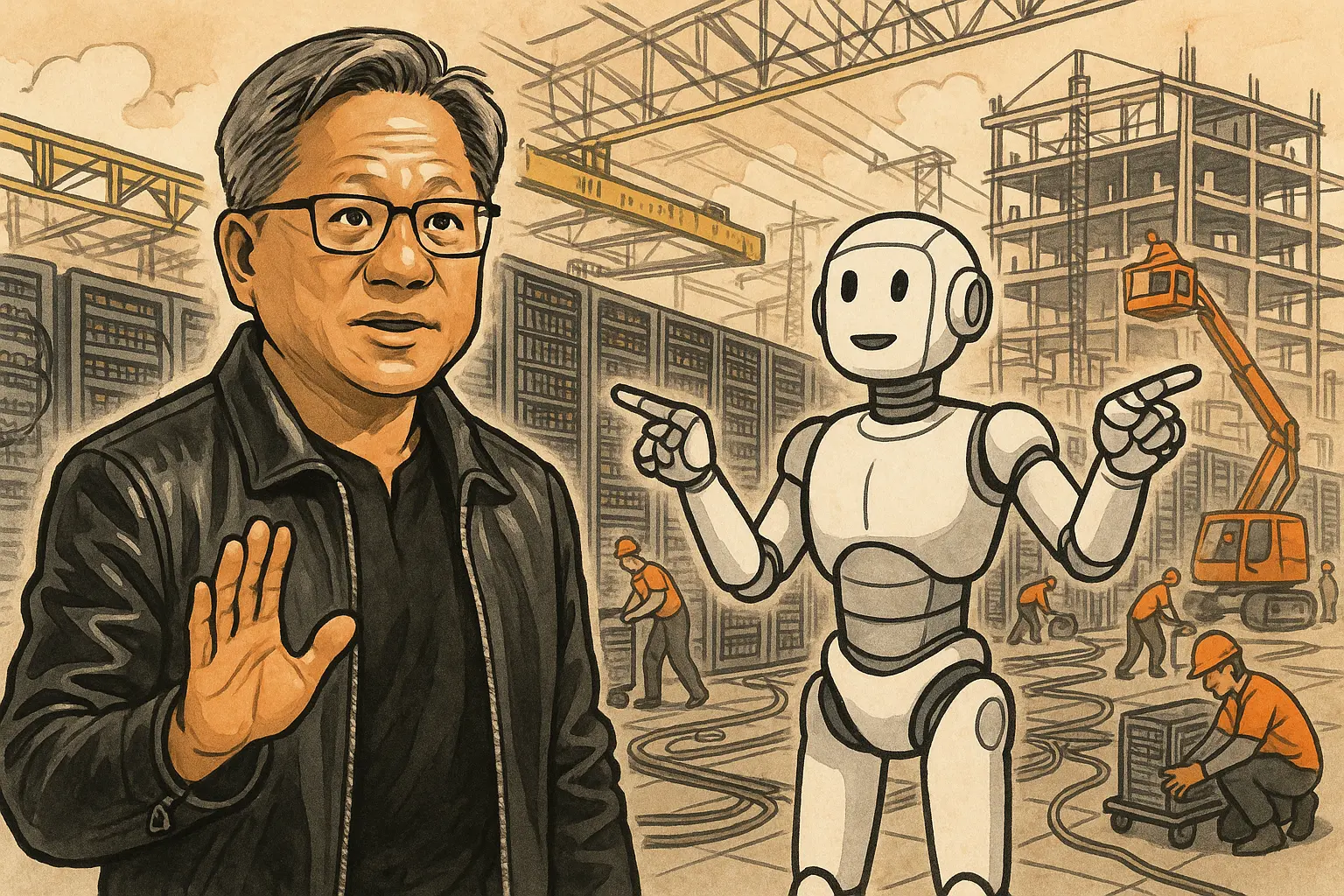
Nvidia founder Jensen Huang stated in a blog post on Tuesday that artificial intelligence (AI) will not replace jobs on a large scale as many fear, because the infrastructure required to build and maintain this technology is enormous and will continue to create a large number of high-skilled jobs. Huang pointed out that AI has become an essential infrastructure, comparable to electricity and the internet.
The “Five-Layer Cake” Framework: A Systematic Analysis of AI Infrastructure
Huang compares the complete AI infrastructure to a “five-layer cake,” which consists of: energy, AI chips, infrastructure, AI models, and applications.
He explained that traditional software operates by “retrieving stored instructions,” whereas AI “performs on-demand reasoning and generates intelligence.” This fundamental difference means that the infrastructure supporting AI “must be reinvented from scratch,” as existing frameworks cannot be directly applied.
Huang noted that AI data centers demand a wide range of technical skills, including electricians, plumbers, steelworkers, network technicians, and operators. He described these as “highly technical, well-paying jobs that are in short supply.” He also emphasized that currently, “many infrastructures are not yet in place, many workers have not been trained, and many opportunities have yet to be realized.”
Real-World Employment Effects: Layoff Cases and Analyst Assessments
However, Huang’s optimistic view faces direct challenges from actual corporate behaviors:
- Block (a company under Jack Dorsey): Laid off 40% of its staff last month, with co-founder Jack Dorsey explicitly attributing this to the company’s AI applications.
- Pinterest and Dow Chemical: Earlier this year, together laid off over 5,000 employees, both citing AI-driven efficiency improvements as the reason.
- Goldman Sachs analysts: Assessed that AI-related unemployment is “noticeable but moderate,” predicting the U.S. unemployment rate will gently rise from the current 4.4% to 4.5% by year’s end.
Goldman’s analysis neither fully supports Huang’s argument that “AI mainly creates jobs” nor endorses the pessimistic view of large-scale unemployment. Instead, it depicts a slow, structural transformation process.
Nvidia’s Business Position: The Biggest Beneficiary of AI Infrastructure Development
Nvidia is currently one of the biggest commercial beneficiaries of the AI boom and is the leading supplier of AI hardware, with strong demand for chips. Since OpenAI launched ChatGPT in 2023, sparking an AI race, Nvidia’s stock has surged over 1,300%. Against this backdrop, Huang further emphasized the global scale of AI infrastructure development: “Every company will use AI, every country will build AI. That’s why the scale of AI construction is so enormous and why it impacts so many industries simultaneously.”
Frequently Asked Questions
Q: How does Jensen Huang believe AI can both impact employment and create jobs?
A: Huang’s core argument is that the scale of AI infrastructure construction is huge, covering five layers: energy, chips, data centers, AI models, and applications, requiring many high-skilled technical workers. He believes AI mainly replaces repetitive knowledge work, while infrastructure development creates demand for jobs like electricians and engineers in different categories.
Q: What exactly is the “five-layer cake” framework of AI infrastructure?
A: The “five-layer cake” is Huang’s metaphor for describing the complete AI infrastructure ecosystem. The five layers are: energy (power supply), AI chips (hardware computation), infrastructure (data centers and networks), AI models (software intelligence), and applications (user-facing products and services). He argues that because AI’s operational logic is fundamentally different from traditional software, these five layers must be rebuilt from the ground up.
Q: How does Goldman Sachs’ assessment of AI’s employment impact align with Huang’s view?
A: Goldman Sachs analysts believe that AI-induced unemployment is “noticeable but moderate,” with the U.S. unemployment rate expected to rise gently from 4.4% to 4.5%. This assessment neither fully supports Huang’s optimistic view that AI mainly creates jobs nor endorses the pessimistic outlook of large-scale unemployment, instead indicating a gradual structural adjustment process.
Disclaimer: The information on this page may come from third parties and does not represent the views or opinions of Gate. The content displayed on this page is for reference only and does not constitute any financial, investment, or legal advice. Gate does not guarantee the accuracy or completeness of the information and shall not be liable for any losses arising from the use of this information. Virtual asset investments carry high risks and are subject to significant price volatility. You may lose all of your invested principal. Please fully understand the relevant risks and make prudent decisions based on your own financial situation and risk tolerance. For details, please refer to
Disclaimer.


