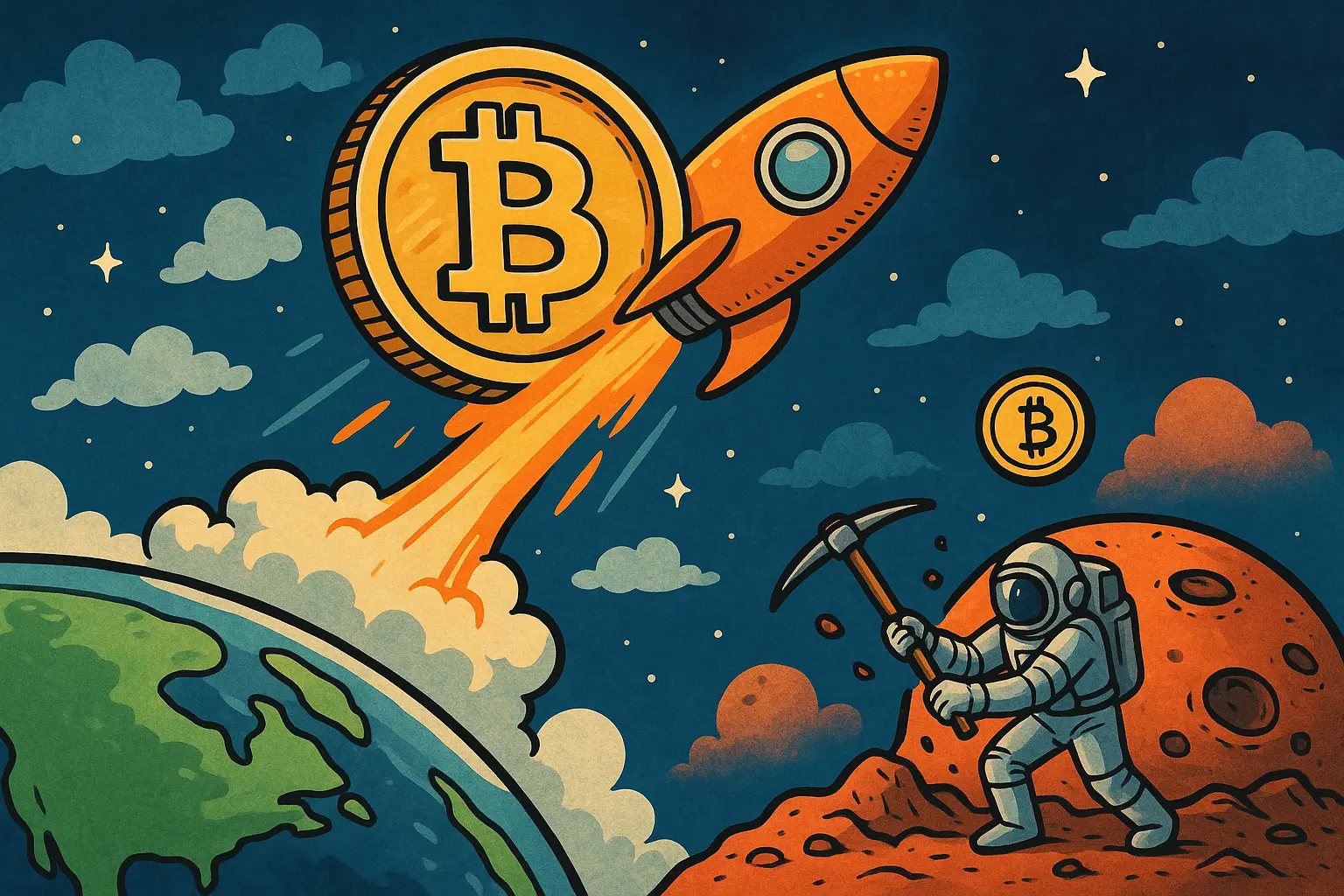
Supported by Nvidia, the new space data center startup Starcloud announced that its second spacecraft will be launched later this year, at which point the company will begin mining Bitcoin in Earth’s orbit, becoming the first company in human history to mine Bitcoin outside of Earth. Meanwhile, space cryptocurrency researchers have also proposed a theoretical framework for sending Bitcoin transactions to Mars. Although local mining on Mars is currently not feasible, the technical possibility of receiving payments has been established.
Starcloud’s Space Mining Plan: The First ASIC Mine Outside Earth
Founded in early 2024, Starcloud’s initial goal was to build a space data center to meet the growing energy demands of artificial intelligence. In November last year, the company successfully launched a satellite equipped with Nvidia H100 GPUs into orbit, marking the first time such high-performance GPUs have operated in space. The entire data center plan involves approximately 88,000 satellites, primarily powered by solar energy.
Johnston stated that operating Bitcoin ASIC miners in space would be one of the most attractive applications of space computing, because the abundant and nearly free solar energy in space, combined with the low-cost hardware of ASICs, would make Bitcoin mining economically far more advantageous than on Earth. He directly pointed out on X: “Bitcoin mining consumes about 20 gigawatts of electricity continuously. Mining on Earth is pointless; ultimately, all of this will take place in space.”
Why Is Space Bitcoin Mining 30 Times Cheaper Than on Earth? The Cost Gap Between ASIC and GPU
Johnston’s core argument is based on the stark difference in hardware costs between ASICs and GPUs:
- GPU Cost: About $30,000 for a 1 kW B200 chip
- ASIC Cost: About $1,000 for a 1 kW ASIC chip
- Cost Difference: Approximately 30 times more expensive for GPUs per kilowatt
This gap is especially critical in space scenarios. Although the cost per kilogram for launching into space remains high, companies like SpaceX continue to reduce launch costs. The lightweight and low-cost ASIC miners will have a significant deployment cost advantage over GPUs. Johnston believes that the free solar energy in space, combined with the extremely low-cost hardware of ASICs, makes the long-term economic model of space Bitcoin mining highly feasible.
Bitcoin and Mars: 3-Minute Transfer Theory, Mining Delay Still a Deadly Obstacle
Another fascinating prospect in space cryptocurrency is transmitting Bitcoin transactions to Mars. Tech entrepreneurs Jose E. Puente and Carlos Puente stated to Cointelegraph last September that, in theory, using NASA or Starlink’s optical links combined with a new interstellar timestamp system, Bitcoin transactions could be sent to Mars in just three minutes. Routing would involve space stations, antennas, satellites, and even lunar relay stations.
However, local mining on Mars remains a distant goal. Bitcoin mining requires miners to verify blocks nearly simultaneously worldwide, but the communication delay between Mars and Earth ranges from several minutes up to twenty minutes. This makes it impossible for any Mars-based miner to complete the proof-of-work within an effective time window—receiving payments is feasible, but mining is currently not.
Current Mining Environment
While Starcloud announced its space mining plans, the terrestrial mining industry is also facing cyclical pressures. Bitcoin is currently around $67,336, down about 48% from its peak of $126,080 on October 6 last year. Miner profitability has narrowed accordingly.
The good news is that mining difficulty has decreased by about 7% from its all-time high of 155.9 trillion units set in November, now at 145 trillion units, providing miners with a brief respite.
Frequently Asked Questions
When will Starcloud’s space Bitcoin mining officially start?
According to CEO Philip Johnston, the company’s second spacecraft will be launched “later this year,” at which point Bitcoin mining will commence in orbit. The specific launch date has not yet been announced. The first spacecraft successfully carried Nvidia H100 GPUs into orbit last November, marking a technological milestone for this Bitcoin mining project.
Is space Bitcoin mining really more cost-effective than on Earth?
Based on Johnston’s analysis, the hardware cost of ASIC miners is about one-thirtieth that of GPUs per kilowatt of hash power. Coupled with the abundant solar energy in space, this could theoretically significantly reduce marginal mining costs. However, factors such as launch costs, satellite maintenance, and interstellar communication delays must still be considered in the overall economic model. No large-scale commercial validation data is available yet.
Can Bitcoin transactions really reach Mars in 3 minutes?
In theory, yes. Research by Jose E. Puente and Carlos Puente shows that using optical communication links (Starlink or NASA Deep Space Network) combined with an interstellar timestamp system, Bitcoin transaction data could be transmitted from Earth to Mars in about three minutes. However, this system requires deploying receiving infrastructure on Mars, and local mining on Mars remains unfeasible due to communication delays.
Disclaimer: The information on this page may come from third parties and does not represent the views or opinions of Gate. The content displayed on this page is for reference only and does not constitute any financial, investment, or legal advice. Gate does not guarantee the accuracy or completeness of the information and shall not be liable for any losses arising from the use of this information. Virtual asset investments carry high risks and are subject to significant price volatility. You may lose all of your invested principal. Please fully understand the relevant risks and make prudent decisions based on your own financial situation and risk tolerance. For details, please refer to
Disclaimer.


