The People’s Bank of China is pushing to make the renminbi, popularly known as the yuan, an efficient international currency for international settlements. Pan Gongsheng, Governor of the People’s Bank of China, reinforced that the institution is still promoting financial cooperation with the Global South.
PBOC Governor: Yuan Internationalization Still an Objective for China
China is still pursuing the internationalization of its currency, the yuan, as part of its comprehensive economic policy.
The People’s Bank of China (PBOC) Governor Pan Gongsheng recently stated that China is promoting the use of the renminbi, commonly referred to as the yuan, as a key element of the nation’s foreign payment arsenal.
At a press conference, Gongsheng declared:
“We are gradually promoting yuan internationalization. China will create a more safe, efficient, and diversified system of cross-border payments.”
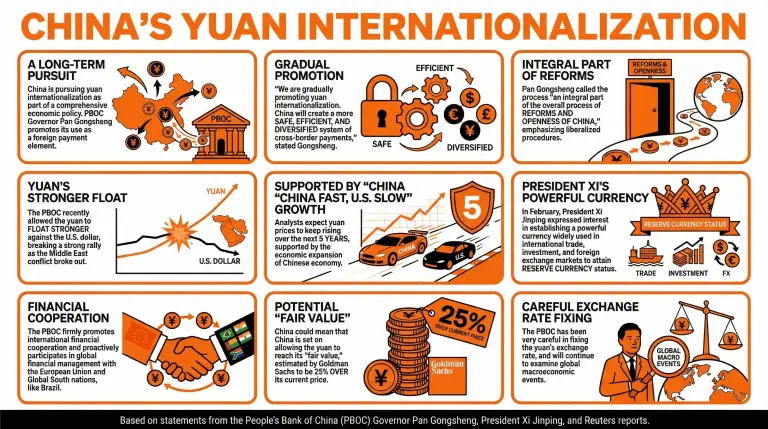
In addition, Gonsheng referred to this internationalization as “an integral part of the overall process of reforms and openness of China,” stressing that the institution was working on liberalizing procedures in this regard.
Gongsheng stressed that the PBOC “firmly promotes international financial cooperation and proactively participates in global financial management” talks with the European Union and Global South nations, like Brazil.
The bank has recently allowed the yuan to float stronger against the U.S. dollar, with the currency breaking one of its strongest rallies against the greenback as the Middle East conflict broke out.
Analysts expect the yuan to keep rising over the next 5 years, supported by the “China Fast, U.S. Slow” growth pattern, as the Chinese economy expands faster than the American one, supporting the yuan’s underlying value.
In February, China’s President Xi Jinping expressed a renewed interest in establishing a powerful currency to be “widely used in international trade, investment and foreign exchange markets, and attain reserve currency status.”
This could mean that China is set on allowing the yuan to reach its “fair value,” estimated by Goldman Sachs to be 25% over its current price.
Nonetheless, the PBOC has been very careful in fixing the yuan’s exchange rate, and it will surely continue to do so, examining global macroeconomic events in the journey towards a powerful yuan.
FAQ 🧭
- What is China’s current goal regarding its currency, the yuan?
China aims to internationalize the yuan as a central part of its economic policy, enhancing its use in global payments.
- What recent comments did the PBOC Governor make about yuan internationalization?
Governor Pan Gongsheng emphasized the need for a safer, efficient, and diversified system of cross-border payments to support yuan internationalization.
- How has the yuan’s value changed recently in relation to the U.S. dollar?
The PBOC has allowed the yuan to float stronger against the U.S. dollar, experiencing one of its strongest rallies amid recent geopolitical tensions.
- What are the long-term expectations for the yuan’s value?
Analysts forecast that the yuan’s value may rise significantly over the next five years, driven by China’s faster economic growth compared to the U.S.
Disclaimer: The information on this page may come from third parties and does not represent the views or opinions of Gate. The content displayed on this page is for reference only and does not constitute any financial, investment, or legal advice. Gate does not guarantee the accuracy or completeness of the information and shall not be liable for any losses arising from the use of this information. Virtual asset investments carry high risks and are subject to significant price volatility. You may lose all of your invested principal. Please fully understand the relevant risks and make prudent decisions based on your own financial situation and risk tolerance. For details, please refer to
Disclaimer.


