
The U.S. spot Bitcoin ETF experienced five consecutive weeks of outflows totaling approximately $4.5 billion at the beginning of 2026, marking the worst start to the year since its launch. However, strong inflows over the following two weeks nearly offset this decline. As of March 5, the total net inflow for all spot Bitcoin ETFs reached $55.72 billion, significantly rebounding from the low point and narrowing the gap with the early-year benchmark of $57.08 billion.
ETF Capital Flows: A Three-Week Reversal of Five Weeks of Outflows
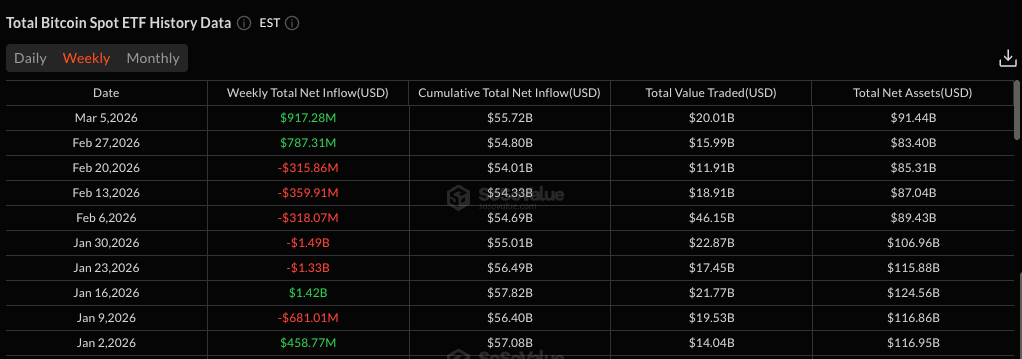
(Source: SoSoValue)
In early 2026, BlackRock’s IBIT lost over $2.1 billion during the five worst weeks, and Fidelity’s FBTC lost more than $954 million. The combined outflow of about $4.5 billion is the longest consecutive outflow record since early 2025.
However, the capital reversal has been equally swift. Here are the specific flow figures for the past two weeks:
- Week of February 27: Net inflow of $787 million, marking the first reversal of the outflow trend
- March 2: Single-day inflow of $458 million
- March 3: Single-day inflow of $225 million
- March 4: Single-day inflow of $462 million (over $1.1 billion combined over three days)
- March 5: Single-day outflow of $228 million, ending three days of inflows; but the weekly net inflow still totaled $917 million
It’s noteworthy that this round of inflows is no longer concentrated in a single fund but involves multiple funds showing continuous strength over several days, reflecting a genuine shift in overall market sentiment rather than internal fund rotation within the ETF sector.
Geopolitical Tensions Between Bitcoin and Gold: Short-Term Divergence Doesn’t Define Long-Term Trends
Since the U.S.-Israel airstrike on February 28, Bitcoin has risen about 12%, while gold initially surged but quickly retraced its gains, sparking market discussions that “Bitcoin is the new safe-haven asset, gold has lost its relevance.” Eric Balchunas responded directly on X, warning that this framework is a trap.
He pointed out that immediately after the airstrike news, Bitcoin reacted by dropping sharply from around $67,000 to a low of $63,038; gold surged close to $5,376 per ounce, consistent with traditional safe-haven logic. Bitcoin’s subsequent rebound occurred after the death of Iran’s Supreme Leader Khamenei was confirmed, while gold retreated as expectations of Federal Reserve rate hikes were factored in.
Balchunas believes that Bitcoin’s 12% increase may have little to do with geopolitical relations. Instead, changes in institutional sentiment and reduced market resistance are likely the main drivers; gold’s decline could be a normal profit-taking after rising over $1,000 per ounce in the 60 days prior to the airstrike. The context is also crucial: Bitcoin has fallen about 23% since January 2026, both assets starting from extreme points, and a few days of divergence are insufficient to determine their long-term asset characteristics. “Gold and Bitcoin are both assets I respect,” he said.
Frequently Asked Questions
Q: What caused the large outflows from Bitcoin ETFs at the beginning of 2026?
The outflows of about $4.5 billion over five weeks are attributed to rising global risk aversion following the U.S.-Israel conflict, a significant pullback in Bitcoin from its highs (down about 23% from the start of the year to the lows), and institutional investors actively reducing risk exposure amid macroeconomic uncertainty.
Q: Why does Eric Balchunas warn against judging Bitcoin and gold based on short-term geopolitical movements?
Balchunas points out that Bitcoin initially dropped after the airstrike (from $67,000 to $63,038), while gold first rose then fell. Both trends stem from their respective extreme starting points, not from fundamental changes in the assets’ nature. He warns that drawing conclusions from just a few days of price divergence can lead to incorrect investment decisions.
Q: What is the significance of the broad participation in this round of Bitcoin ETF inflows?
Early 2026 inflows mainly concentrated in single funds like IBIT, but this round shows multiple funds experiencing continuous strength over several days. Balchunas notes that this broad participation reflects a genuine shift in overall market sentiment, not just internal ETF fund rotation, and indicates a stronger trend confirmation.
Disclaimer: The information on this page may come from third parties and does not represent the views or opinions of Gate. The content displayed on this page is for reference only and does not constitute any financial, investment, or legal advice. Gate does not guarantee the accuracy or completeness of the information and shall not be liable for any losses arising from the use of this information. Virtual asset investments carry high risks and are subject to significant price volatility. You may lose all of your invested principal. Please fully understand the relevant risks and make prudent decisions based on your own financial situation and risk tolerance. For details, please refer to
Disclaimer.


