
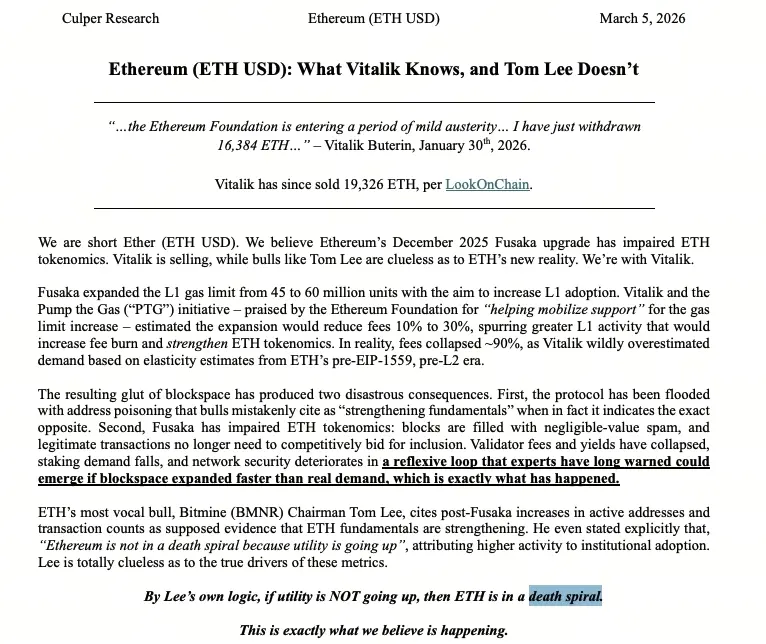
Short research firm Culper Research released a report on Thursday revealing its short positions on Ethereum (ETH) and concept stocks. The report states that the “Fusaka” network upgrade led to an oversupply of block space, with transaction fees dropping about 90% since the upgrade, damaging Ethereum’s token economic model and potentially triggering a negative feedback loop of validator yield deterioration and staking demand decline. The report describes this potential scenario as a “death spiral.”
How the Fusaka Upgrade Damages Ethereum’s Token Model
(Source: Culper Research)
Culper Research’s core short thesis is based on the aftereffects of the Fusaka upgrade. The upgrade significantly expanded network block space, creating an oversupply without corresponding user demand, directly compressing transaction fees.
Culper estimates that since the Fusaka upgrade, Ethereum transaction fees have fallen about 90%. Since validator rewards partly come from transaction fees, the fee shrinkage directly reduces staking returns. The report warns that if this trend continues, validator yields could further deteriorate, lowering staking demand and network security, forming a self-reinforcing death spiral—fee decline → staking yield reduction → decreased staking attractiveness → reduced network security → further weakened utility.
Vitalik’s Selling and Tom Lee’s Bull-Bear Dispute
Culper Research directly names two key market figures in the report, presenting contrasting assessments of Ethereum:
Vitalik Buterin’s Selling Signal: The report cites on-chain detective Lookonchain data indicating that Ethereum co-founder Vitalik Buterin has sold nearly 20,000 ETH this year, worth about $40 million at current prices. Culper states, “Vitalik is selling, while bulls like Tom Lee are unaware of Ethereum’s new situation. We support Vitalik.”
Questioning Tom Lee’s Fundamental Arguments: Tom Lee, Chairman of BitMine and Chief Investment Strategist at Fundstrat, previously cited rising transaction counts and increasing active addresses as signs of improving Ethereum fundamentals. Culper directly refutes this, pointing out that a significant portion of the surge in activity is due to “Address Poisoning Attacks”—where attackers send small transfers to trick users into copying malicious wallet addresses, not genuine demand growth.
Culper’s conclusion is: “According to Lee’s own logic, if Ethereum’s utility isn’t increasing, then Ethereum is in a death spiral. That’s exactly what we believe is happening.”
BitMine’s $7.4 Billion Unrealized Loss: Structural Risks in Corporate Ethereum Holdings
Another core focus of Culper Research’s report is BitMine (BMNR). Since July 2025, BitMine has accumulated about 4.4 million ETH as corporate treasury assets, making it one of the largest corporate buyers of ETH. According to DropsTab data, about 45% of these holdings are in loss, with unrealized losses estimated at $7.4 billion.
Culper believes that if Ethereum’s fee income continues to decline and staking yields further decrease, large ETH holdings by corporations will face greater exposure risks, and the underlying logic of their treasury strategies will be fundamentally challenged.
Frequently Asked Questions
Q: What is the mechanism behind Culper Research’s so-called Ethereum death spiral?
A: Culper describes the death spiral as a self-reinforcing negative feedback loop: Fusaka upgrade → oversupply of block space → fee collapse (estimated over 90%) → validator staking yield decline → decreased staking demand → reduced network security → further weakening of Ethereum’s overall utility.
Q: How does Vitalik Buterin’s selling behavior support Culper’s bearish thesis?
A: Culper cites on-chain data from Lookonchain indicating Vitalik has sold nearly 20,000 ETH this year (about $40 million), using this as evidence that Ethereum’s founder is also reducing his holdings. However, on-chain data cannot confirm specific motives for selling; this interpretation is Culper’s opinion, not an independent fact.
Q: What are the structural differences between BitMine’s $7.4 billion unrealized loss and MicroStrategy’s Bitcoin strategy?
A: MicroStrategy’s Bitcoin treasury strategy hinges on Bitcoin’s fixed supply cap of 21 million coins, whereas BitMine’s ETH treasury partly relies on staking yields. If staking yields continue to decline, the yield logic of BitMine’s holdings faces fundamental challenges, which Culper sees as making it more vulnerable compared to Bitcoin treasury strategies.
Disclaimer: The information on this page may come from third parties and does not represent the views or opinions of Gate. The content displayed on this page is for reference only and does not constitute any financial, investment, or legal advice. Gate does not guarantee the accuracy or completeness of the information and shall not be liable for any losses arising from the use of this information. Virtual asset investments carry high risks and are subject to significant price volatility. You may lose all of your invested principal. Please fully understand the relevant risks and make prudent decisions based on your own financial situation and risk tolerance. For details, please refer to
Disclaimer.


