
Pi Network (PI) token price remains above $0.1600, continuing the roughly 2% rebound from the previous day, but supply-side pressure is intensifying. In February, 32.36 million PI tokens are still scheduled to unlock, with an even higher projected unlock of 154 million tokens in March, leading to ongoing accumulation of supply pressure. Technical indicators show weakening buying momentum, and the support level at $0.1533 will be a key short-term threshold for the bulls and bears.
Supply Pressure: Token Inflows to Exchanges and Upcoming Unlocks
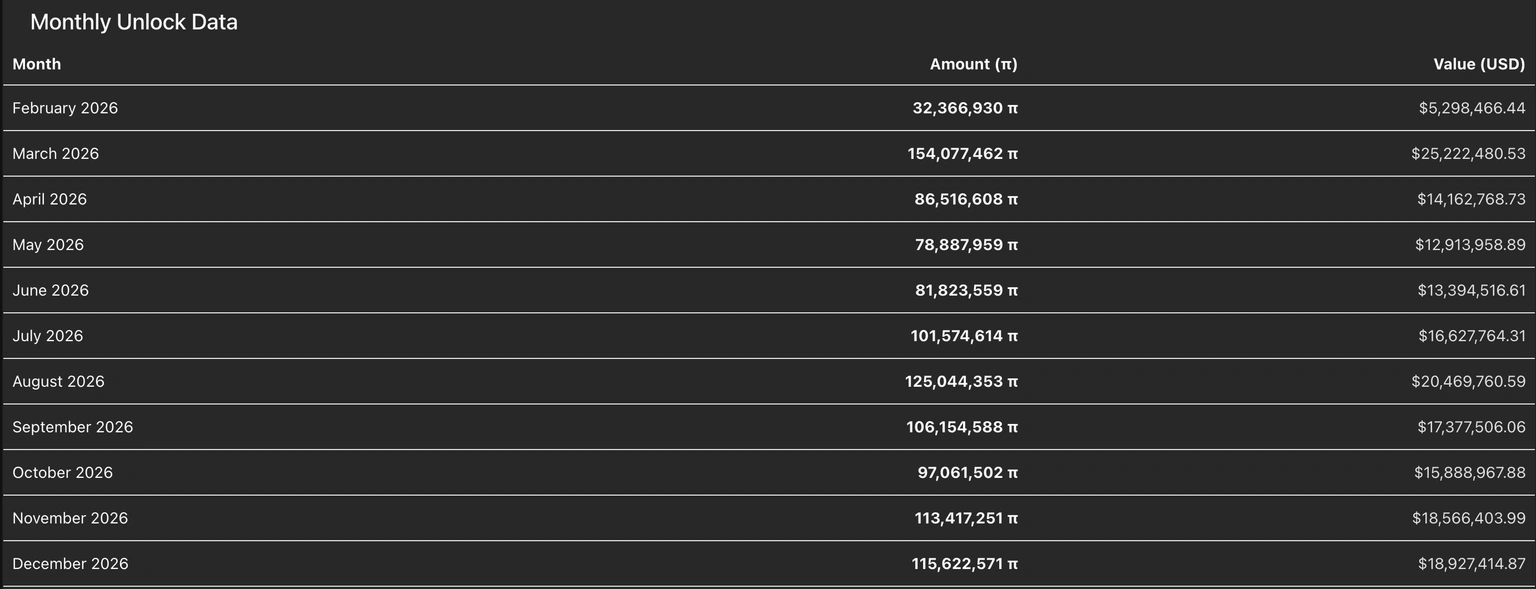 (Source: PiScan)
The rapid increase in centralized exchange PI balances is one of the most direct on-chain signals reflecting holders’ selling intentions. When tokens flow heavily into exchanges, it usually indicates that holders are preparing to sell. The 2.16 million PI inflow over the past 24 hours, in the context of no clear bullish signals yet, constitutes a notable short-term selling pressure.
Unlock Schedule’s Deeper Impact
Remaining February Unlock: 32.36 million PI tokens, short-term supply increase confirmed
Projected March Unlock: approximately 154 million PI tokens, nearly five times February’s amount, significantly extending market pressure window
Current CEX Holdings: over 432 million PI, roughly valued at $7.08 million, indicating substantial token release pressure remains
The ongoing monthly unlock mechanism means that even if a technical rebound occurs in the short term, the increasing supply will continue to exert structural resistance on PI’s price growth.
Technical Analysis: RSI Weakening and Key Price Level Battles
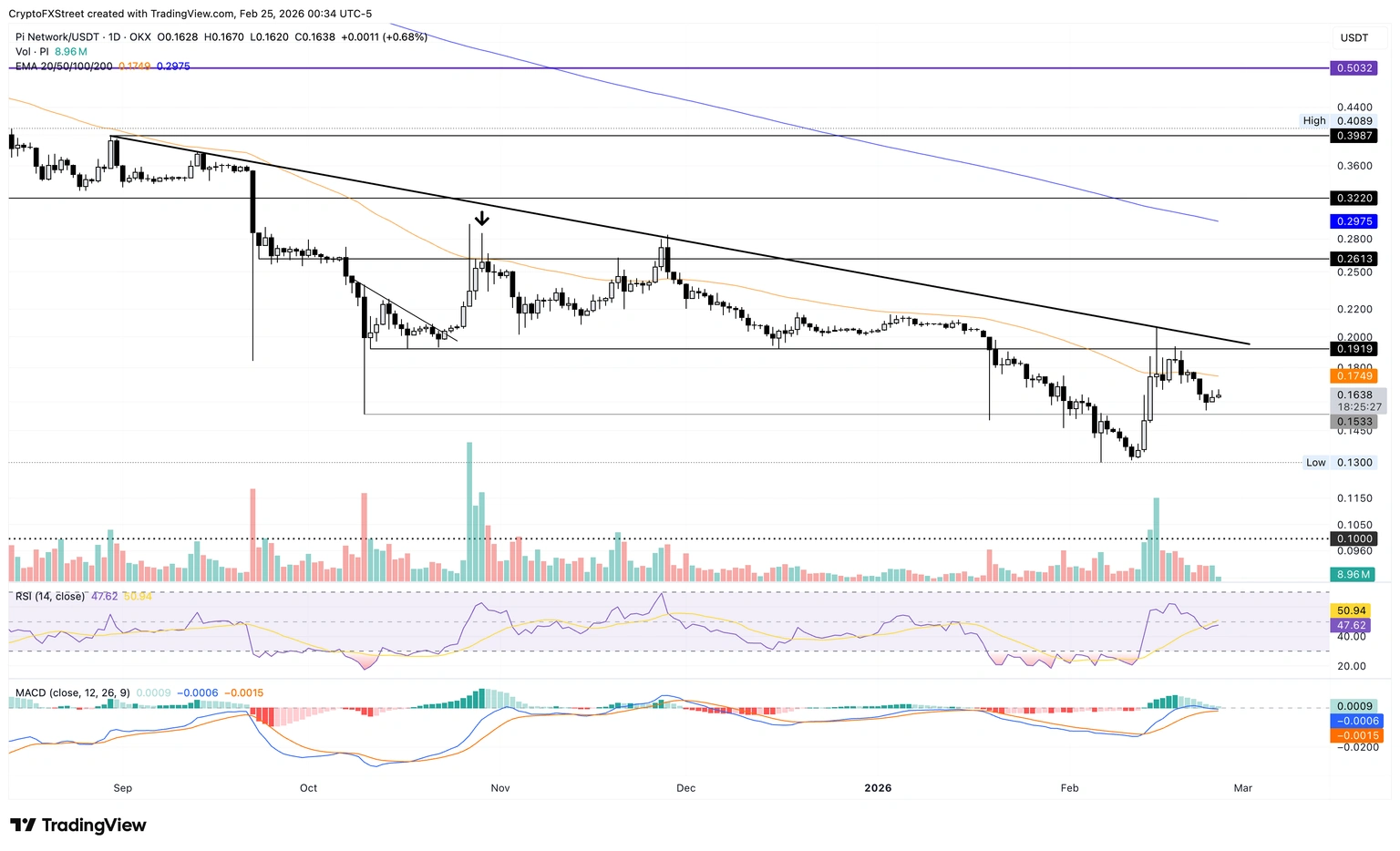 (Source: TradingView)
Pi Network After reaching resistance at $0.1919 and falling about 15%, the price is consolidating above the support at $0.1533 (October 10 low). Monitoring this level will be crucial for the near-term trend:
Bullish Defense Line: $0.1533 is a recent effective technical support. Holding this level could lead to targets of $0.1749 (50-day EMA), $0.1919 (downtrend resistance), and $0.2613 (September 23 low).
Bearish Risk: Falling below $0.1538 support could open the door to challenge the February 6 low of $0.1300.
Technical indicators currently lean toward a defensive stance. The Relative Strength Index (RSI) has declined from a high of 62 on February 17 to around 47, breaking below the midline, indicating a clear reduction in buying momentum. The Moving Average Convergence Divergence (MACD) remains slightly flat above the signal line, with the positive histogram shrinking, raising the risk of a bearish crossover.
Frequently Asked Questions
Why is there a large inflow of tokens into centralized exchanges for Pi Network?
Large inflows into centralized exchanges typically signal increased selling intent from holders, possibly from early miners who have completed KYC and migrated to mainnet, or from short- to medium-term holders adjusting their positions with caution. Significant inflows often create short-term selling pressure before the market can absorb them.
How will the 154 million token unlock in March affect PI’s price?
The 154 million unlock represents a substantial increase in supply, accounting for over one-third of the current exchange holdings (432 million). If most of these tokens enter the market upon unlock, it could directly increase selling pressure; if holders choose to retain their tokens, the impact may be limited. The actual effect depends on holder behavior and is a structural risk inherent in the unlock schedule.
What is the technical target if PI breaks above the 50-day EMA?
A confirmed breakout above $0.1749 (50-day EMA) would suggest a short-term target of $0.1919 (downtrend resistance connecting the highs of August 30 and February 15). Further突破 beyond $0.1919 could aim for the higher resistance at $0.2613. However, given ongoing supply pressure, such breakouts need strong volume confirmation to be credible.
Disclaimer: The information on this page may come from third parties and does not represent the views or opinions of Gate. The content displayed on this page is for reference only and does not constitute any financial, investment, or legal advice. Gate does not guarantee the accuracy or completeness of the information and shall not be liable for any losses arising from the use of this information. Virtual asset investments carry high risks and are subject to significant price volatility. You may lose all of your invested principal. Please fully understand the relevant risks and make prudent decisions based on your own financial situation and risk tolerance. For details, please refer to
Disclaimer.


