


What is Ethereum vs Bitcoin?
What Is Bitcoin?
Bitcoin is a digital currency system that operates independently of banks or governments, relying on a decentralized peer-to-peer network. Decentralization means no single authority can arbitrarily change the rules or freeze funds; instead, network participants collectively maintain the ledger. Transactions are recorded on the blockchain—a public ledger that anyone can audit and verify.
Bitcoin’s issuance and security are governed by the Proof of Work (PoW) consensus mechanism. Miners use computing power to solve cryptographic puzzles, earning the right to add new blocks and receiving rewards in newly minted coins and transaction fees, ensuring transactions are orderly and secure on the blockchain.
Current Price, Market Cap, and Circulating Supply of Bitcoin (BTC)
Based on provided data as of 2026-01-15:
- Latest price: approximately $96,312.60.
- Circulating supply: 19,976,012 BTC; Maximum supply cap: 21,000,000 BTC.
- Market capitalization: about $1,923,941,653,351; Market dominance: around 56.48%.

Click to view Top Crypto Market Cap Share
- 24-hour trading volume: approximately $1,572,501,682.
- Price change: 1 hour +0.04%, 24 hours +1.40%, 7 days +5.79%, 30 days +12.19%.
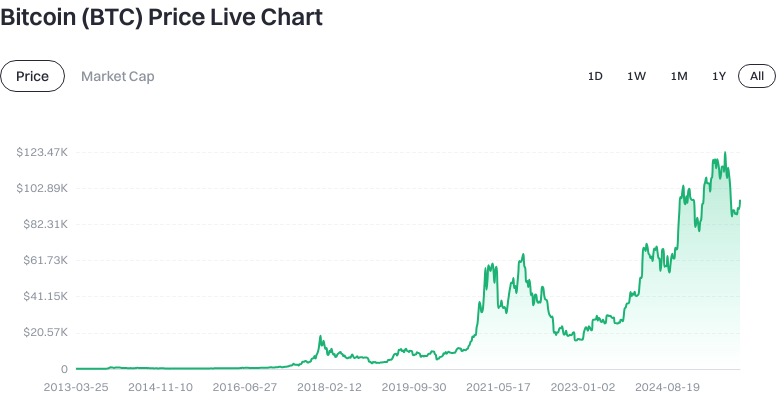
Click to view BTC Latest Price Data
These figures fluctuate with market conditions; for live prices and statistics, refer to the Gate platform.
Who Created Bitcoin (BTC), and When?
Bitcoin was introduced by the pseudonymous Satoshi Nakamoto, who published its whitepaper and open-source software in 2008. The mainnet launched with the genesis block in 2009. After initial development and community engagement, Satoshi gradually stepped back, leaving global open-source contributors to maintain the code and protocol. Bitcoin’s anonymity and open-source nature have fostered community-driven development since its inception.
How Does Bitcoin (BTC) Work?
Bitcoin records transactions on a blockchain. Each block contains validated transactions and the hash of the previous block, forming an immutable chain. Hashing compresses data into a fixed-length fingerprint; any minor change alters the hash, which helps prevent tampering.
Proof of Work (PoW) requires miners to find hash values meeting a difficulty target. The difficulty adjusts dynamically according to network-wide computational power, aiming for an average block time of about 10 minutes. Miners package transactions and broadcast new blocks; other nodes verify and accept them.
Users control assets through private and public keys. A private key is a confidential string that must be securely stored; it enables the owner to sign transactions. A public key or its derived address is used to receive funds. Losing your private key means you cannot access the associated assets.
Bitcoin’s issuance follows a halving schedule: approximately every four years, block rewards are cut in half, ultimately capping supply at 21 million coins to ensure scarcity.
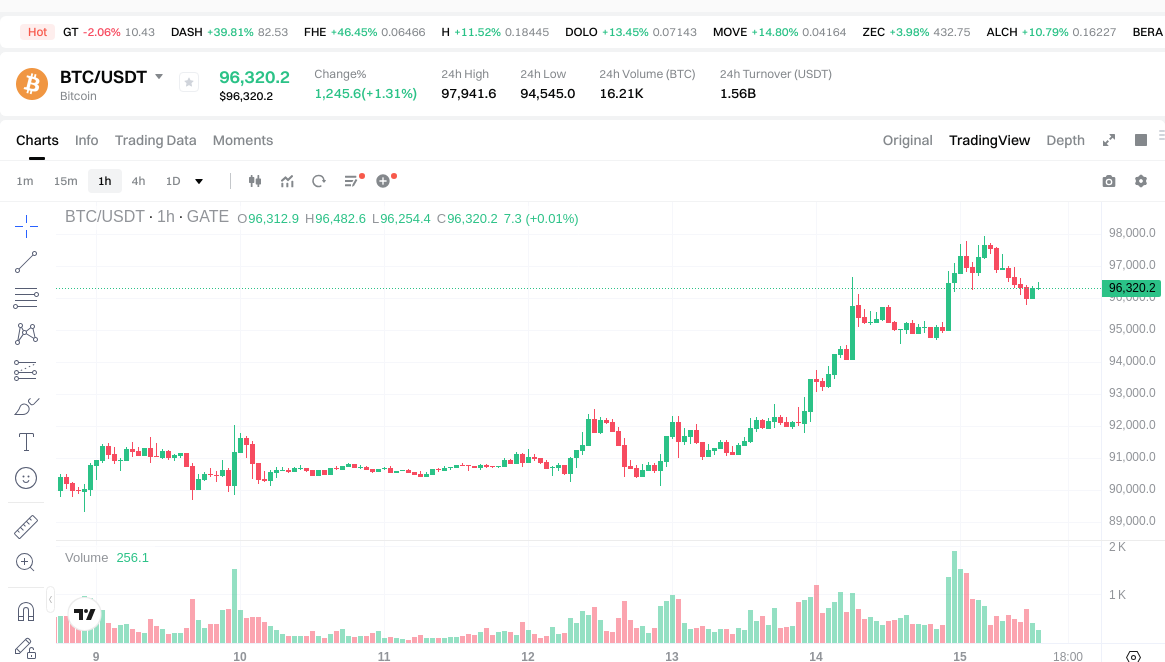
Click to view BTC USDT Price
What Can You Do With Bitcoin (BTC)?
Bitcoin is used for value storage and portfolio diversification; its fixed supply and globally auditable ledger have led many to regard it as “digital gold.”
For cross-border payments, users can transfer directly between addresses without traditional intermediaries—ideal for peer-to-peer value transfer.
For micropayments and instant transactions, Bitcoin leverages the Lightning Network—a layer-two scaling solution enabling fast, low-fee payments through payment channels with final settlement on the main chain.
In e-commerce and service payments, some merchants accept Bitcoin; users can pay by scanning with their wallet apps.
Wallets and Extensions in the Bitcoin (BTC) Ecosystem
Wallets are categorized as hot wallets and cold wallets. Hot wallets are connected apps for mobile or desktop—ideal for frequent transactions; cold wallets are offline devices or paper backups for long-term secure storage. Hardware wallets are a type of cold wallet, keeping private keys offline and safe from malware.
Block explorers let users look up transaction and block data by entering addresses or transaction IDs.
Layer-two extensions include the Lightning Network for micro and high-frequency payments; multisig schemes (requiring multiple keys for authorization) enhance security for organizations or families; full node software enables users to independently verify rules and transactions.
Main Risks and Regulatory Considerations for Bitcoin (BTC)
Price volatility: Crypto assets can experience rapid price swings, making short-term returns unpredictable.
Private key management: If your private key is leaked or lost, asset control is irreversibly lost. Back up your recovery phrase securely offline.
Security risks: Beware of phishing sites, fake apps, or fraudulent support contacts. Always verify website URLs, addresses, and networks before logging in or transferring funds; enable two-factor authentication (2FA).
Regulatory compliance: Crypto regulations vary by country—commonly involving KYC (identity verification), anti-money laundering, and tax reporting. Understand local compliance requirements and follow relevant laws.
Platform and network risk: Strengthen account security settings on exchanges; blockchain congestion or rising fees may affect transfer speed and cost.
How to Buy and Safely Store Bitcoin (BTC) on Gate
Step 1: Register and complete identity verification. Open an account on Gate using real credentials and follow prompts for KYC to ensure compliance and withdrawal rights.
Step 2: Enable security protection. In security settings, activate two-factor authentication (2FA), set a strong password, and configure withdrawal whitelists to prevent unauthorized access.
Step 3: Deposit funds and purchase BTC. Use fiat onramp for instant purchase or deposit funds before trading BTC/USDT on the spot market. Place a market order (executed at current price) or limit order (set your desired price) as needed.
Step 4: Withdraw and self-manage assets. For long-term storage, withdraw to your personal wallet via the BTC mainnet—carefully check recipient address; test with a small amount first before larger transfers. Back up your recovery phrase offline; avoid photos or cloud storage.
Final step: Ongoing maintenance. Regularly check wallet backups for accessibility; keep multiple secure copies in different locations. Track withdrawal fees and confirmation times as they change.
Key Differences Between Bitcoin (BTC) and Ethereum (ETH)
Purpose: Bitcoin focuses on value storage and peer-to-peer payments; Ethereum is a programmable smart contract platform supporting decentralized applications (DApps).
Consensus mechanism: Bitcoin uses Proof of Work (PoW); Ethereum switched to Proof of Stake (PoS) after “The Merge”, allowing stakers to validate transactions. PoW relies on computational competition; PoS depends on token staking and slashing mechanisms for security.
Supply model: Bitcoin has a fixed cap of 21 million coins with inflation decreasing after each halving; Ethereum has no hard cap—issuance rate changes with EIP-1559’s burn mechanism and PoS rewards, resulting in periods of net deflation or inflation.
Programmability & scalability: Bitcoin’s scripting is limited on the main chain—primarily enabling payments—with microtransactions expanded via Lightning Network. Ethereum natively supports complex smart contracts and diverse layer-two solutions (Rollups), improving throughput and lowering fees.
Governance & upgrades: Bitcoin upgrades are conservative, prioritizing stability and compatibility; Ethereum upgrades are more frequent, focusing on performance, economics, and developer experience.
Summary of Bitcoin (BTC)
Bitcoin is a decentralized, transparent value network governed by PoW and halving mechanisms to control supply and ensure security—a fixed cap of 21 million coins creates scarcity. Its market cap dominance highlights its leading position in crypto markets, though prices and volume fluctuate over time. For Gate users looking to buy BTC, key steps include completing compliant onboarding, activating 2FA, placing sensible orders, and managing assets independently—securely backing up private keys/recovery phrases, withdrawing to trusted wallets, testing with small amounts first. Compared to Ethereum, Bitcoin prioritizes value storage and payments while Ethereum emphasizes programmability and application ecosystems. For long-term strategy, track halving cycles, network security/costs, scaling solutions progress—and always understand risks and regulatory obligations before choosing your storage or allocation approach.
FAQ
Which Is Better to Invest In—Ethereum or Bitcoin?
It depends on your investment goals and risk tolerance—there’s no universal “best” choice. Bitcoin, as the first cryptocurrency, has higher market cap and recognition with relatively lower risk; Ethereum offers broader use cases due to smart contracts in DeFi and NFT ecosystems—potentially higher growth but more volatility. Beginners should start by understanding both technologies and use cases; try small-scale investments on Gate based on personal needs.
What Are Ethereum’s Advantages Over Bitcoin?
Ethereum’s biggest advantage is supporting smart contracts—making it a programmable blockchain platform where developers can build decentralized apps (DApps) covering DeFi lending, NFT issuance, gaming, etc. Bitcoin mainly serves as digital currency and value storage—simpler but more stable. In short: Ethereum powers an application ecosystem; Bitcoin is an asset.
Is Ethereum’s Transaction Speed Much Faster Than Bitcoin’s?
Yes—Ethereum’s block time is about 12–14 seconds vs Bitcoin’s ~10 minutes, so transaction confirmations are faster on Ethereum. However, their design goals differ: Bitcoin prioritizes security/decentralization with slower blocks by design; Ethereum seeks higher throughput alongside robust security. Note that both networks can slow down during congestion—spot trading on Gate offers smoother experience at such times.
Why Is Bitcoin’s Total Supply 21 Million While Ethereum Has No Cap?
This reflects two distinct monetary philosophies: Bitcoin’s fixed supply creates scarcity like gold; Ethereum has no hard cap but enforces annual issuance limits—continuously incentivizing miners/validators for network security. Both approaches have tradeoffs: Bitcoin’s predictable supply builds consensus expectations; Ethereum’s flexible model supports long-term network sustainability.
Should Beginners Start With Bitcoin or Ethereum?
It’s recommended to start with Bitcoin—its concepts/mechanisms are simpler for grasping blockchain fundamentals and consensus models. Once comfortable with Bitcoin basics, move on to Ethereum/smart contracts for deeper understanding. Practically, try buying small amounts of BTC on Gate to experience transfers firsthand before exploring Ethereum applications.
Quick Reference Glossary for Bitcoin (BTC)
- Proof of Work (PoW): A consensus mechanism where miners solve complex mathematical problems to validate transactions and create new blocks.
- Mining: The process where miners compete using computational power for block creation rights; successful validation earns BTC rewards.
- Blockchain: A chronologically linked data structure recording all bitcoin transactions—with immutability.
- Hash value: The unique identifier produced by encrypting block data—ensuring integrity and security.
- Private key: The user’s secret key used to sign transactions/prove ownership of bitcoin—must be kept confidential.
- Difficulty adjustment: Automatic tuning of mining difficulty by the bitcoin network based on total computational power—to maintain average block time at 10 minutes.
Further Reading & Resources on Bitcoin (BTC)
-
Official Website / Whitepaper:
-
Development / Documentation:
-
Industry Media / Research:
Related Articles

In-depth Explanation of Yala: Building a Modular DeFi Yield Aggregator with $YU Stablecoin as a Medium
BTC and Projects in The BRC-20 Ecosystem
