When ZachXBT posted a teaser on X stating, “On February 26, I will release an investigation into a highly profitable company for insider trading,” the market was still in speculation mode. Prediction markets quickly placed bets, with discussions centering on several prominent platforms. The final name revealed was Axiom Exchange.
This direct identification brought prior market speculation to a close.
How the Event Unfolded: From Teaser to Naming Axiom
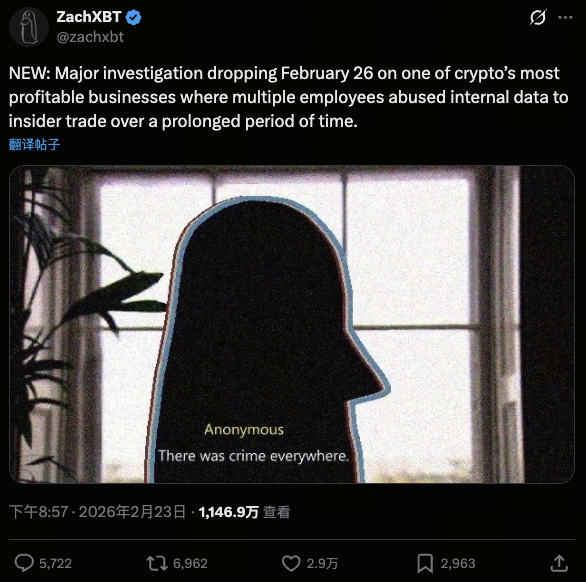
Source: https://x.com/zachxbt/status/2025917891678523644
ZachXBT initially withheld the investigation’s target, only stating that the report involved long-term insider trading through abuse of internal information. Given his track record of influencing project trajectories, the market quickly interpreted the teaser as a price-sensitive signal.
On Polymarket, prediction contracts on “Who will be investigated?” appeared rapidly, with funding reaching the multi-million dollar level.
When Axiom was ultimately disclosed as the subject, the shock stemmed not only from the platform’s size, but also from the investigation’s focus on internal privilege abuse and user data tracking.
Axiom’s Rise and Key Timeline
Axiom was founded by Mist and Cal in 2024. In winter 2025, the company joined the Y Combinator incubation program, quickly drawing industry attention.
Public data shows:
The platform’s total revenue exceeded $390 million
It is recognized as a high-profit, fast-growth trading platform
User base and market activity expanded rapidly
Timeline overview:
- Early 2025 — Initial signs of similar behavior emerged
- February 2026 — Audio recordings exposed internal profit schemes
- February 26, 2026 — Investigation report published
This timeline demonstrates that the behaviors under investigation were not isolated incidents, but ongoing structural issues.
From Individual Actions to Systemic Gaps: Dissecting Axiom’s Internal Privilege Issues
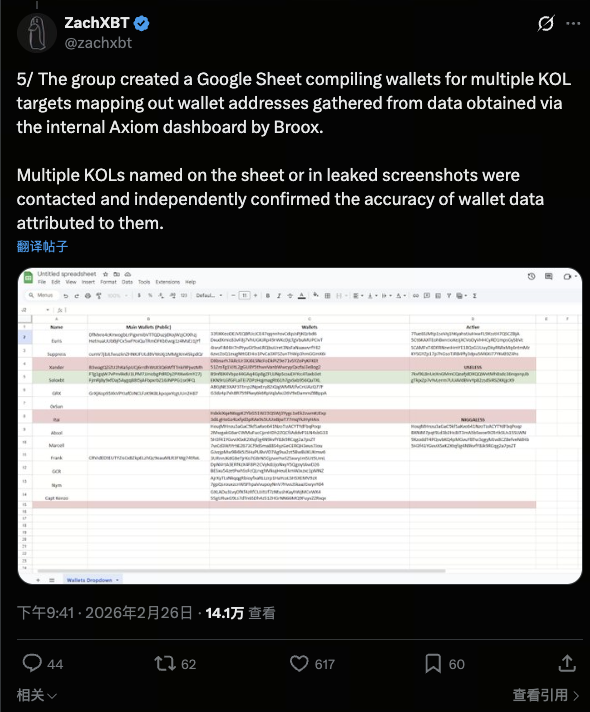
ZachXBT’s investigation pointed to systemic abuse of internal privileges at Axiom Exchange. Key personnel included Broox Bauer (Axiom Senior Business Development, New York), associated moderator Gowno (Seb, recently hired), BD employee Ryan, and moderator Mystery (believed to be part of the group).
Abuse Methods and Key Evidence:
Direct Query and Screenshots: Broox admitted to using the internal dashboard since early 2025 to query and track private wallets, sharing dashboard screenshots with the group that displayed private wallets and registration info for traders like “Jerry” and “Monix.”
Data Cataloging and Sharing: The group compiled key KOLs and target wallets in Google Sheets for centralized tracking and coordinated action.
Strategic Target Selection: They prioritized high-value private wallets with minimal address reuse (e.g., traders using private wallets for large buys before promoting meme coins), linking these on-chain behaviors to site UID, referral codes, and nicknames to generate actionable intelligence.
Live Trading Profit Chain: Broox presented screenshots of his exchange balance, and the investigation showed his main fund flows corresponded to specific centralized exchange (CEX) deposit addresses.
Circumventing Existing Rules: The involved personnel used internal tools to identify behavioral patterns (such as accounts buying and promoting meme coins like “AURA”), then pre-positioned externally or through associated accounts, converting internal visibility into trading advantage (example target profit: around $200,000).
Structural Vulnerabilities and Governance Deficiencies: As a fast-growing exchange (from Y Combinator’s incubation), Axiom revealed critical governance weaknesses during rapid expansion. BD/moderator and other non-technical roles could directly access aggregated views mapping UID⇄wallet addresses, deposit/withdrawal paths, transaction history, and behavioral tags. The platform lacked strict access control, immutable operation logs, and query alerts, making the combination of “data access privileges + tradable market assets” highly lucrative for arbitrage.
Legal and Compliance Risk Notice: With evidence pointing to sustained, coordinated internal queries and live trading profit models, ZachXBT advised Axiom’s founders to initiate an independent investigation and consider legal action, potentially involving the U.S. Attorney’s Office for the Southern District of New York (SDNY). As of now, the Axiom team has been contacted and responded, but has not explicitly denied the abuses revealed in the investigation.
Reviewing the Investigation Narrative and Evidence Strength
Key evidence disclosed so far includes:
In crypto, on-chain data is transparent, but internal platform privilege actions are often not fully public.
Authenticity assessment will depend on:
Whether the platform conducts a public audit
Whether an independent investigation is launched
Whether privilege logs are disclosed
The persuasiveness of the investigation ultimately depends on verifiability.
Historical Cases of Internal Privilege Abuse and Governance Failure in Crypto
To assess this controversy’s place in the industry, it is necessary to review representative cases involving internal privilege abuse, information asymmetry, or governance failure in crypto.
| Institution |
Year |
Roles Involved |
Source of Information Advantage |
Abuse Method |
Consequences and Impact |
| Coinbase |
2022 |
Product Manager |
Pre-launch token lists |
Leaked upcoming asset information to friends and family, bought in advance for profit |
U.S. Department of Justice prosecution, first criminal case of crypto insider trading |
| OpenSea |
2021 |
Product Lead |
NFT homepage recommendation mechanism |
Bought relevant NFTs before recommendation, sold after exposure |
Criminal charges, company strengthened internal trading policies |
| FTX |
2022 |
Internal management/related market makers |
Risk parameters and liquidation mechanism privileges |
Alameda received special privileges and preferential treatment |
Collapse exposed internal control failures, triggered systemic crisis |
| BitMEX |
2020 |
Management |
Lack of compliance and risk control systems |
Insufficient KYC and compliance controls |
Executives prosecuted, increased regulatory scrutiny in the industry |
| Axiom Exchange |
2026 |
BD / moderator |
Internal dashboard, UID and wallet mapping |
Queried sensitive user data and conducted insider trading (allegation phase) |
Currently under investigation and public scrutiny |
These cases illustrate that different institutions and business models share similar structural logic: when internal information advantages combine with tradable assets, lack of effective separation and audit mechanisms creates opportunities for insider arbitrage.
Whether it’s token launch lists, homepage traffic allocation, risk parameter settings, or wallet data mapping, the essence is “non-public but potentially price-sensitive” information. History repeatedly shows that issues often originate not just from individual actions, but from unclear privilege hierarchies, insufficient log audits, or lack of employee trading restrictions within the institutional environment.
Whether the Axiom incident enters the legal realm remains to be seen. However, past experience shows that neglecting internal controls during expansion cycles leads to long-term costs outweighing short-term gains. The true significance lies not in the outcome of a single case, but in whether it drives adoption of more mature governance and compliance frameworks.
Stress Test for Industry Trust Mechanisms
The core impact of this event is whether trading platform internal governance is strong enough to prevent employee-level insider trading.
Compared to traditional finance, crypto:
Has uneven regulatory coverage
Lacks unified audit standards
Varies in compliance maturity
If users believe internal staff can track their wallets and trade against their positions, trust costs will rise sharply. This affects not only a single platform, but may extend to:
The reputation of centralized exchanges
Data access privilege management standards
Industry self-regulation mechanisms
Amplification Effects of Prediction Markets and Information Pricing Dynamics
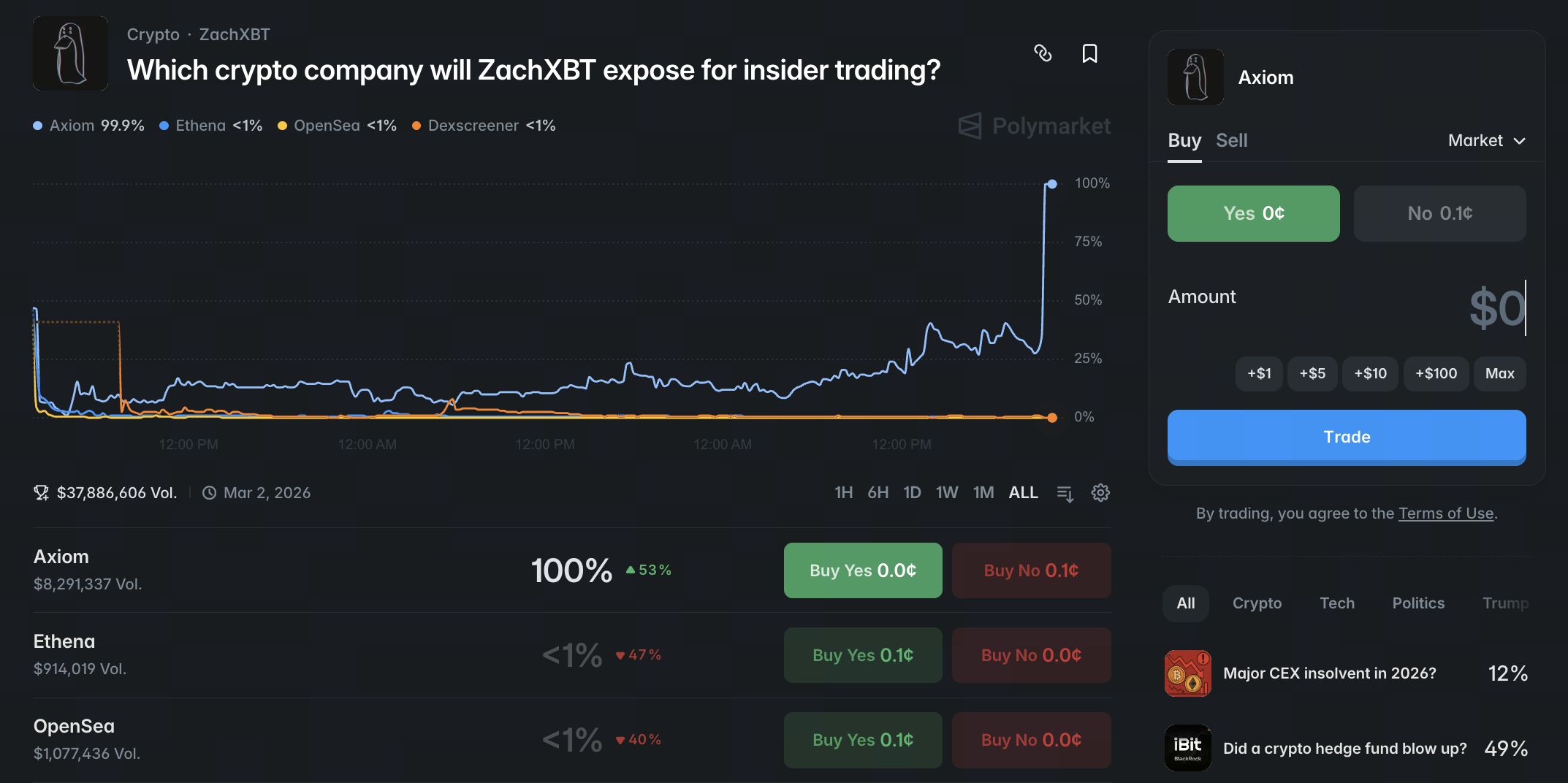
Source: Polymarket
In this incident, prediction market platform Polymarket acted as an amplifier. After ZachXBT released the teaser, the market quickly launched a contract titled “Which crypto company will ZachXBT expose for insider trading?” allowing users to bet on the target to be disclosed on February 26, 2026. Choices included Axiom, Meteora, Pump.fun, Jupiter, MEXC, and others. In a short period, contract trading volume surged to millions of dollars (some stats showed even higher peaks), with Axiom’s implied probability fluctuating between 8%–40%, while Meteora briefly led at around 43%.
This dynamic was not simply a “guessing game.” Prediction market price changes influenced secondary market sentiment—before the investigation results were announced, tokens of platforms listed as high-probability targets experienced downward pressure. When ZachXBT officially named Axiom, the contract settled to 100%, and prior probability fluctuations were validated as expectations driven by real capital.
Mechanistically, this created a rare feedback loop: investigation teaser → prediction market bets → probability changes influence market sentiment → sentiment shapes public focus. Prediction markets are intended to price future information, but in high-profile events like this, their prices become new information sources. While there is currently no evidence of bets placed using advance information, this structure inherently amplifies the trading value of “semi-public information” and provides a real-world example of the boundary between information disclosure pace and market fairness.
Where Is the Axiom Incident Headed?
The outcome of this turmoil remains open-ended.
- If Axiom proactively brings in third-party independent audits, publicly discloses privilege usage records, and takes clear action against those involved, the incident may turn from a crisis into an opportunity for governance improvement;
- If the platform denies the allegations and both sides engage in prolonged disputes over evidence, the controversy may temporarily erode market trust;
- If the issue crosses borders or compliance boundaries, regulatory intervention cannot be ruled out.
Over the longer term, regardless of how the case is defined, this event may prompt the industry to re-examine privilege hierarchies, behavioral log audits, and employee trading restrictions, driving centralized exchange governance toward greater transparency and standardization.
Conclusion
The Axiom incident is not merely a dispute over employee misconduct. It exposes a structural issue: in a crypto environment with highly concentrated data and fluid trading, how should boundaries between internal privileges and market behavior be defined? The real key is not just the outcome, but whether crypto trading platforms can build robust internal checks and transparent mechanisms while pursuing high-profit growth.
This turmoil may be only just beginning.







