High TPS (transactions per second) signals scalability, but each additional transaction increases the burden on nodes responsible for maintaining network decentralization.
TPS is widely used as a performance metric for blockchains, yet this figure alone does not accurately represent the network’s true scalability.
Psy Protocol founder and former hacker Carter Feldman explained to Cointelegraph that TPS statistics can be misleading because they ignore how transactions are actually validated and propagated in decentralized systems.
“Many pre-mainnet tests, testnets, or isolated environments measure TPS with just a single node. In those scenarios, you could even claim Instagram is a blockchain capable of 10 billion TPS, since a centralized authority validates all API calls,” Feldman said.
This issue partly arises from the design philosophy of most blockchains. As networks aim for higher speeds, each node’s workload increases, making decentralization more challenging. By separating transaction execution from validation, it’s possible to reduce this burden to a certain extent.
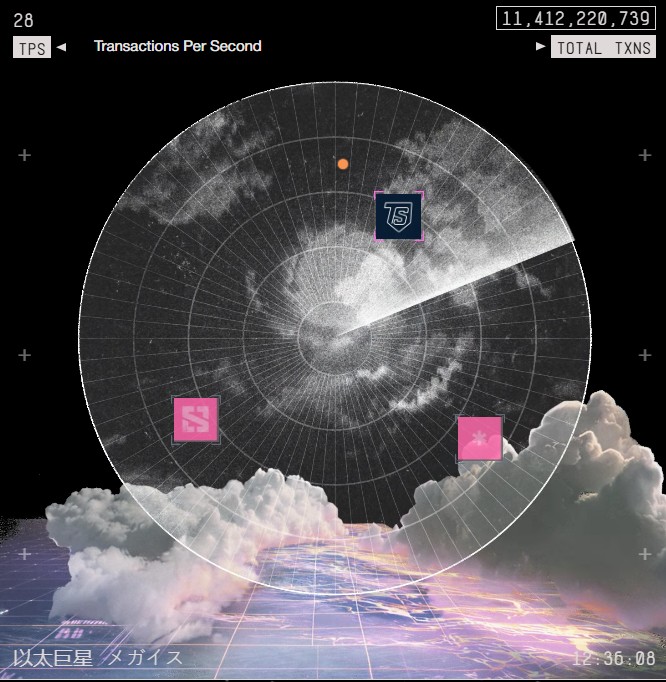
New projects promote high TPS, but actual network usage rarely reaches the stated maximum. Source: MegaETH
TPS Ignores the Cost of Decentralization
TPS can serve as a valid benchmark for blockchain performance—the higher the TPS, the greater the network’s capacity for real-world usage.
Yet Feldman argues that most headline TPS numbers are idealized and difficult to map onto actual mainnet throughput. Eye-catching statistics do not reflect how systems perform in decentralized environments.
“TPS measured on a virtual machine or single node does not represent the real performance of a blockchain mainnet,” Feldman said.
“Still, the number of transactions a blockchain can process per second in production is a practical way to assess its scalability—that’s the essence of scaling.”
Every full node must verify whether transactions comply with protocol rules. If one node accepts an invalid transaction, others should reject it. This is fundamental to operating a decentralized ledger.
Blockchain performance typically measures the speed of virtual machine transaction execution, but in real-world conditions, bandwidth, latency, and network topology are just as critical. Ultimately, performance depends on how efficiently transactions are received and validated by other nodes across the network.
Consequently, TPS figures published in whitepapers often diverge significantly from mainnet performance. Tests that isolate execution from propagation and validation costs mostly measure virtual machine speed, not blockchain scalability.
EOS, where Feldman served as a block producer, set historic records during its initial token offering. Its whitepaper claimed a theoretical TPS of 1 million—a figure that would stand out even in 2026.
EOS never reached its theoretical TPS target. Early reports suggested it could process 4,000 transactions per second in ideal conditions. However, Whiteblock’s research indicated its real-world throughput was only about 50 TPS.
In 2023, Jump Crypto demonstrated Solana’s validator client Firedancer, achieving the 1 million TPS test benchmark that EOS never reached. Many validators now run its hybrid version, Frankendancer. In real-world conditions, Solana typically processes 3,000–4,000 transactions per second, with roughly 40% being non-vote transactions—better reflecting genuine user activity.
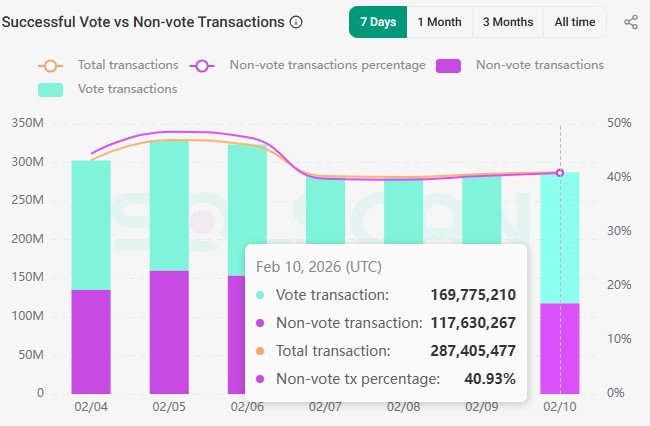
On February 10, Solana’s non-vote transaction TPS was 1,361. Source: Solscan
Breaking the Linear Scaling Dilemma
Blockchain throughput usually grows linearly with workload. More transactions increase activity, but also require each node to receive and validate more data.
Each additional transaction raises the computational burden. At a certain point, unless decentralization is compromised, bandwidth, hardware, and synchronization latency will make continued linear scaling unsustainable.
Feldman says overcoming this limitation requires rethinking validity proofs—such as through zero-knowledge (ZK) technology. ZK enables proof of a batch of transactions without forcing every node to rerun them. Because it allows verification without exposing all data, ZK is also considered a privacy solution.
Feldman believes recursive ZK proofs can help solve scalability challenges. In essence, this means using one proof to validate other proofs.
“You can combine two ZK proofs into a new ZK proof that validates the correctness of the previous two,” Feldman said. “So, you can merge two proofs into one.”
“For instance, with 16 users’ transactions, you can turn them into 8 proofs, then combine those 8 into 4 proofs,” Feldman explained, demonstrating a multi-layer proof tree diagram that ultimately converges into one proof.
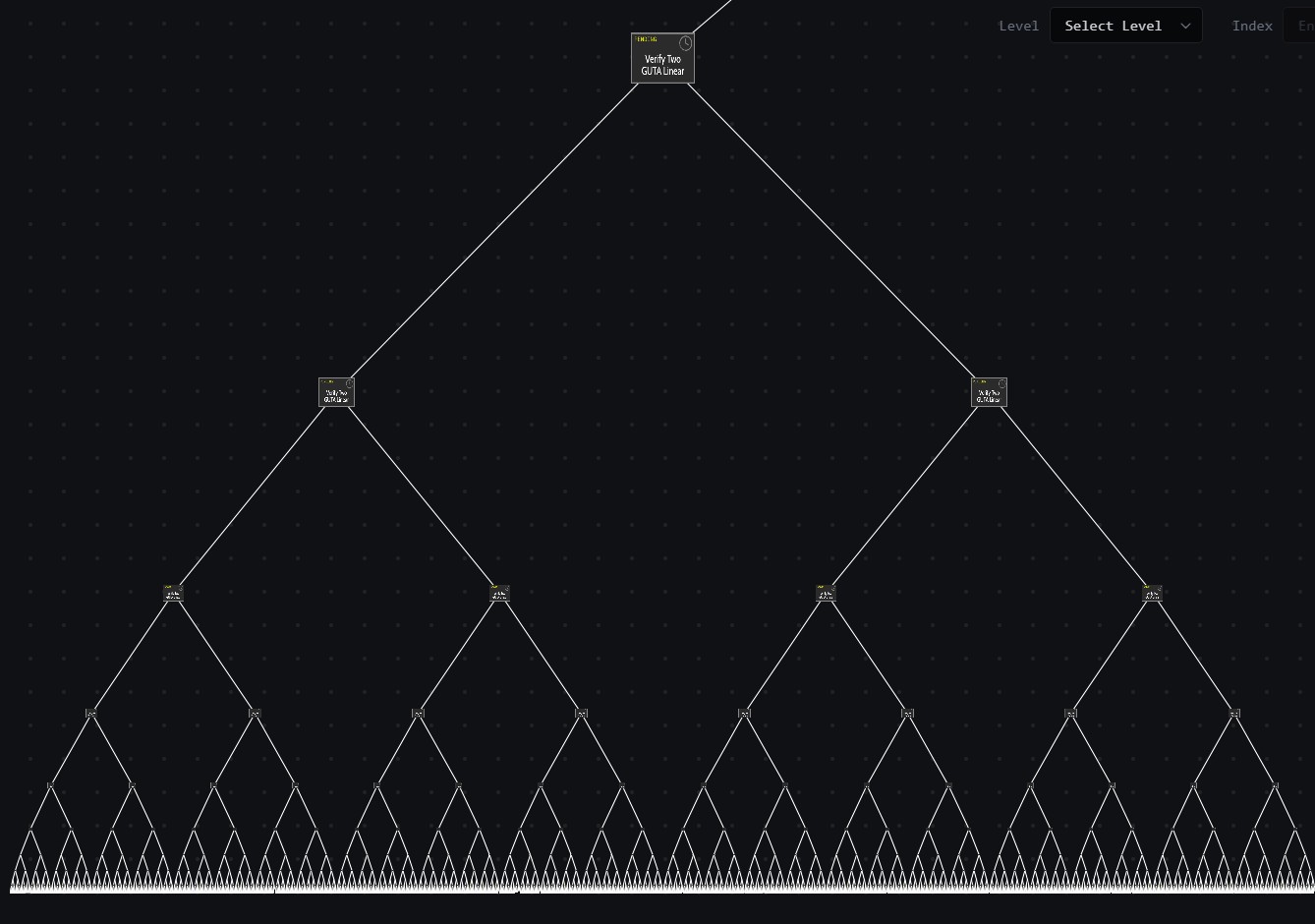
How multiple proofs are merged into one. Source: Psy/Carter Feldman
In traditional blockchain architectures, increasing TPS raises each node’s requirements for validation and bandwidth. Feldman notes that proof-based architectures allow throughput to increase without proportionally boosting node validation loads.
This does not mean ZK removes all scaling trade-offs. Proof generation is computationally intensive and may require specialized infrastructure. Validation becomes cheaper for ordinary nodes, but the heavy lifting shifts to provers handling complex cryptography. Integrating proof-based validation into existing blockchain architectures is challenging, which explains why mainstream networks still rely on traditional execution models.
Beyond Pure Throughput: Measuring Performance
TPS is not irrelevant, but its value depends on context. Feldman notes that economic signals—such as transaction fees—provide clearer insight into network health and demand than pure throughput.
“I think TPS can be the second most important metric for blockchain performance, but only in production, or when transactions are not just processed but also forwarded and validated by other nodes,” he said.

LayerZero Labs introduced the Zero chain, claiming ZK technology enables scaling up to 2 million TPS. Source: LayerZero
The mainstream blockchain architectures also influence investor decisions. Sequential execution chains are difficult to migrate to proof-based validation without a complete redesign of transaction processing.
“Initially, almost all funding went only to ZK EVM (Ethereum Virtual Machine projects),” Feldman explained, describing Psy Protocol’s early funding challenges.
“No one wanted to invest because it was so time-consuming. You can’t simply ‘fork’ the EVM or its state storage, since everything is handled completely differently.”
In most blockchains, higher TPS means greater load for each node. A single high metric does not imply this load is sustainable.
Disclaimer:
- This article is republished from [Cointelegraph]. Copyright belongs to the original author [Yohan Yu]. If you have any concerns about this republication, please contact the Gate Learn team, who will handle the matter promptly according to relevant procedures.
- Disclaimer: The views and opinions expressed in this article are solely those of the author and do not constitute investment advice.
- Other language versions of this article are translated by the Gate Learn team. Without mentioning Gate, translated articles may not be copied, distributed, or plagiarized.







