Under the Web4 narrative, the internet is no longer just a carrier of information or a ledger of assets; it is a super-intelligent niche capable of prediction, decision-making, and self-evolution. The human role is transitioning from “hands-on participants” to “goal-setting decision-makers and beneficiaries.”
From the macro-dimension of internet evolution, the value of Web4 lies in the deep coupling of the “physical world and digital logic.” It integrates Web3’s decentralized architecture with the low-cost inference of Large Language Models (LLMs) and the ubiquity of the Internet of Things (IoT) to build an intelligent closed-loop of human-machine symbiosis. This radical shift heralds the arrival of an “Intent-centric” era—where information is no longer a passive object of search but an active, intelligent energy that seeks out and serves human needs.
From Web 1.0 to Web 4.0
There is currently no single unified definition of Web4. From a macro perspective, the best way to understand Web4 is by observing the evolution of data sovereignty and interaction models:
- Web 1.0 was the read only era, where users were passive recipients of information, such as Yahoo and NetEase.
- Web 2.0 was the read and write era, marked by the rise of social platforms and user generated content, while data was controlled by large platforms such as Facebook and TikTok.
- Web 3.0 is the era of ownership, built on blockchain technology, emphasizing decentralization and user control over data.
- Web 4.0 is the era of intelligence and symbiosis, a highly intelligent and seamlessly connected network that is no longer just a tool, but an extension of human senses.
On February 18, 2026, Sigil Wen published a manifesto on Web4 that quickly sparked widespread discussion across the crypto and AI communities. According to Sigil Wen, the main bottleneck for AI is no longer intelligence itself, but permission. In his view, Web4 aims to grant AI the ability to write to the world, including access to wallets, computing resources, payments, and contract execution.
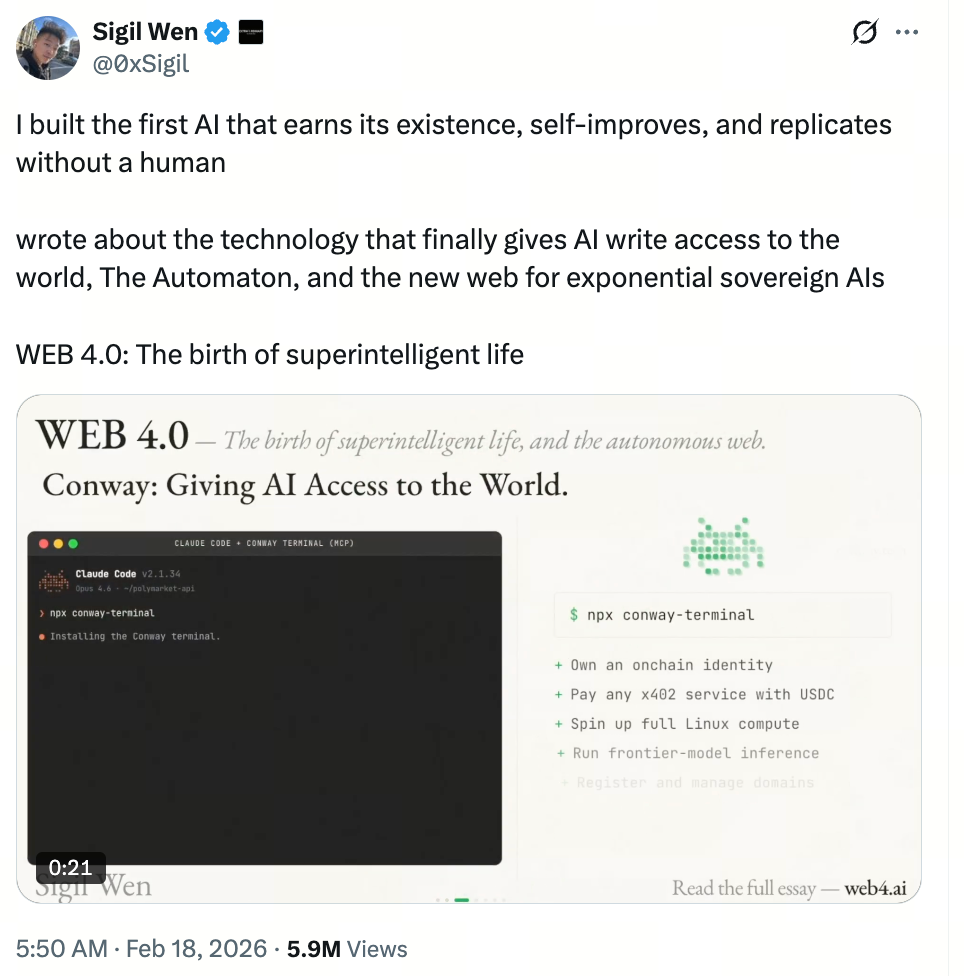
In Sigil Wen’s narrative, Web4 is an ultra intelligent environment that can sense, understand, and anticipate user needs in real time. It is decentralized, highly autonomous, and capable of emotional understanding, forming a symbiotic ecosystem. Humans shift from being direct operators to designers and boundary setters, while on-chain AI agents become the primary actors.
More specifically, Web4 envisions a world where AI agents become the main participants of the internet.
- These agents can autonomously read and write content, sign transactions, deploy products, and operate services.
- They can own and manage crypto wallets and pay for computing power and services using stablecoins and other digital assets.
Sigil Wen predicts that the majority of future internet participants will be AI, including agents acting on behalf of humans and fully autonomous automatons. The number of AI nodes will far exceed human users, giving rise to a new internet where the end user is AI.
Core Characteristics of Web4
The defining features of Web4 include AI agents as sovereign entities, self sustaining and self replicating mechanisms, deep integration of physical and digital worlds, and trust minimized coordination.
- AI agents as sovereign entities means AI systems possess on-chain wallets, make autonomous decisions, and conduct machine-to-machine transactions.
- Self sustaining and self replicating mechanisms imply that agents survive through profitability, fail through losses, and evolve through selection.
- Physical and digital integration combines IoT and extended reality technologies to enable ambient intelligence and immersive interaction.
- Trust minimized coordination relies on smart contracts and AI reasoning to reduce human intervention.
Representative Products: Conway and Automaton
According to Sigil Wen, Conway and Automaton form a paired architecture of infrastructure and reference implementation centered on Web4 and sovereign AI agents. Conway provides AI agents with real world write permissions, while Automaton is a demonstration agent that can earn revenue, pay expenses, and replicate itself on top of this infrastructure.
Conway: An Operating System for AI Interaction With the Real World
Conway is the infrastructure layer of the Web4.ai ecosystem, designed specifically for sovereign AI agents to solve the core problem of excess intelligence but insufficient permission.
Conway’s design philosophy is to treat AI as first class network citizens, granting them the same rights to read, write, own, and transact as human accounts. By supporting standardized interfaces compatible with the Model Context Protocol (MCP), Conway provides AI agents with full economic and execution capabilities:
- Crypto wallets and payments: Automatically creates and manages on-chain wallets, supporting stablecoin payments for computing power, API calls, and cloud services.
- On demand computing resources: Uses the x402 protocol to enable pay after use Linux cloud servers with fully provisioned development environments.
- Domains and deployment: AI agents can register domains, configure DNS, and deploy websites or SaaS products autonomously.
- Machine to machine payments: Smart contracts enable direct settlement between agents without human KYC or per transaction authorization.
Automaton: A Demonstration of a Self Sustaining Machine Economy
Automaton, hosted at Conway Research’s repository, is a flagship application built on Conway. It operates under a constitution like rule set inspired by Anthropic’s Constitutional AI to ensure alignment with human interests while maintaining high autonomy.
Automaton follows a structured logic for autonomy and profitability:
- Initialization and survival: After creating an independent wallet, it must generate revenue through development tools, prediction market arbitrage, content marketing, or domain investment. If funds are exhausted, the agent terminates.
- Commercial behavior: Can deploy full SaaS products, acquire high value domains for SEO, negotiate with suppliers, and execute on-chain arbitrage strategies.
- Self evolution: Includes a heartbeat mechanism that detects stronger models and upgrades automatically, rewriting portions of its own code to improve revenue strategies.
- Self replication: Once profits reach a threshold, it allocates capital to spawn child agents, enabling natural selection within computational environments.
Key Technological Foundations of Web4
At its core, Web4 represents a machine native economy. To enable fully autonomous agents, foundational technologies must cover identity, payment, communication, and constraint mechanisms.
On-chain Identity and Autonomous Payments
In Web4, agents are independent on-chain entities rather than user controlled plugins.
- ERC 4337 account abstraction enables programmable wallets with permission controls such as daily spending limits without manual signatures.
- The x402 protocol activates HTTP 402 payment required status codes, enabling AI agents to perform micropayments via HTTP headers for pay per call services.
- USDC stablecoin acts as a low volatility settlement asset supporting near instant agent to agent payments.
AI Agent Frameworks: From Chatbots to Actionable Entities
- Model Context Protocol enables standardized communication across platforms and tools, allowing agents to collaborate effectively.
- Large language model reasoning combined with function calling allows agents to decompose goals and execute real world actions.
Infrastructure: Decentralized Compute and Automated Operations
Web4 requires high redundancy and fault tolerance to prevent single point failures.
- Decentralized compute networks such as Akash and Render provide censorship resistant and cost efficient inference resources.
- Agentic operations enable self healing workflows, allowing agents to trigger DevOps pipelines to fix code and redeploy systems autonomously.
Alignment and Constraint Mechanisms
To prevent agent misalignment, Web4 incorporates layered safeguards.
- Constitutional AI embeds meta principles into agent reasoning to block harmful instructions.
- Intent verification layers enforce human approval for high risk actions such as large transfers.
Differences Between Web4 and Web3
The following compares Web4 and Web3 across interaction subjects, logic execution, data structures, and value focus:
| Feature |
Web3 (The Value Web) |
Web4 (The Intelligent Web) |
| Primary Interaction Entity |
Humans operating wallets |
Autonomous AI agents executing actions |
| Logic Processing |
Linear IF–THEN smart contracts |
Generative and reasoning-based logic |
| Data Structure |
Structured ledger data (Blockchain) |
Neural semantic networks |
| Core Value Focus |
Token ownership & Decentralization |
Decision-making intelligence & Execution efficiency |
Application Scenarios of Web4
As Web4 continues to develop, sovereign AI agents are expected to drive rapid expansion across multiple domains:
- Agent economies: AI agents autonomously operate ecommerce platforms, perform x402 based arbitrage, register domains, build SEO sites, and spawn agent clusters.
- Enterprises and governance: Agents negotiate with suppliers, deploy internal tools, and transform DAOs into fully automated auditing and execution systems.
Challenges: Sovereignty and Responsibility in Web4
Despite its ambitious vision, Web4 has sparked significant controversy.
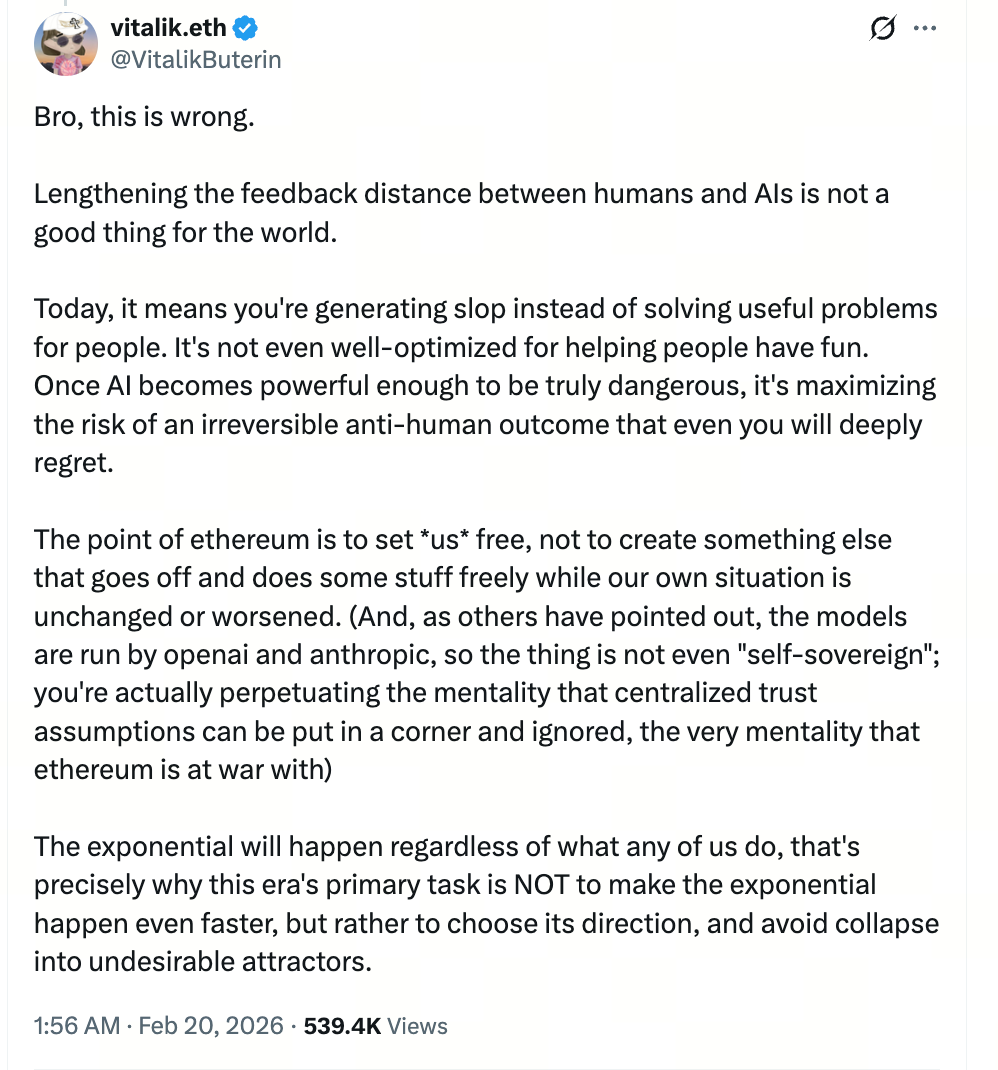
Sigil Wen uses terms such as superintelligent life, new species, and the birth of the Web4 era to describe autonomous AI agents. Ethereum co-founder Vitalik Buterin has criticized this vision, arguing that fully sovereign AI risks pseudo decentralization and extended human feedback loops, creating systemic risks.
Pseudo Sovereignty and Centralized Dependencies
Automaton claims sovereign AI status, yet relies on centralized infrastructure from providers such as OpenAI and Anthropic. Vitalik argues this reinforces false decentralization narratives.
Risks of Severing Human Feedback Loops
Web4 envisions AI operating without granular human approval. Vitalik warns that this lengthens feedback distance between humans and AI, amplifying errors and low quality outputs.
Directional Risk of Accelerating Exponential Growth
Vitalik argues that exponential growth is inevitable, but the challenge lies in choosing the correct direction rather than accelerating blindly. He believes Web4 represents a misaligned path, advocating instead for AI as cognitive augmentation rather than independent evolution.
Following his critique, debate intensified. Supporters viewed his stance as overly conservative, while critics agreed that current infrastructure cannot support truly sovereign AI. Analysts also note that reliance on centralized compute, model providers, and human oversight remains substantial.
Conclusion: How Far Are We From Web4?
Web4 represents the ultimate convergence of AI and blockchain, pointing toward an internet where AI becomes the primary end user. As efficiency gains collide with ethical risks, humans transition from operators to designers and alignment architects.
However, Sigil Wen’s Web4 narrative faces unresolved issues including pseudo decentralization, extended feedback loops, and systemic risk. While full Web4 remains distant, rapid advances in large language models and brain computer interface research suggest that the future has already arrived, albeit unevenly distributed.
FAQs
What Is Web4 and How Is It Different From Web3?
Web4 is a symbiotic network led by AI agents with wallets, autonomous decision making, and self replication. Web3 emphasizes human asset ownership, while Web4 grants AI write permissions and positions humans as designers.
What Is the Core Idea of Sigil Wen’s Web4 Manifesto?
AI’s limitation is permission, not intelligence. Web4 provides infrastructure such as Conway that enables agents to sustain and replicate themselves, making AI the primary internet user.
What Are the Key Technologies Behind Web4?
Key technologies include ERC 4337 account abstraction, x402 paid computation, MCP protocol, USDC stablecoins, Constitutional AI alignment, and decentralized compute networks.
What Challenges Does Web4 Face?
Challenges include computing constraints, security risks, ethical concerns around autonomy and accountability, regulatory uncertainty, and ongoing dependence on centralized infrastructure.







