Against the backdrop of a burgeoning “stablecoin payment chain” landscape, the birth of Stable marks a paradigm shift for stablecoins from single assets to independent financial infrastructure. As the global stablecoin market capitalization surpasses $300 billion, market demand for low-friction, predictable-cost payment networks has reached a peak. With over $2 billion in pre-deposits and the deep ecosystem support of Tether, Stable has rapidly become a cornerstone of the payment sector.
The value of Stable lies in its pioneering significance as a “stablecoin-native ecosystem,” representing a deep alignment of Web3 finance with traditional payment habits. By returning Gas fees to USD-denominated pricing and competing with zero-fee networks like Plasma, Stable is redefining the capital efficiency of on-chain transfers.

The Team and Investors Behind Stable
Stable is led by CEO Brian Mehler, who has experience in both traditional finance and the crypto industry. He joined Block.one in 2018 as Vice President of Investments and participated in the launch of the EOS fund. The project’s CTO is Sam Kazemian, who brings deep crypto industry experience as the founder of Frax Finance and a co founder of Everipedia.
On the funding side, Stable has received support from traditional financial institutions, crypto exchanges, top tier venture funds, and stablecoin issuers.
In July 2025, Stable announced the completion of a 28 million dollar seed round led by Bitfinex and Hack VC, with participation from Franklin Templeton, Castle Island Ventures, KuCoin Ventures, and angel investors including Tether CEO Paolo Ardoino and Braintree founder Bryan Johnson.
In September 2025, Stable disclosed a strategic investment from PayPal Ventures. As part of this partnership, the US dollar stablecoin PYUSD was introduced into the Stablechain ecosystem.
Key Highlights and Advantages of Stable
Stable positions itself as a high performance Layer 1 built for institutional settlement and B2B cross border payments, differentiating itself from general purpose blockchains by focusing on stablecoin payment pain points.
The most significant breakthrough is its USDT native gas mechanism. On most blockchains, users often cannot complete transfers because they lack the native gas token such as ETH or SOL. Stable removes this friction by allowing gas to be paid directly in USDT through USDT0, eliminating wrapping and unwrapping steps and providing clear payment certainty.
To match Web2 level user experience, Stable also offers gas free peer to peer transfers and sub second finality. User to user transfers can be completed at zero cost and confirmed within milliseconds, making the network suitable for retail payments and high frequency settlement.
For enterprise use cases, Stable focuses on predictable costs. Its fee structure allows merchants to accurately forecast operating expenses and avoid the gas fee spikes caused by congestion on traditional blockchains.
As a payment chain supported by Tether, the world’s largest stablecoin issuer, Stable benefits from natural liquidity advantages and institutional trust, strengthening its position in partnerships with global payment players such as PayPal.
How Does Stable Work?
According to official documentation, the Stable system architecture consists of several core components:
- Execution layer providing an EVM compatible smart contract environment
- Consensus layer enabling fast and secure transaction finality
- State management for efficient blockchain state storage and updates
- Network layer handling peer to peer communication and data propagation
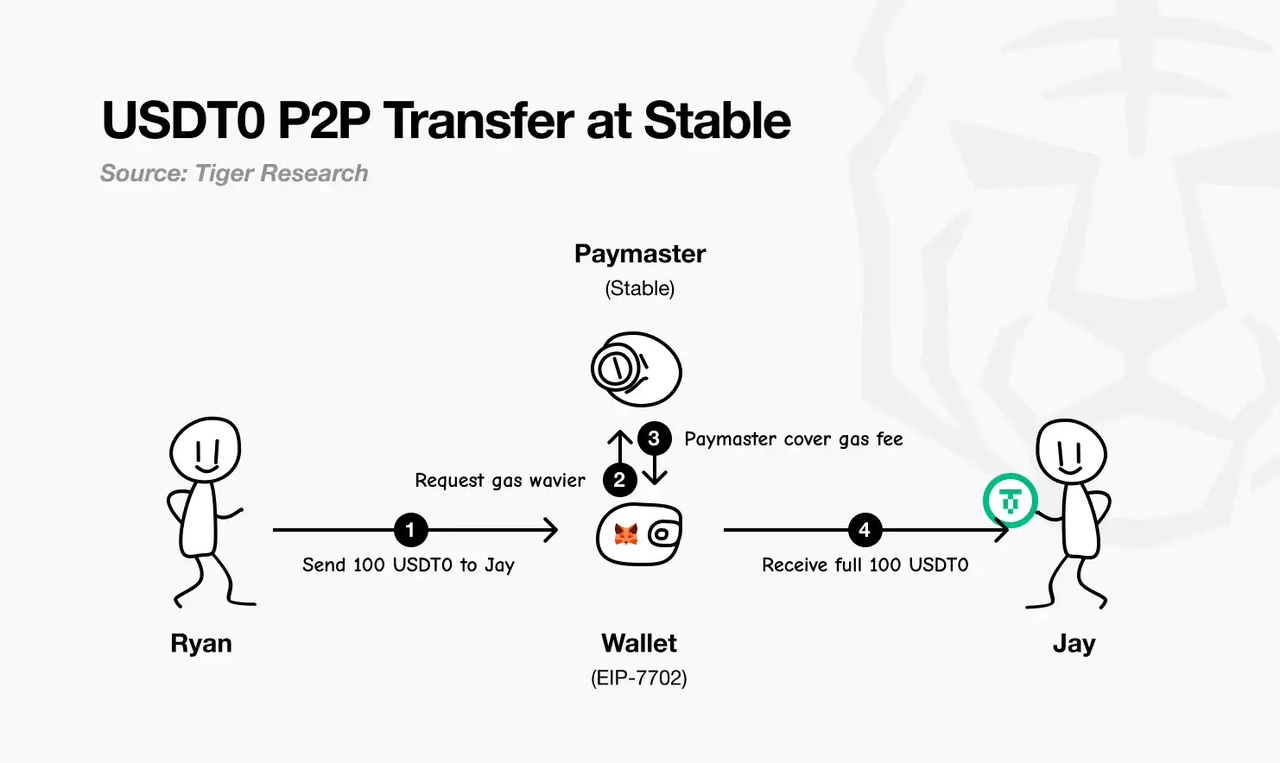
When a user initiates a transaction on Stable, the process follows a clear flow. The user sends or pays using USDT. A small amount of USDT is deducted directly from the transaction as gas. The transaction is confirmed and settled within sub second finality, and the result is final without waiting for multiple confirmations.
StableChain forms the technical foundation of the ecosystem. By combining StableBFT, a multi path remote procedure call architecture, and StableEVM, the network is optimized for payments and trading, supporting over ten thousand transactions per second.
Stable vs Plasma
Both Stable and Plasma are Layer 1 blockchains focused on stablecoin payments and supported by Tether, but they differ significantly in architecture, ecosystem focus, and backing. Stable emphasizes USDT native gas and payment certainty, while Plasma focuses on institutional yield and financial application integration.
| Dimension |
Stable |
Plasma |
| Core focus |
USDT focused payment chain |
High performance stablecoin chain |
| Technical emphasis |
Payment certainty and predictable costs |
Performance and EVM compatibility |
| Gas model |
USDT native gas upgraded to USDT0 |
Custom gas token (XPL) |
| Token market cap |
330 million USD |
180 million USD |
| Funding raised |
28 million USD |
75.83 million USD |
| Key supporters |
Bitfinex, Tether |
Founders Fund, Bitfinex |
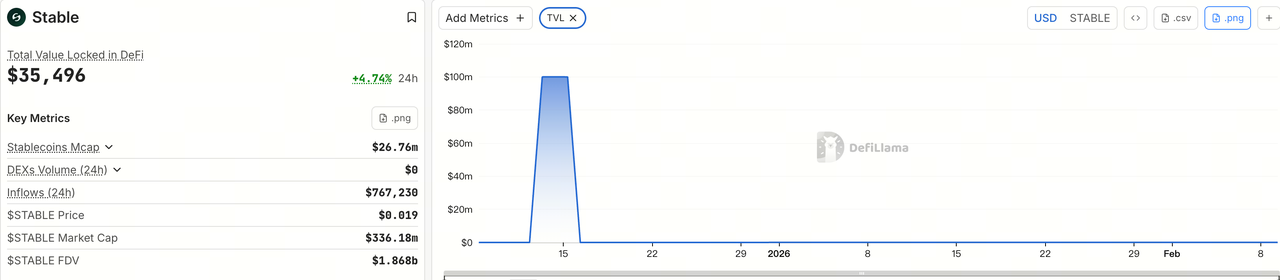
From an ecosystem perspective, Plasma currently leads. According to DeFiLlama data as of February 9, Plasma’s total value locked reached 2.9 billion USD, driven by deep integrations with protocols such as Aave, Pendle, and Fluid. Stable’s TVL, by contrast, is under 36 thousand USD.
In terms of capital support, the two projects show different profiles. Stable raised 28 million USD in its seed round, backed by exchanges and venture funds that provide targeted early liquidity. Plasma raised a cumulative 75.83 million USD across multiple rounds, giving it greater financial flexibility for aggressive ecosystem incentives.
What Is the STABLE Token?
STABLE is the governance token of the Stable mainnet and ecosystem. It is designed to align long term incentives among validators, developers, and users.
Importantly, STABLE is not used as the gas token. Its functions include protocol governance voting, validator staking and selection, and ecosystem incentives for developers and participants.
STABLE Tokenomics and Distribution
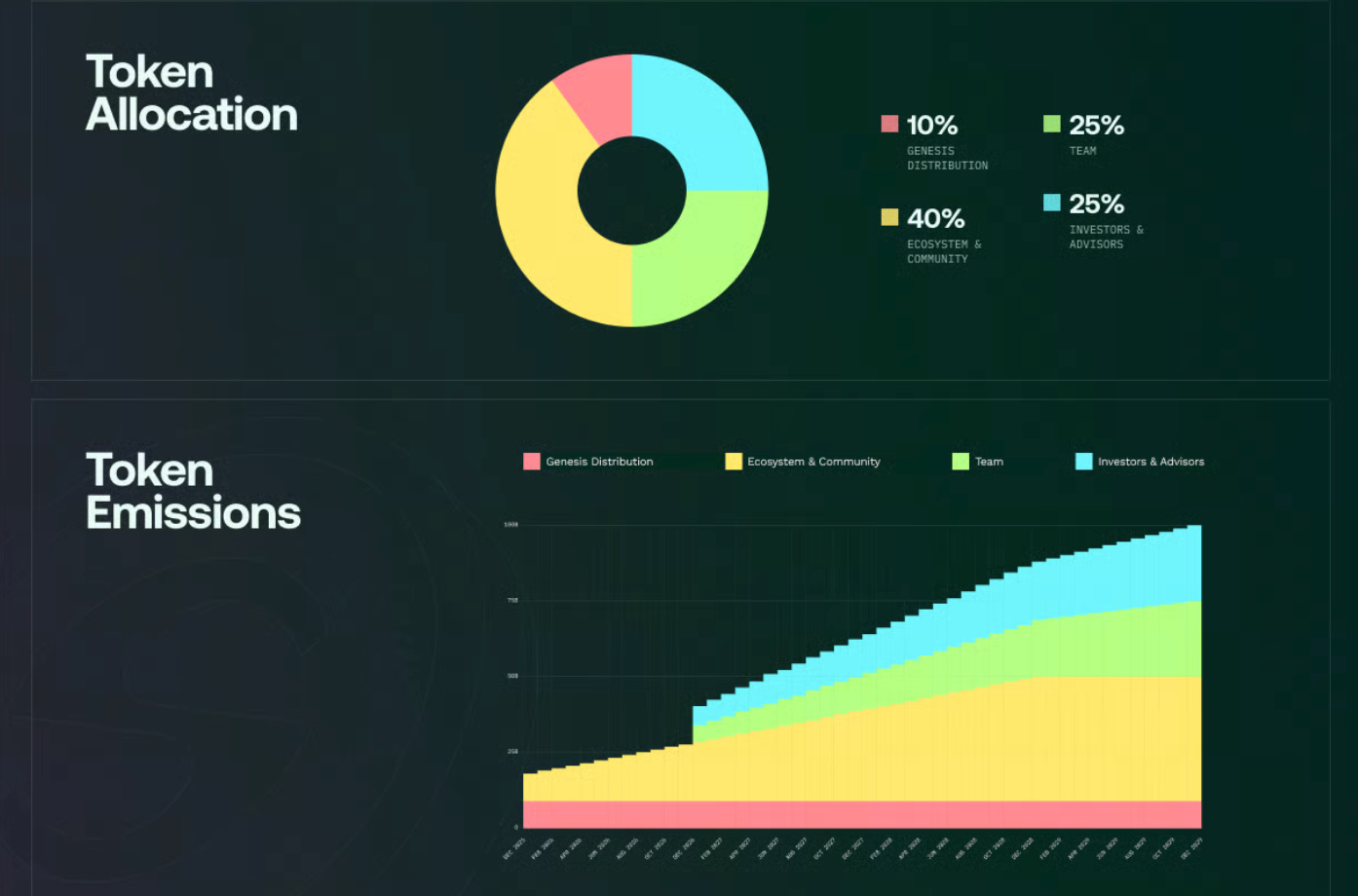
STABLE has a fixed total supply of 100 billion tokens. Its token design focuses on three goals: empowering a payment optimized Layer 1, supporting sustainable growth, and rewarding long term contributors.
The distribution is as follows:
- Investors and advisors: 25%
- Team: 25%
- Ecosystem and community: 40%
- Initial allocation: 10% for early incentives, exchange campaigns, and initial on-chain liquidity
How to Buy STABLE Tokens
As of February 9, 2026, STABLE is listed on centralized exchanges such as Bybit and Gate, and is also available on decentralized platforms including Uniswap and PancakeSwap.
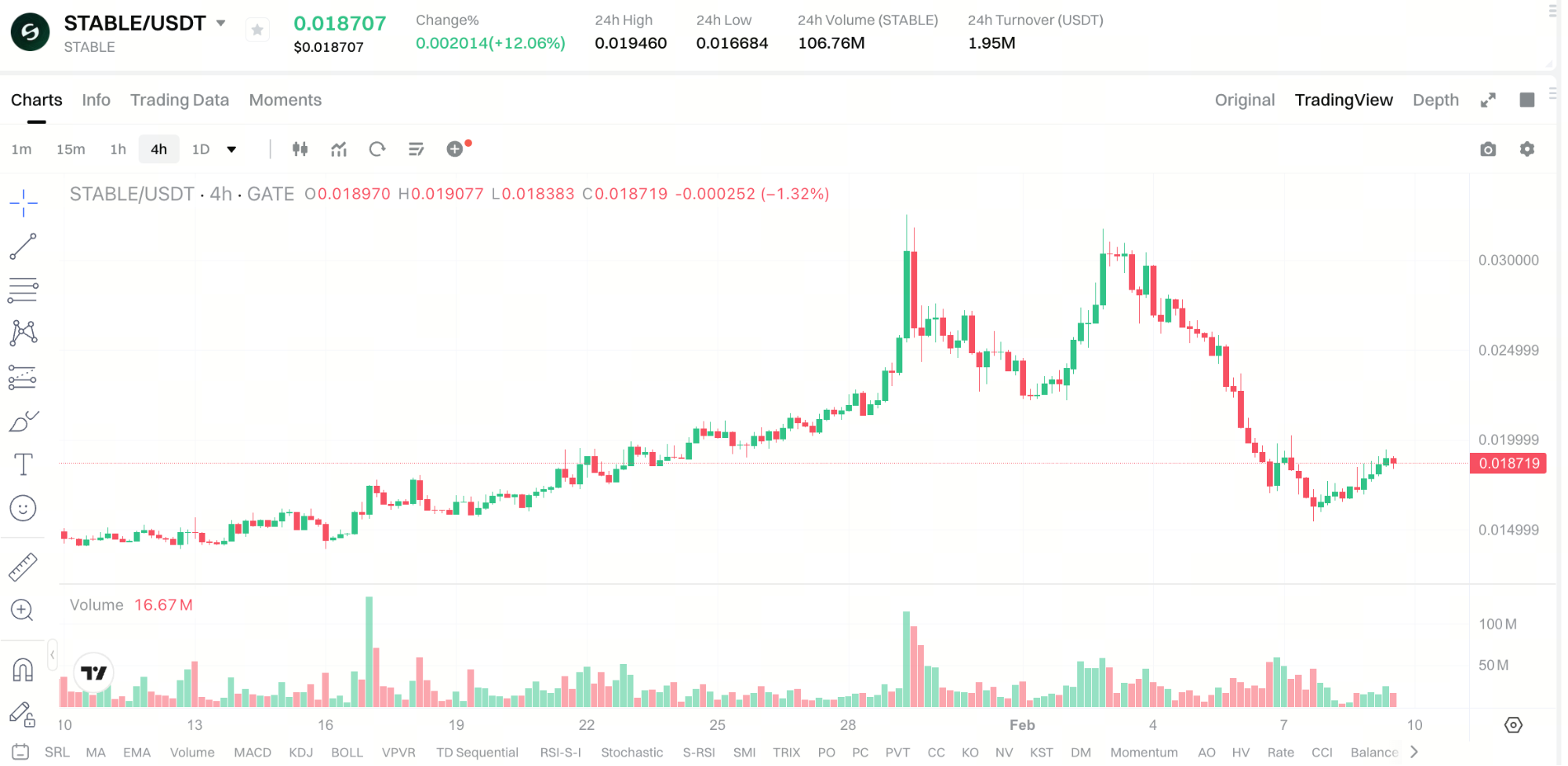
According to Gate, the current price of the STABLE token is 0.018 USD, with a 24-hour increase of 9 percent and a circulating market capitalization of 330 million USD. The specific trading steps are as follows:
- Register a Gate account and complete KYC verification
- Deposit USDT or other major cryptocurrencies
- Search for “STABLE” on the trading page
- Select the STABLE/USDT trading pair
- Enter the purchase amount and price, then place the order
- After purchase, users can withdraw the tokens to an on-chain wallet or store their STABLE tokens on the platform
Controversies and Risks
Since launch, Stable has faced community scrutiny. In October 2025, during the first deposit phase capped at 825 million USD, large deposits were observed before the official announcement. Ten whale addresses deposited around 600 million USD, all originating from a single wallet, raising concerns about insider participation. The team did not directly address these claims.
On November 6, 2025, the second deposit phase opened with a 500 million USD cap. Heavy traffic caused site slowdowns, extended review times, and repeated requests for documentation, leading to user dissatisfaction.
During recent market downturns, DeFi TVL across many chains declined. According to DeFiLlama, Stable’s TVL dropped to around 35,496 USD, attracting further attention.
Latest Developments and the 2026 Roadmap
Following mainnet launch and token airdrop in December, Stable’s recent progress has focused on technical upgrades, ecosystem integrations, and the launch of StablePay.
On January 23, Stable announced an upgrade to version 1.2.0 scheduled for February 4. This upgrade transitions the native gas asset to USDT0, removes wrapping processes, improves indexer staking observability, and enhances developer compatibility.
On January 26, PayPal backed stablecoin PYUSD launched on the Stable mainnet, expanding payment infrastructure.
According to the roadmap, Stable aims to reach over ten thousand transactions per second in Q2 while maintaining reliability, targeting adoption by financial institutions for settlement use cases.
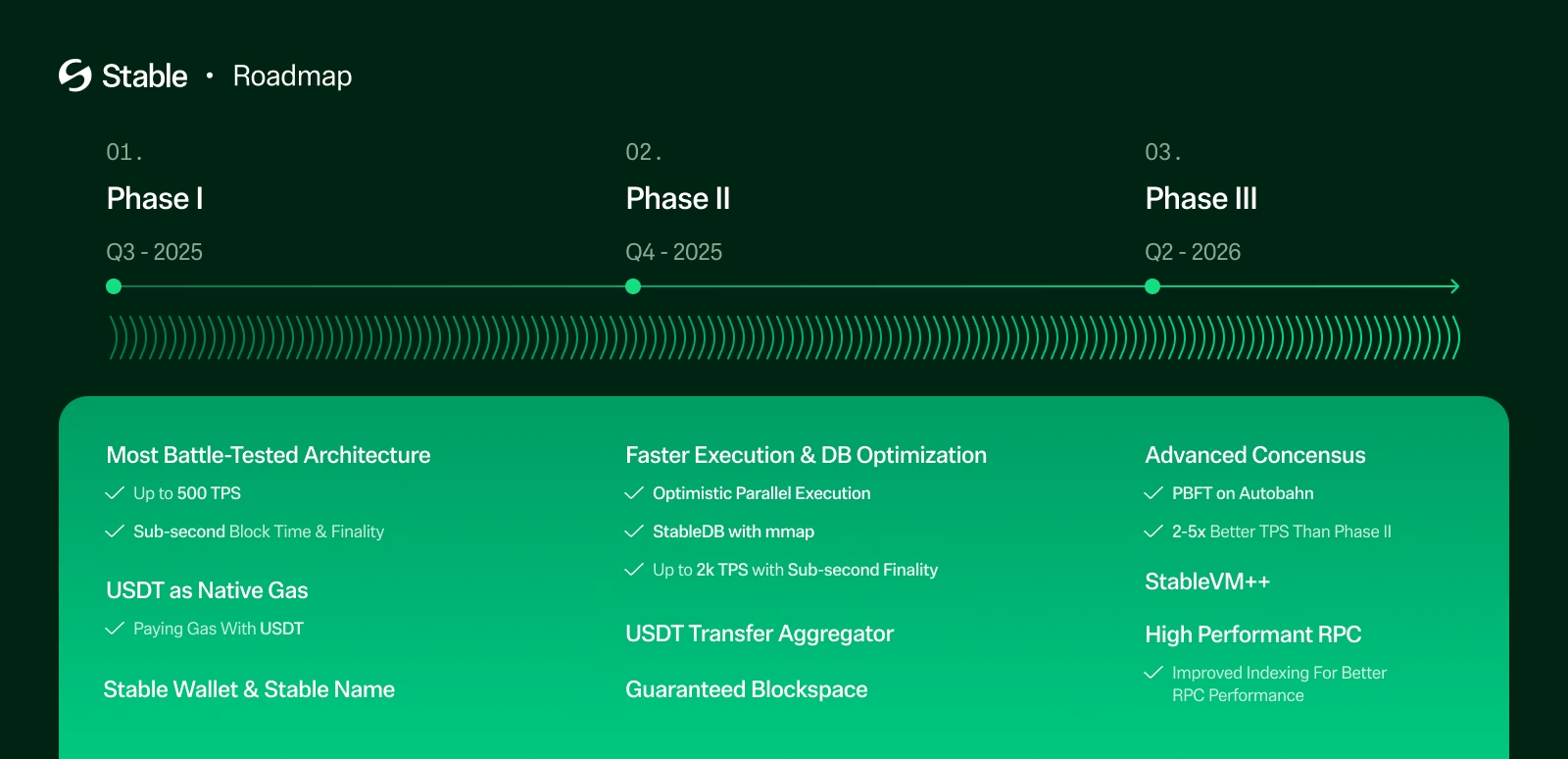
In 2026, StablePay will enter public testing and be officially released. Designed as a simple wallet for stablecoin native retail payments, it aims to let users and merchants send and receive stablecoins as easily as traditional payment apps.
Conclusion
Stable’s strategy is clear. It does not aim to become a full featured DeFi ecosystem. Instead, it focuses on maximizing payment certainty.
While Stable lags behind Plasma in terms of TVL and capital scale, it reflects a broader trend toward specialized blockchain infrastructure. Although its ecosystem is currently smaller and post airdrop momentum has cooled, Stable’s focused payment positioning and strong institutional backing give it advantages in specific verticals. In 2026, the pace of ecosystem development and institutional adoption will be key indicators of Stable’s success.
FAQs
What is the relationship between Stable and Tether?
Stable has received official investment and support from Tether and uses USDT as its native gas asset, making it an important part of the Tether ecosystem.
How can users participate in the Stable ecosystem today?
The deposit campaigns and airdrops have concluded. Users can follow new operational activities, participate through holding or trading STABLE tokens, or engage with upcoming ecosystem applications.
How is StableChain different from other stablecoin Layer 1 blockchains?
StableChain is backed by Tether and optimized for institutional payments. It uses USDT native gas, provides sub second finality, and supports gas free peer to peer transfers, prioritizing payment certainty over generalized DeFi functionality.







