As DeFi matures, the industry is moving away from competition among individual protocols toward ecosystem-level rivalry. Many projects now focus on achieving greater scalability, governance efficiency, and composability while maintaining decentralization. Against this backdrop, Sky has emerged by introducing a modular protocol architecture and layered ecosystem design that enables various DeFi services to integrate and evolve as “subsystems.”
Looking at the broader blockchain landscape, Sky is more than just a new DeFi protocol—it’s a new model for financial infrastructure. By decoupling governance, liquidity, and functional modules, Sky aims to function as an on-chain financial operating system, enabling lending, stablecoins, yield strategies, asset management, and more, all within a unified ecosystem.
Sky Protocol: Background and Core Positioning
 Image source: Sky official website
Sky Protocol positions itself as a modular DeFi ecosystem infrastructure, allowing diverse financial applications to operate collaboratively under a unified protocol framework.
In recent years, DeFi has evolved from single-protocol models to complex multi-protocol systems. Lending, DEXs, stablecoins, and yield aggregators now form a comprehensive financial stack. However, most of these protocols are developed independently, leading to fragmented liquidity, scattered governance, and inconsistent technical standards.
Sky Protocol is designed to solve these challenges. By creating a unified foundational protocol and modular ecosystem architecture, Sky lets developers build diverse financial modules that share core governance and liquidity resources.
This approach makes Sky more of a financial platform than a standalone product.
How Sky Protocol Works
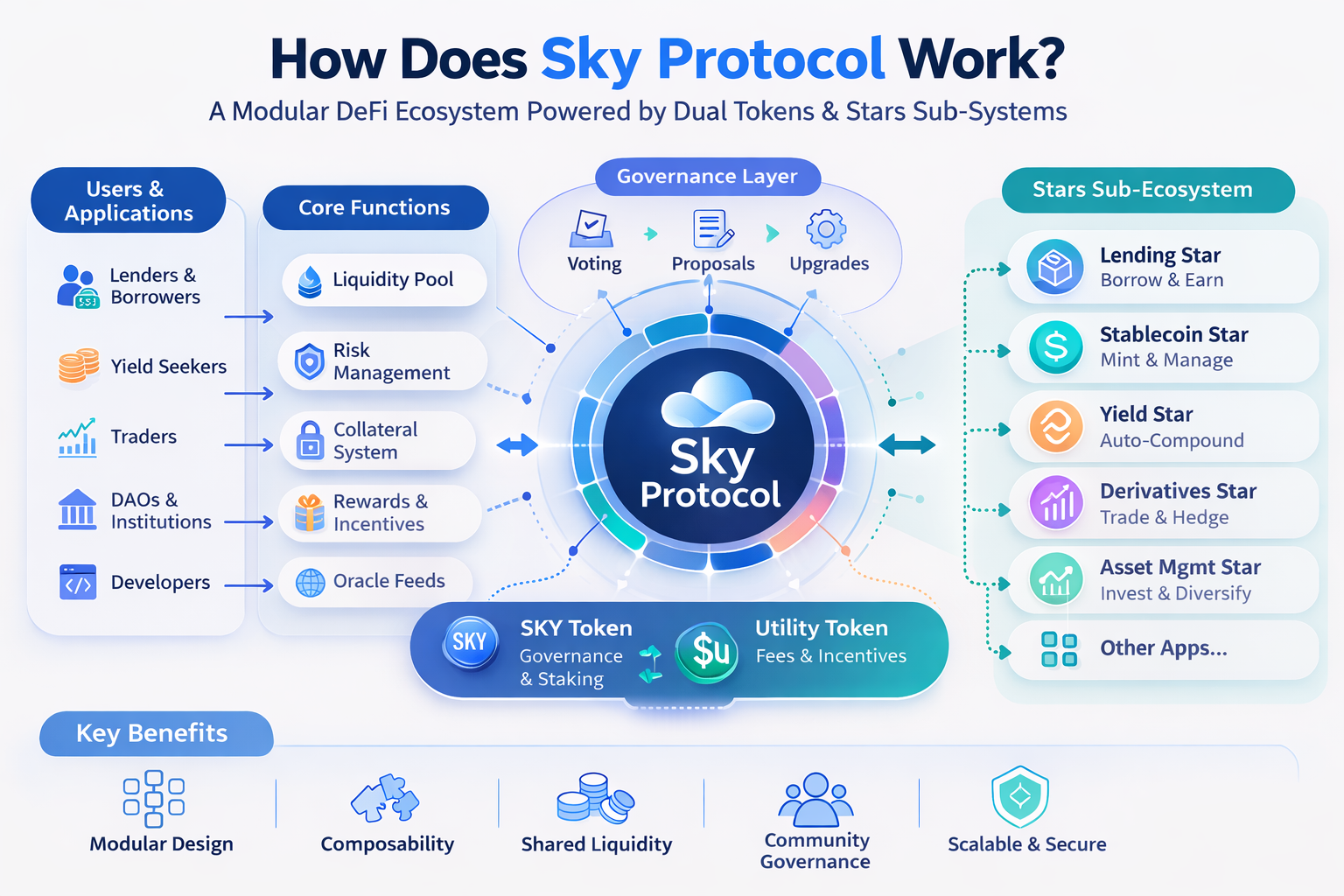
Sky’s operational logic is built on three pillars: a dual-token model, Stars sub-ecosystems, and a modular protocol architecture.
Together, these features create Sky’s financial system—one that supports stable governance and flexible ecosystem growth.
Dual-Token Model
Sky uses a dual-token structure to balance governance power and economic incentives.
In many DeFi protocols, a single token is used for governance, rewards, and value capture, often resulting in complex tokenomics and volatility. By separating these functions, Sky assigns distinct roles to each token.
Typically:
- SKY Token: Used mainly for governance and protocol control
- Ecosystem or Utility Tokens: Used for protocol operations, incentives, or liquidity management
This structure stabilizes governance and reduces protocol exposure to market swings.
The dual-token model also enables more advanced economic designs, such as revenue sharing, staking rewards, and protocol fee redistribution.
Stars Sub-Ecosystem
Stars are a central feature of the Sky ecosystem—a network of subsystems anchored to the core protocol.
Each Star can be an independent DeFi app, for example:
- Lending protocols
- Yield aggregators
- Derivatives platforms
- Asset management protocols
These applications maintain technical independence while sharing Sky’s foundational infrastructure for governance, liquidity, and security.
This model allows Sky to add new financial applications without compromising core protocol stability.
Modular Strategy: Stars Sub-Ecosystem
Modularity is at the heart of Sky’s design philosophy.
Traditional DeFi architectures often integrate new features directly into a main protocol, increasing complexity and risk. Sky’s modular approach enables features to exist as separate modules.
This structure delivers several clear benefits:
- Enhanced scalability. New protocols can join the ecosystem as Stars, without overhauling the core system.
- Risk isolation. Issues in one Star don’t threaten the entire protocol.
- Developer friendly. Modular architecture opens the door for more development teams to participate.
As DeFi evolves, this model is increasingly viewed as the future of financial systems.
Key Components of Sky
Sky Protocol is built on several core layers working together:
Governance Layer: Oversees protocol upgrades, parameter changes, and ecosystem strategy.
Liquidity Layer: Provides shared liquidity for Stars, boosting capital efficiency.
Security Mechanisms: Includes smart contract audits, risk controls, and protocol insurance.
Development Framework: Offers APIs, SDKs, and protocol interfaces to help developers integrate new DeFi applications quickly.
This layered design makes Sky a comprehensive financial infrastructure, not just another DeFi app.
SKY Token Governance and Economics
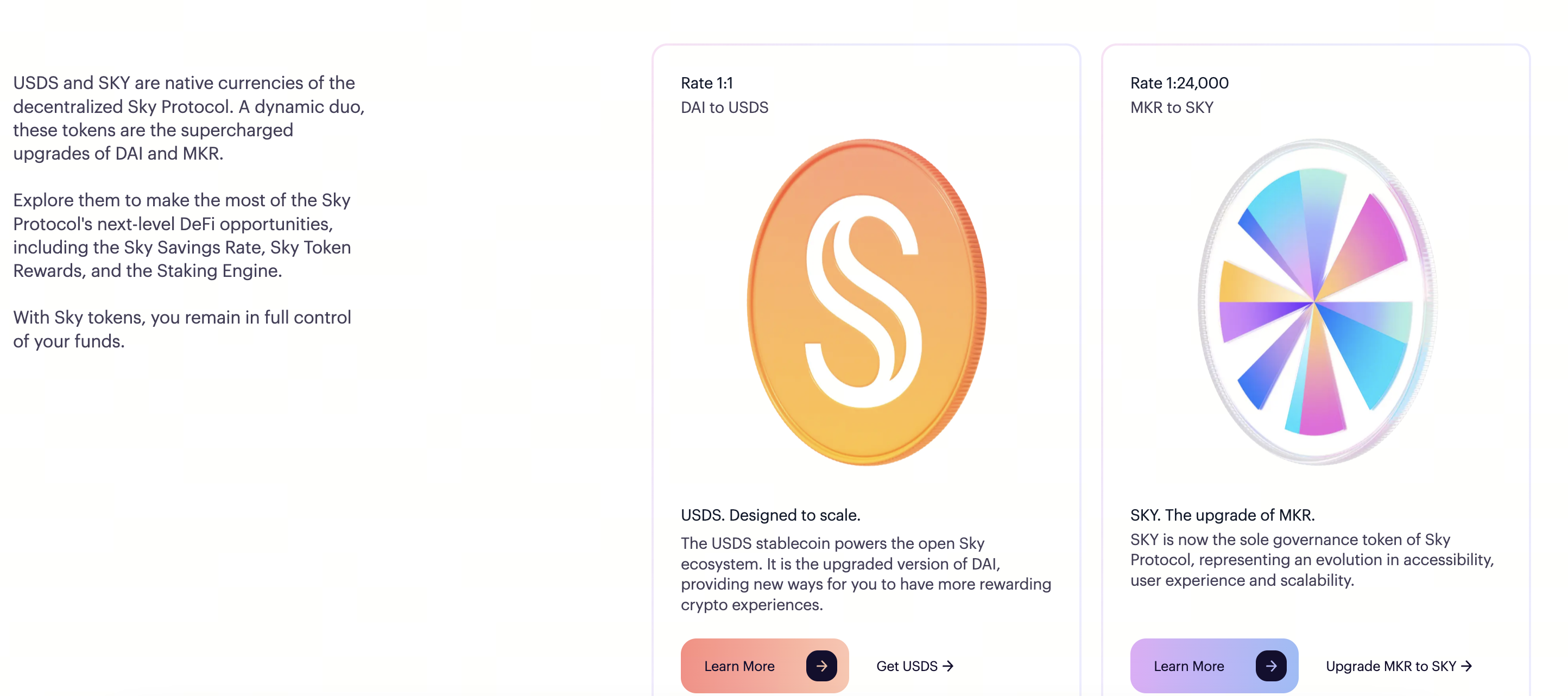
The SKY token plays a pivotal role throughout the ecosystem, especially in governance and incentives.
Governance Functions
SKY holders can:
- Vote on protocol upgrades
- Adjust fee structures
- Approve new Star projects
- Decide on ecosystem fund allocations
This governance model gives the community direct influence over the protocol’s direction.
Staking and Incentives
SKY tokens can be staked for ecosystem rewards, including:
- Sharing in protocol revenue
- Participating in liquidity incentives
- Increasing governance weight
As the ecosystem grows, SKY’s value typically tracks usage, trading volume, and protocol revenue.
Main Use Cases and Applications for Sky
Sky’s design supports a broad range of DeFi applications:
1. Decentralized Lending: Lending Stars enable users to collateralize digital assets for loans.
2. Yield Strategies: Yield aggregators help users automatically optimize DeFi returns.
3. Derivatives Trading: Some Stars offer perpetual contracts or options.
4. Asset Management: Institutions or DAOs can build on-chain asset management tools in the Sky ecosystem.
5. Cross-Protocol Financial Composability: Modularity enables seamless integration across protocols, powering complex strategies.
Risks of Investing in or Participating in the Sky Ecosystem
Sky’s innovative DeFi architecture brings risks, including:
Smart Contract Risk
Smart contract bugs or vulnerabilities can lead to loss of funds.
Market Volatility Risk
Crypto asset prices are highly volatile, which may impact collateral value.
Governance Risk
Decentralized governance improves transparency but can be swayed by large token holders.
Ecosystem Development Uncertainty
The growth of Stars depends on developer and market adoption; slow expansion may impact long-term value.
It’s critical to understand the project’s structure and risks before joining the Sky ecosystem.
Sky’s Future Direction and Ecosystem Outlook
As DeFi enters its next phase, modular financial infrastructure is emerging as a major trend.
Sky’s ecosystem strategy focuses on:
Ecosystem Expansion
Attracting more developers to launch new Stars.
Cross-Chain Integration
Supporting multi-chain assets and cross-chain liquidity.
Institutional-Grade DeFi
Building advanced risk controls and compliance features to bring in institutional capital.
On-Chain Financial Composability
Leveraging modularity to create complex on-chain financial products.
If these initiatives succeed, Sky could become a leading DeFi infrastructure platform.
Summary
Sky (SKY) introduces a modular DeFi architecture that leverages a dual-token system and Stars sub-ecosystem to build a scalable on-chain financial platform.
Unlike traditional single-protocol models, Sky operates as a financial platform, supporting multiple independent apps within a unified framework and shared governance and liquidity mechanisms.
This design expands the ecosystem’s capability and offers a new foundation for DeFi’s evolution. Still, like any crypto project, Sky’s long-term success depends on execution, adoption, and market conditions.
FAQs
Q1: What is Sky (SKY)?
Sky is a modular decentralized finance protocol that creates open DeFi infrastructure through a dual-token model and Stars sub-ecosystem.
Q2: What’s the role of the SKY token?
SKY is used for protocol governance, ecosystem incentives, and participating in protocol decisions.
Q3: What are Stars in the Sky ecosystem?
Stars are subsystems within Sky—each can be an independent DeFi app, such as lending or yield strategy platforms.
Q4: How does Sky differ from traditional DeFi protocols?
Sky’s modular architecture lets multiple financial applications run within a unified ecosystem, rather than as isolated protocols.
Q5: What risks are associated with participating in Sky?
Key risks include smart contract vulnerabilities, market volatility, governance risks, and uncertainty in ecosystem development.







