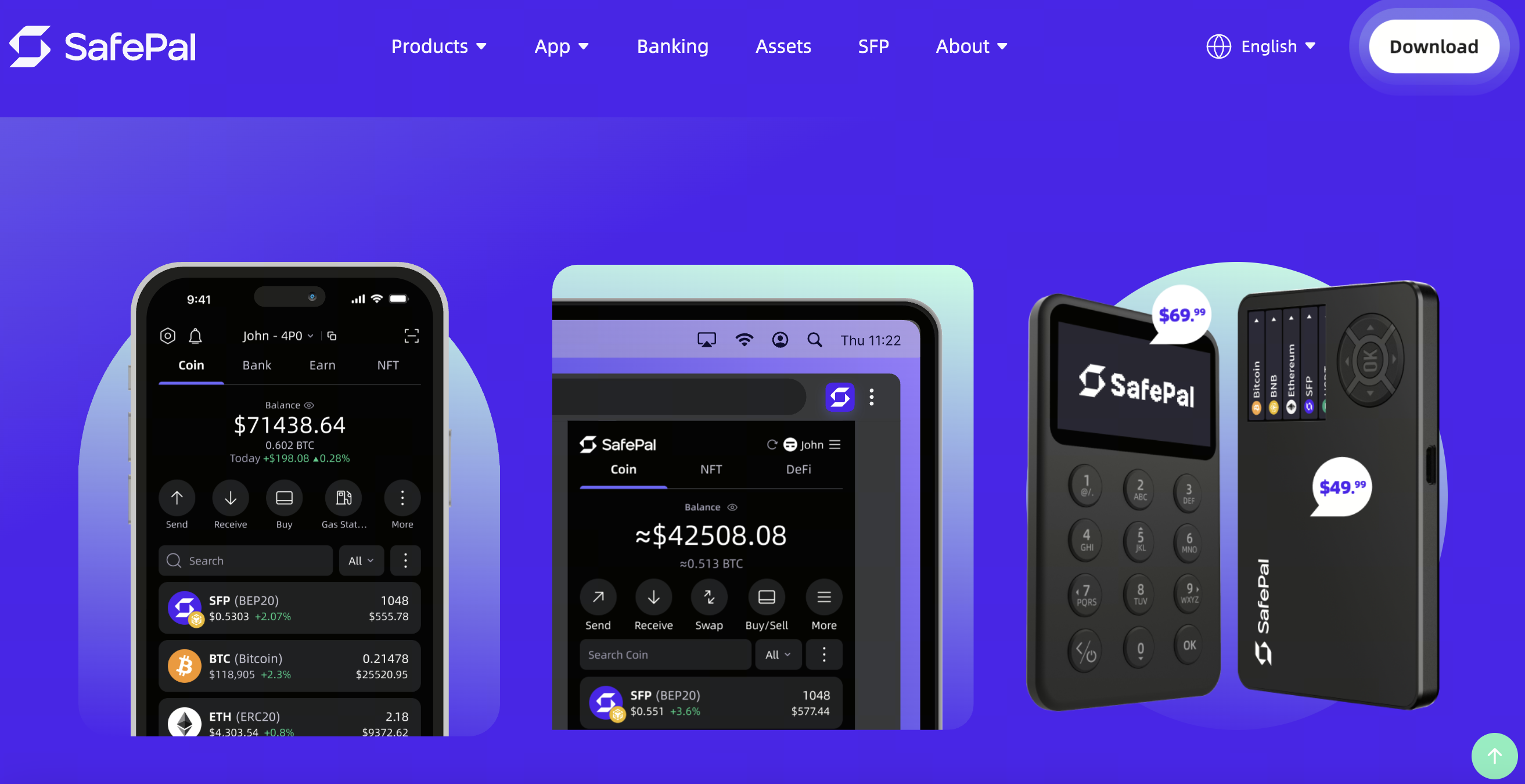
Image source: SafePal Official Website
SafePal (SFP) is a self-custody crypto asset ecosystem integrating hardware wallets, mobile software wallets, browser extensions, and on-chain services. SFP serves as the core utility token of this ecosystem.
In today’s market, wallets have evolved beyond simple “storage tools”—they are now gateways to DeFi, NFTs, on-chain trading, cross-chain bridges, and real-world payments. Users demand wallets that are not just “usable” but also “secure, composable, and frictionless,” driving increased attention to platforms with seamless hardware and software integration.
From an industry perspective, SafePal’s value lies in its coverage of the security layer (hardware and key management), trading layer (Swap, Bridge, Earn, CEX Mini Program), and ecosystem layer (SFP incentives and community collaboration). The following sections break down its tokenomics, security architecture, governance, DeFi applications, competitive advantages, risks, and future potential.
SFP Tokenomics and Allocation Mechanism
SFP has a fixed maximum supply of 500 million tokens, positioning it as a “utility scarce token” rather than an inflationary model. SFP was first publicly offered via Binance Launchpad (50 million tokens, 10%), with the remaining allocation dedicated to ecosystem incentives, team and advisors, private and seed rounds, and community operations. Tokens enter circulation through a vesting unlock mechanism.
SFP’s value is multifaceted, deriving from multiple use cases:
- Ecosystem rewards: airdrops, event incentives, and partner project equity.
- Staking enhancement: boosting returns in Earn or partner pools.
- Gas Station: converting SFP to multi-chain Gas tokens, reducing cross-chain friction.
- Listing and ecosystem services: projects can use SFP to apply for DApp or token display within the wallet.
- Governance extension: voting and participation rights in ecosystem and community decisions.
The critical factor for SFP is not just its “issuance structure,” but whether “demand is continuously generated.” When wallet trading, cross-chain activity, and value-added services are active, token usage rises; during periods of reduced on-chain activity, demand for the token typically declines.
SafePal’s Core Technology and Security Architecture
SafePal’s technical roadmap is a dual-stack approach—combining “software usability” with “hardware security.” The software manages multi-chain assets, DApp connections, and trade aggregation; the hardware handles cold storage and signature isolation for high-value assets.
SafePal hardware wallets utilize Secure Element chips for security. According to the 2025 official announcement, the hardware line was upgraded from CC EAL 5+ to CC EAL 6+, covering all major models. This upgrade provides:
- Enhanced protection against physical and side-channel attacks;
- Improved key protection under complex attack scenarios;
- Greater competitiveness at financial-grade security standards.
Beyond chip level, SafePal remains non-custodial: users control their Private Keys and seed phrases, and the platform does not custody assets. For users, this ensures “full asset sovereignty,” but also means “backup responsibility falls entirely on themselves.”
SafePal’s Decentralized Governance and Community Participation
SafePal’s governance is currently a gradual process focused on “community collaboration, functional voting, and event incentives,” rather than an immediate shift to full DAO.
SFP’s governance value is reflected in three key areas:
- Ecosystem participation: token holders can influence product and ecosystem direction through activities, proposals, and community discussions.
- Asset listing and community feedback: SafePal maintains community voting and feedback mechanisms to prioritize new assets or features.
- Cross-protocol governance access: users can connect to external governance platforms through the wallet and participate in on-chain protocol voting.
SafePal is in a “platform-to-on-chain governance transition phase”—a model that offers higher execution efficiency but demands greater transparency and robust proposal feedback.
SafePal’s Application Scenarios in Decentralized Finance
SafePal’s DeFi value is in “entry aggregation,” not “single protocol innovation.” Users can manage assets, perform cross-chain swaps, participate in returns, and interact with DApps from a unified wallet interface.
Main scenarios include:
- Swap / Bridge: multi-chain asset swaps and bridging within the wallet, reducing cross-chain complexity.
- Earn / Staking: participate in on-chain returns via aggregated products; 2026 saw integration of TRX staking returns.
- DApp Browser: direct access to multi-chain protocols for trading, lending, NFTs, and on-chain tools.
- Payment and real-world consumption: linking on-chain assets to real-world payments via Banking Gateway and Mastercard.
From 2025–2026, SafePal expanded chain support (e.g., Hedera, World Chain, Lemon Chain) and integrated platforms like Polymarket, deepening the “wallet as entry point” experience.
Compared to MetaMask and Trust Wallet, SafePal’s differentiation is not just “multi-chain support,” but its integrated product strategy:
- Unified hardware and software: SafePal operates both wallet types, ideal for layered asset management—high-frequency operations plus cold storage.
- Deeply embedded trading and value-added modules: from Swap and Bridge to Earn and partner trading, minimizing platform switching.
- SFP equity system: the token’s functions span Gas, incentives, enhancement, and ecosystem services.
- Global operations and multilingual support: prioritizing emerging markets and mobile experience.
Differentiation is not absolute advantage. MetaMask’s ecosystem and plugins appeal to heavy EVM users; Trust Wallet’s simplicity suits newcomers. SafePal is best for users seeking “security layering and integrated asset management.”
Risks to Consider When Investing in SFP
As a platform utility token, SFP’s investment logic focuses on “whether platform growth reliably translates to token demand.” Key risks include:
- Market cycle risk: crypto markets are volatile; platform tokens often see compressed valuations in bear markets.
- Competitive risk: wallet competition is fierce, with leaders strengthening multi-chain and trading features.
- Execution risk: delays or inefficiencies in launching features, partnerships, or incentives impact token demand.
- Regulatory and compliance risk: wallet, payment, and on-chain financial regulations may change rapidly by region.
- Token supply-demand mismatch: if new features don’t drive sustained use, token demand may be driven by sentiment alone.
Assessing SFP requires tracking active addresses, product retention, on-chain activity, and partnership quality—not just price trends.
SafePal (SFP) Future Directions and Market Potential
Recent developments show SafePal’s roadmap is clear:
- Security capabilities will continue to improve. After EAL 6+ upgrades, focus may shift to supply chain stability, firmware transparency, and seamless cross-device experience.
- Multi-chain coverage will expand. Intensive chain support additions in 2025–2026 aim to capture emerging ecosystem traffic.
- Transition to “asset operating system.” Integration of trading, returns, payments, and partner apps reinforces the “one entry, many tasks” model.
- Refined community and ecosystem incentives. Initiatives like the Solana ecosystem incentive plan aim to build early network effects in new ecosystems.
If these directions are realized, SafePal could become the “high-security asset gateway for the cross-chain era.” However, prolonged industry inactivity may pressure platform token valuations. Market potential exists, but realization depends on product execution and genuine user growth.
Summary
SafePal (SFP) delivers “secure storage, on-chain trading, asset appreciation, and real-world payment access” in a unified self-custody system. SFP is a functional asset designed for wallet ecosystem usage—not just a narrative token.
SafePal’s ongoing progress in security, on-chain integration, and ecosystem partnerships demonstrates it is advancing beyond the early wallet stage. For investors, rational evaluation means verifying growth through real product and token usage data—not relying solely on short-term price movements.
FAQs
Q1: Are SafePal and SFP the same?
No. SafePal is the wallet and service ecosystem; SFP is its token, used for incentives, equity, and governance.
Q2: Will SFP’s supply increase indefinitely?
No. SFP has a fixed cap of 500 million tokens. Long-term value depends on ecosystem demand growth.
Q3: Is SafePal only for hardware wallet users?
No. SafePal offers software wallets and browser extensions. Hardware wallets suit large, long-term holdings; software wallets are ideal for frequent interactions.
Q4: What is SafePal’s most practical DeFi feature?
For most users: multi-chain asset management, in-wallet Swap/Bridge, DApp connectivity, and yield aggregation—all reduce complexity.
Q5: What indicators matter most when investing in SFP?
Focus on platform fundamentals: active users, on-chain activity, product updates, and partnership continuity. Then assess position and risk based on market cycles.