RWA (Real-World Assets) refers to physical or financial assets from the traditional financial system that are tokenized and brought on-chain using blockchain technology, enabling them to be traded, financed, and circulated within blockchain ecosystems. The emergence of RWA represents a transition of blockchain technology from purely crypto-native assets toward carrying real economic value.
‘This article starts from the basic definition and technical significance of RWA, explains why the crypto market needs RWA, examines how RWA operates and what asset types are involved, discusses its integration with traditional finance and DeFi, outlines regulatory and compliance challenges, identifies key participants, analyzes investment risks, and explores future trends, providing a structured framework for understanding RWA.
What Is RWA?
RWA, or Real-World Assets, refers to the digitization of valuable real-world assets such as real estate, bonds, private credit, commodities, and accounts receivable through blockchain and smart contract technology. These assets are issued as on-chain tokens, enabling them to be divisible, transferable, and tradable. The tokens represent contractual claims on the underlying assets or their cash flows.
Core concept:
The value of traditional assets is abstracted into on-chain representations, breaking geographical and time constraints and enabling global, 24/7 trading.
Why Does the Crypto Market Need RWA?
In its early stages, the crypto market was dominated by native crypto assets and NFTs, whose value largely depended on market sentiment and consensus. Long-term market development requires asset classes backed by real value, offering stable income and defensive characteristics. The introduction of RWA can:
- Expand asset diversity: Introduce traditional assets such as government bonds, funds, and corporate debt.
- Increase market maturity: Cash-flow-based assets help attract institutional capital.
- Enhance market stability: Compared with highly volatile crypto assets, RWAs provide stronger value anchors.
- Scale capital markets: Industry reports suggest the global RWA tokenization market is growing rapidly and may reach trillions or even tens of trillions of dollars over the next decade.
How Does RWA Work? The Basic Asset-On-Chain Process
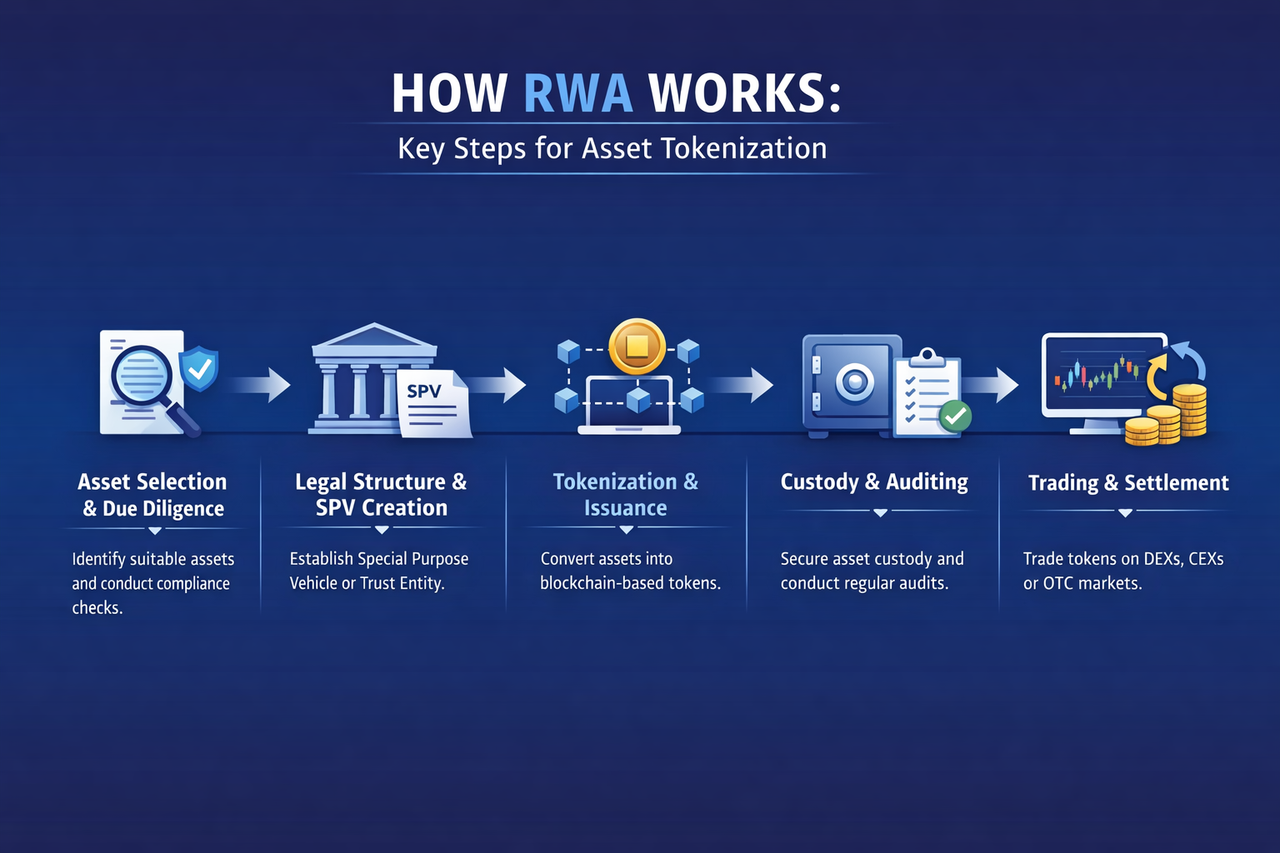
The typical RWA tokenization process includes the following key steps:
- Asset selection and due diligence: Identify suitable assets and complete compliance reviews.
- Legal structuring and SPV setup: Assets are often held through special purpose vehicles (SPVs) or trust structures for regulatory compliance.
- Asset digitization and token issuance: Asset rights are converted into smart contract tokens, defining rules such as dividends and voting rights.
- Custody and auditing: Underlying assets are held by trusted custodians and regularly audited to verify the on-chain tokens correspond to off-chain assets.
- Secondary market trading and settlement: RWA tokens can be traded on decentralized exchanges, centralized platforms, or compliant OTC markets, and used for lending, collateralization, and other financial activities.
This process relies on mature smart contracts, oracles, identity verification systems, and compliance tooling.
Common Types of RWA Assets
Current RWA categories include:
- Government bonds and public funds — such as on-chain treasury products launched by large institutions.
- Corporate bonds and private credit — yield-bearing private debt and credit instruments.
- Real estate and infrastructure — tokenized ownership or cash-flow rights.
- Commodities and precious metals — for example, gold-backed tokens such as PAXG.
- Funds and equity assets — on-chain representations of private funds or exchange-traded products.
| Asset Category |
Example Underlying Assets |
Source of Returns |
Risk Characteristics |
Typical Use Cases |
| Government Debt Assets |
U.S. Treasuries, short-term Treasury bills |
Fixed interest income |
Interest rate risk, sovereign credit risk |
On-chain stable yield products, institutional cash management |
| Corporate Bonds And Private Credit |
Corporate bonds, private loans |
Bond interest, loan interest |
Credit default risk, liquidity risk |
DeFi collateralized lending, fixed-income strategies |
| Real Estate |
Commercial properties, residential real estate |
Rental income, asset appreciation |
Market cycle risk, management risk |
Fractional asset investment, global investment access |
| Commodities And Precious Metals |
Gold, silver, oil |
Price appreciation |
Commodity price volatility risk |
Hedging allocations, on-chain commodity trading |
| Accounts Receivable And Trade Finance |
Corporate receivables, supply chain invoices |
Discount-based returns |
Payment default risk |
On-chain financing, corporate cash flow optimization |
| Private Equity And Fund Shares |
Private equity funds, venture capital funds |
Equity dividends, exit proceeds |
Long exit cycles, opaque valuation |
On-chain fund share liquidity |
| Infrastructure Assets |
Power projects, toll roads |
Long-term cash flows |
Policy risk, operational risk |
Long-duration yield token products |
| Art And Collectibles |
Artwork, antiques |
Auction-based appreciation |
Valuation volatility, low liquidity |
Fractional investment for high-net-worth assets |
These asset classes, combined with blockchain characteristics, enable improved liquidity and more flexible investment instruments.
The Relationship Between RWA and Traditional Finance (TradFi)
RWA serves as a key bridge between traditional finance and blockchain technology. Through tokenization, traditional assets can:
- Improve liquidity: High-value assets can be fractionalized, increasing participation.
- Increase efficiency: Smart contracts automate settlement and income distribution.
- Enable global access: Cross-border participation is no longer constrained by legacy settlement systems.
- Enhance transparency: On-chain data is auditable and traceable.
At the same time, banks and asset managers are actively exploring RWA initiatives, accelerating the integration of traditional financial services with blockchain infrastructure.
RWA Integration with DeFi
RWA applications within DeFi primarily include:
- Collateral for lending: RWA tokens can be used as collateral in decentralized lending protocols.
- Liquidity provision and yield strategies: Users earn returns by providing liquidity for RWAs.
- Cross-protocol composability: DeFi protocols expand fixed-income offerings using RWA assets, attracting more conservative capital.
This integration enhances DeFi composability and capital efficiency while introducing real-world yield sources.
Compliance and Regulatory Challenges of RWA
Regulation is a central challenge for RWA development:
- Legal classification and securities status: Jurisdictions differ on whether tokens qualify as securities, requiring careful legal structuring.
- Regulatory frameworks: Some regions support RWA innovation, while others impose stricter oversight.
- Disclosure and transparency: Audits, custody reports, and compliance disclosures must meet regulatory standards.
Global regulatory divergence will significantly influence RWA adoption and implementation models.
Key Participants in the RWA Ecosystem
Major participants include:
- Institutional asset managers: Tokenized fund products and on-chain asset issuance.
- Blockchain infrastructure platforms: Providing tokenization frameworks and RWA tooling.
- DeFi protocols: Integrating RWA tokens into lending and liquidity markets.
- Oracles and compliance service providers: Supplying pricing data, audits, and identity verification.
Together, these participants are driving the transition from pilot projects to scalable markets.
What Risks Should Investors Consider When Investing in RWA?
Despite its potential, RWA carries several risks:
- Legal and regulatory risk: Policy changes may affect liquidity and compliance.
- Infrastructure risk: Smart contract vulnerabilities and oracle failures remain concerns.
- Liquidity risk: Some RWA tokens may have limited secondary market trading.
- Custody and audit transparency risk: Weak asset backing can undermine trust.
Investors should assess asset quality, regulatory status, and platform security carefully.
Long-Term Potential and Future Trends of RWA
Based on current data and forecasts, RWA may exhibit the following trends:
- Large-scale growth: Market size may expand from tens of billions to trillions of dollars.
- Technology maturation: Privacy protection, cross-chain interoperability, and compliance tooling will improve.
- Clearer global regulatory frameworks: More jurisdictions may adopt RWA-friendly policies.
- Deeper TradFi and DeFi integration: Enabling richer financial products and ecosystems.
Conclusion
RWA connects traditional financial assets with blockchain technology through tokenization, improving liquidity, transparency, and accessibility. While regulatory, technical, and market maturity challenges remain, RWA holds significant long-term potential. Understanding its operating logic and risks is essential for participants seeking to navigate the future of finance.
FAQs
Q1: What is the difference between RWA and stablecoins?
RWA represents tokenized real-world assets, while stablecoins such as USDC or USDT are typically backed by fiat reserves and aim to maintain price stability.
Q2: Can retail investors participate in RWA?
Some RWA products are limited to qualified investors, but more retail-accessible offerings are emerging as compliance frameworks mature.
Q3: Will RWA replace traditional finance?
RWA is more likely to complement and optimize traditional finance rather than fully replace it, though it may reshape asset trading and management models.
Q4: What are the main risks of RWA?
Key risks include regulatory uncertainty, technical vulnerabilities, custody and audit issues, and market liquidity constraints.







