As users push to broaden asset representation on the Bitcoin network, structures originally designed just for value transfers are being reimagined. This shift positions Ordinals as a pivotal entry point for understanding the Bitcoin NFT and inscription ecosystem.
This topic typically centers on three core aspects: the numbering mechanism, methods for inscribing data, and the asset representation structure. Together, these elements underpin Ordinals’ operational logic and its ecosystem foundation.
What Are Ordinals (ORDI)?
The Ordinals protocol uniquely numbers every satoshi, allowing each one to be tracked, identified, and enhanced with additional data. This expands both the expressive power and potential applications of individual satoshis on the Bitcoin network.
Operationally, each satoshi is numbered in the order blocks are created, enabling precise identification and tracking. By embedding data within transactions, certain satoshis can be assigned extra information—these are known as “inscriptions.”
From a structural perspective, Ordinals do not change Bitcoin’s core rules. Instead, they interpret existing transaction data to represent assets, operating entirely on Bitcoin’s base network.
This approach enables Bitcoin to serve not only as a vehicle for value transfer but also as a platform for richer forms of digital content.
How Does the Ordinals Protocol Work?
Ordinals function through a combination of satoshi numbering and data embedding mechanisms.
The protocol numbers satoshis according to block and transaction sequence, then appends data in a prescribed format within transaction inputs to bind the information to a specific satoshi.
Structurally, this process requires no additional tokens or sidechains. All information is recorded directly in Bitcoin blocks and validated and stored by the network’s nodes.
This architecture delivers a fully on-chain, verifiable, and immutable method for recording asset data.
How Are Inscriptions Created and Stored on Bitcoin?
Inscriptions are digital assets formed by embedding data directly into a satoshi.
In practice, users employ purpose-built tools to initiate an “inscribe” operation, embedding text, images, or other data into a Bitcoin transaction. This data is then confirmed in a block and stored permanently.
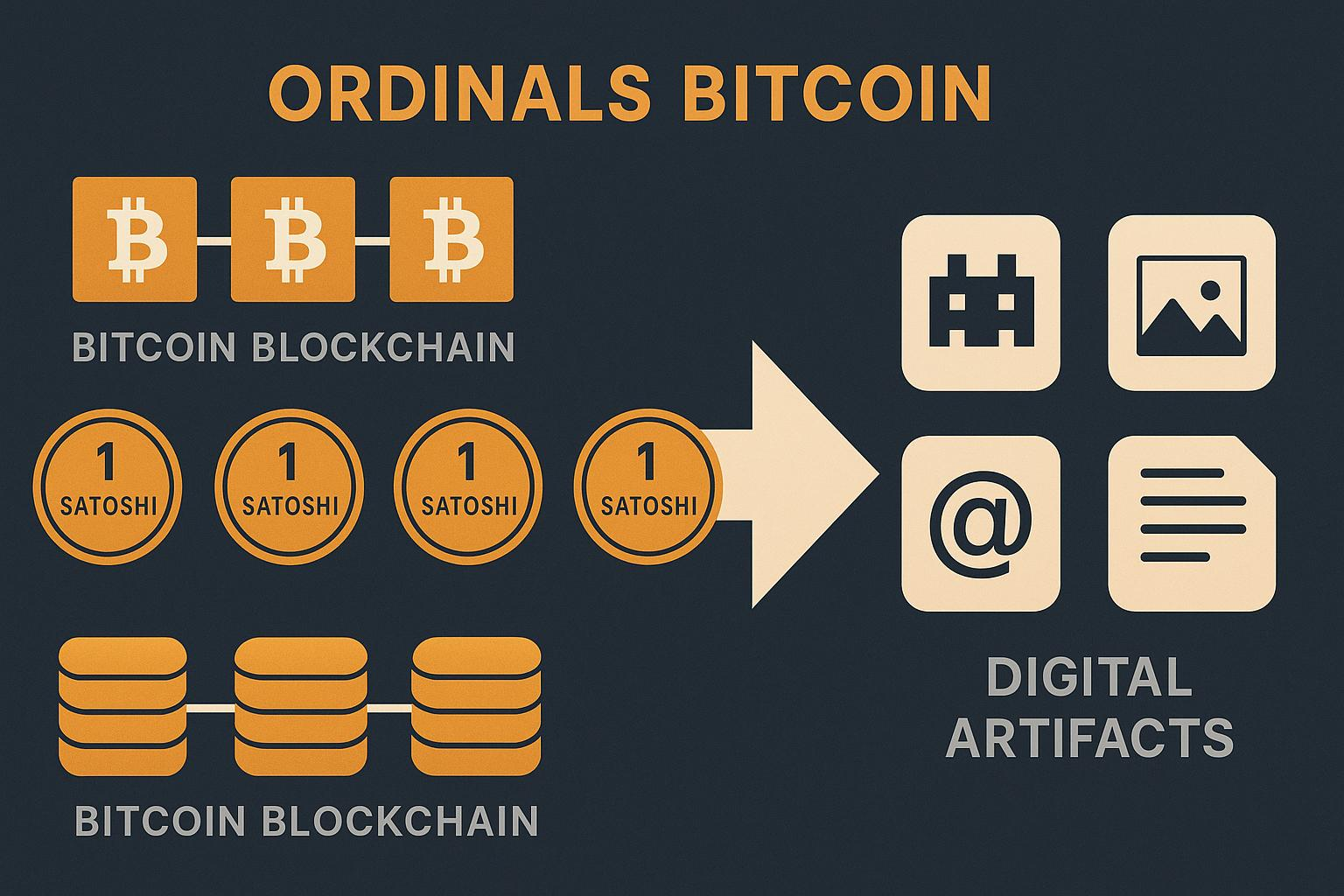
Structurally, inscriptions are tied directly to Bitcoin transactions—not to external storage solutions—ensuring their fully on-chain nature.
This design means NFT-like assets no longer rely on off-chain data, significantly boosting data integrity and verifiability.
What Role Does ORDI Play in the Ordinals Ecosystem?
ORDI is a token created under the inscription standard and serves as a representation of fungible assets within the Ordinals ecosystem.
ORDI’s issuance and transfer rules are defined through the inscription process, enabling its transfer and trading on the Bitcoin network.
Functionally, ORDI doesn’t participate in network operations directly but exists as an asset type in the ecosystem, complementing inscription-based NFTs.
ORDI’s role is pivotal: it introduces tokenization to Ordinals, moving beyond NFTs to enable a broader range of digital assets.
What Are the Main Use Cases for Ordinals?
Ordinals are focused on digital asset creation and content representation.
Through inscriptions, users can create NFTs, tokens, or other data assets and trade them in the marketplace.
These applications leverage Bitcoin’s security and immutability, making Ordinals ideal for collectibles, identity markers, and data recording.
This evolution transforms Bitcoin from a pure payment network into a versatile asset platform.
How Do Ordinals Differ from Traditional NFTs?
Ordinals and traditional NFTs diverge significantly in data storage and implementation methods.
Traditional NFTs often store metadata off-chain, while Ordinals record data directly on-chain.
Unlike traditional NFTs that rely on smart contracts, Ordinals use Bitcoin’s transaction structure for asset representation. This results in a more streamlined protocol, though with somewhat limited functionality.
In short, Ordinals prioritize data integrity, while traditional NFTs offer greater flexibility and scalability.
How Do Ordinals Relate to the Bitcoin Network?
Ordinals are built entirely atop the Bitcoin network.
They utilize Bitcoin’s native transaction and scripting structures for data inscription without altering the underlying consensus rules.
Ordinals rely on network nodes to interpret transaction data, functioning as an application-layer protocol within the Bitcoin ecosystem.
This setup means Ordinals inherit Bitcoin’s security model directly.
What Are the Strengths and Limitations of Ordinals?
Ordinals present both innovation and constraints.
Their primary advantage is complete on-chain data storage; however, limited block space restricts data capacity.
Lacking smart contract support, Ordinals have less flexibility and extensibility compared to other on-chain systems.
As a result, Ordinals are best suited for straightforward asset representations rather than complex applications.
Summary
By numbering satoshis and embedding data, Ordinals empower Bitcoin with digital asset capabilities, building an ecosystem centered around inscriptions.
FAQ
What are Ordinals?
A protocol for creating inscription assets on Bitcoin.
What is the relationship between inscriptions and NFTs?
Inscriptions are an on-chain approach to NFT representation.
How is ORDI created?
It’s a token form defined by inscription protocol rules.
Do Ordinals change the rules of Bitcoin?
No—they leverage the existing structure without altering core rules.
What data can Ordinals store?
Primarily text and images, or other small-sized data.