From a technological and industry evolution perspective, AINFT represents more than an incremental upgrade to NFT functionality. It reflects a foundational design for the deep integration of Web3 and artificial intelligence. By combining multimodal AI, model aggregation, wallet as account architecture, and usage based payment mechanisms, AINFT seeks to turn AI capabilities directly into on-chain assets that can be tokenized, settled, and governed within blockchain systems. In this structure, artificial intelligence becomes a composable, tradable, and programmable on-chain resource rather than an external service.
This approach addresses several structural challenges in today’s AI landscape, including fragmented model availability, high subscription costs, and steep usage barriers. At the same time, it provides a more flexible and extensible intelligent base layer for applications such as gaming, decentralized finance, content creation, and DAO governance, where adaptive and interactive intelligence is increasingly required.
This article will first explain what AINFT is and how it uses AI driven NFT structures to redefine the functional boundaries of digital assets. It will then describe AINFT’s integration with the TRON ecosystem, the operating logic of its marketplace and model aggregation platform, and the fundamental differences between AINFT and traditional NFTs. Finally, it will outline AINFT’s token mechanisms, Web3 architecture, and core application scenarios, helping readers gain a comprehensive understanding of how AINFT is positioned as a key piece of digital infrastructure in the Web3 plus AI era.
What Is AINFT?

(Source: OfficialAINFT)
AINFT is a Web3 platform built on the TRON ecosystem. Its core idea is to embed AI capabilities into NFT structures, allowing digital assets to move beyond static collectibles and become flexible assets with learning, interaction, and evolutionary capabilities.
The project originates from the APENFT ecosystem and completed a major upgrade in October 2025, further focusing on AI-driven application scenarios. Unlike traditional NFTs that primarily represent ownership, AINFT integrates AI models into NFTs, enabling assets to self-adjust and respond to data inputs.
How Does AI Drive NFTs?
Traditional NFTs typically represent ownership of artworks, music, or in-game items. Once minted, their content usually remains fixed. AINFT introduces AI models to drive NFTs, enabling them to:
- Read real-time on-chain and off-chain data
- Adjust behavior based on user interaction
- Autonomously generate text, images, or other content
- Act on behalf of holders in financial or governance operations
With this structure, NFTs can function as:
- Trading assistance tools
- Game characters that evolve over time
- AI-powered content creation engines
- DAO voting analysis assistants
AINFT also supports multimodal AI, capable of processing text, images, audio, and video data. This allows NFTs to function as multi-purpose digital entities rather than single-function assets.
Integration With The TRON Ecosystem
AINFT is not positioned as a standalone NFT project, but as an attempt to build a complete AI-native Web3 environment. Ecosystem projects such as SunLumi, Banana King AI, and SunGenX explore AI-generated content, interactive NFTs, and autonomous agent applications.
Another key direction is the tokenization of AI models. Users can store AI models as digital assets in wallets and trade or monetize them, turning AI into an on-chain, transferable resource.
Application areas include:
- Gaming: Characters with learning and adaptive capabilities
- DeFi: Automated strategies and asset management
- Content creation: Real-time generation of art and music
- DAO governance: Proposal analysis and voting assistance
Asset ownership remains fully controlled by user wallets, without reliance on centralized platforms.
Core NFT Marketplace In The TRON Ecosystem
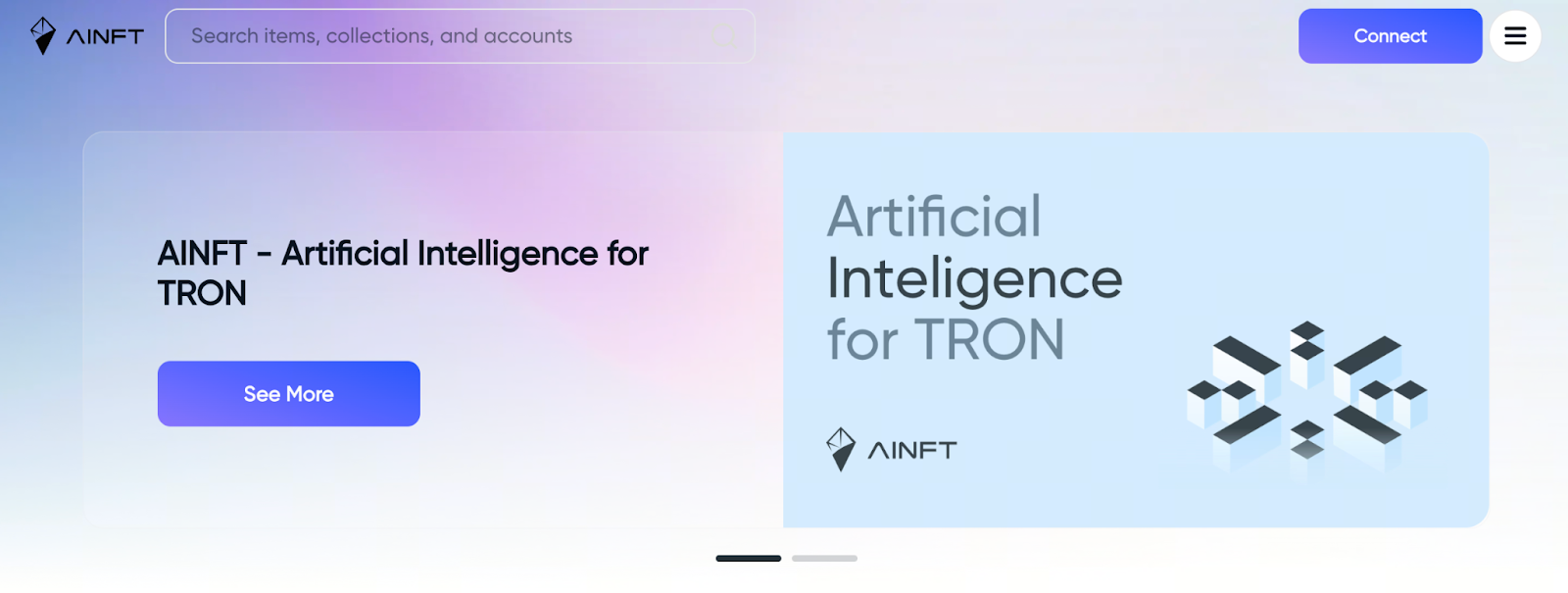
(Source: marketplace.ainft)
The AINFT Marketplace is a core infrastructure component and positions itself as a major NFT trading venue within the TRON ecosystem. It is built on BSC, TRON, and Ethereum Layer 1, integrating BTFS decentralized storage and BitTorrent Chain cross-chain capabilities.
Key features include:
NFT Discovery And Exploration
- Categorized displays of art, collectibles, and virtual assets
- Search tools and trending rankings
- Support for discovering emerging projects
Trading And Auction Mechanisms
- Instant trading and auction formats
- Low fees and fast confirmation
- Direct monetization for creators
NFT Minting Tools
- Fast NFT creation from uploaded digital content
- Batch operation support
- Lower barriers for creators
Security And Wallet Integration
- TRON wallet support
- Encrypted transaction processes
- Anti-scam protection mechanisms
The marketplace serves as a critical node for NFT value circulation.
AINFT vs. Traditional NFTs: What Is The Difference?
Traditional NFTs primarily function as on-chain ownership certificates. Whether digital art, music, or in-game items, their content and logic are usually static after minting. They mainly serve as collectibles or proof of ownership.
AINFT introduces AI models into this structure, giving NFTs dynamic capabilities. These NFTs can read on-chain and external data, adjust strategies based on user behavior, and generate new content. AINFT transforms static digital certificates into interactive, learning, and evolving intelligent digital entities.
From a usage perspective, traditional NFTs typically rely on single marketplaces for trading. AINFT integrates AI model execution, Web3 wallet authentication, and on-chain payment mechanisms, positioning NFTs not only as tradable assets but also as functional carriers for Web3 + AI applications.
A Web3-Native AI Large-Model Aggregation Platform
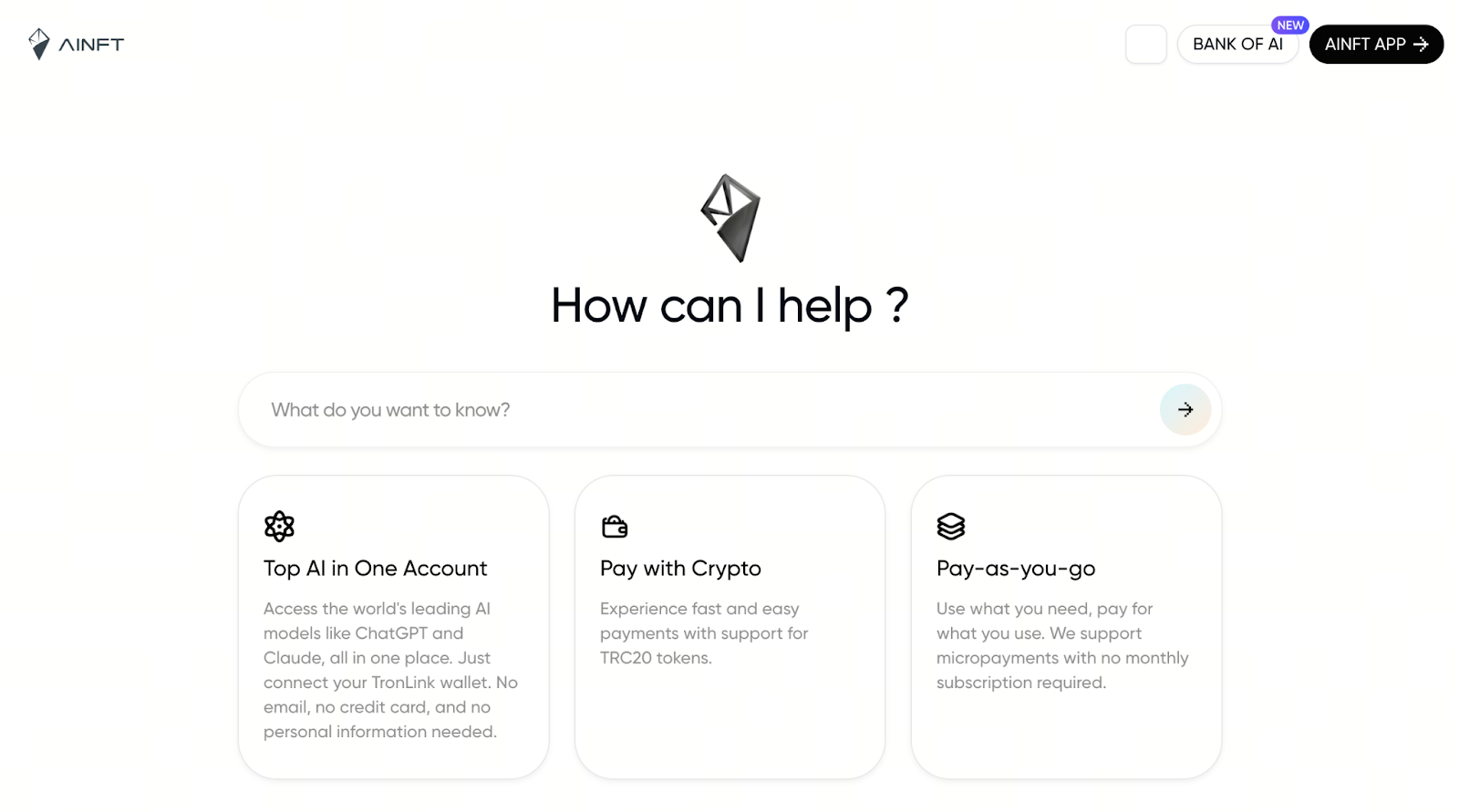
(Source: AINFT)
Another core initiative of AINFT is the creation of a Web3-native AI model aggregation gateway.
The platform integrates major global large-model capabilities, including:
- ChatGPT series
- Claude series
- Gemini series
Users can switch freely between models within a single interface without registering on multiple platforms.
Two Key Industry Problems Addressed
Problem 1: Fragmented models and complex switching
Different AI models excel at different tasks, requiring users to manage multiple accounts and platforms.
Problem 2: High fixed subscription costs
Most mainstream models use monthly subscription pricing, which is inefficient for low-frequency users.
AINFT (NFT) Token Mechanism: Economics And Use Cases
AINFT (NFT) is a governance token issued by the AINFT Foundation. It follows ERC-20 and TRC-20 standards, with a total supply of 999,990,000,000,000 tokens.
Token holder rights include:
- Participation in governance voting
- Sharing platform revenue
- Receiving NFT airdrop rewards
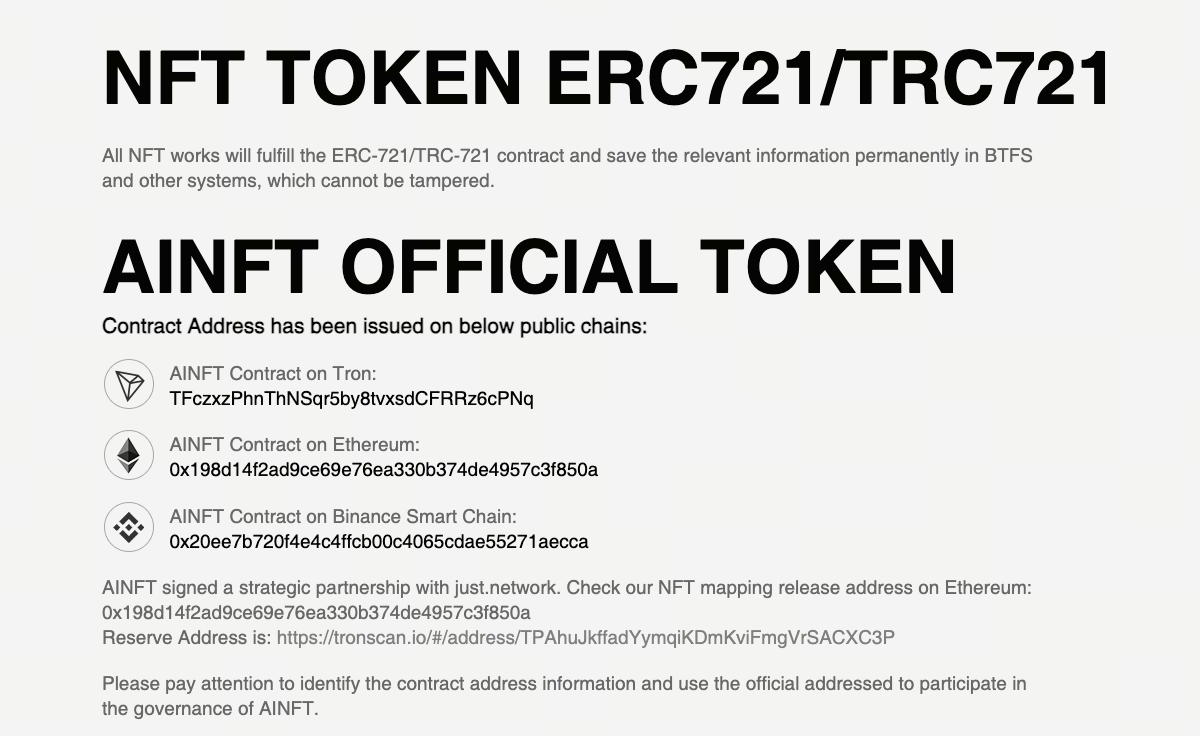
(Source: foundation.ainft)
The NFT token is currently listed on more than 27 centralized and decentralized exchanges, including Gate, Uniswap, PancakeSwap, and Sunswap.
AINFT’s Web3 Architecture
AINFT is built on Web3-native principles, with decentralized logic across identity, payments, and developer integration. It adopts a wallet-as-account model integrated with TronLink. Users do not need traditional registration or KYC processes and authenticate solely through on-chain signatures, maintaining full control over their on-chain identity.
For payments, AINFT uses a usage-based model supported by a credit system. Users can top up using TRX, NFT, USDT, and other crypto assets. Credits can be used across different AI models and are deducted based on actual usage, enabling a pay-as-you-go experience that improves efficiency and cost transparency.
AINFT also provides standardized APIs, allowing developers to integrate platform capabilities quickly, reduce technical barriers, shorten development cycles, and accelerate the deployment of Web3 + AI applications.
Core Application Scenarios Of AINFT
AINFT’s use cases extend beyond NFT collection and trading into multiple blockchain-AI convergence areas. In gaming, AINFT can function as characters or virtual assets that learn and evolve based on player behavior. In DeFi, it can act as an automated agent for executing strategies or managing assets.
In content creation, AINFT can generate text, images, or music and circulate them as NFTs, enabling creators to monetize AI-generated outputs directly on-chain. In DAO governance, AI models can assist with proposal analysis and voting support, improving decision efficiency.
By transforming AI models into ownable and tradable on-chain assets, AINFT positions artificial intelligence as a composable element within the Web3 ecosystem.
How To Participate In The AINFT Ecosystem
Participation in the AINFT ecosystem is built around Web3 wallet access. Users can connect supported TRON ecosystem wallets, such as TronLink, to log in directly without traditional registration or verification. New users may receive free credits to experience AI model services.
At the asset level, users can:
- Trade NFT tokens
- Participate in platform governance voting
- Mint and trade NFTs in the marketplace
- Use credits to access AI large models on demand
Developers can integrate AI capabilities into their own applications using standardized APIs, combining on-chain payments with decentralized architecture to build Web3 + AI products. Whether users, creators, or developers, participants can find multiple entry points into the AINFT ecosystem.
Summary
AINFT is not merely an NFT marketplace or an AI tool platform. It represents an attempt to assetize and tokenize AI capabilities within a blockchain framework and to redesign usage experiences through Web3 architecture. From AI-evolving NFTs to model aggregation and usage-based payment mechanisms, AINFT explores a new form of Web3 + AI integration. What it builds is not just a tool platform, but a new digital infrastructure that combines assets, identity, and intelligent services.
FAQs
How Is AINFT Different From Traditional NFTs?
Traditional NFTs primarily represent ownership of digital assets, with content that remains fixed after minting and is mainly used for collection and trading. AINFT embeds AI models into NFT structures, enabling NFTs to read on-chain and off-chain data, adjust behavior based on user interaction, and generate new content, making them intelligent digital assets with learning and evolutionary capabilities.
What Is The Purpose Of The AINFT (NFT) Token?
AINFT (NFT) is the platform’s governance token, issued under ERC-20 and TRC-20 standards. Token holders can participate in governance voting, share platform revenue, and receive ecosystem rewards. The token is listed on multiple centralized and decentralized exchanges and serves as a core medium for value circulation and rights distribution within the ecosystem.
How Can Users Participate In The AINFT Ecosystem?
Users can connect supported TRON ecosystem wallets, such as TronLink, to access the platform without traditional registration or KYC. After logging in, they can use credits to access AI models on demand, mint and trade NFTs in the marketplace, or participate in governance. Developers can integrate AI capabilities into their own applications using standardized APIs, expanding Web3 + AI use cases.