In the decentralized finance (DeFi) ecosystem, lending protocols serve as the backbone of on-chain capital markets. Among these, Aave has established itself as a long-term leader, creating a permissionless liquidity marketplace through overcollateralized lending, a dynamic interest rate model, and modular risk management.
Aave is more than a lending platform—it acts as a primary liquidity source and interest rate benchmark for many DeFi protocols. As a critical Web3 infrastructure, Aave efficiently matches capital through smart contracts, while its innovative aTokens and Flash Loans have significantly expanded what's possible in on-chain finance.
Aave’s Origin and Development
Aave began as the ETHLend project in 2017, founded by Stani Kulechov, later pivoting to a pool-based lending model to address the inefficiencies of peer-to-peer matching.
After its 2020 rebrand, Aave evolved into a multi-chain, institutional-grade, modular lending protocol, powered by innovations like Flash Loans, a dynamic interest rate model, and comprehensive risk controls. Its native token, AAVE, is integral to protocol governance and security modules.
Aave’s core design combines overcollateralized lending, dynamic rate adjustments, and automated liquidation. Unlike traditional financial institutions, Aave eliminates credit assessments, relying on collateralization and automated liquidation to manage risk.
The core of Aave’s operations is its liquidity pool system and smart contract-driven, dynamic interest rate model.
Depositors add assets to public liquidity pools, while borrowers draw from those pools and pay interest. Smart contracts automate the entire process, eliminating the need for manual intervention.
Overcollateralization ensures solvency; borrowers must pledge assets exceeding their loan amounts. If the collateral’s value drops below a safety threshold due to market volatility, the system triggers automatic liquidation to protect pool funds.
Interest rates adjust dynamically based on pool utilization: as borrowing demand and utilization increase, rates rise to attract more deposits; when utilization falls, rates decrease. This algorithm helps balance liquidity.
Aave’s architecture fuses capital efficiency with automated, real-time risk management.
Aave’s Core Features and Innovations
Aave features a dynamic interest rate model that adjusts in real time with market supply and demand, and allows users to lock in fixed rates to hedge volatility.
A major innovation is aTokens—interest-bearing tokens users receive when depositing assets (e.g., deposit ETH and receive aETH). aTokens accrue interest directly in user wallets, automating yield generation.
Aave pioneered the “Flash Loan”—an uncollateralized loan that must be borrowed and repaid within the same block. If not, the transaction reverts. This leverages blockchain atomicity, making Flash Loans a powerful tool for arbitrage and debt restructuring.
Aave also introduced credit delegation, allowing liquidity providers to delegate borrowing power and explore on-chain credit systems.
Aave V3 adds isolation mode and high-efficiency mode, using asset tiering and correlation optimization to boost capital utilization and reduce systemic risk. Multi-chain support expands Aave’s reach, giving users lower-cost, higher-efficiency lending across diverse networks.
AAVE Tokenomics and Use Cases
AAVE is Aave’s native governance token, with a fixed supply of 16 million. It is essential for system stability and decentralized governance.
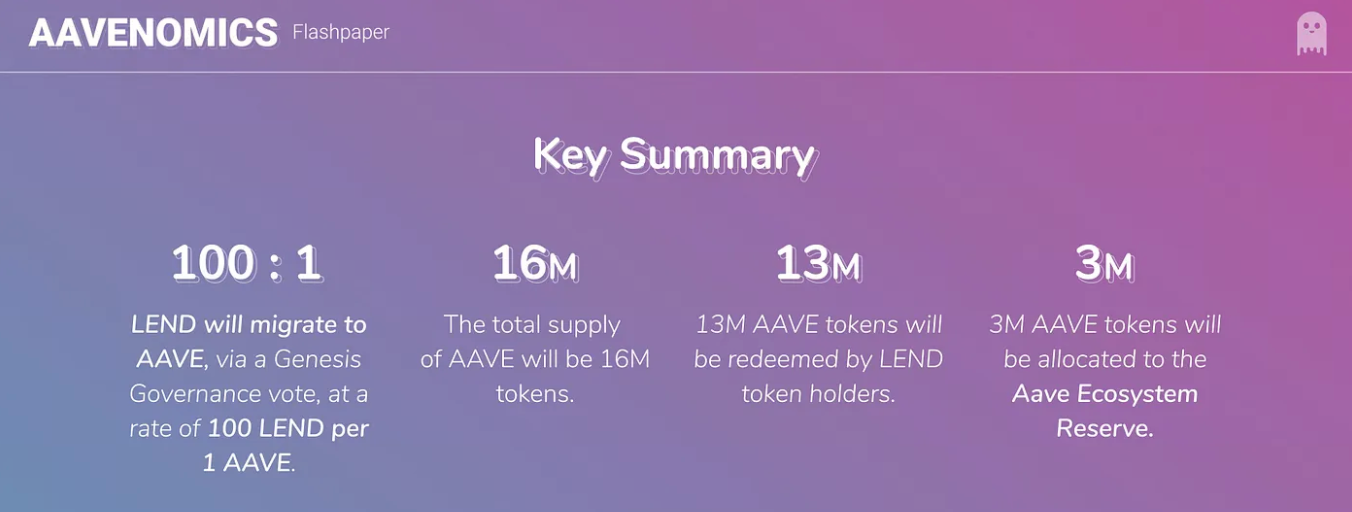 Screenshot source: Stani Kulechov Medium
AAVE holders participate in protocol governance, voting on parameter changes, asset onboarding, and upgrades—ensuring the community steers Aave’s development.
AAVE can be staked in the Safety Module; stakers earn rewards but may absorb losses in extreme events to cover protocol deficits. This decentralized insurance pool bolsters system resilience.
AAVE’s supply is capped, with no ongoing inflation. Its value derives from protocol revenue and ecosystem growth. Long-term performance is closely tied to Aave’s usage and lending volumes.
Aave V2, V3, and V4: Key Differences
Aave V2 marked a milestone in protocol maturity, optimizing collateral and stable rate models. As the multi-chain ecosystem expanded and risk management needs grew, V3 introduced major upgrades in capital efficiency and cross-chain capabilities.
| Dimension |
V2 |
V3 |
V4 |
| Capital Efficiency |
Standard |
E-Mode Enhanced |
Liquidity Hub Unified Management |
| Risk Segregation |
Limited |
Isolation Mode |
Hub & Spoke Model |
| Cross-Chain Foundation |
Deployed |
Portal for Cross-Chain Liquidity |
Spokes for Liquidity Routing |
| Risk Parameters |
Static |
Granular Dynamic Management |
Redesigned Liquidation Engine |
V3 introduces isolation mode, which confines high-risk assets to independent pools, preventing systemic impact. E-Mode raises borrowing limits for highly correlated assets, significantly boosting capital efficiency.
On the cross-chain front, V3’s Portal mechanism enables liquidity migration across networks and sharpens multi-chain expansion. Risk parameters are now more granular, with dynamic borrowing caps and liquidation thresholds.
V3 focuses on refined risk management and global liquidity integration.
In late 2025, Aave previewed V4, which builds on V3’s liquidation engine with major enhancements:
- Dynamic liquidation thresholds and automated auctions for faster, more efficient liquidations with less manual intervention;
- On-chain oracle and MEV (Miner Extractable Value) protection to minimize slippage and manipulation risk during liquidation;
- Support for partial liquidation and batch processing, allowing borrowers to reduce costs and avoid full liquidation.
 Image source: Aave
Aave vs. Compound: Lending Protocol Comparison
Compound is Aave’s main competitor. Both protocols use liquidity pools and algorithmic rates, but differ in strategy.
| Dimension |
Aave |
Compound |
| Asset Variety |
Wide range, including RWA |
Fewer, more conservative assets |
| Innovative Features |
Flash Loans, Rate Switching, E-Mode |
Core lending, minimalist design |
| Interest Rate Model |
Stable and variable rates |
Variable rate only |
| Multi-Chain Deployment |
Ethereum, Polygon, Avalanche, etc. |
Primarily Ethereum mainnet |
Aave pushes feature innovation (e.g., Flash Loans, credit delegation, multi-chain), while Compound is streamlined and conservative.
In risk management, Aave employs safety modules and isolation mechanisms for robust defenses; Compound’s risk tiering is simpler. Aave’s E-Mode boosts capital efficiency, especially for stable asset use cases.
Aave’s Main Use Cases and Applications
Beyond basic lending, Aave enables leveraged trading (borrowing stablecoins against collateral), arbitrage (using Flash Loans to capture price gaps), and institutional stablecoin yield strategies. Liquidation bots rely on Aave’s mechanisms for risk management.
Yield aggregators and other DeFi protocols use Aave as a core liquidity source, facilitating complex yield strategies. Its composability makes it a foundational building block for on-chain finance.
Aave’s Strategic Significance in DeFi
Aave’s significance extends beyond lending scale—it is a capital pricing center. Rate movements signal market liquidity conditions, serving as an on-chain benchmark.
As capital market infrastructure, Aave underpins stablecoins, derivatives, and yield platforms. Many protocols build atop its liquidity, creating a complex composable network.
Aave’s risk controls and governance are industry benchmarks, making it a testing ground for decentralized risk management. Strategically, Aave is a core pillar of DeFi.
What Risks Should Users Watch for When Using Aave?
Despite robust risk controls, users must consider several risks. Liquidation risk arises if collateral value drops rapidly—assets may be sold automatically to cover debt.
Smart contract risk remains, despite audits—unknown bugs can exist. Oracle risk can trigger erroneous liquidations if price feeds malfunction.
Stablecoin depegging and extreme market volatility also threaten stability. Governance disputes can alter protocol parameters.
Understanding these risks and managing leverage responsibly is essential when using Aave.
Summary
Aave has built a decentralized capital market through overcollateralized lending, dynamic rates, and modular risk controls. Innovations like Flash Loans, multi-chain expansion, and the Safety Module keep it at the forefront of DeFi lending.
However, higher capital efficiency brings greater complexity. Understanding Aave’s mechanisms and risk controls is crucial. For those focused on DeFi infrastructure, Aave is indispensable.
FAQs
Is there a risk of loss when depositing to Aave?
The main risk is smart contract vulnerability. Under normal operation, principal is safe, but interest rates fluctuate with utilization.
What is the “Health Factor”?
The health factor measures collateral safety versus borrowed assets. A higher value means greater safety; below 1 triggers liquidation.
Can I deposit without borrowing?
Yes. Many use Aave as a decentralized savings tool for passive yield.
Do Flash Loans require collateral?
No, but borrowing and repayment must occur within a single block or the transaction fails.
What are the main differences between Aave V3 and V4?
Aave V4 introduces the unified Hub-Spoke liquidity model.
Which chains does Aave support?
Besides Ethereum, Aave supports Polygon, Avalanche, Arbitrum, Optimism, and several other Layer 2s and public blockchains.







