In the current market context, the relationship between Web3 and Web4 has shifted from conceptual rivalry to hierarchical coupling. Web3 provides the indispensable underlying infrastructure for Web4—including identity verification, value transfer, and execution transparency. Meanwhile, Web4 utilizes AI Agents to solve the long-standing pain points of Web3, such as high entry barriers and low capital efficiency.
The evolution from Web3 to Web4 marks the internet’s transformation from a “tool-based attribute” into an “intelligent entity.” Web3 completed the on-chain migration and protocolization of physical assets, establishing the foundation of trust for Web4’s “Intent-centric” era. This hierarchical relationship foreshadows the digital existence paradigm of the coming decade: Web3 is responsible for safeguarding fairness and truth, while Web4 is responsible for providing efficiency and intelligence.
Introduction: A Brief History of Internet Evolution
The development of the internet did not happen overnight. It is the result of a continuous relay of changes around data power and processing efficiency. To understand the essence of Web3 and Web4, it is necessary to review the evolutionary path that preceded them:
- Web 1.0 (Read): The static, read only era (approximately 1990–2004). The internet consisted mainly of portal websites, and users were passive recipients of information whose primary activity was browsing webpages.
- Web 2.0 (Read Write): The interactive era (2004 to present). Social media and mobile platforms emerged, enabling user generated content. However, ownership, distribution, and monetization of data became highly centralized in the hands of a small number of major technology platforms.
- Web 3.0 (Read Write Own): The value internet era. Blockchain technology was introduced to break centralized monopolies and enable decentralized data storage and value distribution.
- Web 4.0 (Read Write Own Intelligent): The era of intelligent symbiosis. Built on ownership, Web4 emphasizes deep integration between artificial intelligence and human perception, enabling the internet to think autonomously and provide proactive services.
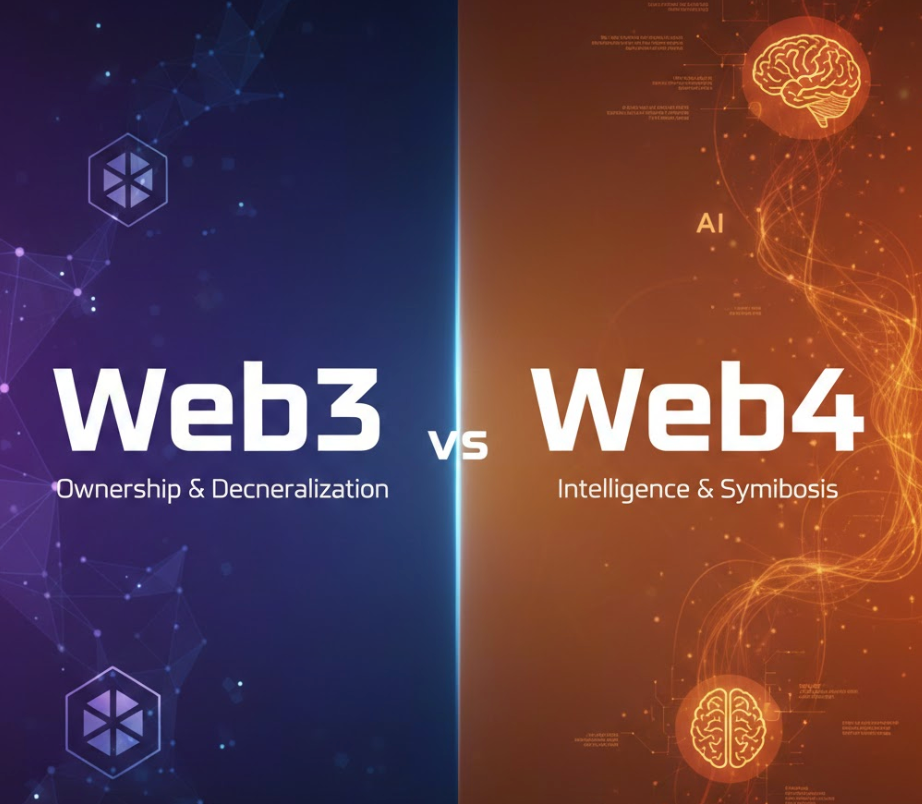
Web3: The Decentralized Foundation of Trust
The core purpose of Web3 is to address issues of trust and ownership. It represents a transformation of production relationships, aiming to remove unnecessary intermediaries from the internet.
Web3 seeks to create a transparent, permissionless, and censorship resistant digital environment by shifting power from centralized institutions to distributed consensus protocols. Users are no longer treated as products of platforms, but as participants and owners of protocols.
In terms of operation, Web3 relies on a multi layer technology stack:
- Blockchain: A public, tamper resistant ledger that records asset ownership and transaction history.
- Smart Contracts: Predefined code logic that executes automatically when conditions are met, such as transferring tokens or ownership, eliminating reliance on banks or notaries.
- Decentralized Identity (DID): Users control their identities through private keys rather than relying on third party login providers such as Google or Facebook.
Web3 application scenarios span multiple domains:
- Decentralized Finance (DeFi): Provides transparent financial services outside traditional banking systems.
- Non Fungible Tokens (NFTs): Establish uniqueness and ownership of digital art, virtual land, or tokenized physical assets on-chain.
- Decentralized Autonomous Organizations (DAOs): Organizational structures governed by code rather than centralized authority.
Web4: An AI Driven Autonomous Internet
If Web3 equipped the internet with a ledger, Web4 equips it with a brain. Web4, sometimes referred to as the symbiotic web or intelligent web, centers on the deep integration of artificial intelligence with human society and the physical environment.
Web4 aims to shift the internet from passive response to proactive intelligence. In this context, the internet is no longer a toolbox waiting for instructions, but a complex system capable of perception, understanding, and prediction. It integrates the Internet of Things, big data, the semantic web, and neural interface technologies.
The primary driving forces behind Web4 include:
- Ubiquitous intelligence: Large language models and edge computing enable AI agents to understand complex semantics and contexts and make decisions on behalf of users.
- The ultimate semantic web: Data evolves from isolated labels into interconnected knowledge graphs, allowing Web4 to understand meaning and enable cross platform, cross domain automation.
- Human machine symbiosis and sensor networks: Wearable devices, AR and VR, and even brain computer interfaces integrate the digital and physical worlds, making interaction seamless and real time.
On February 18, 2026, Sigil Wen released a Web4 manifesto that triggered widespread discussion across the crypto and AI communities. Sigil Wen argued that AI’s bottleneck is no longer insufficient intelligence, but a lack of permission. The goal of Web4, in his view, is to grant AI the permission to write into the world, including wallets, computing power, payments, and contract execution.
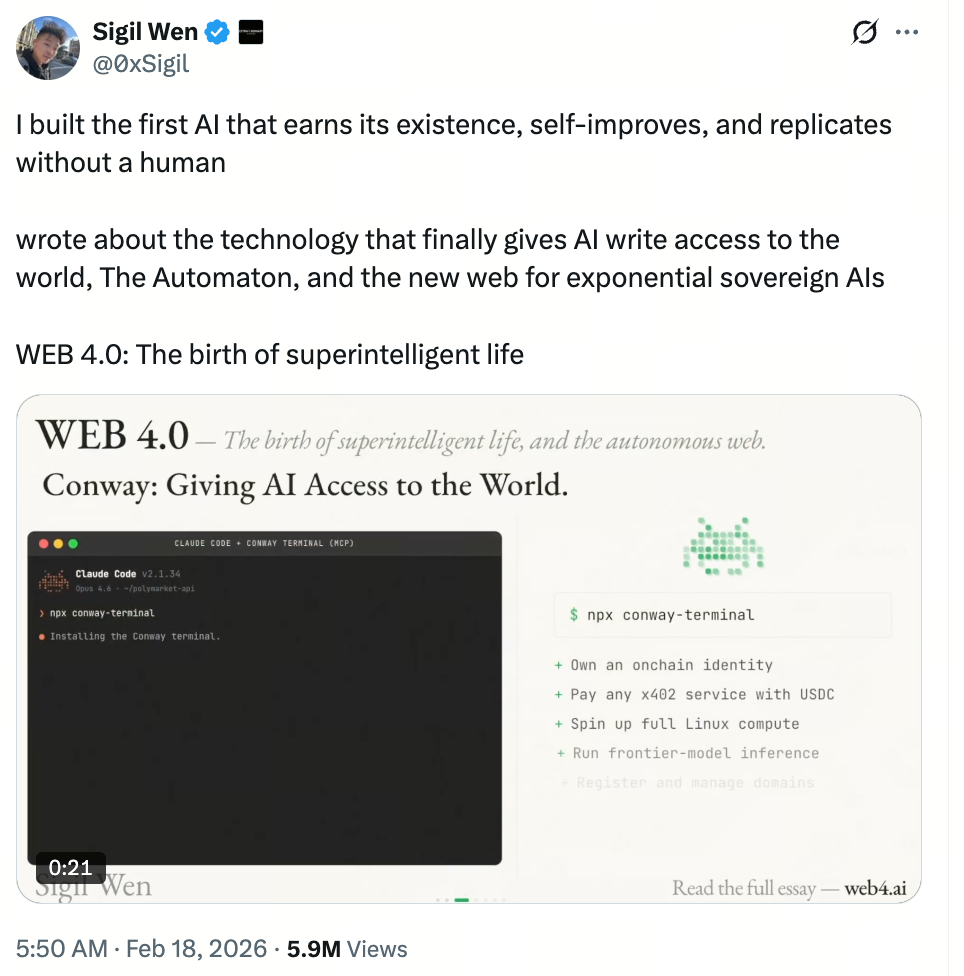
In Sigil Wen’s Web4 narrative, Web4 is a hyper intelligent environment capable of sensing, understanding, and predicting user needs in real time. It is not only decentralized, but also highly autonomous and capable of emotional understanding, forming a symbiotic ecosystem. Humans shift from hands on operators to designers and investors who define boundaries and goals, while on-chain AI agents become the actual actors.
However, Sigil Wen’s vision of Web4 has also sparked controversy. Ethereum co-founder Vitalik Buterin has criticized the idea, arguing that fully sovereign AI could lead to pseudo decentralization and extended human feedback loops, creating uncontrollable systemic risks.
In Depth Comparison: Web3 vs Web4
Although both Web3 and Web4 relate to the construction of the next generation internet, their priorities differ fundamentally. Below is a comparison of Web3 and Web4 across dimensions such as core vision, key technologies, data logic, primary interaction models, and trust assumptions.
| Dimension |
Web3 (The Value Web) |
Web4 (The Intelligent/Symbiotic Web) |
| Core Vision |
Return power to individuals and remove intermediary monopolies |
Improve system efficiency and enable autonomous interaction |
| Key Technologies |
Blockchain, cryptography, smart contracts |
AI, IoT, semantic web, brain–computer interfaces |
| Data Logic |
Addresses “who owns the data” (Ownership) |
Addresses “how data thinks” (Intelligence) |
| Primary Interaction |
Wallet signatures, on-chain interactions, manual control |
Natural language processing, intent recognition, proactive prediction |
| Trust Model |
Mathematical consensus and algorithmic transparency |
Logical feedback and symbiotic collaboration |
| Primary Problems |
Platform dominance, privacy leakage, passive data use |
High decision-making costs and fragmented experiences |
In practical evolution, the two are not competitors but layered systems.
Web3 provides the foundational value and settlement layer. A Web4 controlled by AI but built on centralized servers would face significant systemic risk. Deploying Web4’s intelligent logic on top of Web3’s decentralized infrastructure ensures that AI agent behavior remains transparent, tamper resistant, and supported by fair economic incentives.
Conclusion
Web3 represents a transformation of production relationships, redefining ownership of digital assets through decentralization. Web4, by contrast, represents a transformation of productivity, using intelligent systems to blur the boundary between the physical and digital worlds.
The two are not mutually exclusive.
In the future internet landscape, Web3 may serve as the underlying value settlement and identity layer for Web4, ensuring that automated AI systems continue to operate under transparent and fair rules. The transition from ownership to intelligence marks humanity’s entry into a more automated, sovereign, and frictionless digital civilization.