Background: Why Scaling Is Again a Core Issue
Ethereum’s scaling strategy in recent years has centered on Rollups and the data availability layer. As Layer 2 becomes the primary venue for transaction processing, Layer 1 increasingly focuses on settlement and security.
Yet, several challenges remain:
- Persistent state expansion
- Overly simplistic gas pricing models
- Rising hardware requirements for validator nodes
- Ongoing tension between scaling execution and decentralization
In this context, Vitalik’s approach to scaling is not merely about increasing block size—it represents a fundamental structural upgrade.
Short-Term Optimization: Enhancing Slot Utilization and Execution Efficiency
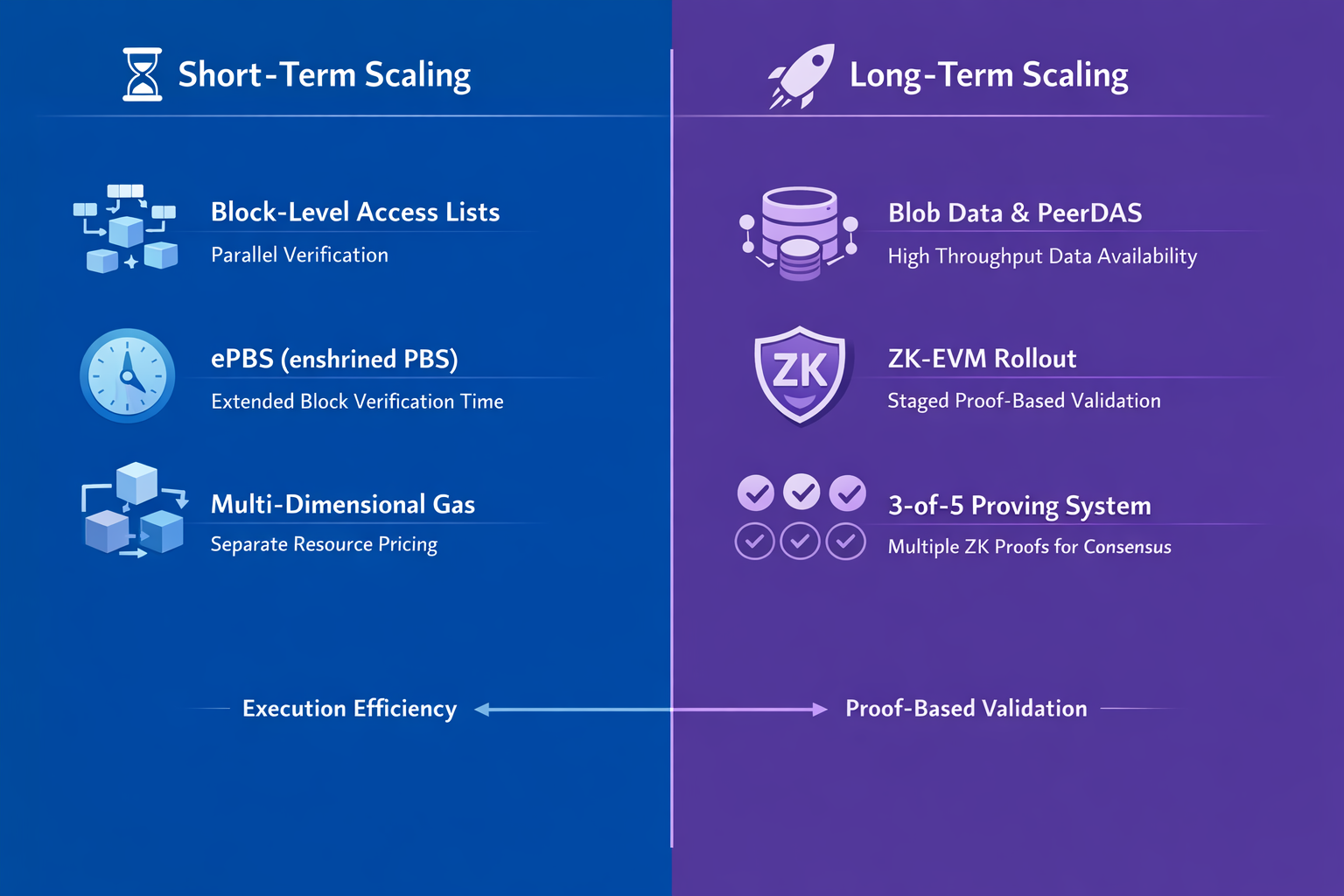
The short-term roadmap targets three main areas:
- Block-level access lists
- ePBS (Enshrined Proposer-Builder Separation)
- Gas repricing
The central objective is not simply to “increase block size,” but to maximize slot efficiency.
Currently, block verification uses only a small fraction of the slot’s available time. Excessive verification times can destabilize consensus. The ePBS design extends block verification windows, creating safer conditions for raising gas limits.
This results in:
- Conditional increases in execution capacity
- Reduced verification risk during extreme congestion
- Improved client resource utilization
It’s important to note that these gains are about “unlocking efficiency,” rather than expanding capacity by orders of magnitude.
Multidimensional Gas: Structural Reform of Resource Pricing
Multidimensional gas is the most pivotal institutional innovation in this upgrade cycle. The current EVM operates with a single gas dimension, yet blockchain workloads consume multiple resources:
- Computation
- State writes
- Data bandwidth
- Storage growth
Unified pricing for these resources distorts true costs. Vitalik’s proposal is as follows: In the first phase, separate “state creation” costs from execution costs. For example, SSTORE’s zero→nonzero operation will require additional state-creation gas.
Key points include:
- State creation gas is excluded from traditional transaction gas limits
- Execution capacity can expand
- State growth is independently constrained
This signals a clear policy direction: Execution can scale, but state must be restrained. Over the long term, multidimensional gas will allow each resource to have its own floating price, leading to profound effects:
- State resource prices may remain elevated
- Computation resources become more flexible
- Calldata and blob data will form a layered pricing structure
This model mirrors a multi-resource marketplace, rather than a single commodity market.
Blob and PeerDAS: Controlling the Data Layer’s Boundaries
For data scaling, Vitalik notes PeerDAS’s long-term target of around 8MB/sec throughput. While this figure may seem conservative, it establishes clear boundaries:
- Ethereum does not aim to be a global data storage layer.
- Blob data primarily supports Rollups and on-chain settlement.
Going forward, block data will be written directly to blobs, aligning with the ZK-SNARK system so nodes can verify state without downloading the full history.
This creates a key structure:
- ZK ensures computational correctness
- PeerDAS validates data availability
Together, these mechanisms can theoretically enable lightweight node verification even in “ultra-scaled” states.
ZK-EVM Rollout: Transforming the Verification Paradigm
ZK-EVM adoption is not a one-off replacement, but a phased trust process.
- Phase One (2026): A small group of validators may use ZK-EVM clients, but reliance is not mandatory.
- Phase Two (2027): 20% of the network relies on ZK-EVM, supporting higher gas limits.
The final phase introduces a 3-of-5 multi-proof system—each block must include three proofs from five different proof systems. Fundamentally, this shifts from “execution verification” to “proof verification.”
- Traditional blockchain: Each node re-executes the block.
- Future model: A minority generate proofs, while the majority verify proofs.
Performance Impact: The Real Change Beyond TPS
At first glance, scaling implies higher TPS. But the deeper transformation includes:
- Lower node requirements
- Structural room to raise gas limits
- Decoupling execution capacity from state growth
If ZK-EVM matures, Layer 1 could theoretically scale execution without sacrificing decentralization.
The real shift is: Verification costs fall, not execution costs. This represents a fundamentally different philosophy of scaling.
Price and Valuation Logic: Is the Risk Premium Being Repriced?
ETH’s price is driven by three factors:
- Macro liquidity
- Network revenue
- Structural risk premium
In the short term, scaling plans shape market expectations more than immediate revenue.
In the medium term, if gas limits rise and demand persists:
- Total transaction fees may increase
- EIP-1559 burn volume grows
- The logic of ETH supply contraction strengthens
Long-term effects are more significant: If verification costs decrease and network security improves, ETH’s “systemic risk premium” may drop. Lower risk premiums generally push valuation anchors higher.
This is gradual repricing, not sentiment-driven volatility.
Potential Risks and Competitive Variables
Every technology upgrade carries uncertainty.
- ZK-EVM complexity is extremely high
- Multi-proof systems may expand the attack surface
- Provers could become concentrated in computing power
- Multidimensional gas may increase developer adaptation costs
Moreover, if other public chains choose simpler scaling routes, market understanding and patience for complex structures will become a key variable.
Conclusion: ETH’s Long-Term Structural Trajectory
This round of scaling is not simply about performance gains—it aims to resolve three persistent contradictions for Ethereum:
- Scaling execution vs. decentralization
- State expansion vs. sustainability
- Verification cost vs. security
If multidimensional gas and ZK-EVM are successfully implemented, Ethereum will shift from an “execution-verification chain” to a “proof-verification chain.” This marks a paradigm upgrade.
- For performance, it enables sustainable scaling;
- For structure, it abstracts verification;
- For price, it compresses the risk premium over the long term.
Short-term market volatility may not capture this change, but long-term value depends on structural stability. If the system operates smoothly, ETH could evolve from a smart contract platform to the foundational settlement layer for global verifiable computation. The real impact is not in TPS figures, but in whether Ethereum successfully completes this shift in the verification paradigm.







