Introduction: Efficiency Constraints in Traditional Bank Settlement and New Technology Pathways
In the traditional financial system, interbank settlements depend heavily on centralized clearing networks like Fedwire, ACH, and SWIFT. These systems are mature in terms of stability and compliance, but they face long-standing structural limitations. Settlements only operate on business days, with fund flows restricted during holidays and weekends. Cross-institutional clearing cycles often require several days to complete, creating challenges for banks' liquidity management and capital efficiency.
In response, global payment networks are actively exploring new technology solutions. Recently, payment giant Visa took a significant step by introducing blockchain-based stablecoins into interbank settlement systems, paving the way for convergence between traditional finance and crypto infrastructure.
Visa USDC Settlement Service: Institutional-Grade Stablecoin Clearing Mechanism
Source: https://x.com/VisaNews
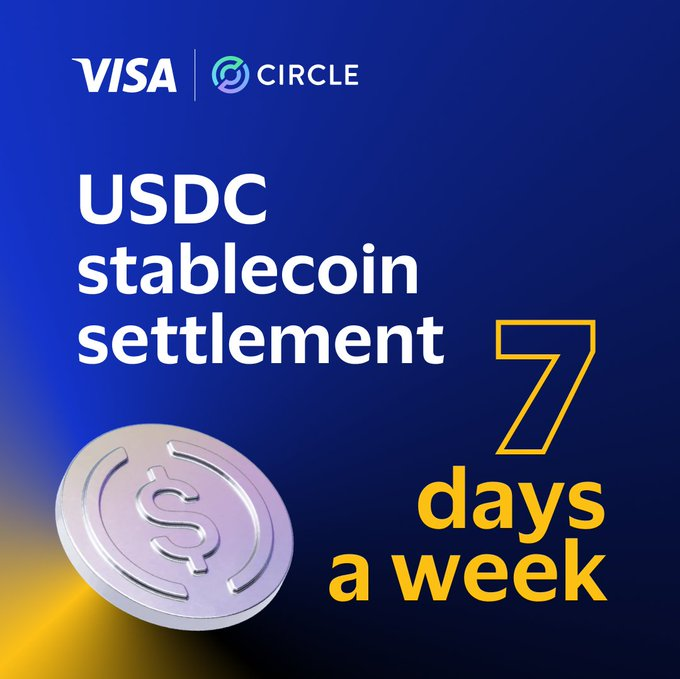
In December 2025, Visa announced it would launch a stablecoin settlement service for banks in the US market. This service enables participating institutions to use USDC—a US dollar stablecoin issued by Circle—to settle Visa network transactions on the Solana blockchain.
Cross River Bank, Lead Bank, and other institutions are among the first participants in this pilot program. Visa plans to expand the service to more banks and fintech companies throughout 2026.
In essence, banks can now settle Visa transactions directly using USDC, reducing their reliance on traditional bank transfer systems. This approach introduces new possibilities for settlement speed, programmable funds, and system openness.
Why Visa Selected Solana as an Initial Settlement Network
For its blockchain network selection, Visa opted not to pursue a multi-chain strategy but instead prioritized Solana as a foundational network for USDC settlement. The main reasons include:
- High throughput and low transaction costs, meeting the needs of high-frequency, large-scale institutional settlements
- Fast confirmation times, supporting real-time or near-real-time fund clearing
- Stable network performance, fulfilling financial institutions’ requirements for system continuity
With Solana, banks can achieve uninterrupted 24/7 settlement, including weekends and public holidays—capabilities that have long been restricted in traditional bank clearing systems.
Practical Implications for US Banks and Payment Institutions
For banks and financial institutions, adopting USDC for settlement is not about replacing the current system but structurally optimizing back-end processes:
Settlement efficiency improves significantly—funds can be cleared around the clock, reducing dependence on limited settlement windows.
Liquidity management becomes more flexible—on-chain settlement enables rapid fund allocation between accounts and systems, lowering idle liquidity costs.
Technology upgrades within a compliance framework—blockchain can serve as a back-end clearing tool within regulatory permissions, boosting operational efficiency without altering the end-user experience.
For everyday consumers, the card payment experience remains virtually unchanged. However, the payment system’s settlement layer is undergoing a major modernization.
Quantifying Improvements in Fund Flow Efficiency
Since 2021, Visa has tested USDC-based settlement and gradually expanded stablecoin settlement scenarios worldwide. As of November 2025, Visa’s annualized stablecoin settlement volume exceeded $3.5 billion.
Compared with traditional clearing mechanisms, blockchain-based settlement offers clear advantages in fund arrival speed, transparency, and cross-system collaboration efficiency—laying a solid foundation for future large-scale adoption.
Regulatory Developments and Institutional Support
The rollout of this service is closely linked to the increasing clarity of US stablecoin regulation. Recently, Circle received regulatory approval to establish a national trust bank and is simultaneously advancing new blockchain infrastructure, such as Arc. The strategic partnership between Visa and Circle reflects how traditional payment institutions are building long-term technology strategies around compliant stablecoins.
More clearly defined regulatory boundaries help reduce compliance uncertainty for banks adopting stablecoin settlement solutions.
Ongoing Risks and Practical Challenges
Despite promising prospects, integrating stablecoin settlement with traditional financial systems still presents several challenges:
- Blockchain network stability and security require long-term validation
- Regulatory frameworks for stablecoins differ across jurisdictions
- Banks face lengthy risk assessment and system integration timelines for new technologies
Consequently, stablecoin settlement is likely to be adopted incrementally, rather than completely replacing traditional clearing systems in the short term.
Future Trends: Structural Evolution of the Settlement Layer
From an industry perspective, Visa’s initiative may drive several long-term trends:
- Banks will gradually introduce crypto asset infrastructure as back-end tools
- Blockchain’s role in payment and settlement layers will continue to grow
- Stablecoins will become a standardized option for inter-institutional fund operations
Visa’s approach may serve as a model for integrating traditional payment networks with blockchain technology.
Conclusion
Visa’s introduction of USDC stablecoin settlement in the US market marks a pivotal step toward an always-on, high-efficiency, and programmable financial settlement system. By leveraging Solana’s performance and the value stability of stablecoins, this model offers banks and financial institutions more flexible settlement pathways.
As more institutions join and the regulatory environment becomes clearer, blockchain-based settlement solutions are poised to become a critical part of institutional financial infrastructure.