Would you believe it if someone told you that some savvy traders can actually make money by predicting the weather and temperature?
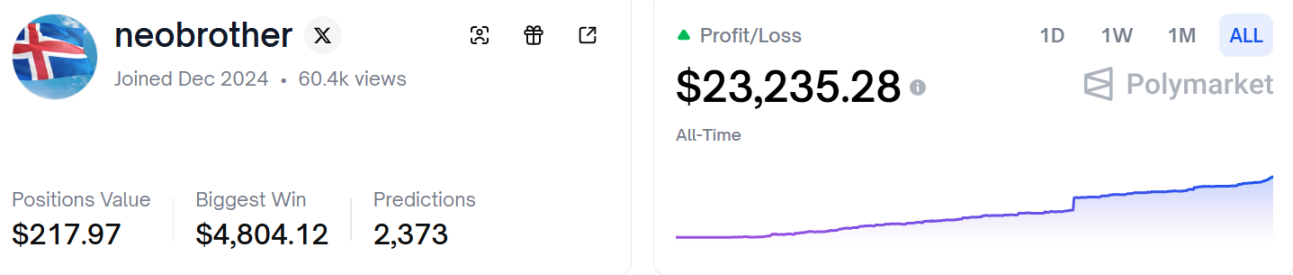
The trader above, known as neobrother, has been aggressively betting on city weather outcomes on Polymarket, amassing over $20,000 in profits. Far from a reckless speculator, he’s a highly data-driven specialist with a focus on niche markets and a strong command of odds and leverage. Nearly all of neobrother’s trades are concentrated in weather prediction markets, particularly on daily high temperatures across major global cities such as Buenos Aires, Miami, Ankara, Chicago, and New York.
He doesn’t wager on broad market trends—he bets on accuracy, operating much like a grid-based arbitrageur in meteorology.
Take Buenos Aires as an example. Rather than backing a single temperature, he applies a “laddering” strategy, simultaneously purchasing “Yes” positions for 29°C, 30°C, 31°C, 32°C, 33°C, and even 34°C+. This approach resembles a strangle strategy or grid trading in options, where he places a cluster of low-priced orders (0.2¢–15¢) within a highly probable temperature range. If the final temperature lands anywhere in this range, the outsized gains from one or two positions—like the 811.78% return from 31°C—more than offset losses on other rungs, resulting in significant profits.
He’s also adept at capturing ultra-low probability opportunities. Most of his prediction market entries are at extremely low prices. For instance, his average entry for the 32°C outcome in Buenos Aires was just 0.7¢, giving him nearly 142x potential odds. The screenshot shows this position has risen to 5¢ (a 733% gain).
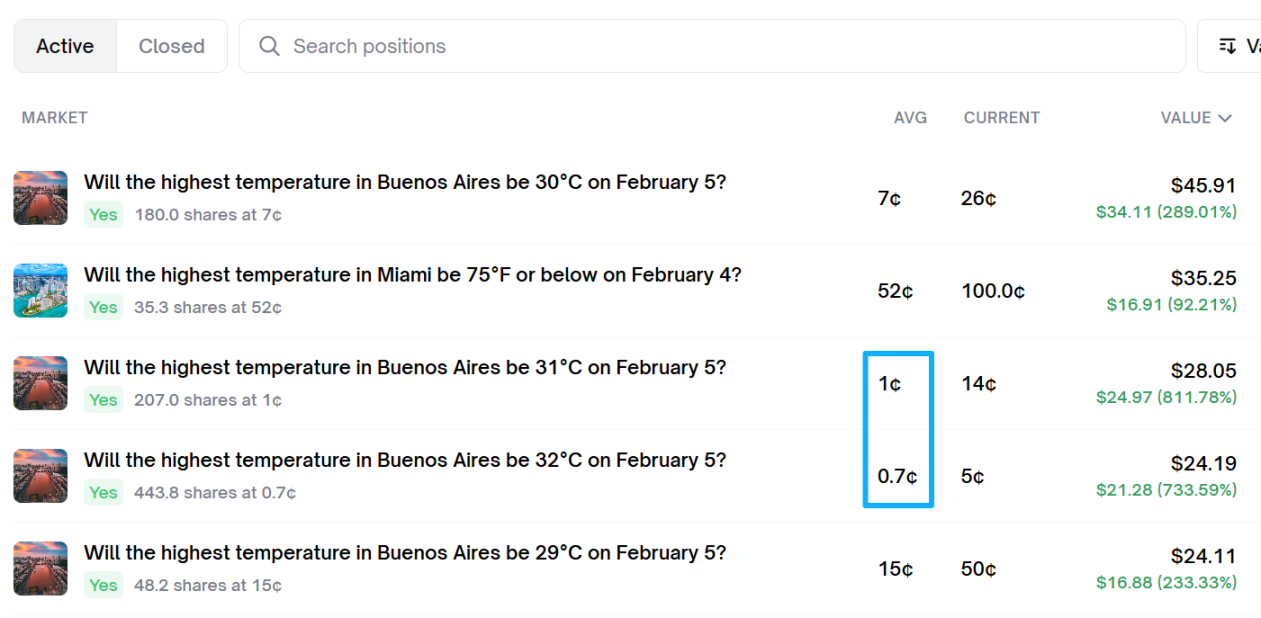
He leverages minimal cost to capture price swings driven by deviations in weather forecasts. This style demands deep expertise in meteorological models like ECMWF or GFS and the ability to act decisively when market prices lag behind forecast updates.
His 2,373 predictions highlight an extremely high-frequency, highly automated or systemized trading approach. He’s likely a quantitative or semi-quantitative trader, using scripts to monitor weather forecast changes in real time and place orders instantly. He never locks large sums into single positions, but instead consistently pursues outsized returns with minimal risk, quickly withdrawing profits or compounding them in subsequent rounds.
He may have access to weather data sources that are more accurate and timely than those available to most retail traders on Polymarket—possibly through direct integration with meteorological APIs. Politics and sports are filled with noise, but weather is pure physics and math. With a precise model, this market becomes a reliable cash machine.
If neobrother is a “weather geek” running laboratory-precision calculations on the elements, then Hans323 is Polymarket’s “black swan hunter” and “odds master.” In London’s weather market, Hans323 placed a single $92,000 bet with only an 8% chance of success and walked away with a staggering $1.11 million profit.
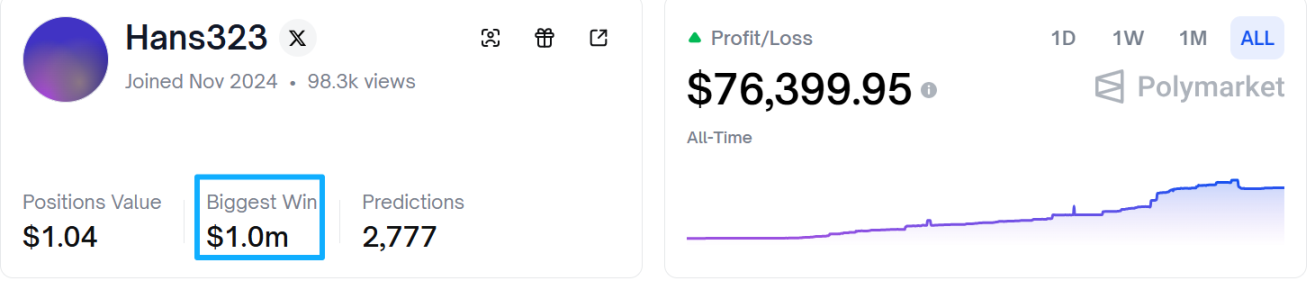
Hans323’s approach goes far beyond basic forecasting—he exploits extremely asymmetric risk-reward profiles to achieve large-scale capital gains.
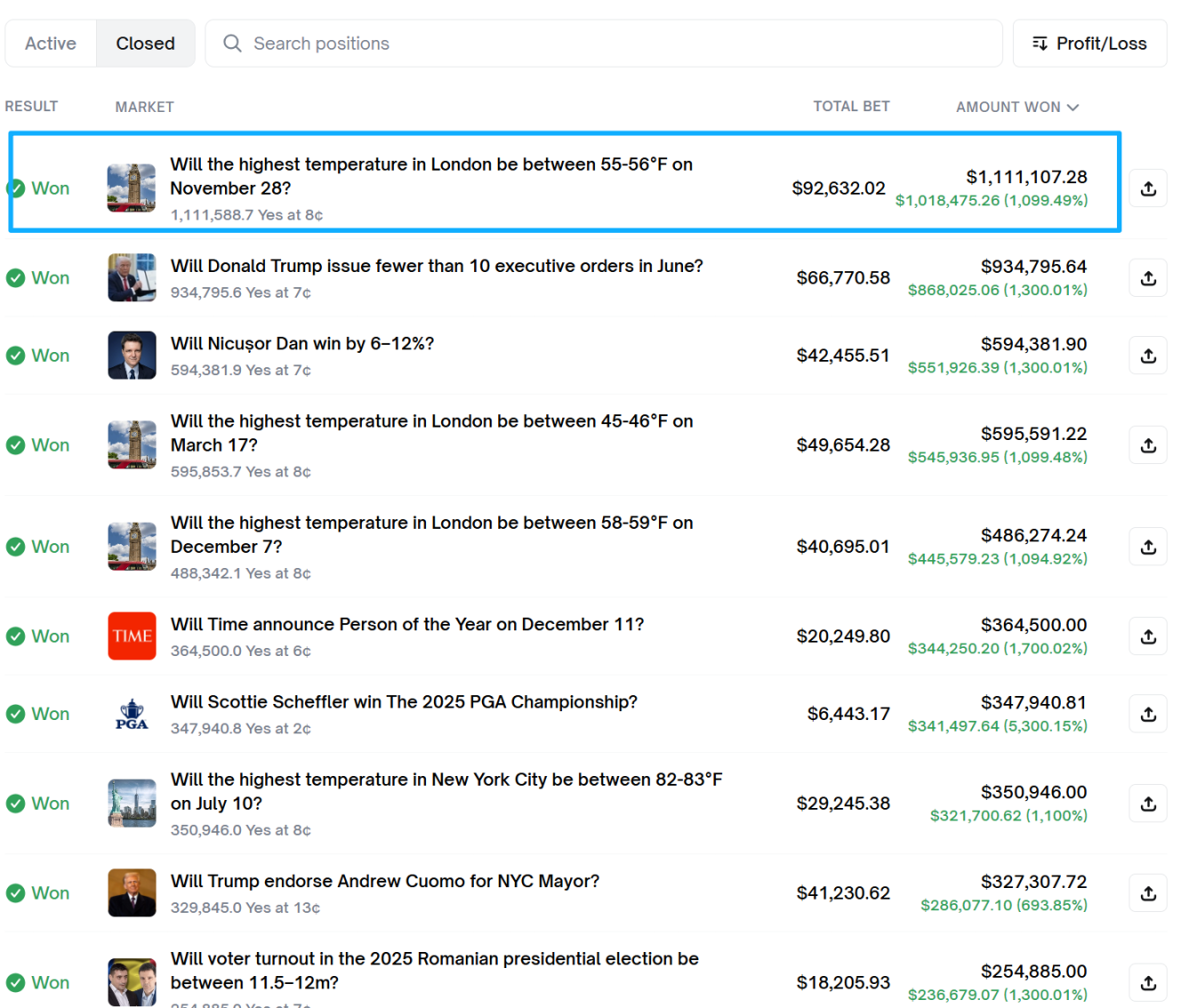
Reviewing his winning trades, entry prices typically range from 2¢ to 8¢. In prediction markets, this means the market assigns just a 2%–8% probability to the outcome. While most participants might risk only $10 on a 2¢ contract, Hans323 committed $92,632 at the 8¢ level for a London temperature bet.
This strategy is reminiscent of hedge fund manager Nassim Taleb’s leveraged investing playbook: he’s unfazed by a 90% failure rate, because a single 1,100% or even 5,300% return can offset thousands of failed attempts.
Unlike neobrother’s “laddered coverage,” Hans323 prefers to deploy large capital on specific, statistically skewed narrow positions—requiring exceptional confidence and robust underlying models.
Additionally, a review of his historical trades suggests he’s a versatile operator, likely backed by a strong data scraping team or specialized intelligence sources. In politics, for example, he bet on Trump issuing fewer than 10 executive orders in June (7¢ entry); in sports, he bought Scottie Scheffler to win the PGA at rock-bottom odds (2¢); and in culture, he successfully predicted TIME’s Person of the Year (6¢)—all with impressive results.
While profit is the goal, ordinary users tracking top traders on Polymarket should look beyond win rates and closely monitor capital allocation and personal risk management. The impact of a major loss varies dramatically based on individual risk tolerance.
Disclaimer:
- This article is republished from [ForesightNews]. Copyright belongs to the original author [Ma He]. If you have concerns regarding this republication, please contact the Gate Learn team for prompt resolution in accordance with established procedures.
- Disclaimer: The views and opinions expressed in this article are solely those of the author and do not constitute investment advice.
- Other language versions of this article are translated by the Gate Learn team. Reproduction, distribution, or plagiarism of this translation is prohibited without proper attribution to Gate.







