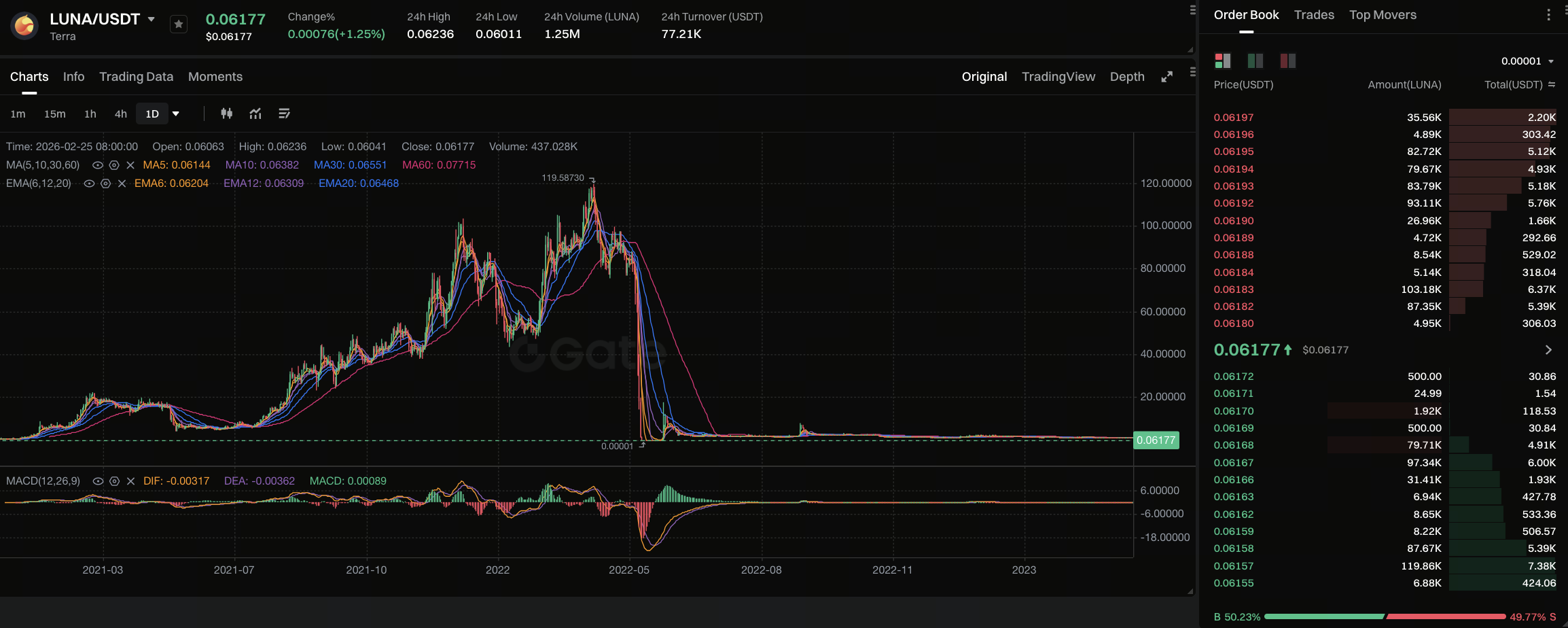
In May 2022, Terra Luna and its algorithmic stablecoin TerraUSD (UST) lost nearly all value within just a few days, wiping out about $40 billion in market capitalization. This event stands as one of the most catastrophic systemic collapses in crypto history.
Debate over the “truth behind the Luna crash” has long focused on two main narratives:
- Some attribute the collapse to a fundamental flaw in the algorithmic design
- Others question whether institutional early withdrawals or information asymmetry played a role
This article examines the event using public information, analyzing it from three dimensions: mechanism, market structure, and key points of contention.
The Mechanism Behind the Luna Collapse: Structural Flaws of Algorithmic Stablecoins
The Terra ecosystem’s core mechanism operated as follows:
- UST maintained its $1 peg through a “mint-and-burn arbitrage mechanism” with LUNA
- If UST fell below $1, users could exchange $1 worth of LUNA for 1 UST
- If UST rose above $1, UST could be burned to mint LUNA
In theory, this created a “market arbitrage stabilization system.” However, UST had no real dollar reserves—its stability depended entirely on market confidence and the ongoing participation of arbitrage capital. When the Anchor protocol saw massive withdrawals in early May 2022, UST came under depegging pressure. As selling intensified, large amounts of LUNA were minted to absorb the shock, causing supply to skyrocket and prices to collapse rapidly.
This is a textbook case of a death spiral: once confidence evaporates, the mechanism accelerates the collapse rather than restoring stability.
Market Liquidity Shocks: How On-Chain Runs Escalate
The UST collapse unfolded in three distinct phases:
- Curve liquidity pools became imbalanced
- Large-scale UST sell-offs followed
- Secondary market confidence collapsed entirely
On-chain data shows significant liquidity withdrawals during critical periods. This led to speculation: did some parties anticipate the depegging risk and exit early?
However, it’s crucial to note: large on-chain transactions ≠ market manipulation, and proactive risk management ≠ illegal activity.
In high-frequency quantitative markets, risk management systems automatically reduce exposure during liquidity anomalies—this is standard market practice.
Institutional Controversy: Jane Street and Jump—Rumor Versus Reality

Image source: https://x.com/BSCNews/status/2026142481084240288
Jane Street and Jump Trading are frequently cited in public discussion.
Why?
- Both are top global market-making and quantitative trading firms
- They have been active in crypto markets
- They participated in early crypto liquidity provision
Additionally, Sam Bankman-Fried previously worked at Jane Street before founding FTX, reinforcing the public’s perception of a “quantitative trading network.”
However, as of February 2026:
- No court has found Jane Street or Jump guilty of manipulating the Luna market
- No public evidence shows they “orchestrated the collapse”
Lawsuits related to insider trading remain at the allegation stage. From a legal perspective, the direct cause of the Luna collapse remains mechanism failure and market panic—not proven institutional manipulation.
Regulatory Consequences: The Fate of the Founders and Company
After the collapse, U.S. regulators filed lawsuits against Terraform Labs and its founder Do Kwon.
The main allegations included:
- Misleading investors
- Failure to disclose risks
- False market statements
Terraform ultimately faced massive civil penalties, and Do Kwon entered legal proceedings. This demonstrates that regulators focused on issues of disclosure and fraud, not on any single institution “targeting” the project.
Structural Summary: The Truth Behind the Luna Collapse
Combining mechanism analysis, on-chain data, and legal developments, a relatively objective conclusion emerges:
- The UST algorithm was fundamentally fragile
- The high-yield model attracted unsustainable deposits
- Once a run began, the mechanism accelerated the collapse
- Institutional trading may have amplified volatility, but there is no conclusive evidence of “behind-the-scenes manipulation”
The Luna crash was essentially a liquidity crisis triggered by structural instability—not a single conspiracy.
Long-Term Impact on the Market
The Luna collapse reshaped three major areas:
- Algorithmic stablecoins have virtually disappeared from the mainstream
- The market is now highly cautious about “unbacked stable models”
- Regulators have accelerated efforts to establish stablecoin frameworks
Today, the significance of discussing the “truth behind the Luna collapse” lies not in chasing conspiracies, but in understanding that, in financial systems, once confidence-based assets lose liquidity support, their value can evaporate in an instant.
Conclusion
The Luna collapse was not a single-point failure, but the result of design flaws, liquidity imbalances, market panic, and high leverage. Whether institutions exited early remains a topic of debate, but based on public and legal information, no definitive conclusion has been reached.
The greatest risk in financial markets is not bad actors, but assuming “liquidity will always be there” in highly leveraged structures.







