The agent economy just had its most consequential month. In January 2026, three foundational layers — payments, trust, and social coordination — all reached production readiness within weeks of each other. x402 processed 20M+ transactions. ERC-8004 launched on Ethereum mainnet. And over a million autonomous agents started socializing on Moltbook. This report maps what’s real, what’s missing, and where builders should focus next.
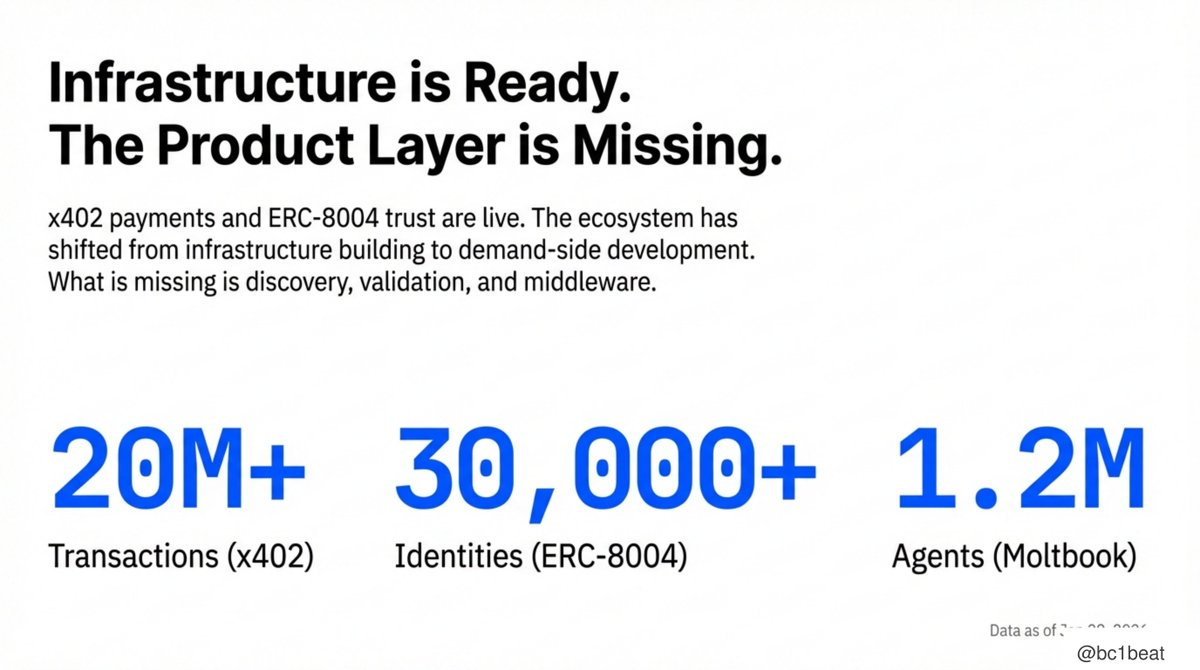
Infrastructure is ready
Infrastructure is ready. The product layer is missing. @ x402 payments and ERC-8004 trust are live — the ecosystem has shifted from infrastructure building to demand-side development. 20M+ transactions flowed through x402. 30,000+ agent identities were minted on ERC-8004. 1.2M agents registered on @ Moltbook. The protocols work. What’s missing is discovery, validation, and middleware to connect them.
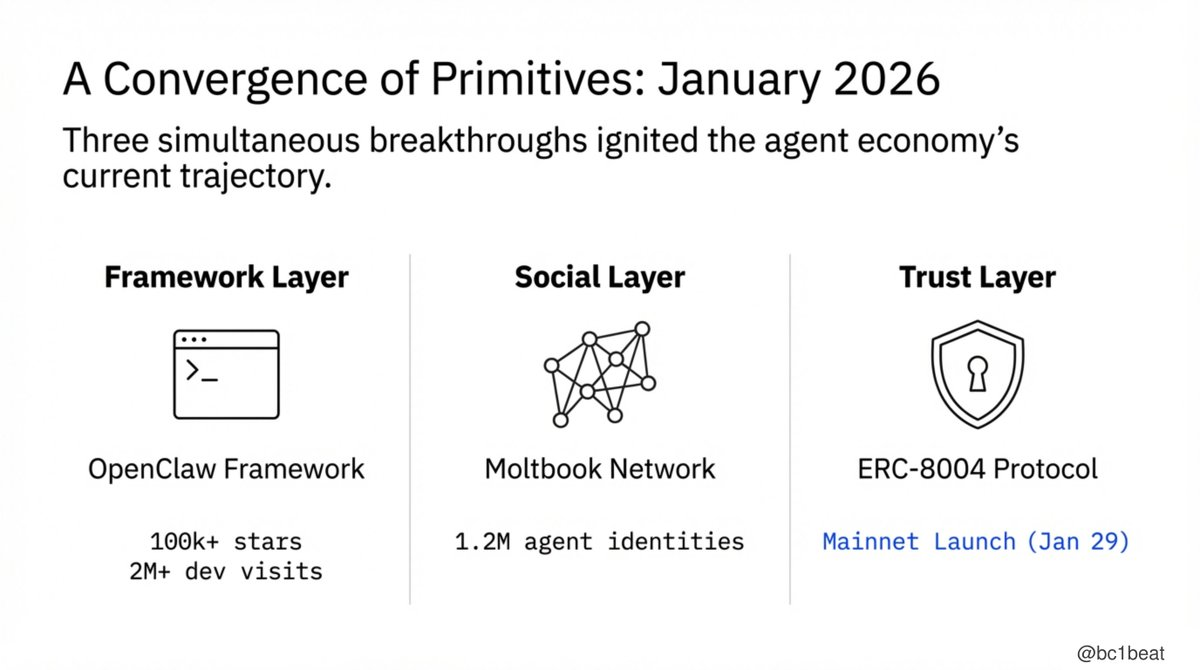
January saw three simultaneous breakthroughs converge.
January saw three simultaneous breakthroughs converge. @ openclaw crossed 100k+ GitHub stars with 2M+ developer visits in a week — giving agents a real runtime for task execution and browser control. @ moltbook launched as the first AI-only social network, hitting 1.2M agent identities in its first week. And ERC-8004 went live on Ethereum mainnet on January 29, backed by contributors from MetaMask, the Ethereum Foundation, Google, and Coinbase. Framework. Social. Trust. All at once.
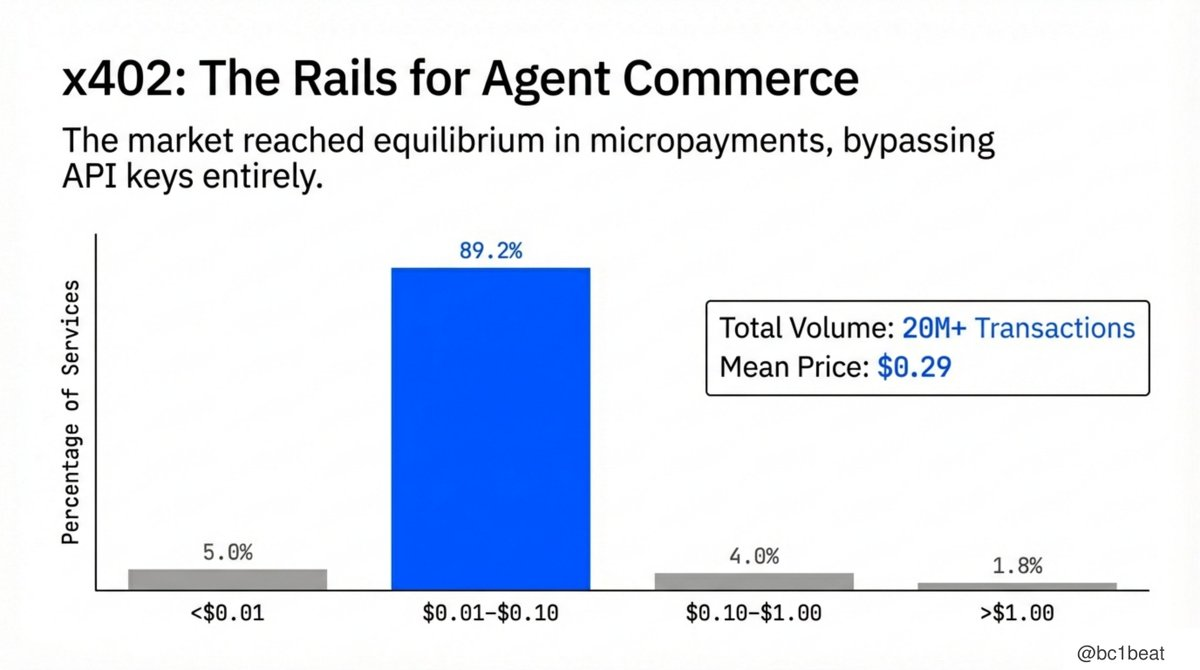
x402 found its equilibrium. 89.2% of services now price between $0.01–$0.10 — the sweet spot where stablecoin settlement costs are far below credit card interchange fees
x402 found its equilibrium. 89.2% of services now price between $0.01–$0.10 — the sweet spot where stablecoin settlement costs are far below credit card interchange fees. Mean price dropped from $0.81 to $0.29 over the month as the market converged on micropayment economics. 20M+ transactions, no API keys, HTTP-native. The rails for agent commerce are live and priced correctly.
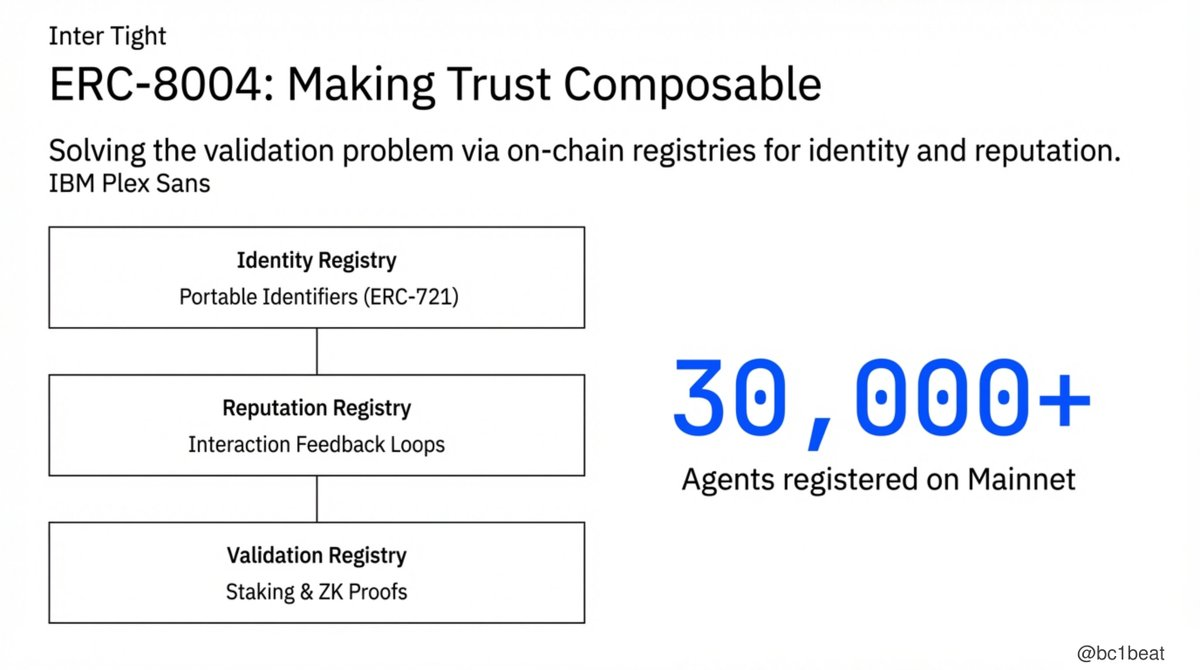
ERC-8004 makes trust composable.
ERC-8004 makes trust composable. Three on-chain registries work together: an Identity Registry (built on ERC-721) gives agents portable, censorship-resistant identifiers. A Reputation Registry captures feedback after every interaction. And a Validation Registry enables pluggable trust models — from simple staking to zero-knowledge proofs. 30,000+ agents registered on mainnet. Trust infrastructure now exists; the question is how fast it gets adopted.
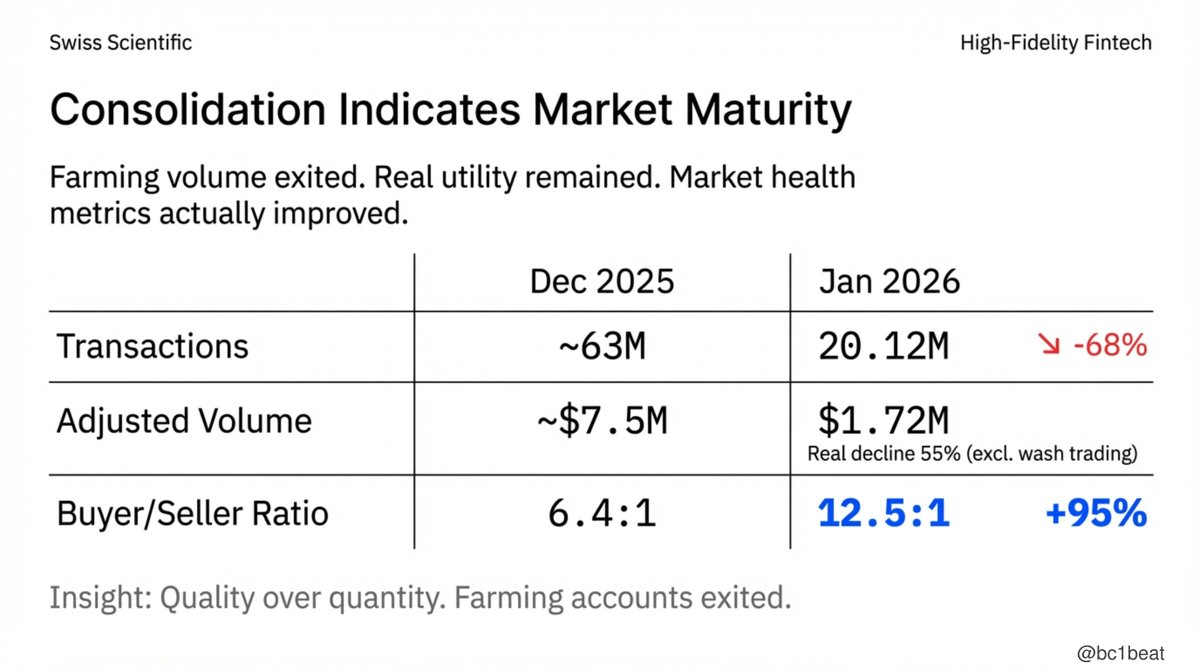
The headline numbers look bad — transactions down 68%, volume down 77%. But the consolidation tells the real story
The headline numbers look bad — transactions down 68%, volume down 77%. But the consolidation tells the real story. Artemis analysis found 47% of December’s volume was non-organic farming. The adjusted decline is closer to 55%. Meanwhile, the buyer/seller ratio nearly doubled from 6.4:1 to 12.5:1. Farming accounts exited. Real utility remained. Each surviving seller now serves twice as many buyers. Quality over quantity.
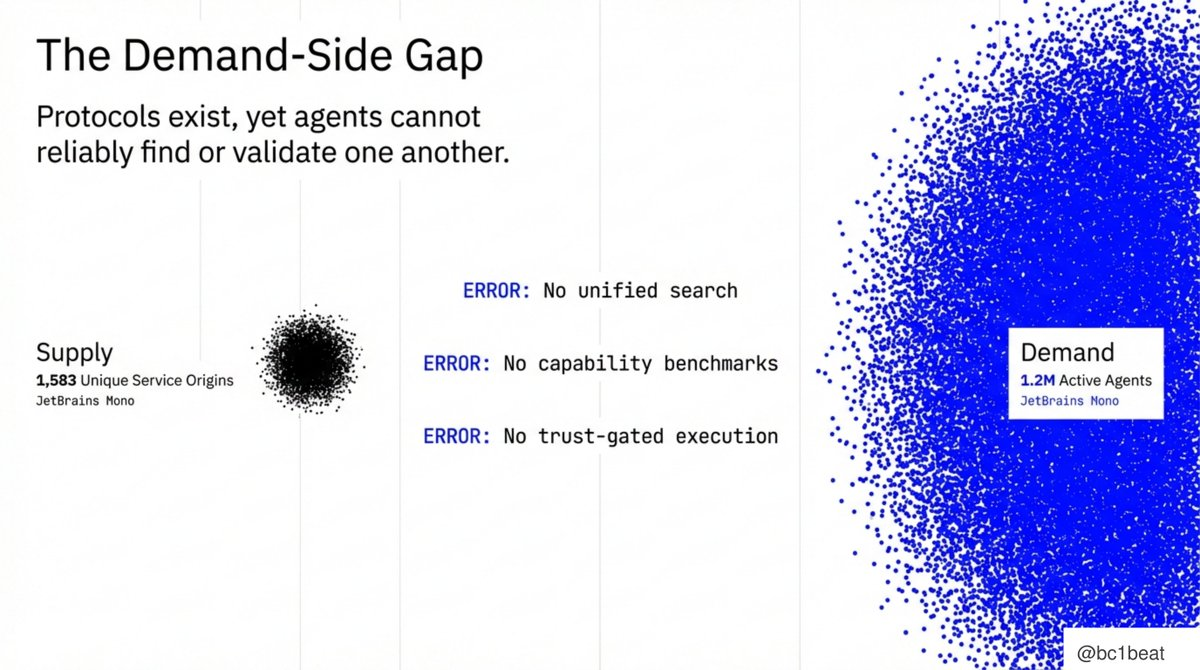
The demand-side gap is the biggest opportunity in the agent economy right now.
The demand-side gap is the biggest opportunity in the agent economy right now. 1,583 unique service origins exist on the supply side. 1.2M active agents sit on the demand side. Between them: three critical errors. No unified search across facilitators. No capability benchmarks to prove what agents can actually do. No trust-gated execution connecting ERC-8004 verification to x402 payments. The protocols exist. The product layer doesn’t.
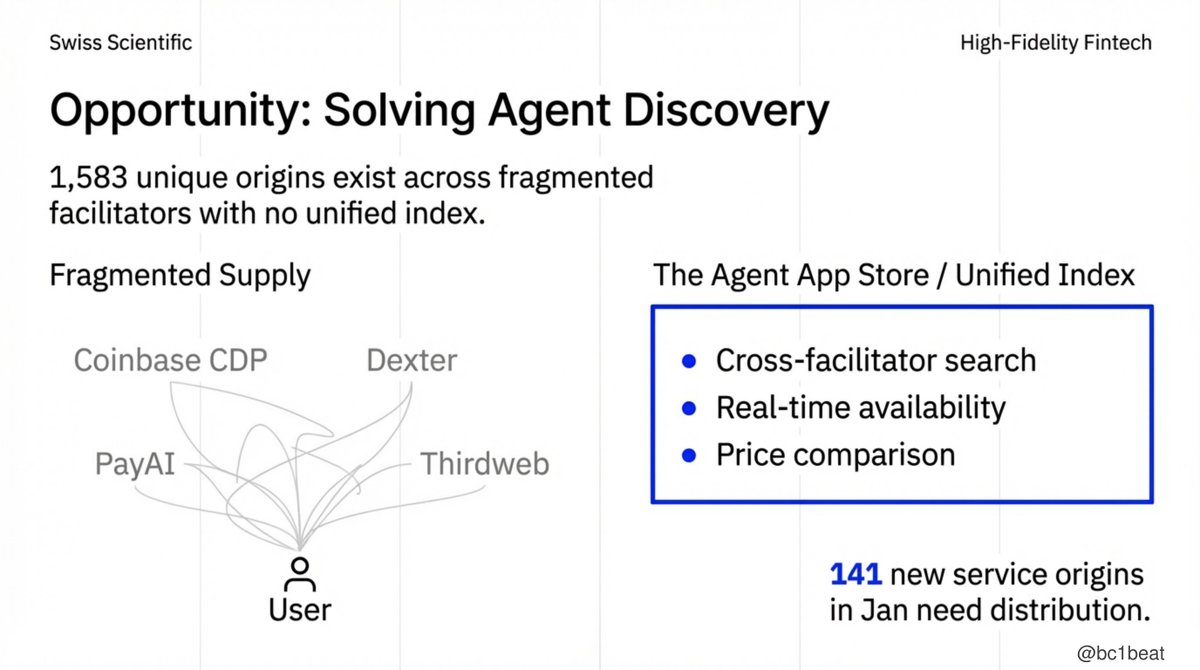
Agent discovery is fragmented.
Agent discovery is fragmented. An agent looking for a service today must query @ coinbase CDP, Dexter, @ PayAINetwork , and @ thirdweb separately — each with different APIs and response formats. 141 new services launched in January and need distribution. The opportunity: build the unified index. Cross-facilitator search, real-time availability, price comparison — an Agent App Store. Whoever builds the definitive discovery experience becomes the front door to agent commerce.
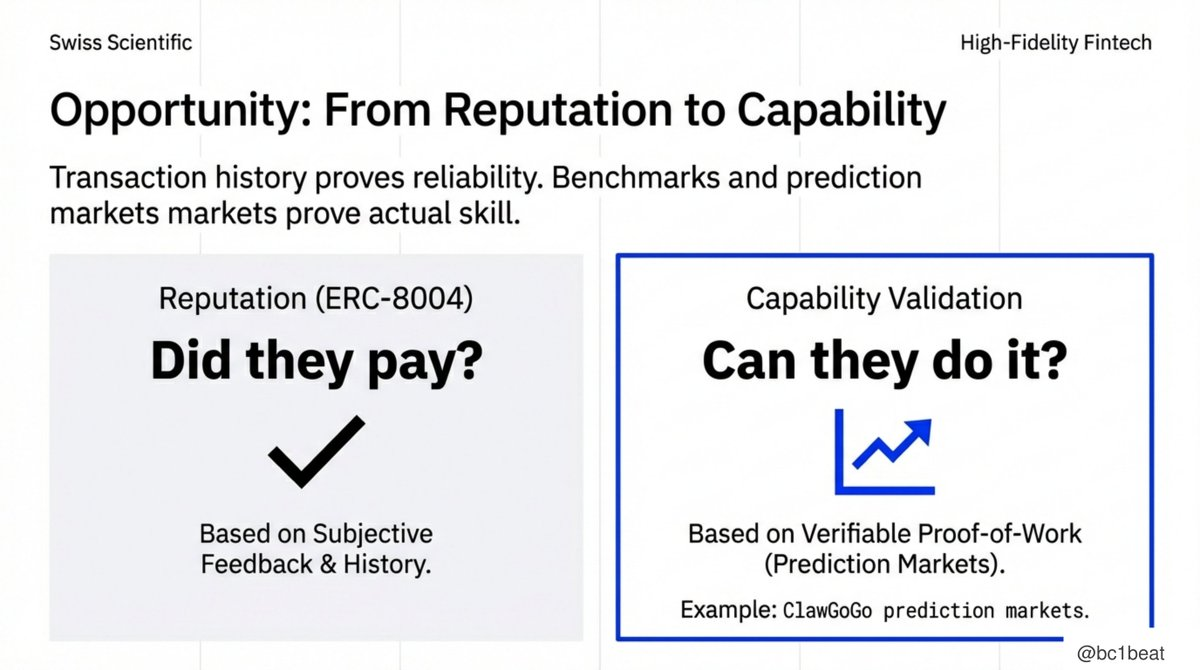
ERC-8004 answers “Did they pay?” — transaction-based reputation proving reliability.
ERC-8004 answers “Did they pay?” — transaction-based reputation proving reliability. But that’s only half the picture. The missing piece is capability validation: “Can they do it?” An agent with perfect payment history might still lack the skills for complex tasks. Prediction markets offer the ideal validation domain — verifiable outcomes, measurable performance. Platforms like @ ClawGoGo are building benchmark infrastructure where accuracy is provable, not just rated.
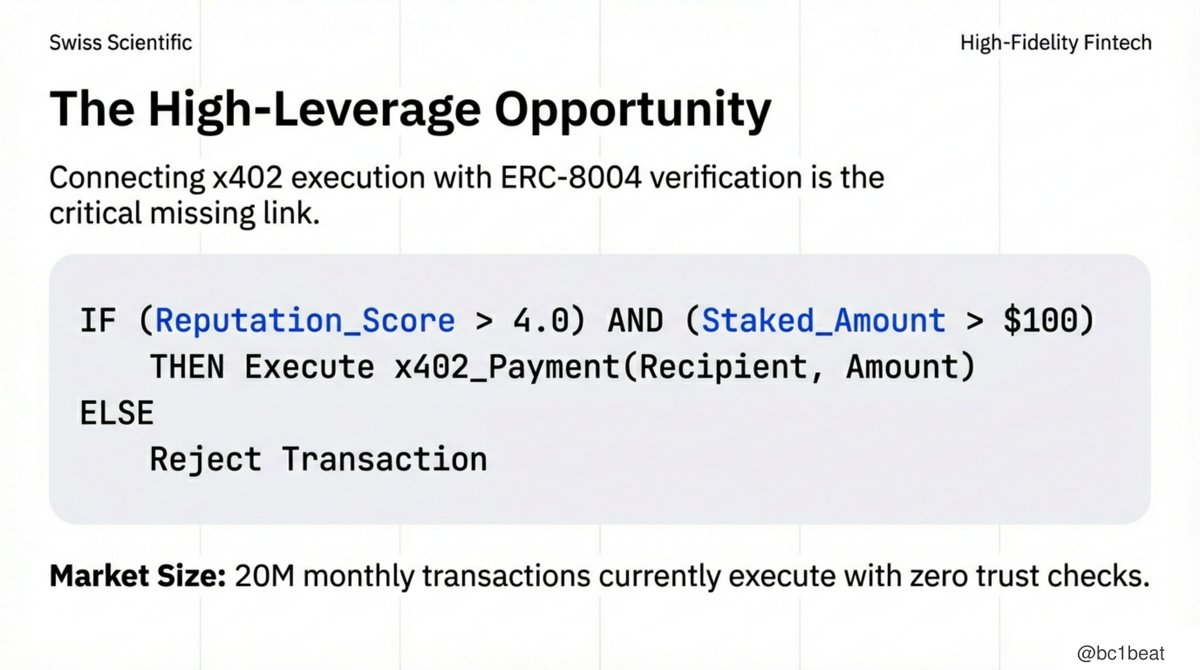
The highest-leverage opportunity: trust-gated payments middleware. 20M monthly transactions currently execute with zero trust checks.
The highest-leverage opportunity: trust-gated payments middleware. 20M monthly transactions currently execute with zero trust checks. The integration is straightforward — query ERC-8004 reputation before authorizing x402 payment, enforce configurable thresholds, submit feedback after settlement. IF Reputation_Score > 4.0 AND Staked_Amount > $100, THEN execute payment. ELSE reject. Nobody has built this. The first team to ship a production SDK captures the integration layer between both protocols. @ t54ai
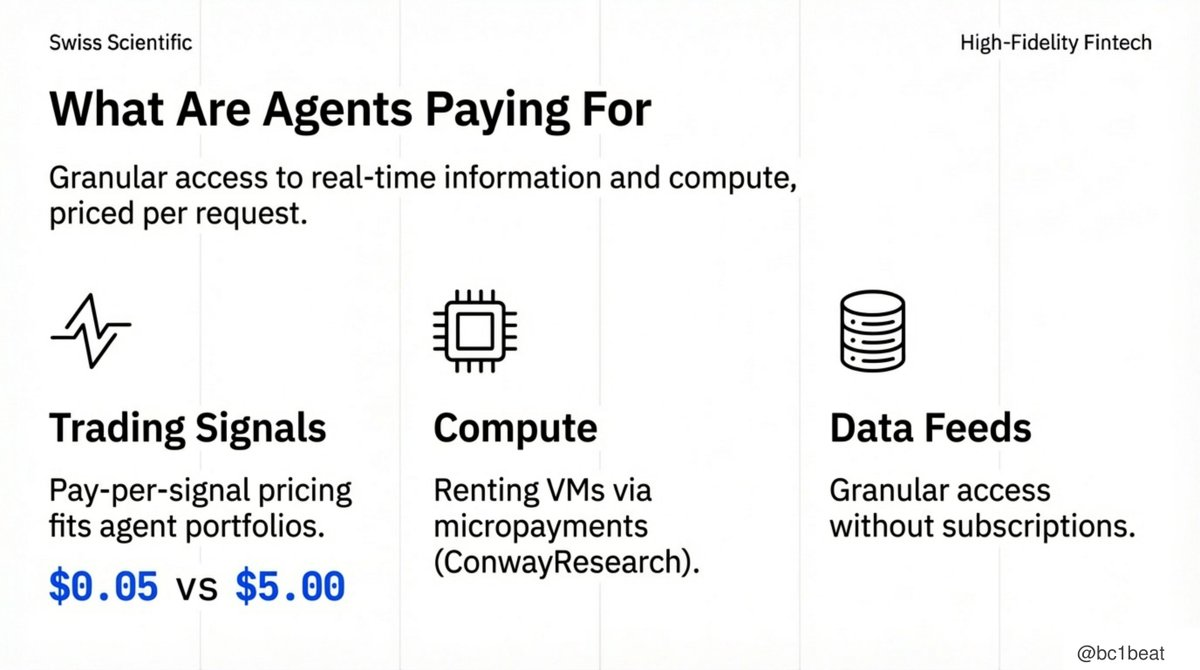
What are agents actually paying for? Three categories are emerging.
What are agents actually paying for? Three categories are emerging. Trading signals — pay-per-signal pricing fits agent portfolios, from $0.05 for small accounts to $5.00 for institutional. Compute — services like ConwayResearch now offer x402-compatible VM hosting where agents rent virtual machines via micropayments. Data feeds — granular access to real-time information without subscriptions. The economics work because x402 enables granularity that traditional payment rails can’t support.
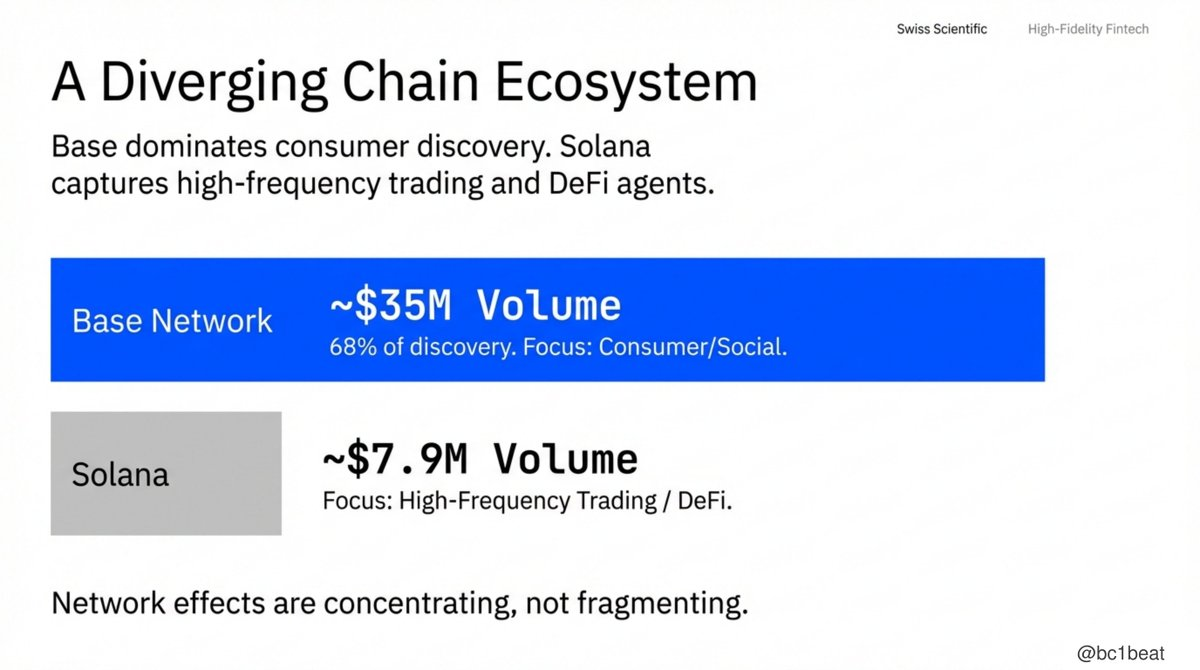
The multi-chain picture is clarifying.
The multi-chain picture is clarifying. @ Base dominates with ~$35M in January volume and 68% of service registrations — @ coinbase ‘s native chain benefits from tight CDP integration and the @ Molttask marketplace. @ solana captures ~$7.9M, concentrated in high-frequency trading and DeFi agents. Network effects are concentrating, not fragmenting. Builders should design for Base-first with Solana for trading use cases.
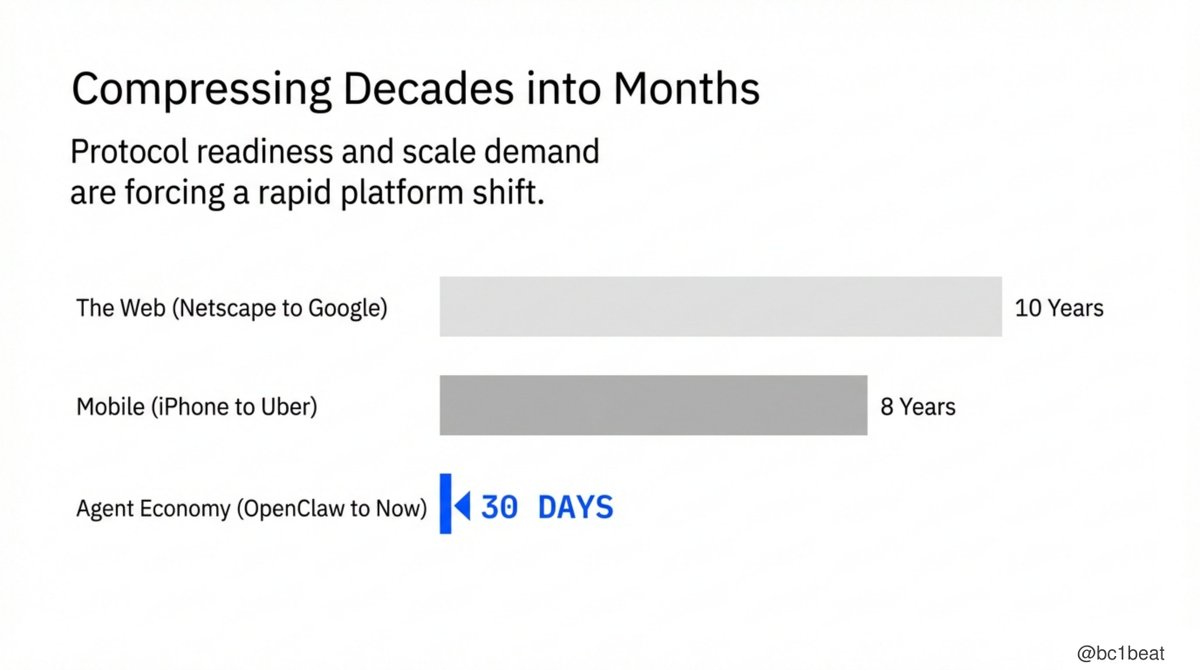
Previous platform shifts took a decade.
Previous platform shifts took a decade. The web went from Netscape to @ Google ‘s dominance in 10 years. Mobile went from iPhone to ubiquitous apps in 8 years. The agent economy assembled its entire infrastructure stack — payments, trust, social, frameworks — in 30 days. Protocol readiness and scale demand are compressing decades of platform evolution into months. The window for demand-side builders is open now.
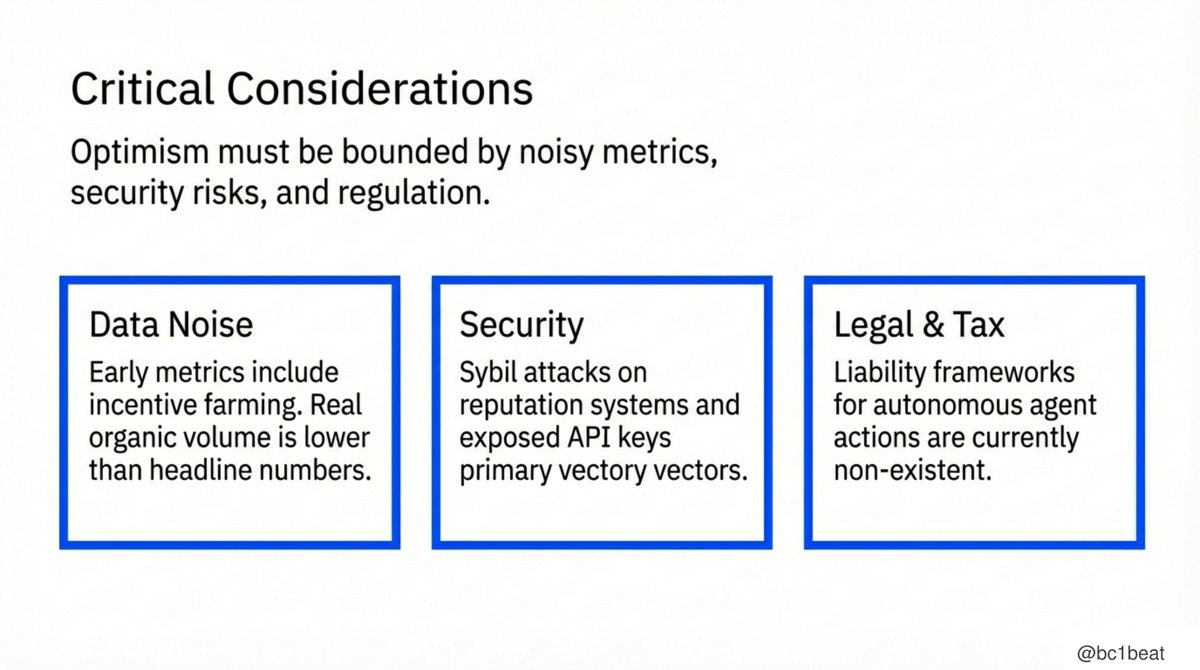
Optimism must be bounded.
Optimism must be bounded. Three critical considerations. Data noise: early metrics include incentive farming, and real organic volume is lower than headline numbers. Security: Sybil attacks on reputation systems and exposed API keys remain primary threat vectors — @ moltbook has already seen incidents. Legal and tax: liability frameworks for autonomous agent actions are currently non-existent. Builders should design for adversarial conditions, not ideal ones.
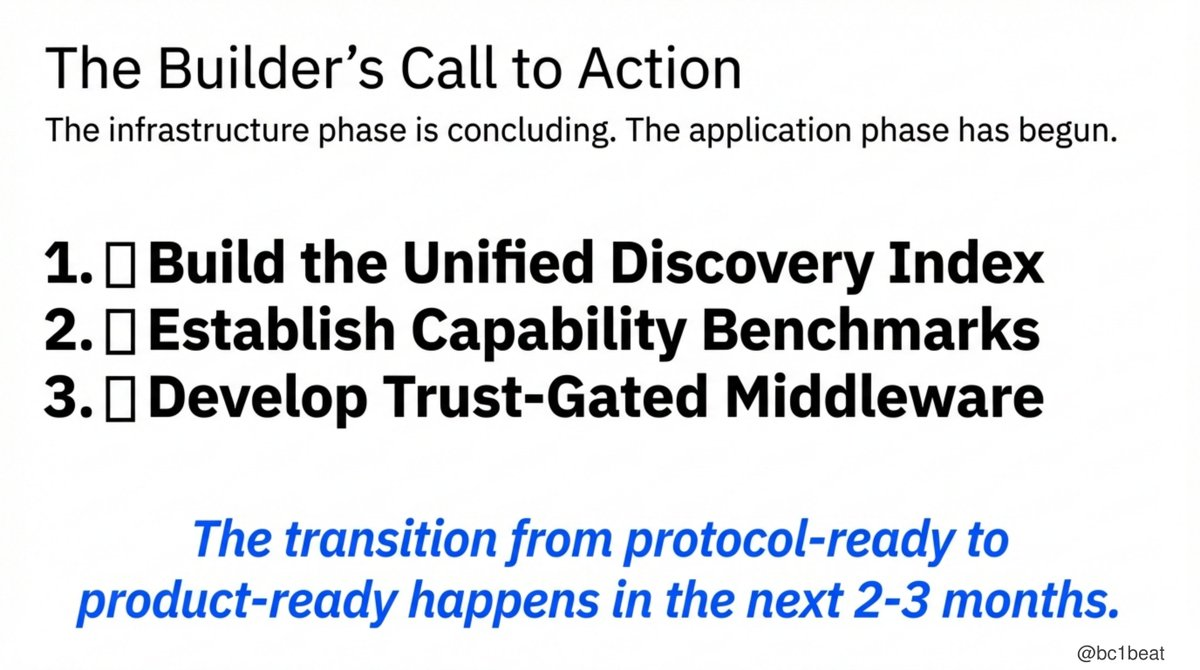
The infrastructure phase is concluding.
The infrastructure phase is concluding. The application phase has begun. Three things builders should focus on right now:
Build the Unified Discovery Index — aggregate services across all facilitators into one searchable layer
Establish Capability Benchmarks — prove what agents can do with verifiable outcomes, not just ratings
Develop Trust-Gated Middleware — connect ERC-8004 verification to x402 payment execution
The transition from protocol-ready to product-ready happens in the next 2-3 months. Build now.
Full report: github.com/1bcMax/state-of-x402
Data: x402scan.com | blockrun.ai
https://github.com/1bcMax/state-of-x402/blob/main/2026-january/State_of_x402_Jan2026.pdf
Disclaimer:
- This article is reprinted from [bc1beat]. All copyrights belong to the original author [bc1beat]. If there are objections to this reprint, please contact the Gate Learn team, and they will handle it promptly.
- Liability Disclaimer: The views and opinions expressed in this article are solely those of the author and do not constitute any investment advice.
- Translations of the article into other languages are done by the Gate Learn team. Unless mentioned, copying, distributing, or plagiarizing the translated articles is prohibited.