Why Perp DEX Will Remain a Hot Sector in 2026
While the growth of spot DEX has largely benefited from on-chain speculation and the surge of long-tail assets, the rise of Perp DEX signals a fundamental change in the structure of crypto trading. More users are moving beyond spot trading, viewing perpetual futures as essential tools for leverage, shorting, hedging, and expressing views across asset classes.
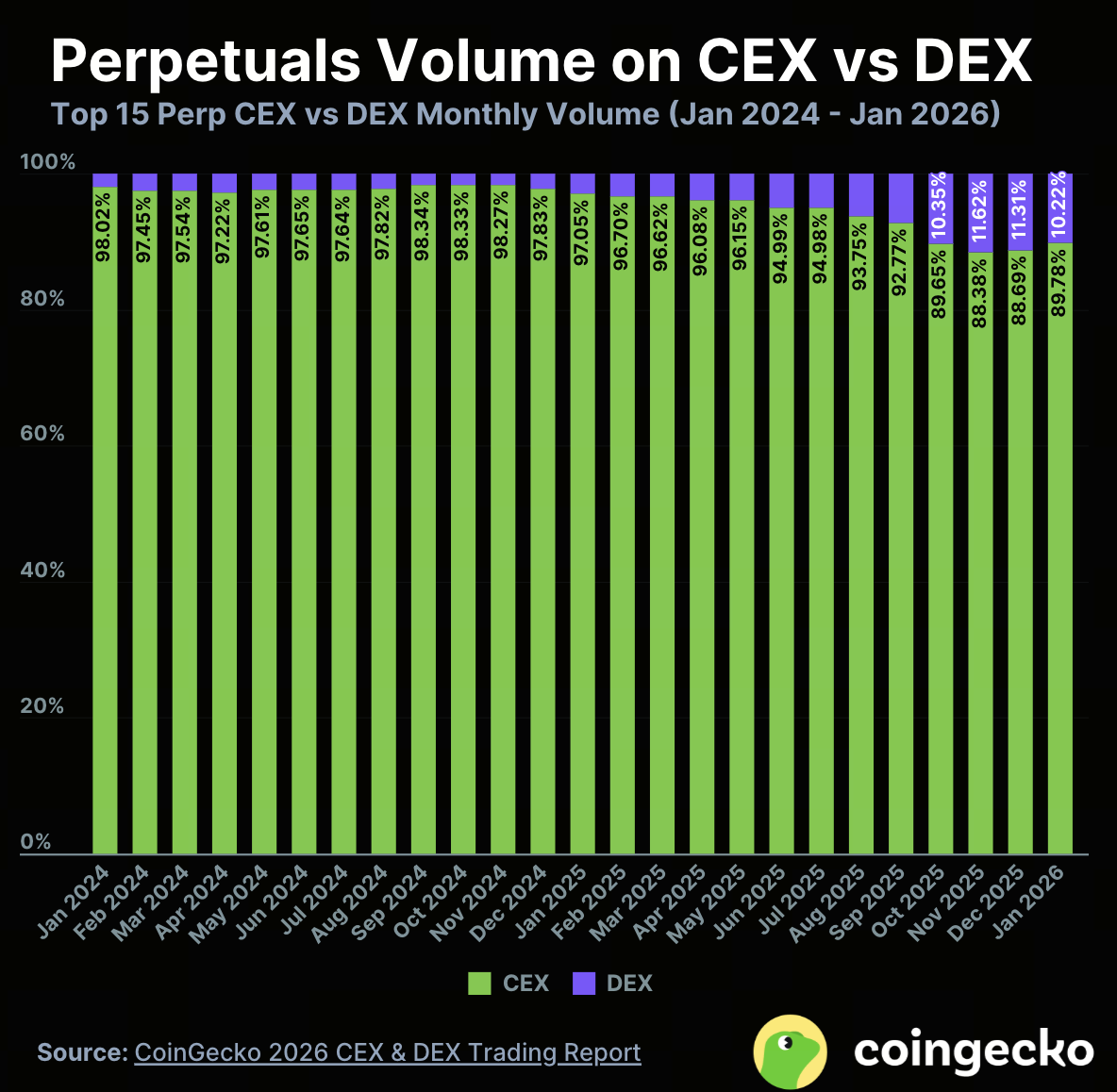
Image source: Coingecko Report
CoinGecko's report, updated March 27, 2026, shows DEX market share in crypto perpetual trading has climbed from 2.0% in January 2024 to 10.2% in January 2026. Over the same period, decentralized perpetual trading volume soared from $81.74 billion to $739.48 billion. The trend is clear: Perp DEX is not yet mainstream, but it has moved from the fringe to a position where it can be discussed as a distinct segment in the broader market.
Hyperliquid stands out as a prime example. CoinGecko data reveals that between August 2025 and January 2026, Hyperliquid's cumulative perpetual trading volume reached $1.59 trillion, putting it at the forefront of the industry. Its importance extends beyond scale, prompting the market to seriously consider: Is the ceiling for on-chain perpetual platforms simply capturing part of crypto futures volume, or can they accommodate broader risk asset trading demand?
Who Is Perp DEX Attracting Right Now?
In today's market, Perp DEX is primarily drawing users from CEX who are especially sensitive to efficiency, transparency, and asset diversity—not the entire user base.
This migration happens on three main fronts:
-
High-frequency and professional traders reassessing on-chain depth: Historically, CEX offered deep liquidity, low slippage, and stable matching. As leading Perp DEX optimize their own chains, order books, and market-making systems, some professional traders now see on-chain platforms as their primary trading venue—not just a place for supplemental positions.
-
Users focused on asset listing speed: CEX listings must consider compliance, risk control, and brand risk, while on-chain perpetual platforms—especially those with flexible market deployment—often list new assets faster. For traders seeking early volatility and new narratives, this difference is crucial.
-
Users who value transparent liquidation and on-chain verifiability: Perp DEX allows orders, positions, liquidations, and fund flows to be tracked on-chain. While this doesn't guarantee greater safety, it does offer a level of verifiability distinct from opaque centralized platforms.
Still, it's premature to conclude that "Perp DEX is replacing CEX." CEX retains strong advantages in several areas:
-
Mature fiat deposit and account systems
-
Lower brand recognition and user education costs
-
Clearer compliance frameworks
-
Friendlier for large funds, institutions, and retail investors
-
More comprehensive customer support, risk control, and product offerings
In short, at this stage, Perp DEX is siphoning off some active users and trading demand from CEX, not driving a wholesale migration.
When CEX Moves Into TradFi: How the Competitive Logic Changes
Viewing Perp DEX expansion as simply "on-chain platforms taking users from centralized platforms" is outdated.
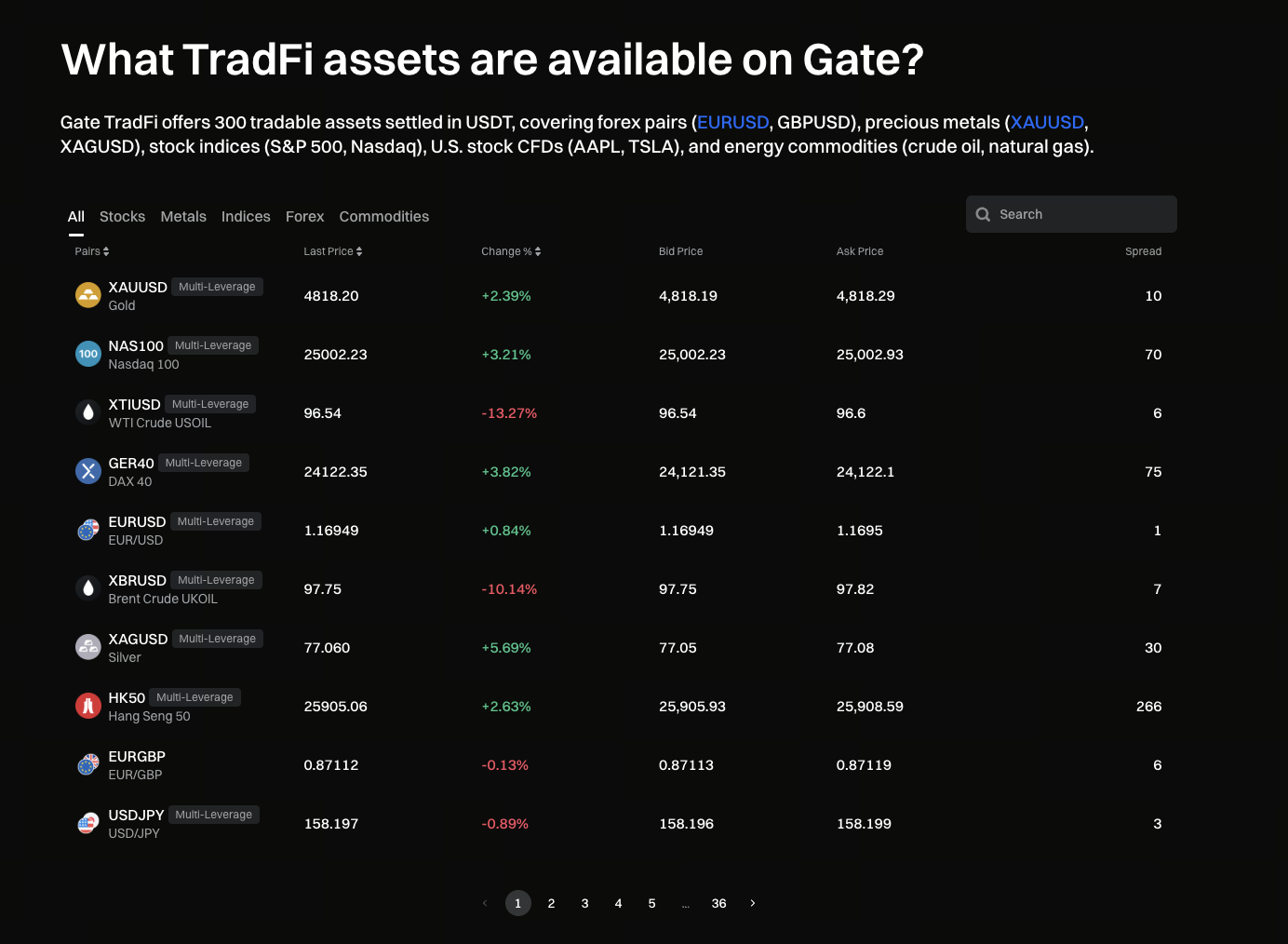
Image source: Gate TradFi Page
CEX are evolving as well. Gate's official page shows that Gate TradFi now offers traditional financial asset trading settled in USDT, covering forex, metals, indices, energy, and US stock CFDs. Tradable assets have reached 300, including EURUSD, XAUUSD, S&P 500, crude oil, and natural gas.
This marks a shift in the competitive landscape.
Previously:
Now:
Both sides are converging toward "multi-asset trading platforms." The distinction is no longer just on-chain versus off-chain, but lies in product mechanisms and infrastructure logic.
Gate's TradFi business, for instance, provides traditional asset price exposure via CFDs, trading according to traditional market hours and platform-centric product design. Some Perp DEX—especially Hyperliquid, which supports permissionless builder-deployed perps under HIP-3—seek to expand tradable assets in a more open, decentralized manner.
The industry's key questions are not "who is more advanced," but:
-
Who best meets crypto users' demand for TradFi exposure
-
Who can build deeper liquidity
-
Who can establish pricing power and trading habits over the long term
Real Opportunities and Limitations for Perp DEX in TradFi Assets
Perp DEX entering TradFi asset trading offers several clear advantages:
-
Extended trading hours: Traditional markets have fixed opening and closing times, while on-chain markets operate 24/7. Users wanting to express risk views outside traditional hours are drawn to on-chain platforms.
-
Unified margin and portfolio trading: Platforms that combine crypto, commodities, indices, and expectation-based assets within a single margin and clearing framework deliver significantly greater trading efficiency.
-
Faster market innovation: Where technology and governance allow, on-chain perpetuals can more rapidly test new assets and structured products.
However, there are clear limitations that prevent Perp DEX from replicating TradFi markets in the short term:
-
Liquidity depth is a critical barrier: TradFi asset trading demand depends not just on listing, but on offer quality, slippage, and capacity for large trades. Without deep liquidity, even strong narratives struggle to drive user retention.
-
Price anchoring and oracle risks are heightened: As trading expands from crypto to gold, forex, stocks, or indices, reliable price sources, update frequency, and handling of extreme market conditions become even more important.
-
Regulatory complexity increases: On-chain platforms that provide price exposure to traditional financial assets face greater compliance challenges. Many products use alternative structures rather than directly replicating spot securities trading.
-
User habits may not shift immediately: Many TradFi users remain loyal to familiar brokers, trading terminals, and regulatory protections. On-chain platforms must offer both freedom and reliability to attract these users.
Perp DEX can serve TradFi asset price trading demand, but are more likely—at least in the short term—to cater to crypto-native users' cross-asset trading, rather than quickly capturing mainstream TradFi users.
The Next Competitive Round: More Than User Migration
Looking ahead, the next phase of competition between Perp DEX and CEX will focus on three factors, not just "who takes more existing users":
-
Who can build a stronger multi-asset liquidity network: The winner may not be the platform with the most asset classes, but the one that turns trading activity into stable liquidity.
-
Who can establish effective pricing mechanisms: As more assets enter crypto trading, price discovery becomes the core battleground. Platforms with higher trading density, robust market-making, and sustained user engagement will gain pricing power.
-
Who can minimize cross-market trading friction: Both CEX and Perp DEX aim to let users trade more assets with fewer accounts, fewer conversion steps, and a unified margin system.
From this perspective, CEX and Perp DEX are not strictly rivals. CEX serve as mature financial interfaces, while Perp DEX are dynamic, flexible trading infrastructures. They will likely compete and coexist, each serving different user groups and asset classes.
Conclusion: Perp DEX and CEX Will Likely Compete and Coexist
Returning to the original question: Is Perp DEX's next battle about taking CEX users, or entering TradFi assets?
The current market reality is: it's not an either/or scenario.
In the short term, Perp DEX mainly attracts traders from CEX who value efficiency, transparency, on-chain composability, and new asset opportunities. In the medium and long term, as CEX expand TradFi product lines, both sides are competing not just for crypto derivative users, but for broader multi-asset trading access.
This means the industry's key question isn't simply "will DEX replace CEX," but:
-
Which platform best meets cross-asset trading demand
-
Which platform can build liquidity and pricing power
-
Which platform can balance compliance, product, and user experience
Perp DEX's boundaries are expanding, but its next challenge is not a simple replacement race. It's a long-term competition centered on users, liquidity, product structures, and TradFi asset integration.







