As the DeFi ecosystem advances from single-protocol systems to complex financial infrastructure, traditional “monolithic protocols” are showing clear limitations in scalability and upgradeability. Modular architecture has emerged as a leading technical trend, built on the core principle of separating protocols into multiple independent, upgradeable, and composable components—allowing developers to innovate continually without sacrificing system stability.
From a Web3 technology evolution standpoint, Sky Protocol’s modular approach is more than a technical enhancement—it’s a reimagining of financial infrastructure. By incorporating the Stars sub-ecosystem, a dual-token economic model, and a plug-and-play module system, Sky Protocol aims to create a scalable DeFi framework where stablecoins, lending, yield strategies, and on-chain applications can seamlessly interact and operate at the protocol layer.
Sky Protocol Modular Architecture Overview
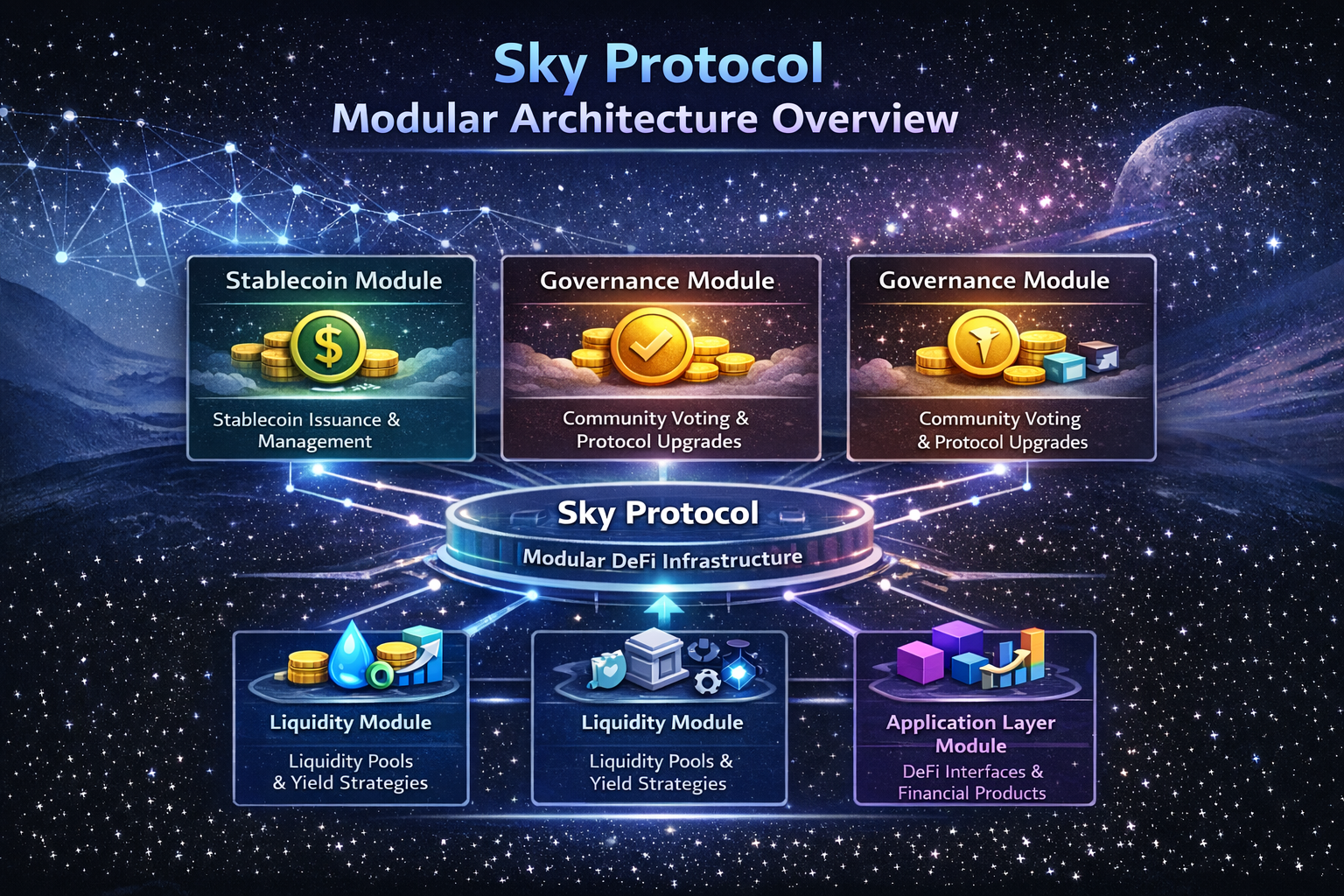
Sky Protocol’s core design philosophy is Modular DeFi Infrastructure. In this model, the protocol is assembled from distinct modules, each dedicated to a specific function.
Sky Protocol’s primary modules typically include:
-
Stablecoin Module: Handles stable asset issuance, collateral management, and liquidation mechanisms.
-
Governance Module: Empowers community voting, parameter changes, and protocol upgrades via governance tokens.
-
Liquidity Module: Oversees liquidity pools, yield strategies, and capital efficiency.
-
Application Layer Module: Supplies interfaces for DeFi apps, derivatives, or other on-chain financial products.
This architecture lets each protocol component be upgraded independently, eliminating the need for complicated system-wide overhauls. For DeFi ecosystems, this significantly reduces the cost of upgrades and accelerates innovation.
How Modules Operate Autonomously and Cooperatively
The essence of modular architecture is the “independent operation + collaborative integration” principle.
Within Sky Protocol, each module features its own logic and smart contracts. For example:
-
The stablecoin module manages issuance and liquidation
-
The yield module handles capital allocation strategies
-
The governance module manages parameter changes and protocol upgrades
Modules interact via standardized interfaces.
For instance:
-
A user mints stablecoins by depositing collateral in the stablecoin module
-
The stablecoins can participate in yield strategies through the liquidity module
-
The governance module can adjust collateral ratios or risk parameters
The key advantage is low coupling between modules.
When a module needs an upgrade, developers only update that specific component—there’s no need to overhaul the entire protocol. This approach dramatically enhances stability and maintainability.
How the Stars Sub-Ecosystem Powers Innovation
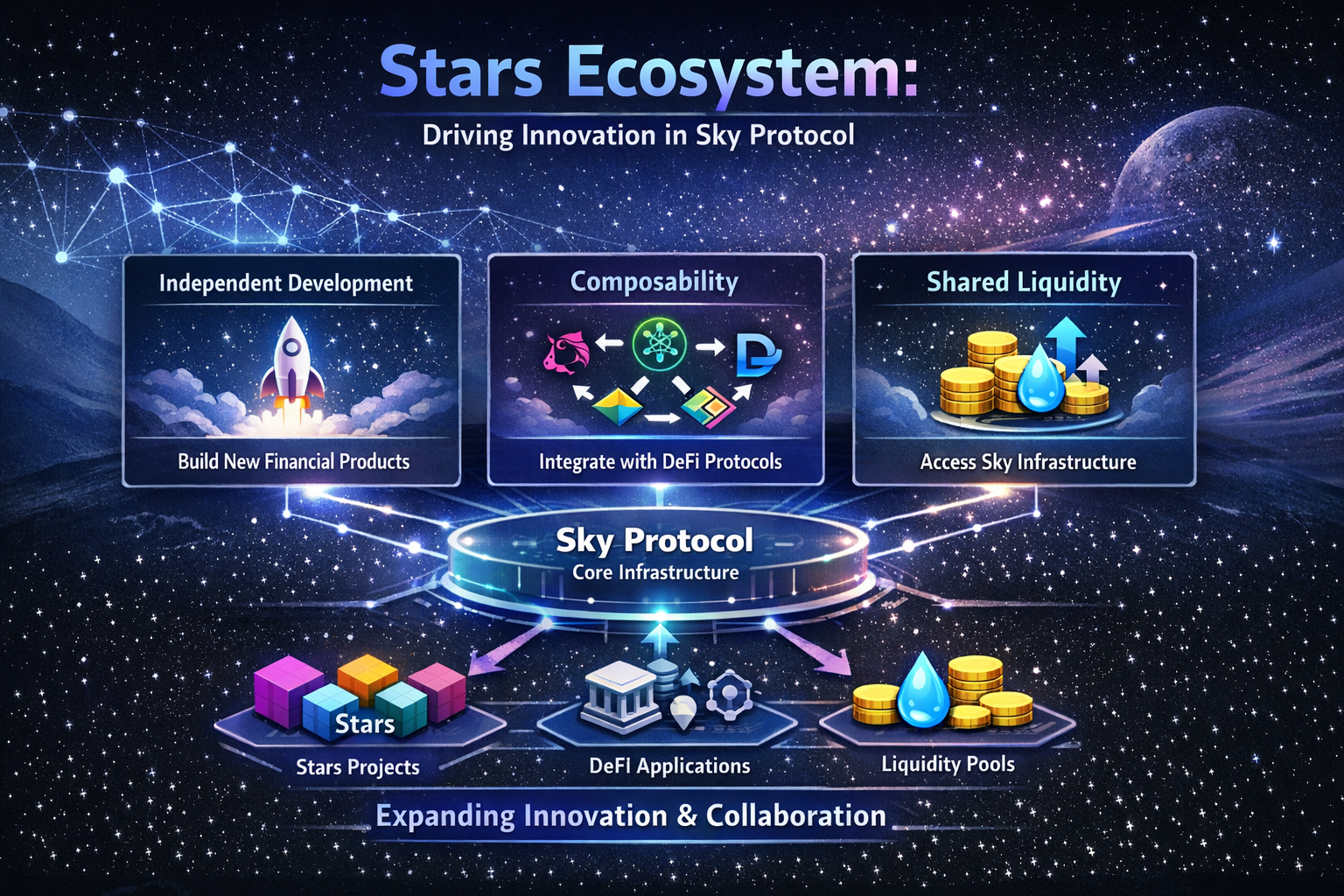
A defining feature of the Sky Protocol ecosystem is its Stars Sub-Ecosystem.
Stars are independent sub-modules or projects built around Sky Protocol. These sub-ecosystems leverage Sky Protocol’s infrastructure while preserving their own innovation space.
Core features of the Stars sub-ecosystem include:
-
Independent Development: Developers can create new financial products on Sky Protocol.
-
Composability: Stars modules can interact with external DeFi protocols.
-
Shared Liquidity: They benefit from liquidity support via Sky’s foundational infrastructure.
This structure resembles an application-layer network in modular blockchain ecosystems. The Stars sub-ecosystem not only expands Sky Protocol’s functionality but also attracts more developers, fostering a self-reinforcing cycle of innovation.
How Sky Protocol Enables Diverse DeFi Use Cases
Modular architecture empowers Sky Protocol to support a broad spectrum of DeFi applications.
Traditional DeFi protocols typically focus on a single function, like lending or trading. Sky Protocol’s design allows for multiple financial functions to be combined flexibly.
Key use cases include:
-
Stablecoin Lending: Users mint stablecoins with collateral and utilize them across modules.
-
On-Chain Yield Strategies: Funds can be automatically allocated among various yield strategies.
-
DeFi Portfolio Products: Developers can combine modules to create novel financial instruments.
For example, teams can leverage stablecoin and liquidity modules to build new derivatives platforms or yield protocols.
This composability is a core engine of DeFi innovation.
Advantages and Potential of Modular Design
Sky Protocol’s modular design delivers several benefits:
1. Greater Innovation Efficiency
Developers can focus on a single module rather than rebuilding the entire system.
2. Lower Technical Risk
Modular structures isolate system risk, preventing single points of failure from impacting the entire protocol.
3. Enhanced Ecosystem Scalability
New applications can quickly integrate via module interfaces.
4. Flexible Upgrade Mechanisms
Modules can be updated independently—no need for sweeping system migrations.
Together, these advantages position modular DeFi protocols for long-term growth.
As the DeFi ecosystem expands, it’s no longer feasible for a single protocol to cover all financial functions. Modular architecture delivers a scalable technical foundation for increasingly complex financial systems.
The Impact of Modular Design on Protocol Governance
Modular design also transforms DeFi governance models.
In Sky Protocol, governance authority can be distributed across multiple layers, including:
This layered approach introduces two key shifts:
1. More Granular Governance. The community can make targeted decisions on individual modules rather than redesigning the entire protocol.
2. Greater Ecosystem Engagement. Sub-ecosystem projects enjoy a degree of autonomy, incentivizing ongoing developer participation.
However, this structure also brings new challenges, such as coordination and revenue distribution.
Robust modular governance mechanisms are therefore essential to maintain efficiency.
Boosting Protocol Scalability and Flexibility with Modularity
Scalability remains a fundamental challenge for blockchain systems.
Sky Protocol’s modular design enhances scalability in several ways:
Functionality Expansion
New features are added by deploying new modules—no need to alter the existing system.
Ecosystem Expansion
Developers can launch new Stars sub-ecosystems, broadening the protocol’s application scope.
Technical Upgrades
When the underlying technology evolves, only the relevant module requires updating.
This approach aligns with the recent trend toward modular blockchains.
By decoupling system components, the protocol achieves ongoing evolution alongside stability.
The Future of Sky Protocol’s Modular Design
Modular DeFi is positioned to shape the industry’s next chapter.
Sky Protocol’s modular architecture could continue to evolve in several key directions:
-
Cross-Chain Financial Infrastructure: Modular design simplifies multi-chain deployment and cross-chain liquidity.
-
AI-Driven and Automated Finance: Future modules may integrate AI-powered asset management strategies.
-
On-Chain Financial Markets: Advanced financial products can emerge through module integration.
-
Developer Ecosystem: The Stars sub-ecosystem will attract diverse development teams.
If these pathways advance, Sky Protocol could become a foundational pillar of modular DeFi infrastructure.
Conclusion
Sky Protocol is redefining DeFi protocol architecture through modular design. By segmenting stablecoin, governance, liquidity, and application-layer functions into independent modules, the protocol maintains system stability while driving continuous innovation.
The Stars sub-ecosystem further extends this potential, empowering developers to create new financial products on a shared infrastructure. Modular design not only enhances protocol flexibility and scalability, but also cultivates a more open environment for DeFi innovation.
As decentralized finance evolves toward greater complexity, modular frameworks like Sky Protocol are poised to become the backbone of next-generation DeFi infrastructure.







