As Web3 applications continue to evolve, blockchain networks require not only secure and reliable execution environments but also efficient data access and external information input capabilities. Whether DeFi protocols need on-chain trading data or lending platforms require real-time price feeds, robust foundational infrastructure is essential. Without efficient data layers and oracle services, decentralized applications would be unable to deliver complex functionalities.
Against this backdrop, The Graph and Chainlink have become two pivotal infrastructure protocols in the Web3 ecosystem. While both serve the blockchain data layer, they solve fundamentally different challenges: The Graph empowers developers to efficiently read on-chain data, while Chainlink enables Smart Contracts to securely access off-chain data. Together, they underpin the seamless operation of DeFi, NFT, and DAO applications, making them indispensable components of the Web3 landscape.
What roles do The Graph and Chainlink play in Web3?
The Graph and Chainlink are both core Web3 infrastructure, but they occupy distinct positions in the data flow.
The Graph’s main function is to index and organize raw blockchain data. Transaction records, contract events, and asset statuses on-chain are often not directly accessible. Through Subgraphs, The Graph builds data indexes, allowing developers to quickly query on-chain data using GraphQL. This positions The Graph as the data query layer of Web3.
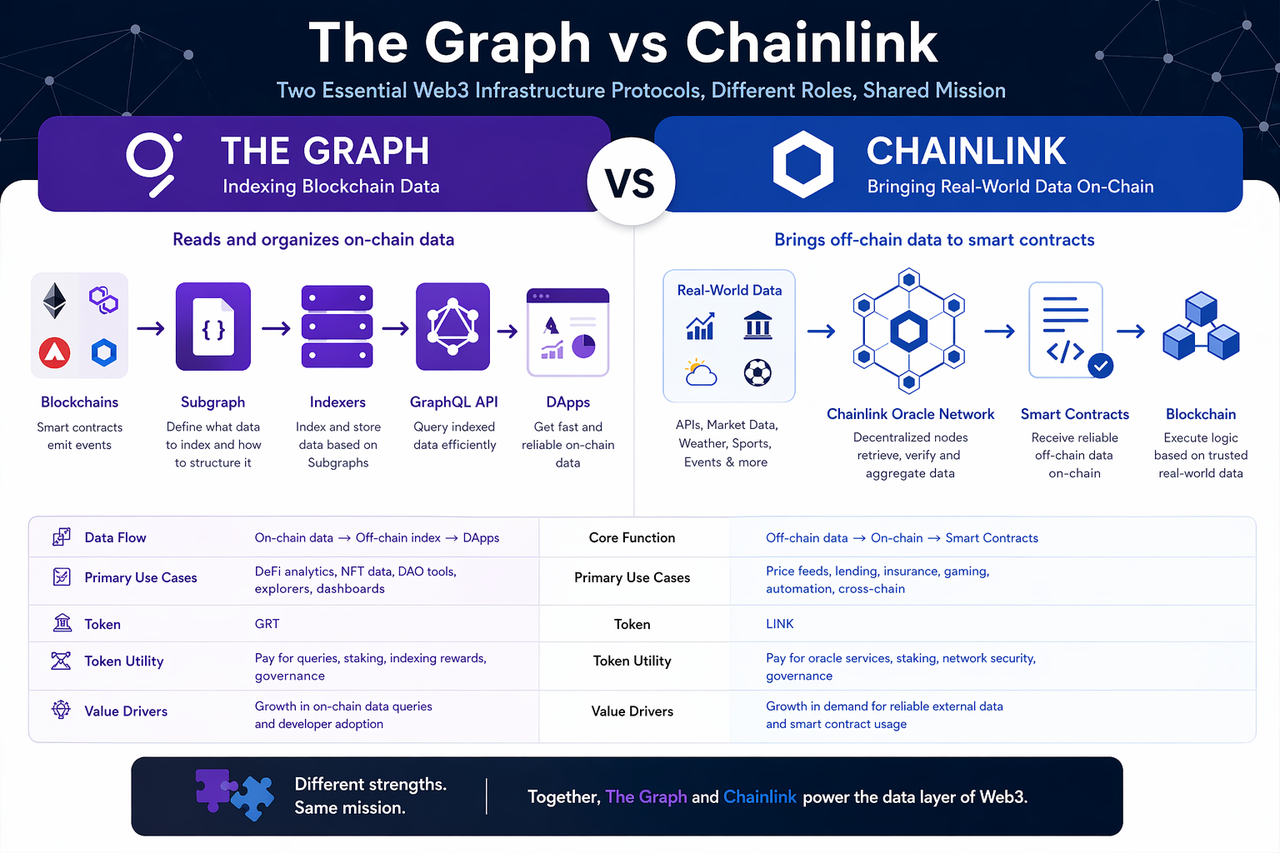
Chainlink, on the other hand, is designed to provide external data support for Smart Contracts. Since blockchains cannot natively access off-chain information, Chainlink leverages a decentralized oracle network to bring real-world data—such as asset prices, weather statistics, and event outcomes—on-chain. As a result, Chainlink serves as the data input layer of Web3.
In summary, The Graph enables developers to efficiently retrieve blockchain data, while Chainlink ensures Smart Contracts can securely leverage off-chain data.
What are The Graph’s core functions?
The Graph’s core function is to index blockchain data and optimize data query efficiency.
Developers define Subgraphs that specify which Smart Contract data to index. Indexer nodes within The Graph network then capture on-chain events and structure them for efficient querying, which applications can access via the GraphQL interface.
This approach dramatically reduces the data access costs for Web3 applications, enabling DeFi protocols, NFT platforms, and DAO tools to quickly retrieve on-chain data. In essence, The Graph addresses the challenge of “how to efficiently utilize on-chain data.”
What are Chainlink’s core functions?
Chainlink’s core function is to provide decentralized oracle services, securely transmitting off-chain data to Smart Contracts.
For example, lending protocols require real-time BTC or ETH price feeds to determine liquidation thresholds, but such price data is not inherently available on-chain. Chainlink aggregates prices from multiple nodes across various data sources and delivers consolidated results on-chain, ensuring high data reliability.
Beyond price oracles, Chainlink supports cross-chain communication, automated execution, and more, establishing itself as critical infrastructure for many DeFi protocols. It fundamentally solves the problem of “how to securely deliver external data to Smart Contracts.”
The Graph vs Chainlink: Key differences
While The Graph and Chainlink are both foundational to Web3’s data infrastructure, they differ sharply in core functionality, network architecture, and value propositions.
| Comparison |
The Graph |
Chainlink |
| Core Function |
Blockchain data indexing |
Off-chain data oracle |
| Data Direction |
On-chain data → Application |
Off-chain data → On-chain |
| Target Users |
DApp developers |
Smart Contracts |
| Core Technology |
Subgraph + GraphQL |
Oracle Network |
| Typical Use Cases |
DeFi data queries, NFT data indexing |
Price oracles, automated execution |
| Token Utility |
Query fees, staking |
Node payments, service fees |
| Value Driver |
Data query demand |
External data integration demand |
Functionally, The Graph focuses on making on-chain data accessible, while Chainlink focuses on enabling access to off-chain data. They are not direct competitors; instead, they jointly establish a comprehensive Web3 data infrastructure.
How do the value propositions of GRT and LINK differ?
The Graph’s native token, GRT, is primarily used for query payments and node staking. Developers pay GRT to query on-chain data, while Indexers, Curators, and Delegators stake GRT to participate in network operations. GRT’s value is thus driven by growing demand for on-chain data queries.
LINK, by contrast, is mainly used to pay oracle node service fees. Protocols that access off-chain data via Chainlink pay in LINK, while node operators earn rewards for providing reliable data. LINK’s value is therefore tied to increasing demand for off-chain data integration.
In short, GRT’s value is rooted in “on-chain data query” demand, whereas LINK’s value is anchored in “off-chain data integration” demand.
Are The Graph and Chainlink competitors?
From a protocol perspective, The Graph and Chainlink are not direct competitors but complementary solutions.
The Graph specializes in enabling developers to access blockchain-native data, while Chainlink focuses on importing external data onto the blockchain. One is the on-chain data query layer; the other is the off-chain data input layer.
In real-world applications, both are often used together. For instance, a DeFi protocol might use The Graph for on-chain trading data and Chainlink for real-time price feeds. Together, they form the backbone of the Web3 data infrastructure.
Which has greater long-term potential: The Graph or Chainlink?
The long-term prospects of The Graph and Chainlink depend on the trajectory of Web3 data demand.
If the number of on-chain applications continues to rise, and demand for on-chain data queries grows, The Graph’s value will increase—especially in DeFi, NFT, and DAO ecosystems where efficient data indexing is critical.
If Smart Contracts increasingly rely on real-world data, demand for Chainlink’s oracle services will also expand. Chainlink’s infrastructure value is particularly prominent in DeFi, RWA, and cross-chain communication.
Both protocols have strong long-term potential, but their value drivers differ. For investors, understanding the distinct sources of demand for GRT and LINK is key.
Summary
The Graph and Chainlink are both foundational infrastructure protocols in the Web3 ecosystem, each with distinct responsibilities.
The Graph handles indexing and querying of on-chain data, delivering efficient data access for developers. Chainlink brings off-chain data onto the blockchain, providing Smart Contracts with reliable external information. Rather than competing, they collaboratively form the critical data layer underpinning Web3 applications.
FAQs
What is the difference between The Graph and Chainlink?
The Graph indexes and queries on-chain data, while Chainlink brings off-chain data onto the blockchain. The Graph solves data access challenges; Chainlink solves data input challenges.
Are The Graph and Chainlink competitors?
No. The Graph and Chainlink serve distinct functions in Web3 and are complementary. Many projects leverage both services simultaneously.
How do the value drivers of GRT and LINK differ?
GRT’s value is driven by demand for on-chain data queries, while LINK’s value is driven by demand for off-chain data integration. Each serves a different data service scenario.
Which is more important, The Graph or Chainlink?
Both are essential. The Graph enables on-chain data access; Chainlink enables off-chain data integration. Together, they support the operation of Web3 applications.







