In recent years, ChatGPT has transformed from a generative AI product for the general public into a versatile tool spanning content creation, knowledge Q&A, code assistance, document processing, and information organization. While its initial appeal for many users lay in its conversational capabilities, the future of ChatGPT will be defined not by its chat function alone, but by its potential to serve as a high-frequency, high-value entry point for work.
From the standpoint of user demand, most people do not simply want to "chat with AI," but expect AI to help them accomplish real tasks—such as quickly compiling meeting minutes, generating report frameworks, analyzing complex materials, writing code, optimizing email communication, and even assisting with workflows across multiple tools and steps. In essence, conversation is merely the mode of interaction; task completion is the outcome users truly value.
Thus, discussions about ChatGPT's future should go beyond natural language interaction and be considered within the broader context of product evolution. Its trajectory may mirror the upgrade paths of search engines, browsers, and smartphones—initially attracting users with a standout capability, then gradually evolving into foundational digital infrastructure.
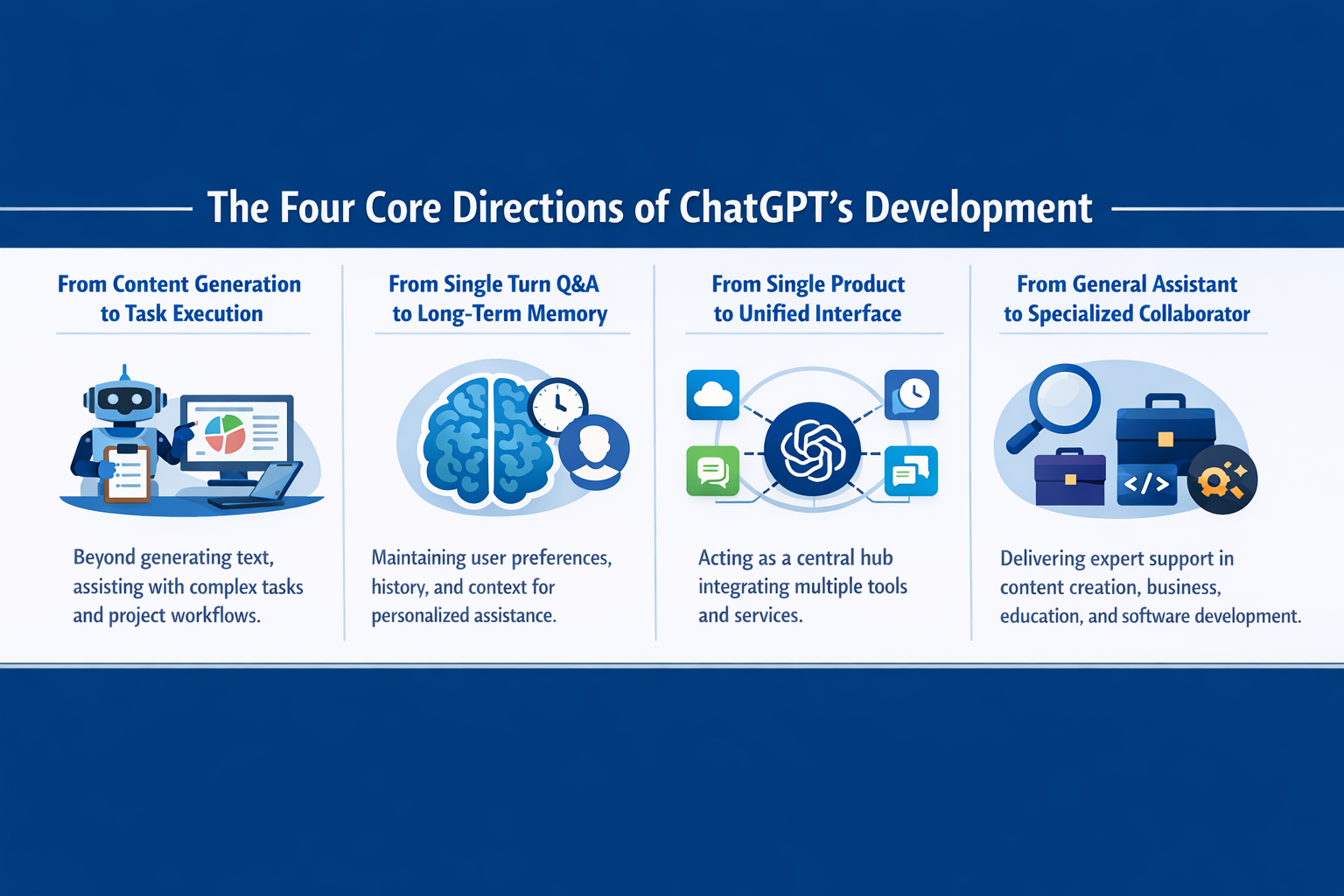
Four Core Directions for ChatGPT's Development
-
From Content Generation to Task Execution
Many users still perceive ChatGPT as a "text generator" or "writing assistant," but content generation is only the foundational layer. The real breakthrough lies in its ability to execute tasks.
Future iterations of ChatGPT will likely go beyond simply outputting content, helping users complete entire workflows. For example, when a user proposes a research topic, the system could provide an abstract, break down the problem, supplement background information, organize conclusions, and even integrate external tools to deliver actionable results. In development contexts, ChatGPT may evolve from a code suggestion tool into an integrated collaborator—understanding requirements, generating code, assisting with testing, and resolving issues.
This shift means ChatGPT's competitiveness will depend increasingly on its ability to comprehend complex tasks and organize multi-step processes, rather than just delivering fluent responses.
-
From Single-Turn Q&A to Long-Term Memory
A clear trend is ChatGPT's evolution from a "reset-every-time conversation system" to a "long-term assistant with sustained context."
High-value AI must understand not only the immediate question but also the user's long-term goals, habits, and preferences. For example, writing a proposal may require tailored approaches depending on industry background, tone, target audience, and decision logic. Without retaining and leveraging this long-term information, AI cannot deliver a stable, efficient collaborative experience.
Long-term memory involves more than saving history—it requires building organized user models, including preferences, task status, project background, and typical workflows. As ChatGPT improves its contextual management, it will transition from being merely "Available" to becoming a "high-dependency" product. This is particularly crucial for enterprise users, whose applications depend on persistent context rather than one-off Q&A.
-
From Standalone Product to Unified Entry Point
ChatGPT's third major direction is evolving from a standalone AI product into a unified entry point for digital services.
Traditionally, users would switch between multiple tools—searching for information, opening documents, managing spreadsheets, sending emails, accessing design tools, or programming environments—to complete tasks. The challenge is not the strength of individual tools, but the high cost of cross-tool collaboration.
If ChatGPT can serve as a "unified interaction layer," users could express their goals in natural language, with the system handling retrieval, analysis, generation, and execution. In this role, AI becomes the central layer connecting disparate tools and services.
From an industry perspective, once a unified entry point is established, product value increases dramatically. Users rely on the entire task collaboration process, not just individual features. This is why many market analysts believe ChatGPT's future is not just as a better chatbot, but as a core component of next-generation digital work interfaces.
-
From General Assistant to Professional Collaboration System
While general capabilities are ChatGPT's strength, its growth potential lies in deep integration within specialized scenarios.
- In content industries, ChatGPT can handle research, topic selection, structural design, editing, and multilingual rewriting.
- In enterprise office settings, it can provide meeting summaries, information extraction, report assistance, and workflow automation.
- In education, it can act as a personalized tutor—explaining concepts, designing exercises, and tracking learning progress.
- In software development, it can enhance code understanding, debugging support, documentation, and engineering collaboration.
Thus, ChatGPT's future is not simply about becoming "more versatile," but about combining general interaction with specialized task adaptation. Only then can it truly enter high-value, high-frequency production workflows.
How Technology Evolution Enables ChatGPT Upgrades
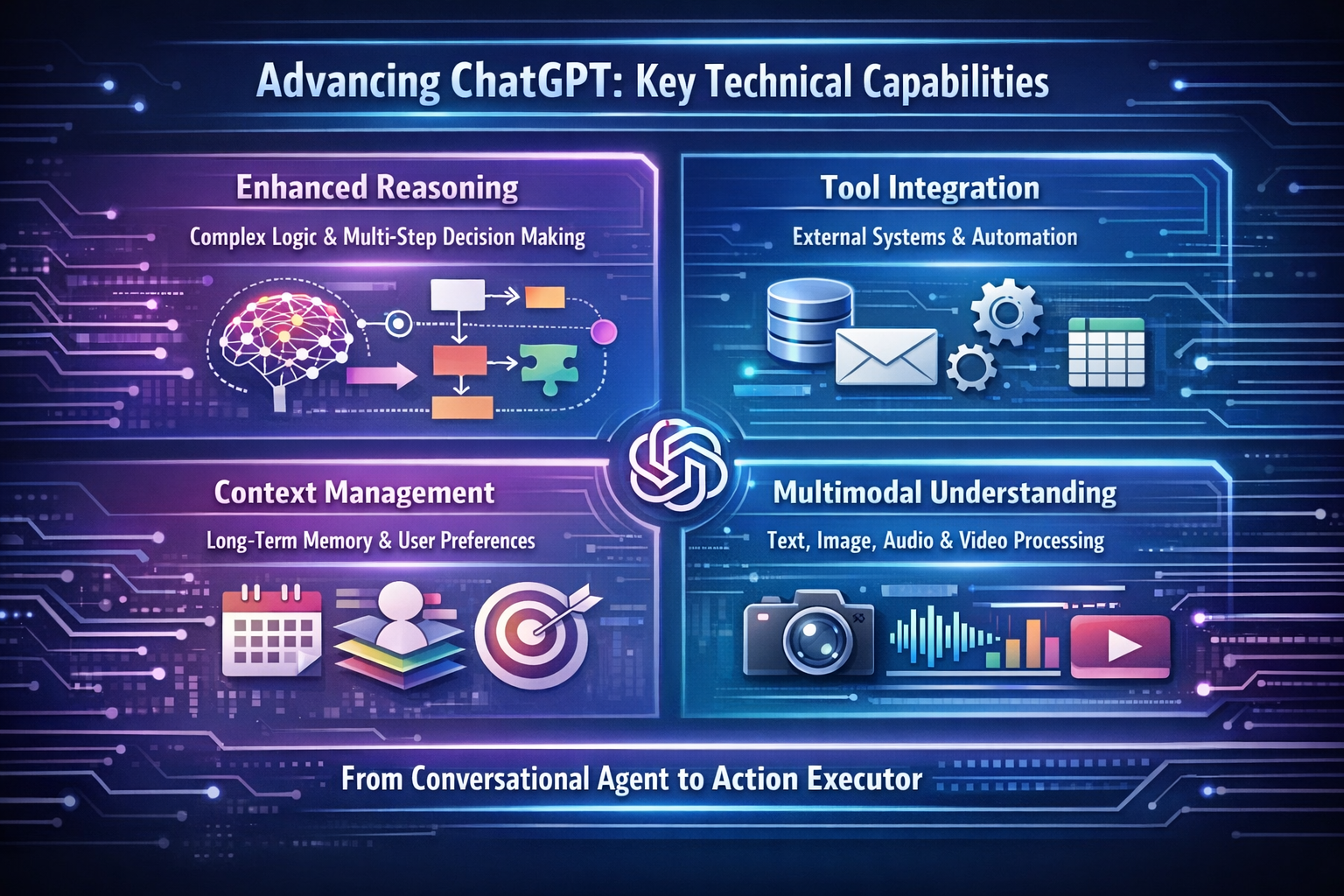
Achieving these advancements requires improvements in foundational technical capabilities.
- Reasoning capabilities: As models advance in complex logic, long-chain analysis, and multi-step decision-making, ChatGPT will be able to tackle real-world problems—not just clear-cut, well-defined questions.
- Tool integration: To complete tasks (not just offer suggestions), ChatGPT must collaborate with external systems—accessing databases, invoking office software, connecting to databases, triggering automation, and reading project context. This transforms AI from a "chat model" into an "execution hub."
- Context management: As usage increases, ChatGPT must handle ongoing projects, roles, preferences, and goals—not just single questions. Efficiently managing and accurately invoking this information in appropriate scenarios will set the ceiling for user experience.
- Multimodal capabilities: While text remains the primary interaction mode, future tasks will involve images, audio, video, spreadsheets, and UI operation records. Multimodal processing will further expand ChatGPT's application boundaries.
ChatGPT's Industry Adoption and Commercial Outlook
From a business perspective, ChatGPT's appeal is not just its cutting-edge technology—it has the potential to transform multiple established markets.
- Office productivity: Knowledge workers process vast amounts of information daily. If ChatGPT can reliably save time and improve quality, it will deliver clear value worth paying for.
- Developer tools: Software development is inherently well-suited for AI collaboration—code is structured, feedback cycles are clear, and iteration is frequent. If ChatGPT evolves to handle requirement analysis, code generation, testing, and project maintenance systematically, its market value will grow further.
- Education and training: Personalized learning is a longstanding goal in education, and AI excels at on-demand explanation, repeated guidance, and instant feedback. If ChatGPT continues to improve reliability and accuracy, it could become indispensable for tutoring, exercises, and learning support.
Once ChatGPT becomes a unified entry point, its business model may expand beyond subscription fees to enterprise collaboration, ecosystem distribution, service integration, and workflow platforms—covering a broader value chain.
Key Challenges Facing ChatGPT
Despite its vast potential, ChatGPT faces significant limitations.
Accuracy and Reliability
For casual use, occasional errors may be tolerable, but in enterprise, professional analysis, or educational contexts, mistakes carry high costs. System stability, verifiability, and control are critical thresholds.
Privacy and Permission Management
Long-term memory and deep personalization enhance experience, but require access to more user data. Without transparent, trustworthy, and controllable permissions, users will hesitate to entrust important tasks to AI.
Product Boundaries
As ChatGPT expands its capabilities, it will increasingly compete with search engines, office software, browsers, enterprise platforms, and development tools. Future competition will be about control of entry points and ecosystem integration—not just model parameters and performance.
User Trust
Even as technical capabilities advance, whether users entrust key decisions, workflows, and content to AI depends on long-term experience. Only sustained, stable, professional, and explainable performance can build lasting trust.
Understanding ChatGPT's Long-Term Value
Looking ahead, ChatGPT's value lies not just in "faster content generation," but in redefining digital interaction. Historically, people adapted to software interfaces; in the future, software may increasingly adapt to human intent via AI.
ChatGPT's development is about evolving from a tool to an intelligent hub—coordinating information, connecting services, understanding intent, and executing tasks. It may not fully replace existing software, but will likely reshape how people use it.
If this trend continues, ChatGPT's ultimate form may resemble a "personal intelligent operating system" rather than a single application—using natural language as the entry, memory and reasoning as the foundation, tool integration and task delivery as the core, embedding itself into every aspect of work, learning, creation, and decision-making.
From this perspective, ChatGPT's future is not just about adding features, but upgrading the digital interaction paradigm. For individuals, it means lower barriers and higher efficiency. For enterprises, it signals new collaboration models and productivity transformation. For the industry, it marks the start of the next-generation entry point competition.