Introduction: When War and Technology Accelerate in Tandem
Until 2026, I never imagined I would experience the realities of war so directly. From my first encounter with evacuation alarms to witnessing Iran launch more than 200 missiles and thousands of drones at the UAE within a two-week span, I became acutely aware that the fundamental operating logic of the world is undergoing profound change. Meanwhile, another entirely different trajectory is rising rapidly: the explosive adoption of artificial intelligence (AI), the rapid spread of tools like OpenClaw, and Bitcoin’s gradual emergence as a strategic reserve asset among certain nations. The parallel acceleration of war and technology is no accident—it signals that human society is entering an “era of polarization,” where deepening divisions will profoundly shape the future landscape.
OpenClaw and Personal Data Sovereignty: How the Tech Giant Curtain Was Accidentally Broken
Internet giants have monopolized the market for so long that both users and the giants themselves have come to assume user data is inherently a corporate asset—a core quantitative metric in public company financial statements. This assumption is now seen as self-evident. Under these rules, the price of using a platform is surrendering ownership of personal data; giants can simply close interfaces, making it prohibitively costly for users to leave. Unless users abandon the service entirely, all personal behaviors, preferences, and social connections remain locked within the giants’ platforms. “Forced consent” privacy policies further reinforce this monopoly—even those who disagree have no real way to resist.
For years, countless innovators have tried to break this curtain, but none have succeeded. In 2018, I attended a Beijing workshop for the Solid project, launched by World Wide Web founder Tim Berners-Lee. Solid aimed to create “data boxes” for end users, allowing personal data to be stored centrally so giants would need explicit user approval to access it. The vision was both forward-looking and reasonable, but, as it directly threatened the core interests of tech giants—essentially asking companies to shackle themselves and cut profits—no major player was willing to adopt it. The project faded from public view. More recently, the Doubao phone, launched last year and promoted as able to freely access all installed apps, quickly faced unified resistance from major Chinese internet companies and was abruptly withdrawn.
Neither internal innovation nor external disruption—by individuals or companies—seemed able to shake the giants’ monopoly, until OpenClaw emerged, providing ordinary users with a real opportunity to break the mold. The widespread adoption of OpenClaw has most benefited domestic large language models; the stock prices and valuations of companies like Minimax reflect this recognition. The core value lies in a new business model: previously, domestic large language models mainly targeted the B2B market, and ordinary users had limited access to their APIs. Thanks to OpenClaw, I began using domestic models like minimax and GLM for the first time. This expanded the user base to a massive C-end audience, especially for unconscious coding needs, and provided a significant boost to the business model. Besides overseas products like ChatGPT and Claude, domestic users prefer platforms such as Qianwen and Doubao, primarily because these platforms offer unlimited subsidies and unrestricted Q&A, greatly lowering barriers to entry.
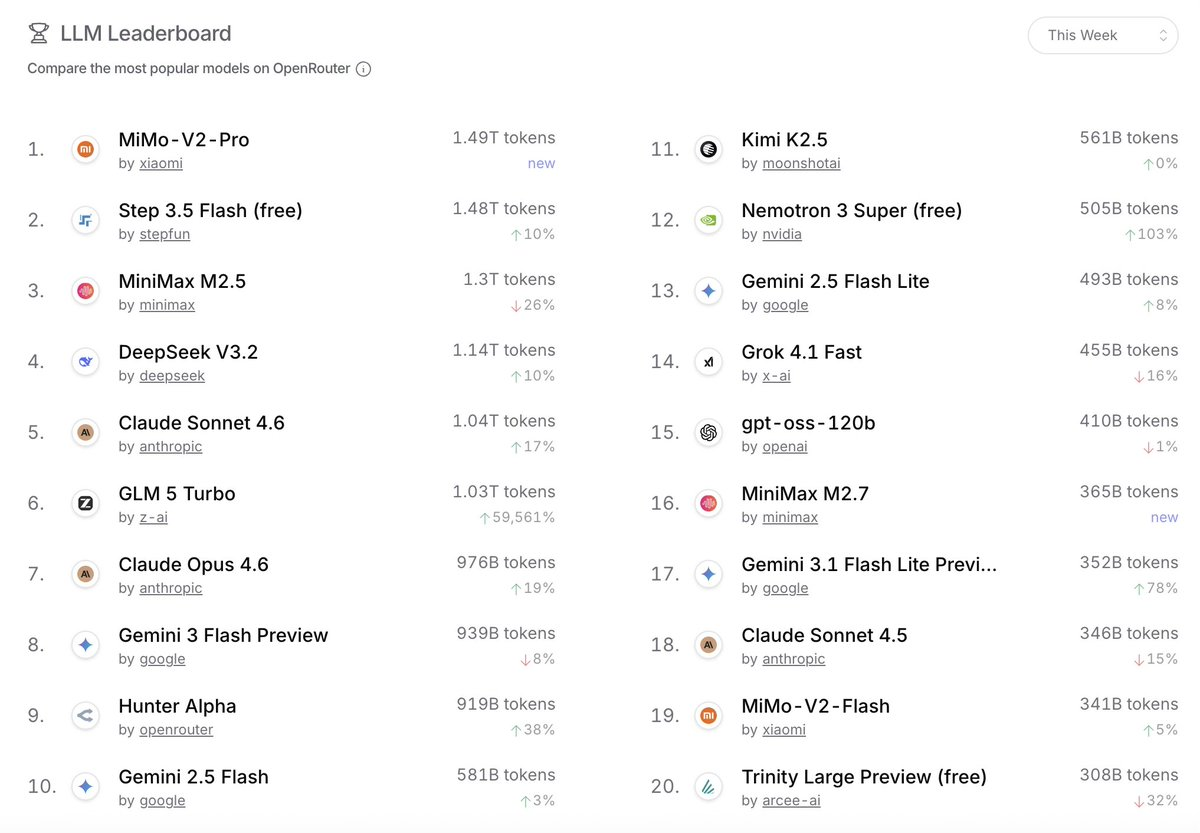 Openrouter has become a key leaderboard for major domestic models
Once basic Q&A needs are met, OpenClaw further aligns with users’ workplace scenarios—enabling users to build complete workflows and turn them into efficient productivity tools. Notably, for everyday needs like scheduling and simple tasks, basic models suffice; high-end models like Claude are unnecessary. As a result, users naturally prioritize cost-effectiveness, adopting a “choose whoever is most economical” approach. Most importantly, OpenClaw restores personal data sovereignty—data is no longer locked on giant servers, but stored on users’ own devices. Following the recent email deletion incident and related media coverage, most users now install OpenClaw on their Mac Minis, work computers, or configure it on VPS as a “second brain.” This local storage model lets users switch large language models without reconfiguring—previously, with ChatGPT, conversations and habits were stored on OpenAI’s servers, so switching meant data couldn’t migrate and retraining was needed. OpenClaw stores all data (such as schedules, conversations, and work records) locally in md format, so users can freely choose more cost-effective models or leverage free tokens for multi-model compatibility. This has brought a massive influx of C-end users to domestic large language models, driving rapid, large-scale adoption.
This growth reflects an “East rising, West declining” dynamic: overseas products like ChatGPT and Claude use subscription models similar to gyms, where some subscribers rarely use the service and platforms profit from resource allocation. OpenClaw, however, uses API integration, and its founder recommends APIs from domestic models like Minimax. This model better fits Asian users’ lack of subscription habits, and API billing by token consumption offers greater cost and flexibility advantages.
OpenClaw’s significance extends beyond boosting domestic large language models; its widespread adoption is systematically dismantling the ecosystem barriers of tech giants. Once users control their data, they seek richer features from OpenClaw, prompting hardware manufacturers to get involved. Previously, companies like Xiaomi and Huawei built closed ecosystems, requiring proprietary apps to control smart devices. Now, hardware makers are developing CLI tools and compatible interfaces for OpenClaw, enabling users to control smart homes, robots, and more through OpenClaw. This will gradually erode the premium that major companies command for ecosystem compatibility.
As for whether giants and hardware manufacturers will refuse to integrate with OpenClaw, I found my answer after using OpenClaw to connect and control a Tuozhu 3D printer: integration capability has become a key factor when buying new hardware.

With intense competition among Q&A bots like Doubao and Qianwen, OpenClaw has opened a second front for long-term token consumption among C-end users. Major manufacturers cannot stand by as companies like Minimax capture the market—they will inevitably join the “free OpenClaw installation” push, leveraging this traffic gateway to compete for users. As this trend accelerates, OpenClaw’s user coverage will become extensive, further strengthening user data sovereignty. For hardware manufacturers, OpenClaw’s vast user base creates a forcing effect—early adopters can capture the market, while latecomers risk missing out. As a result, manufacturers will actively adapt to OpenClaw, and users will prioritize hardware that supports it. This forms a virtuous, user-driven cycle: users control their data, freely switch models, and flexibly combine hardware. OpenClaw thus redefines personal data sovereignty and systematically dismantles the tech giants’ ecosystem monopoly.
Of course, users’ data awareness will continue to seek a balance between convenience and autonomy.
 Tencent has fully integrated OpenClaw, becoming the largest “model data relay station” while providing convenience
Blockchain and Conceptual Armament: Cognitive Weapons Across Generations
Bitcoin has been around for more than a decade, gradually entering the mainstream despite ongoing skepticism. Some argue that Web3 practitioners are simply riding the AI wave, but in my view, AI and blockchain are not mutually exclusive—they are twin stars in the polarized era, converging at a critical crossroads.
As a developer with nearly a decade of Ethereum experience, I’ve often pondered the core competitive advantage of Web3 builders. It’s not a stronger theoretical foundation—Satoshi Nakamoto’s original Bitcoin whitepaper was not recognized by mainstream academia; nor is it superior engineering skills—most early practitioners and developers started at the industry’s grassroots without systematic training; and it’s not decentralization itself, as decentralization often leads to poorer user experience and can even hinder development. Upon reflection, I believe the core advantage of outstanding Web3 practitioners is the ability to “think across generations”—and maintaining this cognitive edge is key to the industry’s sustained growth.
“Conceptual armament” is not about physical force. Its essence is a set of established rules that directly reshape causality and overturn traditional logic. As early as 1992—16 years before Bitcoin’s creation—crypto-punk pioneer Hal Finney stated in an interview that computers should be tools for human liberation and protection, not instruments of control, and that humanity should seek to return power to individuals rather than governments or corporations. In 2013, on the BitcoinTalk forum, Hal Finney further explained Bitcoin’s essence: “I think Bitcoin will eventually become a reserve currency for banks, playing the role gold did in early banking. Banks can issue digital cash based on it, enabling greater anonymity, lighter weight, and more efficient transactions.”
Twelve years later, this prophecy has come true: the United States has included Bitcoin in its national strategic reserves alongside gold and foreign exchange, with a clear mandate not to sell it, holding it permanently as a national reserve asset. Since 1970, countless financial assets have emerged worldwide, but Bitcoin is the only new asset class formally incorporated into the US national strategic reserve system—stocks, bonds, real estate, and commodities have not received this status. This is the power of “thinking across generations”—what Hal Finney foresaw more than a decade ago is now reality. For the blockchain industry, leading cognitive versions are the ultimate weapon, as pure competition in numbers can never counter the curse of currency devaluation caused by “infinite money printing.” As the first “conceptually armed currency,” Bitcoin’s effectiveness does not depend on physical strength but on established code rules and market consensus.
Traditional fiat currency derives value from state backing and central bank issuance—essentially a contest of economic scale. Bitcoin, by contrast, has no issuer or headquarters; its only rule is its code. Over the past decade, centralized institutions have tried to suppress Bitcoin by banning exchanges, prohibiting trading, stigmatizing, and media attacks, but these efforts have only strengthened market consensus. During the recent Iran war, the Iranian currency plummeted almost to zero in a single day, while in the crisis, large amounts of capital flowed into Bitcoin, making it a safe haven asset. Physical suppression only increases Bitcoin’s conceptual weight, pushing it toward recognition and accumulation by sovereign states as a new type of reserve asset. This is the core power of conceptual armament: centralized institutions can ban exchanges, prohibit related transactions, and launch stigmatizing attacks, but they cannot undo market consensus or alter the established rules in the code. As long as consensus exists, Bitcoin will persist. This is not metaphysics, but precisely the domain where Web3 builders excel: foreseeing the future a decade in advance and, through continuous practice, turning foresight into reality.
Beyond Bitcoin, such cases are common in Web3, and this replicability further proves that “thinking across generations” is the blockchain industry’s core advantage. Before personal data sovereignty became a hot topic, Web3 practitioners had already explored a viable path—at its core, data sovereignty is asset sovereignty, achieved through transparent technical design that enables verifiability and traceability. In the DeFi era, practitioners used smart contracts to build automated market-making systems without intermediaries, reconstructing traditional financial logic. Before the metaverse became a buzzword, Web3 entrepreneurs were already several versions ahead of the mainstream, building various metaverse scenarios. Even before the AI multi-agent (Agent) boom, Web3 projects like ACT and Virtuals in 2024 had already explored multi-agent interaction and collaboration.
Regardless of their ultimate success, these projects clearly showcase Web3’s defining trait: always laying the groundwork for the future, gradually turning foresight into reality. In this process, blockchain is steadily moving toward large-scale adoption, with payment scenarios for the AI multi-agent era being a key direction. Today, society is entering an era of billions of intelligent agents; in the future, every user may have multiple agents managing daily affairs, collaborative tasks, travel, shopping, health, and learning—each requiring payment capabilities. Agents must book hotels, pay fares, and remunerate other agents, necessitating secure and efficient payment systems.
But the real question is: are users willing to grant personal bank account access to these agents? Even if they are, centralized banks like Citi, HSBC, Bank of China, and Agricultural Bank of China cannot support direct agent access to accounts—risk control, internal audit, legal, and ethical considerations make it impossible for centralized institutions to allow agents to operate user accounts. After all, agent misuse or hacking risks are hard to control. Here lies blockchain’s advantage: over the past decade, the independent account systems and Web3 usage habits built by blockchain have reduced the cost of creating a new Web3 wallet address by 99.99% compared to opening a new bank account. Users can store small amounts of USDT (e.g., 100 USDT) in a separate wallet for agent collaboration and planning, keeping risk within manageable limits. Thus, the financial infrastructure to serve billions of global agents is gradually taking shape at the intersection of blockchain and AI.
Naturally, traditional institutions will not sit idly by as Web3 captures this market. Stripe, JP Morgan, Ondo, and others are racing to build their own blockchain infrastructure, seeking to dominate the future market for agent-scale infrastructure. They will leverage the blockchain banner to pull rules back into centralized systems, mimic Web3 concepts and thinking, and vie for this core weapon, even planning to tokenize all US stocks and gradually open up blockchain publicity in the media, incorporating Web3 cognition, thinking, and technology into their own systems.
However, it is worth noting that weapons acquired by the strong through imitation of the weak can never be wielded to their full potential. The fundamentally centralized mindset of traditional institutions means they cannot truly understand or practice Web3’s decentralized consensus, nor can they master “thinking across generations.” While AI has already achieved mass adoption, the blockchain and Web3 space must accelerate the transformation of their technological and cognitive advantages into practical products and services, building a solid user base. If Crypto+AI payment scenarios can successfully serve future AI agents, the entire industry will leap forward. In the new polarized era, only those who are strong enough can secure more space for survival and development.
The Future of the Polarization Era: Twin Pillars of Civilization
Since the concept of the “polarization era” was first discussed by TT in 2021, I have witnessed firsthand the rise of geopolitical conflict, financial turmoil, and outbreaks of war—all of which have only strengthened my conviction that the world’s trend toward bipolarity will intensify. This polarization may take two forms: a minority of highly capable individuals, coordinating large numbers of agents and controlling core productivity at the top of society; and the majority relying more on entertainment consumption and universal basic income, gradually detaching from core production.
Yet I remain a technological optimist, convinced that even in a polarized era, ordinary people still have opportunities to change their destinies. I once had the privilege of spending a week with Michael Bauwen of the P2P Foundation at a Zukas event. Bauwen, who received several emails from Satoshi Nakamoto and helped publish the Bitcoin whitepaper on the P2P Foundation forum, once proposed that the future would require “local cosmopolitanism”—in a world of geopolitical conflict and frequent warfare, people would need community-based physical mutual aid and peer-to-peer survival models. At that time, events like US-Israel bombing Iran or Iran attacking US bases and embassies had not yet occurred; in hindsight, his perspective is even more prescient and relevant.
In this increasingly divided world, the fragility of centralized credit systems is ever more apparent: today’s allies may be tomorrow’s adversaries; today’s strong fiat currencies may sharply depreciate or even collapse tomorrow. Blockchain, as open-source and transparent infrastructure, transcends borders and alliances—no matter the country or camp, users have equal access. Even if geopolitical conflict cuts undersea cables or global internet connectivity, blockchain nodes can continue to operate via satellite or radio. It is the only trust foundation capable of crossing borders and camps in the polarization era, providing a unified rule set for a divided world.
AI, meanwhile, offers humanity unlimited productive potential. In a fragmented world, AI can elevate productivity to its peak, helping humanity escape the zero-sum trap and create unlimited incremental value in the virtual world. As I have written before, 90% of human activity will take place in virtual worlds, where AI serves as the “intelligence core”—creating infinite content, unleashing ultimate productivity, and exploring unknown knowledge. Blockchain serves as the “trust core”—establishing transparent rules, returning power to individuals, and preventing the virtual world from being monopolized by a handful of giants.
[
](https://x.com/y2z_Ventures/article/2035997627033231719/media/2035990984228798464)
The two are inseparable and mutually reinforcing: blockchain without AI is relatively limited, only supporting basic accounting and unable to sustain complex virtual civilizations; AI without blockchain may become a tool controlled by giants, trapping humanity in centralized black boxes and depriving people of autonomy. Only through the “twin symbiosis” of AI and blockchain can the future of human civilization be built.
Imagine, when humanity eventually migrates to Mars, what we can take with us is not the Earth’s nations, banks, or credit systems, but only AI and blockchain: AI will help us establish new productivity systems and manage survival and development on a foreign planet; blockchain will provide new rules and trust frameworks, allowing people to maintain an order that belongs to themselves, independent of any centralized institution, no matter how far they are from Earth. This is the ultimate value of the twin technologies in the polarization era—to leave a world of infinite possibilities for the continuation and development of human civilization.
Disclaimer:
-
This article is reprinted from [y2z_Ventures]. Copyright belongs to the original authors [@Web3Ling; @qiqileyuan]. If you have any objections to this reprint, please contact the Gate Learn team, and we will address the issue promptly according to relevant procedures.
-
Disclaimer: The views and opinions expressed in this article are solely those of the author and do not constitute investment advice.
-
Other language versions of this article are translated by the Gate Learn team. Without mentioning Gate, it is prohibited to copy, distribute, or plagiarize the translated article.







