S&P 500 Could Target 7,700: Historical Data Suggests Wars Often Signal Buying Opportunities — Reassessing Equity Market Prospects

2026-03-23 08:02:40
Beginner
Finance
The S&P 500 is poised to reach the 7,700 level, and historical data suggests that periods of conflict frequently create favorable buying conditions in the market. This article examines the drivers of the stock market’s upward momentum, key macroeconomic factors, and potential risks, offering a thorough evaluation of today’s investment landscape.

Event Overview: Tom Lee Reinforces 7,700 Target
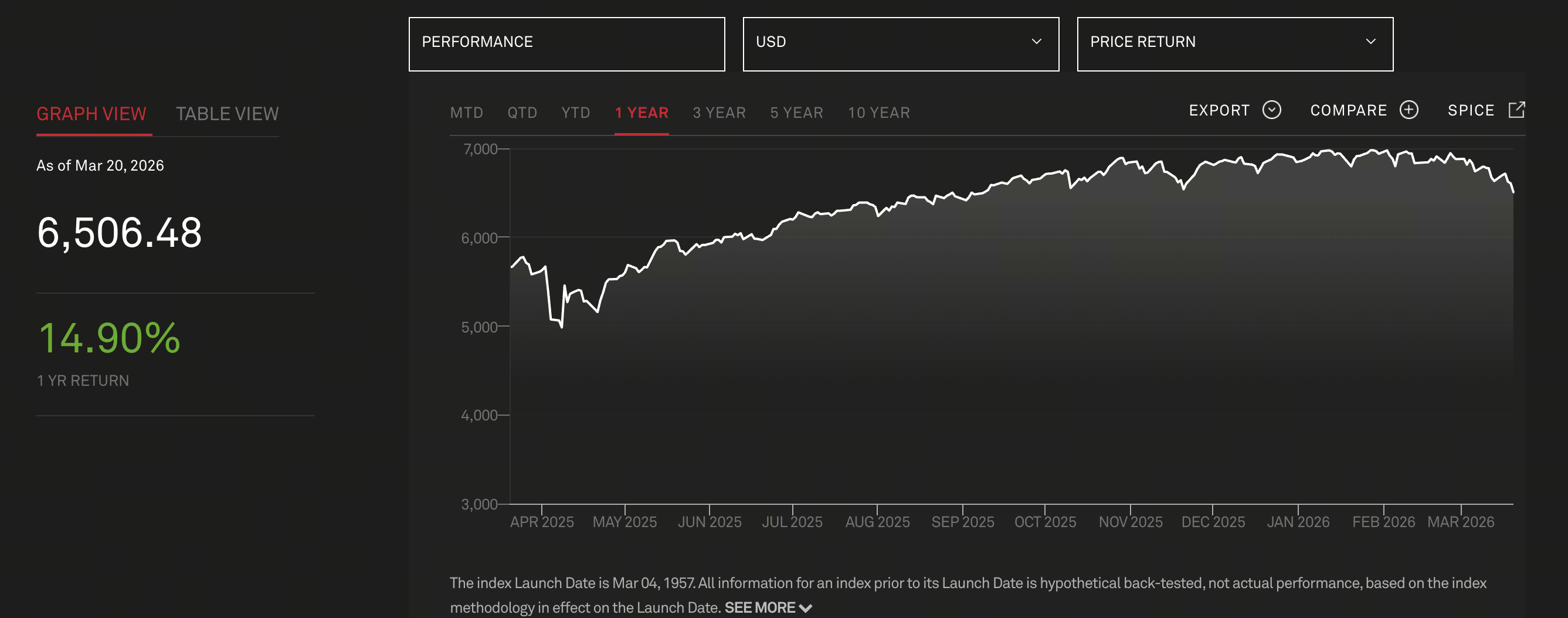
Image source: S&P 500 Index

In March 2026, Tom Lee, co-founder of Fundstrat, reaffirmed in a media interview that he is holding firm on his year-end S&P 500 target of 7,700 points. This projection is part of his long-term market framework—not a temporary adjustment.

He emphasized that the target itself is a “conservative estimate,” grounded only in moderate price-to-earnings ratio expansion and excluding scenarios of extreme liquidity easing or explosive earnings growth.

At the same time, he put forward a view that sparked widespread market discussion: Historically, war has often been a buying opportunity.

Core Analysis: Why War Becomes a “Buy Point”

Tom Lee’s logic is not simply driven by sentiment; it rests on three key mechanisms:

  1. Markets Price in Risk Ahead of Time: Wars typically unfold gradually rather than erupting suddenly. The market begins adjusting asset prices before conflicts officially break out.

  2. Risk Premium Declines After Uncertainty Is Released: Once a conflict materializes and the worst-case scenario is confirmed, the market enters a phase of “restored certainty.”

  3. Policy and Liquidity Tend to Shift Toward Easing: In wartime, fiscal and monetary policies generally aim to stimulate the economy, providing support for asset prices.

He pointed out that, in the past eight major wars, markets typically started forming a bottom early in the conflict, rather than rebounding only after the war concluded.

Historical Review: The Cyclical Relationship Between War and the Stock Market

Historical data shows that war’s impact on the stock market unfolds in distinct stages:

  • Early Stage (Escalation): Market volatility intensifies, risk assets decline

  • Mid Stage (Outbreak): Panic peaks, markets gradually stabilize

  • Late Stage (Policy Stimulus): Economic reconstruction and fiscal expansion drive gains

For instance, during World War II and the Gulf War, the stock market established a bottom in the early phase of conflict.

This phenomenon reflects that the market is more focused on “changes in expectations” than on the event itself.

Current Market Structure: Has Risk Already Been Priced In?

Tom Lee underscored that the current market is not in a phase of “unpriced risk”; instead, it has already undergone structural adjustment:

  • Energy sector: Three-year bear market

  • Financial sector: Persistent weakness

  • Tech giants (MAG-7): Entering an adjustment cycle

These sectors together account for roughly 70% of the S&P 500, indicating that the market as a whole has already undergone significant risk reduction.

Furthermore, gold’s parabolic surge ahead of the conflict signals that capital has already moved into safe-haven assets. The market isn’t ignoring risk—it has already absorbed it.

Macro Variables: Liquidity, Interest Rates, and Earnings Expectations

The foundation for the 7,700 target is not just sentiment or historical precedent, but three major macro variables:

  1. Liquidity Cycle: If the Federal Reserve ends tightening or shifts to easing, it will provide critical support for the stock market.

  2. Corporate Earnings Growth: Advances in AI and automation are boosting productivity, creating structural growth opportunities for corporate profits.

  3. Valuation Expansion: As interest rates decline, the market is willing to assign higher valuation multiples.

Sectors and Capital Flows: Who Will Drive the Next Rally?

From a capital structure perspective, future upward momentum may come from three directions:

  • Technology and AI sectors: Remain the core narrative

  • Traditional industries that have undergone substantial adjustment: Possess potential for valuation recovery

  • Institutional capital returning: After prior risk reduction, positions remain relatively low

It’s important to note that a market rally does not necessarily require a “broad bull market.” It may manifest as structural rotation and pockets of strong performance.

Risks and Uncertainties: The Market Is Not Unilaterally Optimistic

While Tom Lee remains optimistic, his logic does not imply the market is risk-free:

  • Geopolitical conflicts may further escalate

  • A rebound in inflation could limit monetary policy flexibility

  • Excessive AI valuations may trigger corrections

  • If corporate earnings fall short, the foundation for gains will weaken

Therefore, the view that “war is a buy point” is best applied to phased, incremental allocation—not blind bottom-fishing.

Forward Projection: The S&P 500’s Path to 7,700

Based on current information, the S&P 500’s path to 7,700 may involve:

  1. Short-term volatility (driven by geopolitical risk)

  2. Mid-term stabilization (risk pricing completed)

  3. Long-term rally (driven by liquidity and earnings)

Throughout this process, market narratives will gradually shift from “risk” to “opportunity.” “Ultimately, the market’s focus is not on the crisis itself, but on the growth potential that follows.”

Conclusion

Tom Lee’s 7,700-point forecast for the S&P 500 is not simply an optimistic outlook, but a comprehensive assessment based on historical patterns, market structure, and macro variables.

The idea that “war is a buy point” reveals a deeper logic: market rallies often emerge from uncertainty, not certainty.

For investors, the key is not to judge the war itself, but to identify:

  • When risk is priced in

  • When liquidity shifts

  • When earnings are realized

Only when these three factors converge will a genuine market rally take shape.

Author:  Max
Disclaimer
* The information is not intended to be and does not constitute financial advice or any other recommendation of any sort offered or endorsed by Gate.
* This article may not be reproduced, transmitted or copied without referencing Gate. Contravention is an infringement of Copyright Act and may be subject to legal action.

Share

Crypto Calendar
Tokenların Kilidini Aç
Wormhole, 3 Nisan'da 1.280.000.000 W token açacak ve bu, mevcut dolaşımdaki arzın yaklaşık %28,39'unu oluşturacak.
W
-7.32%
2026-04-02
Tokenların Kilidini Aç
Pyth Network, 19 May'da 2.130.000.000 PYTH tokenini serbest bırakacak ve bu, mevcut dolaşım arzının yaklaşık %36,96'sını oluşturacak.
PYTH
2.25%
2026-05-18
Tokenların Kilidini Aç
Pump.fun, 12 Temmuz'da 82,500,000,000 PUMP token'ı kilidini açacak ve bu, mevcut dolaşımdaki arzın yaklaşık %23,31'ini oluşturacak.
PUMP
-3.37%
2026-07-11
Token Kilidi Açma
Succinct, 5 Ağustos'ta mevcut dolaşımdaki arzın yaklaşık %104,17'sini oluşturan 208,330,000 PROVE token'ını serbest bırakacak.
PROVE
2026-08-04
sign up guide logosign up guide logo
sign up guide content imgsign up guide content img
Sign Up

Related Articles

Gate Research: 2024 Cryptocurrency Market  Review and 2025 Trend Forecast
Advanced

Gate Research: 2024 Cryptocurrency Market Review and 2025 Trend Forecast

This report provides a comprehensive analysis of the past year's market performance and future development trends from four key perspectives: market overview, popular ecosystems, trending sectors, and future trend predictions. In 2024, the total cryptocurrency market capitalization reached an all-time high, with Bitcoin surpassing $100,000 for the first time. On-chain Real World Assets (RWA) and the artificial intelligence sector experienced rapid growth, becoming major drivers of market expansion. Additionally, the global regulatory landscape has gradually become clearer, laying a solid foundation for market development in 2025.
2025-01-24 08:09:57
Altseason 2025: Narrative Rotation and Capital Restructuring in an Atypical Bull Market
Intermediate

Altseason 2025: Narrative Rotation and Capital Restructuring in an Atypical Bull Market

This article offers a deep dive into the 2025 altcoin season. It examines a fundamental shift from traditional BTC dominance to a narrative-driven dynamic. It analyzes evolving capital flows, rapid sector rotations, and the growing impact of political narratives – hallmarks of what’s now called “Altcoin Season 2.0.” Drawing on the latest data and research, the piece reveals how stablecoins have overtaken BTC as the core liquidity layer, and how fragmented, fast-moving narratives are reshaping trading strategies. It also offers actionable frameworks for risk management and opportunity identification in this atypical bull cycle.
2025-04-14 07:05:46
The Impact of Token Unlocking on Prices
Intermediate

The Impact of Token Unlocking on Prices

This article explores the impact of token unlocking on prices from a qualitative perspective through case studies. In the actual price movements of tokens, numerous other factors come into play, making it inadvisable to solely base trading decisions on token unlocking events.
2024-11-25 09:15:45
A Guide to the Department of Government Efficiency (DOGE)
Beginner

A Guide to the Department of Government Efficiency (DOGE)

The Department of Government Efficiency (DOGE) was created to improve the efficiency and performance of the U.S. federal government, aiming to foster social stability and prosperity. However, with its name coincidentally matching the Memecoin DOGE, the appointment of Elon Musk as its head, and its recent actions, it has become closely tied to the cryptocurrency market. This article will delve into the Department's history, structure, responsibilities, and its connections with Elon Musk and Dogecoin for a comprehensive overview.
2025-02-10 12:46:01
Gate Research: Web3 Industry Funding Report - November 2024
Advanced

Gate Research: Web3 Industry Funding Report - November 2024

This report summarizes Web3 industry fundraising activities in November 2024. The industry completed 121 funding deals totaling $1.76 billion—a 28.45% decrease from the previous month. Fundraising approaches showed greater diversity, highlighted by MARA's convertible bond issuance and OG Labs' innovative combination of seed round financing and token purchase commitments. Blockchain services and public chain sectors attracted the most investment attention. The report explores key funding achievements from notable projects, including 0G Labs, StakeStone, KGeN, Noble, and Deblock.
2024-12-13 15:30:58
Detailed Analysis of the FIT21 "Financial Innovation and Technology for the 21st Century Act"
Beginner

Detailed Analysis of the FIT21 "Financial Innovation and Technology for the 21st Century Act"

It’s called the Financial Innovation and Technology for the 21st Century Act aka FIT21, and it could make regulating crypto in the U.S. much clearer for everyone working in the industry. 縮短标题:Detailed Analysis of the FIT21 "Financial Innovation and Technology for the 21st Century Act"
2024-06-07 06:25:00