As decentralized finance (DeFi) protocols increasingly shift toward DAO governance models, token governance has emerged as a critical benchmark for assessing a protocol’s decentralization and long-term viability. Unlike traditional platforms dominated by unilateral team decisions, Sky Protocol leverages the SKY token to build on-chain governance, empowering users, developers, and liquidity providers to collaboratively shape protocol governance and value distribution.
From a blockchain economic perspective, SKY is both a governance instrument and a pivotal link between protocol growth and community incentives. Through mechanisms such as staking rewards, ecosystem incentives, and governance participation, Sky Protocol deeply integrates its tokenomics with protocol usage, positioning SKY as a foundational pillar for the ecosystem’s operation.
Core Roles and Functions of the SKY Token
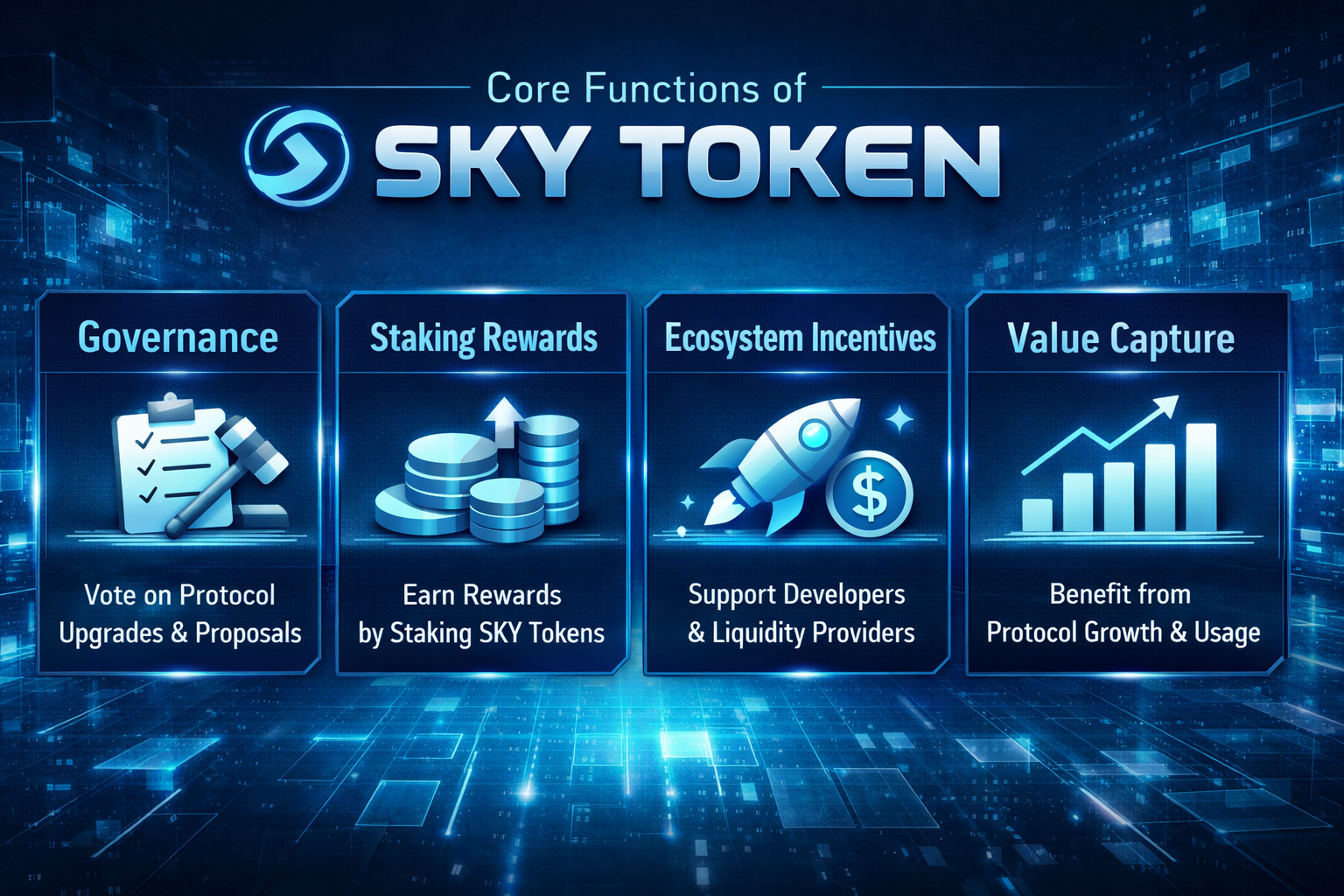
In most DeFi protocols, governance tokens extend beyond voting rights to play essential roles in ecosystem incentives, revenue sharing, and protocol security. As the core asset of Sky Protocol, the SKY token is engineered to unify community engagement, protocol governance, and ecosystem growth within a single framework.
The SKY token’s primary functions include:
1. Governance: Holders of SKY participate in Sky Protocol’s governance votes, influencing key decisions such as protocol upgrades, parameter changes, and strategic ecosystem development.
2. Staking Rewards: By staking SKY tokens, users earn protocol rewards—typically sourced from protocol revenues, ecosystem incentives, or inflationary issuance.
3. Ecosystem Incentives: Sky Protocol incentivizes developers, liquidity providers, and other ecosystem contributors with SKY tokens to drive sustainable protocol development.
4. Value Capture: As protocol utilization increases, demand for SKY in governance and incentive structures rises, creating direct value linkage between the token and protocol growth.
This multi-faceted design makes SKY not just a governance token but a crucial economic driver for Sky Protocol’s ecosystem expansion.
Sky Protocol Governance Mechanism and Token Voting
Sky Protocol utilizes a classic DAO (Decentralized Autonomous Organization) governance structure. Through its on-chain voting system, SKY holders influence major protocol decisions, ensuring community-led governance.
The governance process typically includes:
Proposal: Community members or core developers submit governance proposals, covering areas such as protocol upgrades, fee adjustments, or new feature deployments.
Discussion: Proposals are openly debated on community forums or governance platforms to refine content and gather broad input.
Voting: SKY holders cast votes proportional to their token holdings using a token-weighted voting system—more tokens equate to greater voting power.
Execution: Upon passing and reaching the required threshold, proposals are either automatically enacted or deployed by the development team.
This structure shifts Sky Protocol’s trajectory toward collective community decision-making rather than sole reliance on a core team.
How SKY Tokens Influence Protocol Upgrades and Adjustments
In decentralized protocols, upgrades and parameter changes rely on governance mechanisms. The SKY token is central to enabling this process.
Through governance voting, SKY holders decide on:
Protocol Upgrades: Including smart contract enhancements, feature launches, or technical architecture updates.
Parameter Modifications: Such as trading fee ratios, staking reward rates, and liquidity incentive rules.
Ecosystem Fund Allocation: Community votes determine ecosystem fund usage—for example, supporting new development or marketing initiatives.
Risk Management: Risk parameters (e.g., collateral ratios, liquidation thresholds) are also subject to governance votes.
This approach ensures Sky Protocol can adapt its structure in response to market dynamics while preserving decentralized control.
Token Economic Model: Inflation, Incentives, and Reward Mechanisms
The SKY token economy is engineered around three core objectives:
- Incentivize ecosystem participation
- Ensure long-term sustainability
- Drive token value capture
To achieve these goals, Sky Protocol may implement:
Inflationary Issuance: A portion of SKY tokens are released over time via inflation to reward stakers, liquidity providers, and developers.
Ecosystem Incentives: The protocol maintains an ecosystem fund to support new projects and community growth.
Protocol Revenue Distribution: In some models, protocol revenues are shared with SKY stakers, creating a feedback loop for rewards.
The economic logic is straightforward: Protocol growth → Increased usage → Higher revenue → Greater staking rewards → Attract more participants.
How to Earn Rewards by Staking SKY Tokens
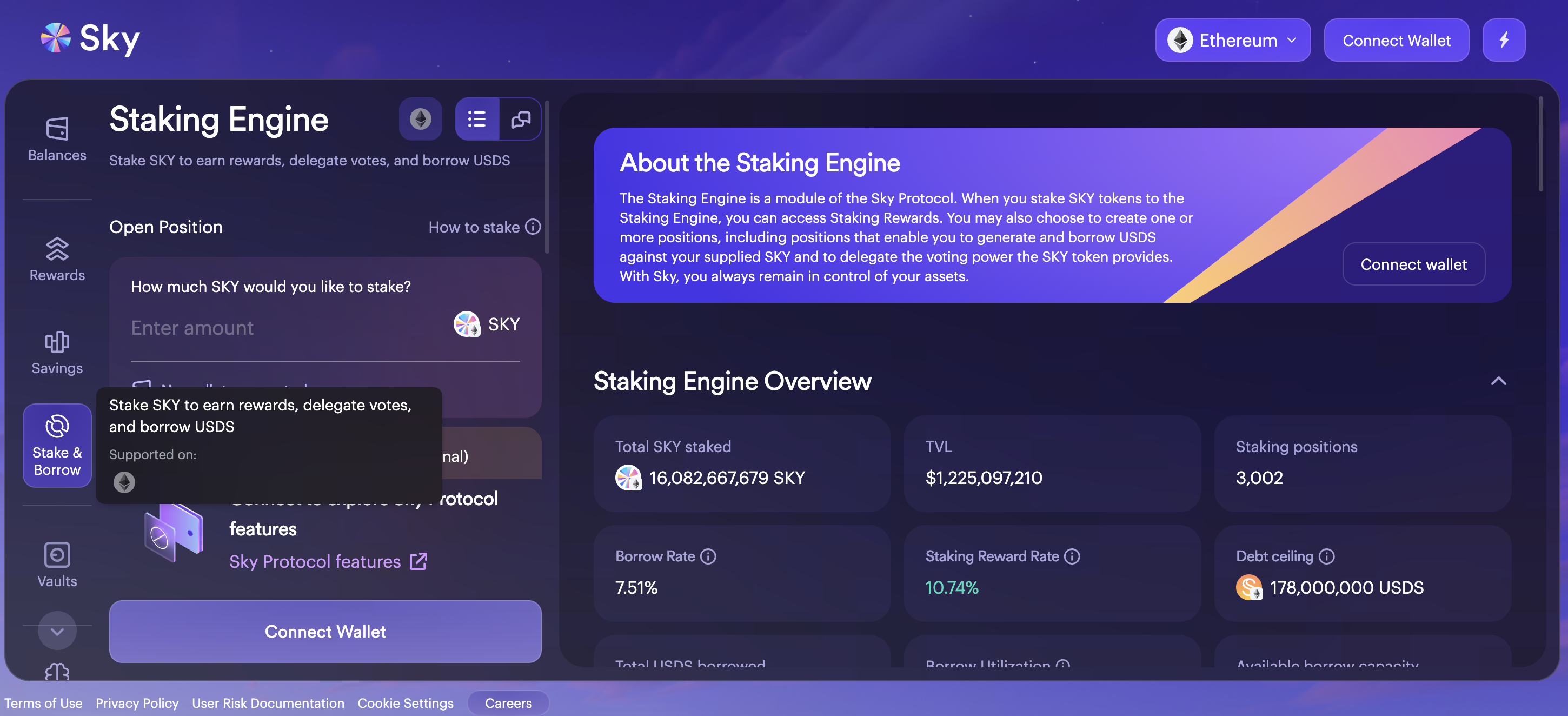 Source: SKY Official Staking Interface
Staking is one of the most effective ways to earn yield with SKY tokens. By locking up tokens, users contribute to protocol security and receive rewards.
The staking process typically involves:
Step 1: Acquire SKY Tokens Obtain SKY via exchanges or on-chain markets.
Step 2: Connect a Web3 Wallet Link a Web3-compatible wallet to the Sky Protocol platform.
Step 3: Stake Tokens Lock your SKY in the staking contract.
Step 4: Receive Rewards Earn proportional rewards based on the amount and duration of your stake.
Staking not only generates income for users but also reduces circulating supply, enhancing the economic stability of the token.
Real-World Applications of SKY in Sky Protocol
Beyond governance and staking, SKY serves multiple roles in the ecosystem.
Governance Participation: Vote on protocol proposals and community decisions.
Liquidity Incentives: Provide liquidity to DeFi pools and earn SKY rewards.
Ecosystem Collaboration Incentives: Support developers and projects building within the Sky Protocol ecosystem.
Community Governance Rewards: Active governance participants may receive additional incentives.
These applications help build a robust and self-reinforcing SKY ecosystem.
Governance Participation Process and User Rights
Participating in Sky Protocol governance is straightforward for the average user.
The basic steps are:
By engaging in governance, users can direct protocol development and earn recognition or potential rewards.
In some DeFi projects, active governance participants may also receive additional incentives or airdrops.
As the DeFi sector evolves, governance tokens are becoming integral to the crypto asset landscape. SKY’s market performance is typically influenced by:
Protocol User Growth: Increasing user numbers boost governance demand and token utility.
Ecosystem Expansion: New applications joining the Sky Protocol ecosystem drive up token demand.
Macro DeFi Market Trends: Broader market sentiment also impacts SKY’s price.
Investors should monitor metrics such as protocol TVL, the number of ecosystem projects, and governance participation to evaluate SKY’s long-term prospects.
However, crypto markets are highly volatile—sound risk management is essential.
Conclusion
SKY is the core governance asset within the Sky Protocol ecosystem, uniquely integrating DAO governance, staking rewards, and ecosystem incentives in a unified economic model. The token voting mechanism empowers community members to directly participate in protocol upgrades, parameter changes, and strategic development, enabling Sky Protocol to evolve into a community-driven platform.
As the DeFi ecosystem continues to mature, the significance of governance tokens is rising. SKY links protocol growth and community interests through its governance rights, staking rewards, and ecosystem incentives—providing users a new avenue to participate in decentralized finance governance.
With Sky Protocol’s ongoing expansion, SKY’s impact on governance, incentives, and value capture is likely to grow. However, as with all crypto assets, SKY’s market performance is subject to macro conditions, protocol development, and industry competition. For those interested in DeFi governance or long-term ecosystem engagement, a thorough understanding of SKY’s governance structure and economic model is essential.







