River is a cross-chain stablecoin protocol built around the concept of Chain Abstraction. It is designed to rethink how assets move and how capital is allocated in a multi-chain environment. Through the Omni-CDP architecture, users can complete collateralization on a single chain while minting the stablecoin satUSD natively on other chains. The process does not require cross-chain bridges, wrapped assets, or repeated conversions, shifting cross-chain capital movement from an operational task to native synchronization of capital state.
As multi-chain DeFi ecosystems become increasingly fragmented, stablecoins have largely remained passive instruments used for pricing and settlement, offering limited capital efficiency and minimal user participation in value creation. River repositions stablecoins as cross-chain capital hubs by combining satUSD, satUSD+, Vault modules, and a behavior-driven yield model. This design allows stablecoins to participate directly in yield distribution and capital circulation, while chain abstraction improves overall liquidity efficiency and composability, positioning River as a capital coordination layer for multi-chain finance.
This article explains River’s positioning and design logic, how Omni-CDP and chain abstraction reshape cross-chain stablecoin operations, and the respective roles of satUSD, satUSD+, and Vault mechanisms. It also examines how this approach alters the functional role of stablecoins in DeFi, helping readers understand River’s potential relevance within multi-chain capital structures.
River Project Overview

(Source: RiverdotInc)
River is a cross-chain stablecoin protocol built on the principle of Chain Abstraction. Its goal is to restructure how assets flow and how capital is allocated in a multi-chain environment. Under traditional cross-chain models, assets typically move through bridges, wrapping mechanisms, and multiple conversions, increasing complexity, risk, and friction. River approaches the problem at the capital structure level. Users collateralize assets on one chain and mint the stablecoin satUSD natively on other chains through Omni-CDP, decoupling collateral location from stablecoin issuance and enabling near-frictionless cross-chain capital movement.
As DeFi ecosystems continue to fragment across chains, River treats stablecoins as the central hub of a multi-chain capital system. By integrating cross-chain collateralization, yield generation, user contribution, and modular Vault mechanisms, assets are able not only to move across chains, but also to circulate continuously across functional modules. This design positions River not as a single stablecoin protocol, but as a cross-chain capital coordination layer aimed at improving capital efficiency and composability in multi-chain finance.
The Limitations Of Traditional Stablecoins: Why Most Stablecoins Remain Passive Instruments
Whether centralized stablecoins such as USDT and USDC or most decentralized stablecoins, their roles within DeFi systems are largely consistent. They primarily serve as pricing units, hedging assets, and sources of trading liquidity. Stablecoin holders typically do not participate in the value generated by their usage. Fees from trading, minting, and liquidation are usually captured by protocols or liquidity providers, leaving stablecoins as assets with high utilization but limited participation in value distribution.
The Role Of satUSD: A Stablecoin Designed As A Cross-Chain Capital Hub
satUSD is not designed to replace dollar-pegged stablecoins. Instead, it functions as the capital core within the River system.
Its design characteristics include:
- Overcollateralization backed by assets such as BTC, ETH, BNB, and LST
- Native cross-chain minting
- Use as the settlement and liquidity medium across all system modules
Through satUSD, stablecoins are positioned as internal capital hubs rather than external transactional tools.
satUSD+: Turning Stablecoins Into Automatically Yielding Assets
satUSD+ is the yield-bearing version of satUSD. Users stake satUSD to obtain satUSD+, which provides:
- Automatically accruing protocol income
- No requirement for manual claiming or compounding
- Continued usability across other DeFi protocols
This design gives stablecoins passive growth characteristics without relying on inflationary token issuance.
River’s Real Behavior Driven Yield Model
The yield generated by satUSD+ is described as coming from actual system usage across River, including:
- Fees from cross-chain minting
- Redemption and liquidation fees
- System revenue generated by Vault strategies
In this model, yield scales with system activity rather than subsidy or token emissions. Under lower market activity conditions, such a structure may exhibit greater resilience compared with incentive-driven yield models.
Smart Vault: A One-Click Stablecoin Yield Solution With No Liquidation Risk
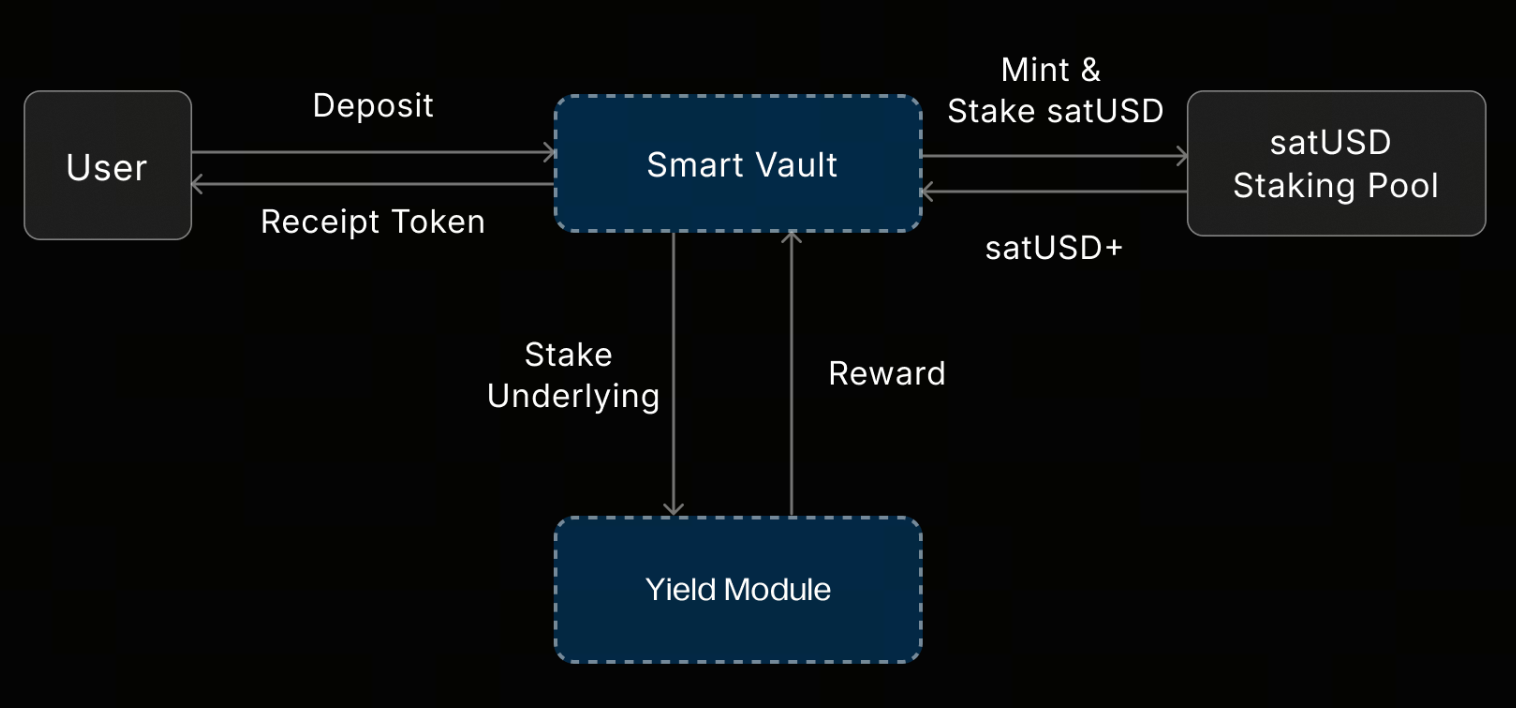
Smart Vault is designed as a low-risk entry point for general users. Unlike traditional yield strategies, users do not hold debt positions, face no liquidation risk, and are not required to monitor collateral ratios. Assets are automatically converted into satUSD by the system and deployed into yield modules, while users hold redeemable claims rather than leveraged positions.
How Smart Vault Works
- Users deposit assets such as BTC, ETH, USDT, or USDC into Smart Vault
- The protocol mints satUSD based on the value of the underlying assets
- satUSD is automatically deployed into staking pools
- Assets are actively allocated across DeFi or CeDeFi yield strategies
- Users receive returns from both asset performance and staking pools
(Source: docs.river)
The Next Stage Of Stablecoin Yield Models
When stablecoins can participate natively in yield distribution, operate across chains, and link returns to real usage, they move beyond being transactional tools and become components of capital allocation. River’s approach suggests a shift in which stablecoins evolve from DeFi lubricants into capital engines.
Summary
satUSD and satUSD+ represent a fundamental shift in the role of stablecoins. When stablecoins are no longer static assets, but instead participate in yield circulation, move across chains, and share in system growth, value distribution structures in DeFi change accordingly.
Further Reading