Against the backdrop of an accelerating global payment restructuring, the rivalry between Ripple and SWIFT has shifted from a simple “replacement relationship” to one of “deep integration and differentiated coexistence.” As SWIFT officially launched its blockchain-based shared ledger and fully implemented ISO 20022 standards in early 2026, the legacy system is attempting to eliminate settlement latency by integrating DLT protocols. Meanwhile, Ripple is leveraging the institutional-grade liquidity brought by XRP spot ETFs (which saw cumulative net inflows exceeding $1.3 billion by early 2026) and its first-mover advantage in RWA (Real-World Asset) clearing to become a dominant force in the trillion-dollar high-frequency settlement market.
From the perspective of global financial evolution, the contest between Ripple and SWIFT symbolizes a “structural reshaping” of traditional financial logic by Web3 technology. Whether through instant settlement using XRP as a bridge asset or SWIFT’s adoption of cross-chain interoperability, these advancements are driving blockchain from the fringes of experimental trading into the core infrastructure of financial institutions, catalyzing a revolutionary shift in global treasury management from “delayed delivery” to “instantaneous flow.”
The Global Cross-Border Payments Landscape
In 2026, global cross-border payment fee revenue is estimated at approximately $24 billion to $40 billion, with an expected compound annual growth rate of around 7% in the coming years. Behind these figures lies an enormous volume of capital flows, amounting to hundreds of trillions of dollars each year.
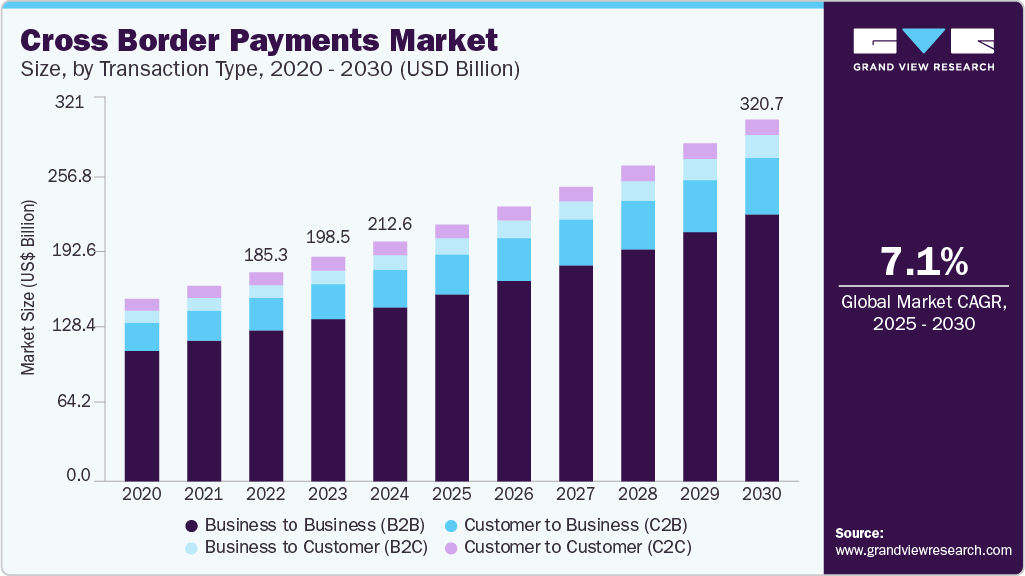
Business-to-business payments are the dominant segment, contributing more than 50% of total market revenue and accounting for the majority of cross-border settlement value. This segment represents the core battleground between SWIFT and emerging on-chain payment solutions.
At present, SWIFT remains one of the foundational infrastructures for large-value cross-border payments, processing roughly 5 trillion US dollars per day and more than $120 trillion annually in interbank value transfers.
By contrast, blockchain-based systems represented by Ripple and XRP are gaining traction in high-frequency, low-value, speed- and cost-sensitive use cases, particularly in emerging market remittances and small and medium-sized enterprise cross-border payments.
Ripple: A Blockchain-Based Global Payments Infrastructure
Ripple is a blockchain fintech company built around the vision of restructuring financial infrastructure. Its core foundation is the public blockchain XRP Ledger (XRPL), with XRP as its native asset, designed primarily for cross-border payments and liquidity solutions.
In cross-border payments, Ripple’s flagship product is On-Demand Liquidity (ODL). ODL uses XRP as a bridge asset to enable fiat to XRP to fiat settlement within seconds. This model eliminates the need for Nostro and Vostro pre-funded accounts, significantly reducing capital lock-up and liquidity costs in traditional payment systems.
SWIFT: The Global Interbank Messaging Hub
Founded in the 1970s, SWIFT (the Society for Worldwide Interbank Financial Telecommunication) is the de facto global standard for interbank financial messaging. It connects more than 11,000 financial institutions across over 200 countries and regions.
SWIFT itself does not settle funds. Instead, it securely transmits payment instructions such as MT and ISO messages between banks. Actual fund settlement occurs through domestic RTGS systems and correspondent accounts. This structure introduces multiple intermediary banks, longer settlement times, and higher costs.
In recent years, SWIFT has continued to advance initiatives such as gpi (Global Payments Innovation), the ISO 20022 upgrade, and real-time payment partnerships. These efforts aim to improve transparency and speed while preserving SWIFT’s strengths in security and compliance.
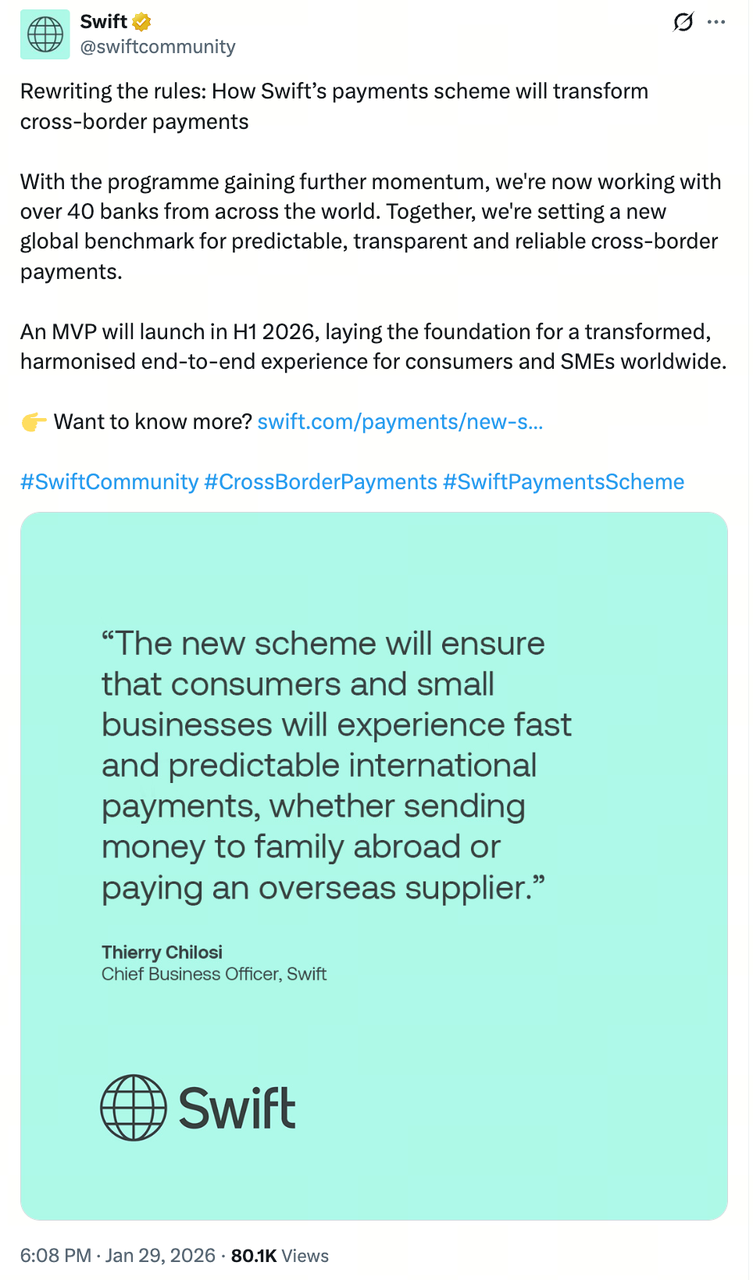
On January 29, 2026, SWIFT announced a new global payments initiative designed to make cross-border transfers as fast and predictable as domestic payments for consumers and small businesses. The plan is scheduled for phased rollout in 2026, with a minimum viable product expected in the first half of the year. More than 40 banks have participated in shaping the framework.
Ripple vs SWIFT: Core Metrics Comparison
Below is a comparison of Ripple and SWIFT across technical architecture and performance, cost structures, and adoption and ecosystem scale.
Technical Architecture and Performance
From a performance perspective, Ripple functions more like a real-time settlement infrastructure, while SWIFT operates as a secure messaging and instruction network.
| Dimension |
Ripple / XRP Ledger |
SWIFT |
| System Nature |
Public Layer 1 blockchain + Enterprise payment network (RippleNet). Uses XRP as a bridge asset for settlement. |
Global interbank messaging network. In 2026, transitioning toward integrated digital ledger capabilities. |
| Consensus / Mechanism |
RPCA (Ripple Protocol Consensus Algorithm): UNL validator voting. No mining; finality in 3–5s with near-zero energy use. |
Traditional Correspondent Banking: Based on ISO 20022 messaging and bilateral trust; moving toward shared ledgers for 24/7 liquidity. |
| TPS & Confirmation |
1,500+ TPS (Mainnet): Most cross-border payments achieve final settlement in 3–10 seconds. |
Variable: Message transmission is instant, but 95% of payments settle within 24h (via gpi). Instant settlement depends on local RTGS availability. |
| Availability |
7×24×365: Fully decentralized and always on. Settlement does not depend on bank hours or national holidays. |
Improving: gpi and ISO 20022 allow for more “after-hours” processing, but final credit is still often gated by local bank operating windows. |
Cost Structure Analysis
From a cost standpoint, Ripple is significantly more efficient than the traditional SWIFT model in both explicit transaction fees and implicit capital costs, making it particularly attractive for institutions and users under liquidity pressure.
Ripple and ODL feature extremely low on-chain fees, often ranging between $0.0001 and $0.001 per transaction. The total end-to-end cost can be compressed to around 0.3%, representing roughly a 90% reduction compared to traditional models. By using on-demand liquidity, institutions can reduce pre-funded capital requirements by more than 60%, freeing liquidity and lowering capital and opportunity costs.
SWIFT payments typically involve fees from the sending bank, intermediary banks, and the receiving bank, combined with foreign exchange spreads. In low-income country corridors, total remittance costs can reach 7%, well above the 3% target set by international organizations.
Adoption Status and Ecosystem Scale
In terms of adoption and market scale, SWIFT remains the dominant incumbent with unmatched network effects and institutional reach. Ripple, however, has established differentiated footholds in specific verticals such as emerging market remittances and on-chain financial integration.
| Dimension |
Ripple / XRP Ledger |
SWIFT |
| Institutional Coverage |
Hundreds of partners on RippleNet; 50-100+ entities in ODL production. Received conditional OCC approval (Dec 2025) for Ripple National Trust Bank. |
~11,000+ financial institution members. Remains the universal standard for Tier 1 global banks and high-value B2B settlement. |
| Geographic Coverage |
Spans 50–60+ countries; heavily concentrated in emerging markets (APAC, LATAM, Middle East) to bypass high-fee banking rails. |
Covers 200+ countries/regions; virtually every major sovereign currency and global financial hub is accessible via SWIFT. |
| Transaction Volume & Scale |
Monthly ODL volume exceeds $15 billion (Feb 2026). Cumulative value in tens of billions; primarily services SME and retail remittance. |
日均交易额约为 $5 trillion ($120T+ annualized). Dominates the global wholesale, interbank, and central bank liquidity markets. |
| Ecosystem Expansion |
Web3 / DeFi Hub: Active ecosystem for RWA (Real World Assets), Native Lending, and RLUSD stablecoin. Over $1.4B in tokenized assets on XRPL (2026). |
Traditional Infrastructure: Focuses on ISO 20022 data standards (SR2026), institutional compliance, and CBDC interoperability projects. |
Global Regulation and Compliance Dynamics
As major economies continue to implement digital asset regulatory frameworks, such as the EU’s MiCA, compliance has become a shared baseline requirement for both systems.
For SWIFT, the network does not issue assets itself and operates primarily within existing banking and clearing regulatory frameworks across jurisdictions. As a result, it is generally categorized as a traditional financial system. Regulatory focus is concentrated on areas such as anti–money laundering (AML), sanctions screening, and cybersecurity.
For Ripple and XRP, the key variable lies in the classification and use of crypto assets:
- In several major jurisdictions, including the United States following key court rulings, as well as parts of Europe and Asia, XRP is increasingly not treated as a security when traded on secondary markets. This reduces compliance uncertainty for institutions using ODL or holding XRP.
- At the same time, regulatory frameworks for crypto assets and stablecoins, such as MiCA in the EU, are being implemented across multiple regions. These frameworks require higher standards of transparency, reserve disclosure, and risk management. This trend is pushing solutions like Ripple toward becoming compliance-oriented financial infrastructure rather than purely speculative crypto tools.
Representative Use Case: Emerging Market Corridors
In real-world payment flows, Ripple forms a complementary or competitive relationship with the SWIFT model. In high-volume remittance corridors such as U.S.–Mexico and U.S.–Philippines, Ripple has demonstrated practical advantages:
- Using ODL, payment providers can move value directly from U.S. dollars to Mexican pesos or Philippine pesos, with XRP acting as a bridge asset. Settlement is completed within seconds, without the need to maintain large pre-funded balances at local banks.
- Empirical data shows that total transaction costs in these corridors can be reduced to approximately 0.3%, significantly lower than the typical 5% to 7% associated with traditional remittance services. Settlement time is also reduced from one to three days to near real time.
Conclusion
The competition between Ripple and SWIFT is fundamentally a contest between technological restructuring and incremental improvement. SWIFT retains its dominance in scale, global coverage, and institutional trust, while Ripple demonstrates next-generation advantages in performance, cost efficiency, and integration with emerging Web3 financial systems.
The cross-border payments market is large enough to support multiple coexisting solutions. However, long-term technological trends clearly favor blockchain-based infrastructures such as Ripple.
As regulatory clarity improves and institutional adoption deepens, the global cross-border payments landscape may undergo significant transformation in the years ahead.







