In the early hours of February 6, as Bitcoin fell below $60,000, panic gripped the entire crypto community. Since its all-time high of $126,000 in October 2025, Bitcoin has dropped 52%.
However, a look at Bitcoin’s 15-year price history reveals a sobering truth: a 52% drawdown is barely a drizzle compared to past cycles.
Bitcoin Bear Markets: The “Drawdown Code”
Let’s examine some data:
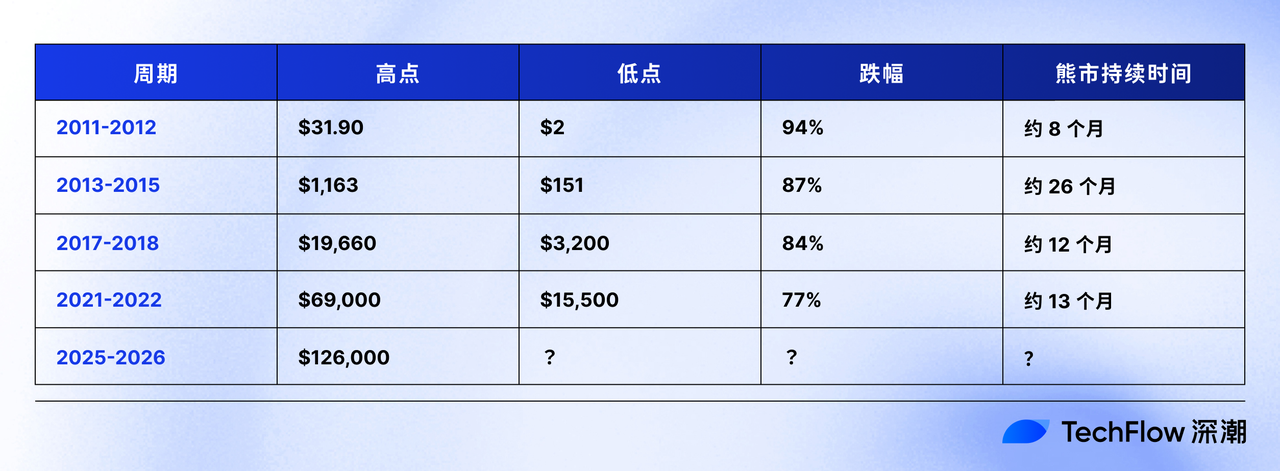
This table highlights a clear trend: the maximum drawdown in each Bitcoin bear market has consistently decreased.
From 94% to 87%, then 84% and 77%, each bear cycle’s “standard” narrows by about 5–10 percentage points.
Breaking down the pace of decline:
- 2011→2013: Down 7 percentage points (94%→87%)
- 2013→2017: Down 3 percentage points (87%→84%)
- 2017→2021: Down 7 percentage points (84%→77%)
On average, each cycle’s maximum drawdown shrinks by roughly 5–7 percentage points.
Why is this happening?
As market capitalization grows, volatility naturally decreases
In 2011, Bitcoin’s market cap was just tens of millions of dollars—a single whale could spark a 94% crash.
By 2026, even if Bitcoin halves from its peak to $60,000, its market cap remains above $1 trillion. Driving a trillion-dollar asset down another 30–40% would require sell pressure thousands of times greater than in 2011.
Institutional adoption creates a “liquidity buffer”
Before 2018, most Bitcoin holders were retail traders and early miners. When panic struck, everyone rushed to exit—there were no institutional buyers to catch the fall.
Since 2022, institutions like BlackRock, Fidelity, and Grayscale have accumulated hundreds of thousands of Bitcoin through ETFs. These players aren’t likely to panic sell after a single crash; their presence acts as a market “safety net.”
According to Bloomberg, as of January 2026, US spot Bitcoin ETFs collectively held over 900,000 BTC, valued at more than $70 billion. This “lock-in effect” directly reduces the available supply for sale.
Bitcoin’s evolution from speculative asset to asset class
Between 2011 and 2013, Bitcoin was a niche experiment, with price action driven entirely by sentiment.
From 2017 to 2021, Bitcoin gained recognition as “digital gold,” but still lacked a clear valuation anchor.
After 2025, with Bitcoin ETFs approved, the GENIUS Act advancing stablecoin regulation, and Trump’s “strategic reserve” proposal—regardless of implementation—Bitcoin has shifted from a fringe asset to a core part of the mainstream financial system.
This evolution has led to a steady decline in volatility.
The impact of halving cycles is diminishing
Historically, Bitcoin’s price was driven by the four-year halving cycle, with new supply cut by 50% each time.
In 2012’s first halving, daily issuance dropped from 7,200 to 3,600 BTC—a massive supply shock.
After the fourth halving in 2024, daily issuance fell from 900 to 450 BTC. While the percentage reduction is the same, the absolute decrease is now much smaller, so the market impact is fading.
The supply-side “deflationary effect” is weakening, and speculative demand is cooling. Together, these trends are compressing volatility.
If History Repeats, Where’s the Bottom?
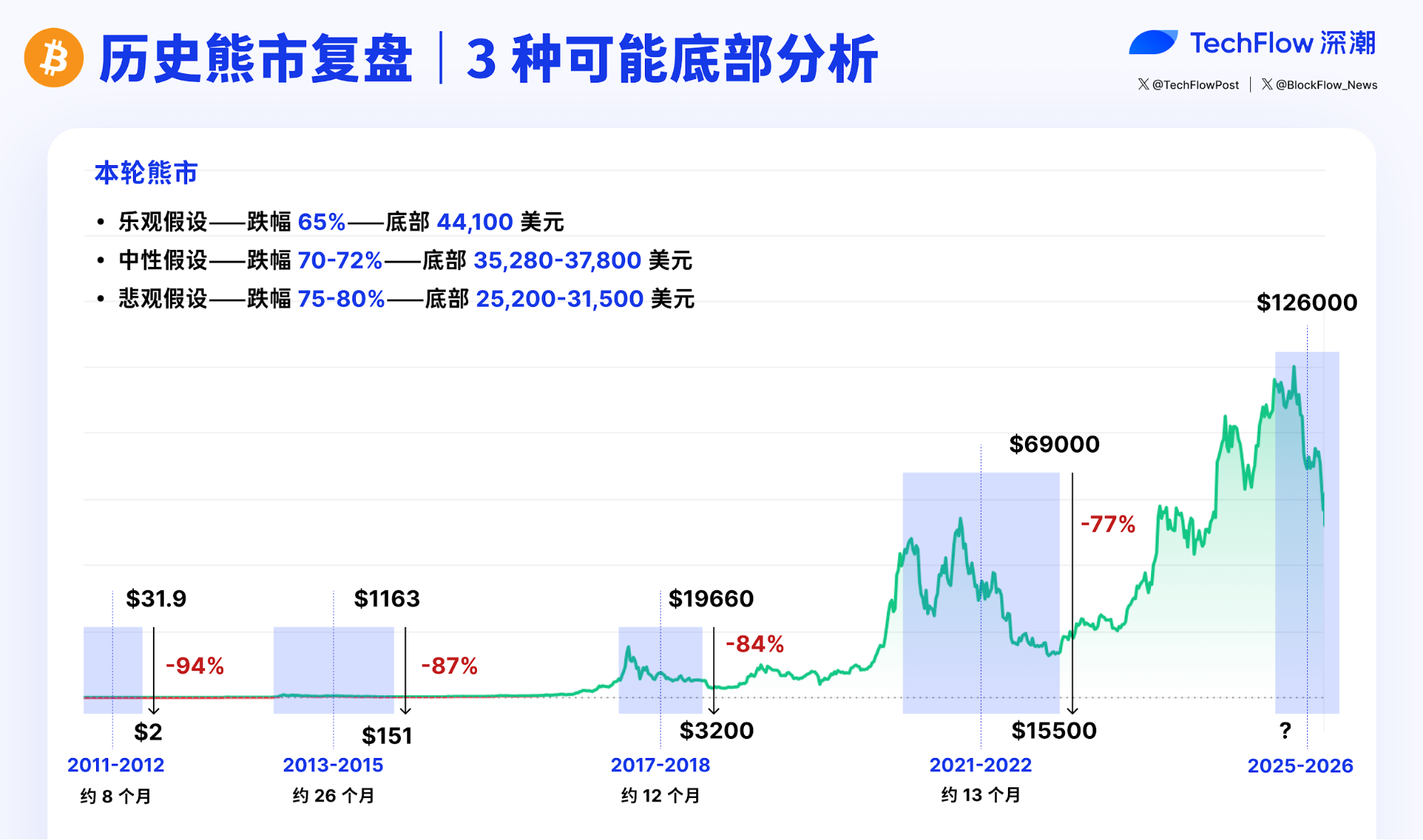
Based on this “cycle-by-cycle narrowing” trend, we can project three scenarios:
Scenario 1: Optimistic—drawdown narrows to 65%
If the maximum drawdown this cycle is 65% (12 points below the previous 77%, slightly above the historic average):
Bottom = 126,000 × (1 - 65%) = $44,100
From $60,000 to $44,100, there’s another 26% downside.
Supporting factors:
Institutional holdings are at record highs, with ETFs providing robust buy-side support
The Fed remains hawkish, but markets have pulled forward rate cut expectations from July to June 2026
Trump’s March 7 White House crypto summit could deliver policy tailwinds
Stablecoins may be shrinking, but TVL (total value locked) remains above $230 billion
Risks:
If highly leveraged holders like Strategy are forced to liquidate, it could trigger a cascade effect
If Trump’s “strategic reserve” pledge drags on, market patience may wear thin
If you favor this scenario: Start accumulating below $50,000, and add aggressively near $45,000.
Scenario 2: Neutral—drawdown of 70–72%
If the maximum drawdown is 70–72% (in line with the historic 5–7 point cycle decrease):
Bottom (70%) = 126,000 × (1 - 70%) = $37,800
Bottom (72%) = 126,000 × (1 - 72%) = $35,280
From $60,000 to $35,000–$37,800, there’s 37–41% downside left.
Supporting factors:
Perfectly fits historic patterns—neither overly optimistic nor pessimistic
The current macro backdrop (rate cut hopes plus balance sheet concerns) is as complex as 2018
$35,000–$38,000 aligns with Bitcoin’s 200-week moving average, historically a strong support
Risks:
If the US economy enters recession, all risk assets could face indiscriminate selling
If the AI bubble bursts and tech stocks collapse, Bitcoin could follow suit
If you favor this scenario: Reserve most of your capital for below $40,000; $35,000–$45,000 is your “heavy buy zone.”
Scenario 3: Pessimistic—drawdown returns to 75–80%
If “this time is different” and a structural collapse pushes the drawdown back to the 2017–2022 average:
Bottom (75%) = 126,000 × (1 - 75%) = $31,500
Bottom (80%) = 126,000 × (1 - 80%) = $25,200
From today’s $70,000 to $25,000–$31,500 would mean another 50% drop—a brutal washout.
Supporting factors:
The February 6 “triple crash” (US stocks, gold, and Bitcoin plunging together) shows Bitcoin’s “safe haven” narrative has collapsed
While ETFs have absorbed supply, they also allow institutions to exit with a single click
Trump’s tariff policy could trigger a global trade war and recession
Crypto industry brain drain and VC exits (e.g., Multicoin co-founder Kyle Samani leaving) signal collapsing confidence
If you favor this scenario: Exit now, wait for a full capitulation below $30,000, or keep only 10–20% of your portfolio as a high-risk bet, moving the rest to the sidelines.
Don’t Fear Missing the Bottom
Some worry about missing this bear market’s bottom-buying opportunity.
The answer is simple: chase the rally or wait for the next cycle.
Crypto isn’t your only shot at financial success. If you think it is, you’ve already lost.
In 2015, missing $150 still left a chance at $3,200 in 2018.
In 2018, missing $3,200 still left a chance at $15,000 in 2022.
The key is surviving until the next cycle.
Don’t quit the market permanently just because you failed on one all-in bet.
Most people obsess over “where to buy,” but ignore “when to sell.”
Consider these three cases:
Case 1:
In December 2018, Mr. Zhang went all-in at $3,200. By June 2019, Bitcoin surged to $13,000—he assumed the bull market had returned and held on. In December 2019, Bitcoin dropped to $7,000, so he panicked and sold at a loss.
Result: Less than 1x profit, washed out before the $69,000 peak in 2021.
Case 2:
Mr. Li also bought at $3,200, but set a rule: “No selling until $50,000.” He ignored all volatility in 2019–2020. In April 2021, Bitcoin hit $63,000—he sold half, locking in a 15x gain. He held the rest until the $69,000 peak in November 2021, then sold the remainder.
Result: Average profit of 18x.
Case 3:
Mr. Wang started investing $1,000 monthly from December 2018, regardless of price. He continued for three years, stopping in December 2021.
His average cost was around $12,000 (buying cheaply early, more expensively later). When Bitcoin reached $69,000 in November 2021, he sold everything, netting about 4.7x profit.
Result: Not as high as Mr. Li, but required no market timing and was the simplest to execute.
These cases show that nailing the bottom isn’t what matters—holding through the cycle is.
If you’re not committed to holding Bitcoin for life, set a take-profit plan in advance. Dollar-cost averaging may not be flashy, but it’s the best strategy for most people. Almost no one buys the bottom and sells the top; buying and selling in batches is always a relatively sound approach.
Final Thoughts: Bear Markets Are the Underdog’s Opportunity
In 2011, buying Bitcoin at $2 would now yield a 30,000x return—even at the recent $60,000 low.
In 2015, buying at $150 is now a 400x gain.
In 2018, buying at $3,200 is now 18.75x.
In 2022, buying at $15,000 is now 4x.
Every bear market is a new round of wealth redistribution.
Those who chased the highs are washed out in the bear market; those who panic sold at the bottom handed their positions to others.
The real winners are always those who dare to accumulate in batches when everyone else has lost hope.
As long as you believe Bitcoin’s price will rebound—and eventually reach new highs.
In 2018, when Bitcoin fell to $3,200, some claimed, “Bitcoin is dead.”
In 2022, when Bitcoin dropped to $15,000, many declared the end of crypto.
In February 2026, as Bitcoin falls below $60,000, the world is asking: “Is this time really different?”
If you believe “history repeats,” then the next 6–12 months may be one of your few chances to buy “the future” at a “relatively low price.”
Whether you believe it or not is your choice.
Disclaimer: This article is for historical data reference only and does not constitute investment advice. Cryptocurrency investments carry extremely high risk. Please make decisions carefully according to your own circumstances. The author and TechFlow bear no responsibility for any investment losses.
Statement:
- This article is reprinted from [TechFlow]. Copyright belongs to the original author [TechFlow]. If you have any concerns about this reprint, please contact the Gate Learn team, and we will handle the matter promptly in accordance with relevant procedures.
- Disclaimer: The views and opinions expressed in this article are solely those of the author and do not constitute investment advice.
- Other language versions of this article are translated by the Gate Learn team. Unless Gate is explicitly mentioned, translated articles may not be copied, distributed, or plagiarized.







