Throughout our Crypto AI research series, we have repeatedly emphasized that the most practical applications in the current crypto landscape are primarily concentrated in stablecoin payments and DeFi, while Agents serve as the primary user-facing interface for AI. As Crypto and AI increasingly converge, the two most valuable paths are: in the short term, AgentFi built upon established DeFi protocols (including foundational strategies like lending and liquidity mining, as well as advanced strategies such as Swap, Pendle PT, and funding rate arbitrage); and in the medium to long term, Agent Payment, which centers on stablecoin settlement and leverages protocols such as ACP, AP2, x402, and ERC-8004.
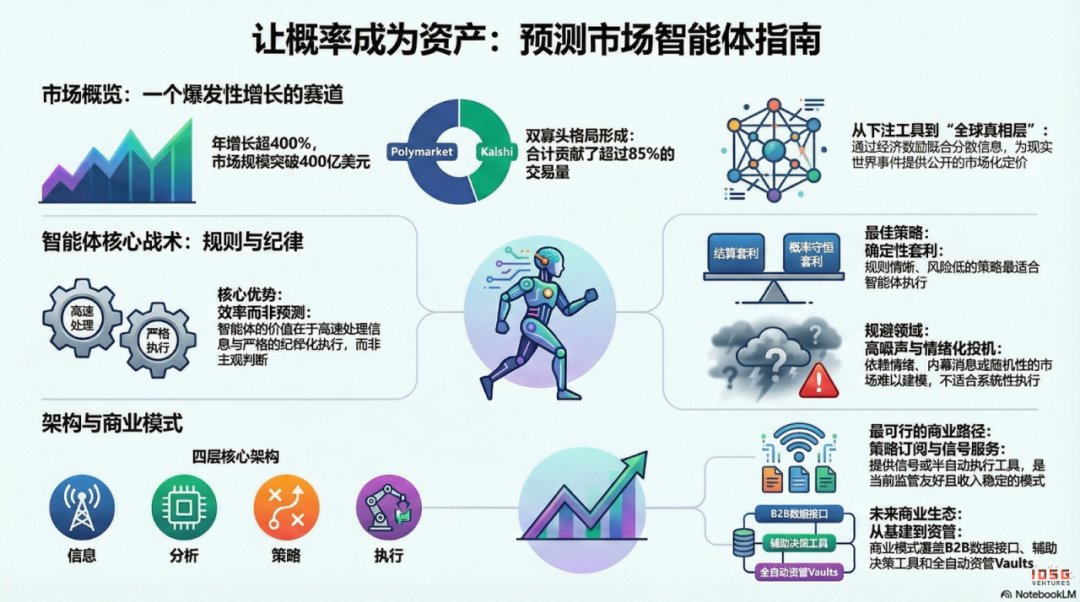
By 2025, prediction markets have emerged as an industry trend that cannot be ignored, with annual trading volume skyrocketing from approximately $9 billion in 2024 to over $40 billion in 2025—a year-over-year increase of more than 400%. This dramatic growth is fueled by several factors: rising uncertainty from macro-political events, the maturation of infrastructure and trading models, and breakthroughs in the regulatory environment (including Kalshi’s legal victory and Polymarket’s return to the US market). By early 2026, Prediction Market Agents are beginning to take shape and are poised to become a prominent new product segment in the agent ecosystem within the following year.
1. Prediction Markets: From Betting Instrument to Global Truth Layer
Prediction markets are financial mechanisms where participants trade on the outcomes of future events. Contract prices reflect the market’s collective assessment of event probabilities. Their effectiveness comes from the fusion of collective intelligence and economic incentives: in a setting where real money is at stake and anonymity is preserved, dispersed information is rapidly aggregated into capital-weighted price signals, significantly reducing noise and false judgments.
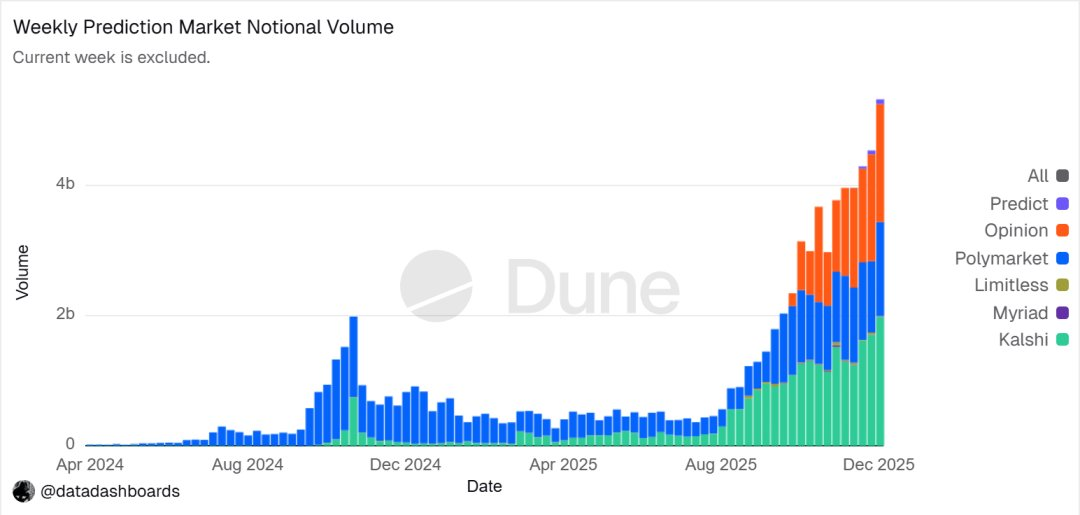 Prediction Market Nominal Trading Volume Trend. Source: Dune Analytics (Query ID: 5753743)
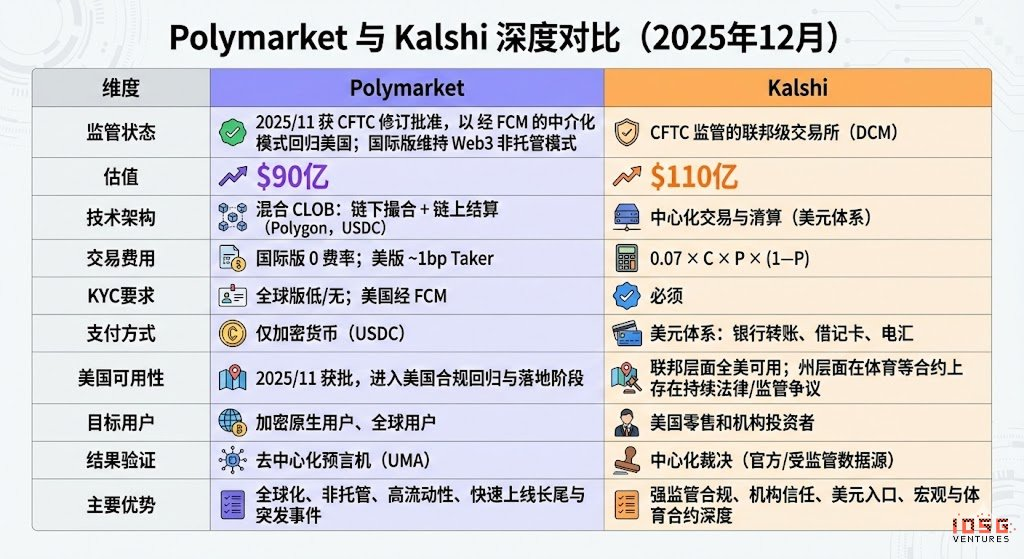
By the end of 2025, prediction markets had solidified into a duopoly led by Polymarket and Kalshi. According to Forbes, total trading volume in 2025 reached around $44 billion, with Polymarket contributing about $21.5 billion and Kalshi approximately $17.1 billion. Data from February 2026 shows Kalshi’s trading volume ($25.9B) surpassing Polymarket’s ($18.3B), approaching a 50% market share. Kalshi’s rapid growth is attributed to its legal victory in election contract cases, first-mover advantage in compliant US sports prediction markets, and clearer regulatory outlook. At present, the two companies have clearly diverged in their development strategies:
- @Polymarket utilizes a hybrid CLOB model with off-chain matching and on-chain settlement, creating a global, non-custodial, highly liquid market. Following its return to compliance in the US, it operates with both onshore and offshore structures.
- @Kalshi integrates with traditional financial infrastructure, connecting via API to major retail brokerages and attracting Wall Street market makers for macro and data-driven contracts. Its products are bound by traditional regulatory processes, resulting in slower responses to long-tail or breaking events.
Beyond Polymarket and Kalshi, other competitive players are developing along two primary tracks:
- The compliance distribution path embeds event contracts within the existing account and clearing systems of brokers or large platforms, leveraging channel reach, compliance credentials, and institutional trust (e.g., Interactive Brokers × ForecastEx’s ForecastTrader, FanDuel × CME Group’s FanDuel Predicts). While these approaches have clear compliance and resource advantages, their products and user bases remain in the early stages.
- The crypto-native on-chain path, represented by @opinionlabsxyz, @trylimitless, and @MyriadMarkets, rapidly scales via points mining, short-term contracts, and media distribution, focusing on performance and capital efficiency. However, long-term sustainability and robust risk controls remain unproven.
Together, these two approaches—traditional finance’s compliance entry and crypto-native performance—define the competitive landscape of the prediction market ecosystem.
While prediction markets superficially resemble gambling and are fundamentally zero-sum, their key distinction lies in positive externalities: by aggregating dispersed information through real-money trading, they provide public pricing for real-world events, establishing a valuable signal layer. The trend is shifting from gaming sop toward a “global truth layer”—with institutions like CME and Bloomberg now integrating these markets, event probabilities have become actionable decision-making metadata for financial and enterprise systems, offering more timely and quantifiable market-based truth.
Globally, regulatory approaches to prediction markets are highly fragmented. The United States is the only major economy to explicitly regulate prediction markets as financial derivatives. In contrast, Europe, the UK, Australia, and Singapore generally classify them as gambling and are tightening restrictions, while China and India ban them outright. The future global expansion of prediction markets will continue to depend on each country’s regulatory framework.
2. Prediction Market Agent Architecture
Prediction Market Agents are entering their initial phase of practical application. Their value is not in “AI predicting more accurately,” but in amplifying information processing and execution efficiency within prediction markets. By design, prediction markets are information aggregation mechanisms, with prices reflecting collective probability judgments. Real-world market inefficiencies stem from information asymmetry, liquidity constraints, and limited attention. The proper role for Prediction Market Agents is executable probabilistic portfolio management: converting news, rule texts, and on-chain data into verifiable pricing deviations, executing strategies faster, more systematically, and at lower cost, and capturing structural opportunities through cross-platform arbitrage and portfolio risk management.
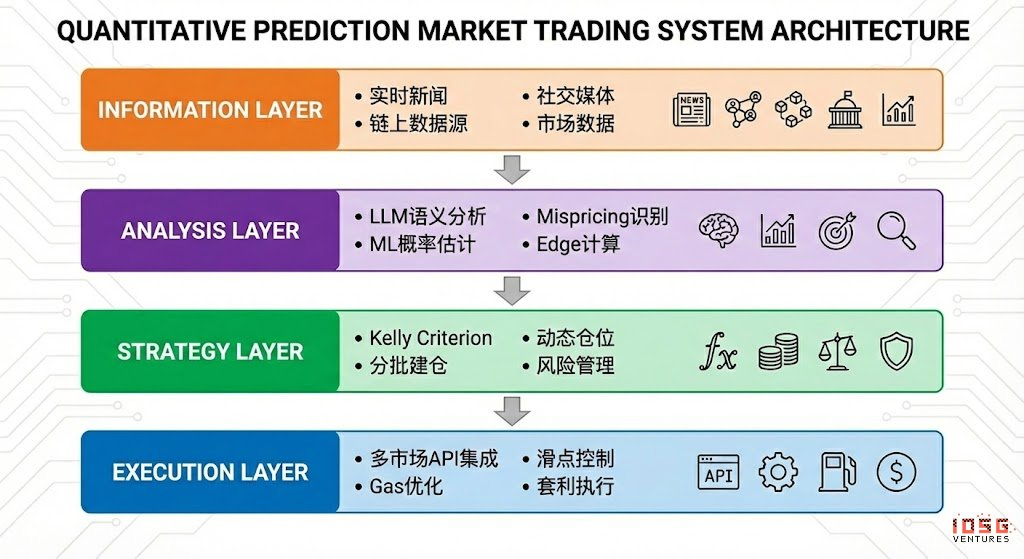
The ideal Prediction Market Agent features a four-layer architecture:
- Information Layer: Aggregates news, social, on-chain, and official data.
- Analysis Layer: Uses LLMs and machine learning to identify mispricing and calculate edge.
- Strategy Layer: Applies the Kelly criterion, batch position building, and risk controls to translate edge into positions.
- Execution Layer: Handles multi-market order placement, slippage and gas optimization, and arbitrage execution, forming an efficient automated loop.
3. Strategy Framework for Prediction Market Agents
Prediction markets differ significantly from traditional trading environments in settlement mechanisms, liquidity, and information distribution. Not all markets and strategies are suitable for agent automation. The core challenge is whether an agent is deployed in scenarios with clear, codifiable rules that match its structural strengths. The following analysis addresses asset selection, position management, and strategy structure.
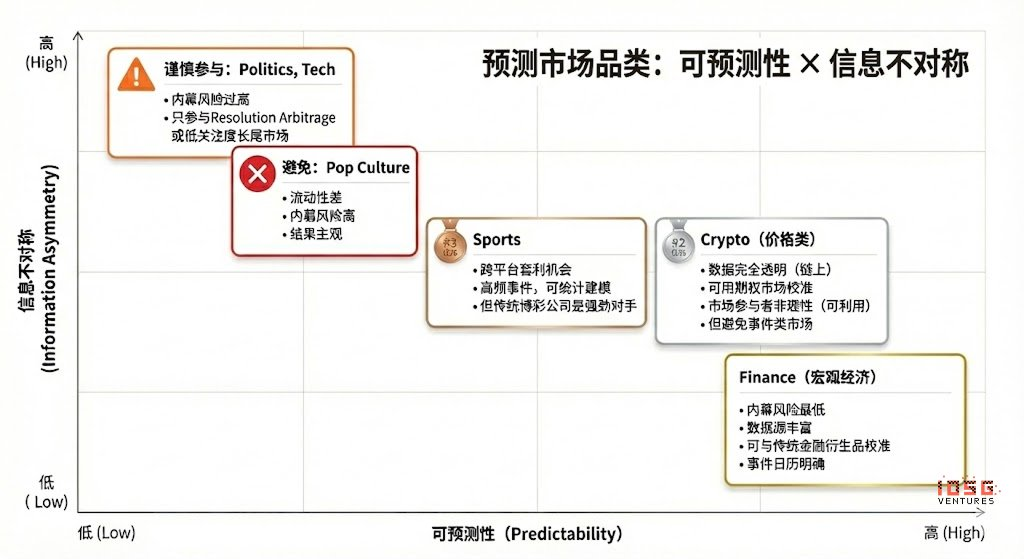
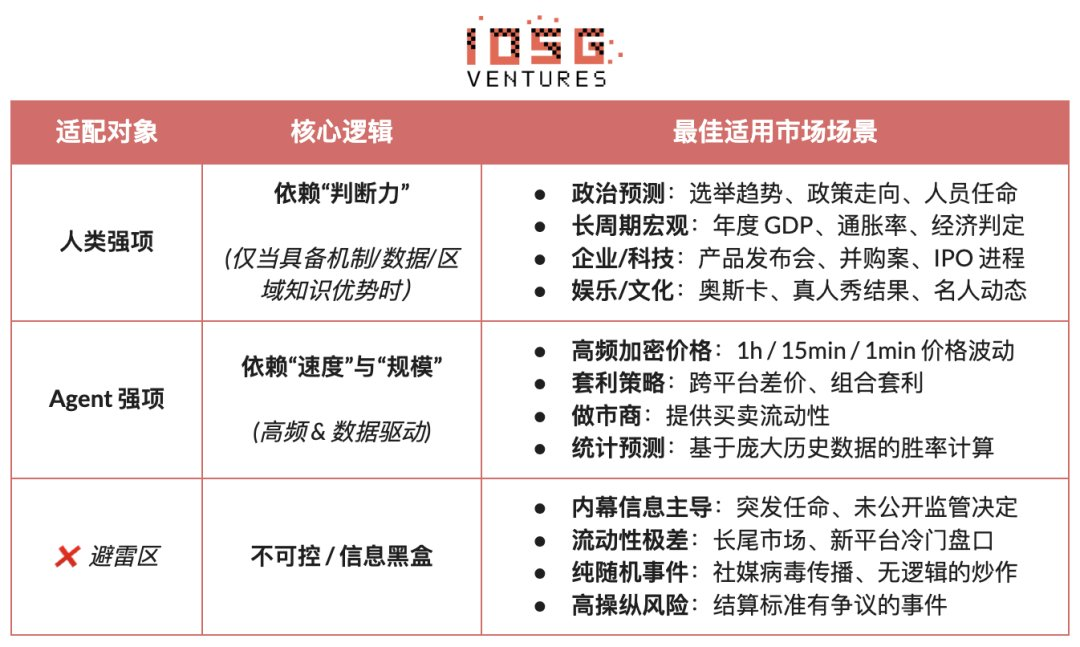
Not all prediction markets offer trading value. Participation value depends on settlement clarity (clear rules, unique data sources), liquidity quality (depth, spread, volume), insider risk (degree of information asymmetry), time structure (expiry and event timing), and the trader’s information edge and professional background. Only when most criteria are met is participation warranted. Participants should match their strengths to market characteristics:
- Human Core Advantage: Markets relying on expertise, judgment, and integration of ambiguous information with wider time windows (days/weeks). Typical examples: political elections, macro trends, corporate milestones.
- AI Agent Core Advantage: Markets reliant on data processing, pattern recognition, and rapid execution with extremely short decision windows (seconds/minutes). Typical examples: high-frequency crypto pricing, cross-market arbitrage, automated market making.
- Unsuitable Fields: Markets dominated by insider information or pure randomness/manipulation, which offer no advantage to any participant.
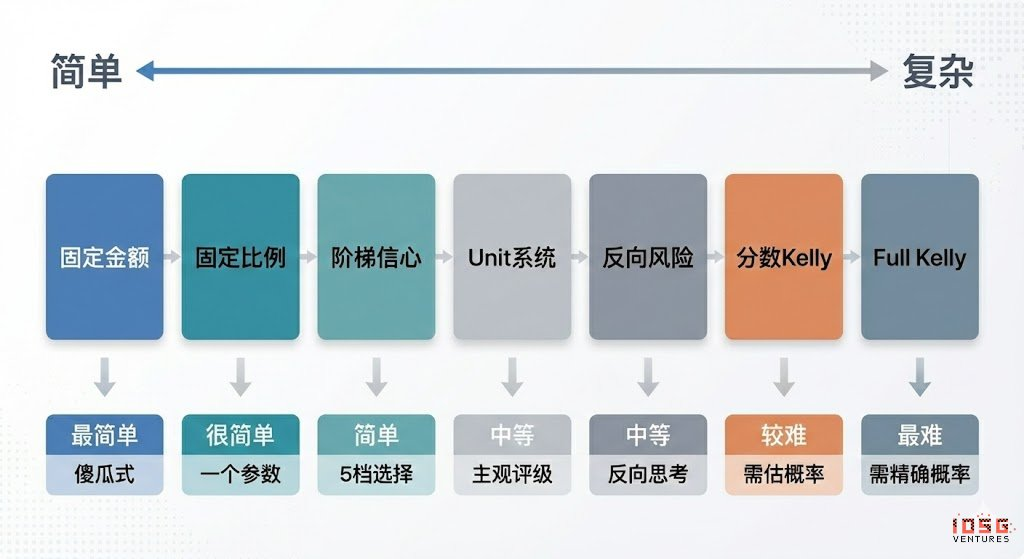
The Kelly Criterion is the most prominent capital management theory for repeated games. It aims not to maximize one-off returns but to optimize long-term compound growth rates. The method estimates optimal position size based on win probability and odds, improving capital growth efficiency under positive expectation, and is widely used in quantitative investing, professional gambling, poker, and asset management.
- Classic form: f* = (bp - q) / b, where f* is the optimal bet ratio, b is net odds, p is win probability, and q = 1 - p.
- For prediction markets: f* = (p - market_price) / (1 - market_price), where p is subjective true probability and market_price is the implied probability.
The Kelly Criterion’s theoretical validity depends heavily on accurate estimation of true probabilities and odds. In practice, traders rarely maintain precise estimates, so professionals often favor more executable, less probability-dependent rule-based strategies:
- Unit System: Divide capital into fixed units (e.g., 1%), invest varying units based on confidence, and use unit caps to automatically limit single-trade risk—the most common practical method.
- Flat Betting: Use a fixed capital proportion for each bet, emphasizing discipline and stability, suitable for risk-averse or low-confidence environments.
- Confidence Tiers: Predefine discrete position tiers with hard caps, simplifying decisions and avoiding pseudo-precision issues in the Kelly model.
- Inverted Risk Approach: Start from the maximum acceptable loss to determine position size, establishing stable risk boundaries from the outset.
For Prediction Market Agents, strategy design should prioritize executability and stability over theoretical optimality. The key is clear rules, simple parameters, and error tolerance. Under these constraints, confidence tiers with fixed position caps offer the most robust position management for PM Agents. This approach does not require precise probability estimates but divides opportunities into limited tiers based on signal strength, assigning fixed positions, and always applies clear caps to control risk, even in high-confidence scenarios.
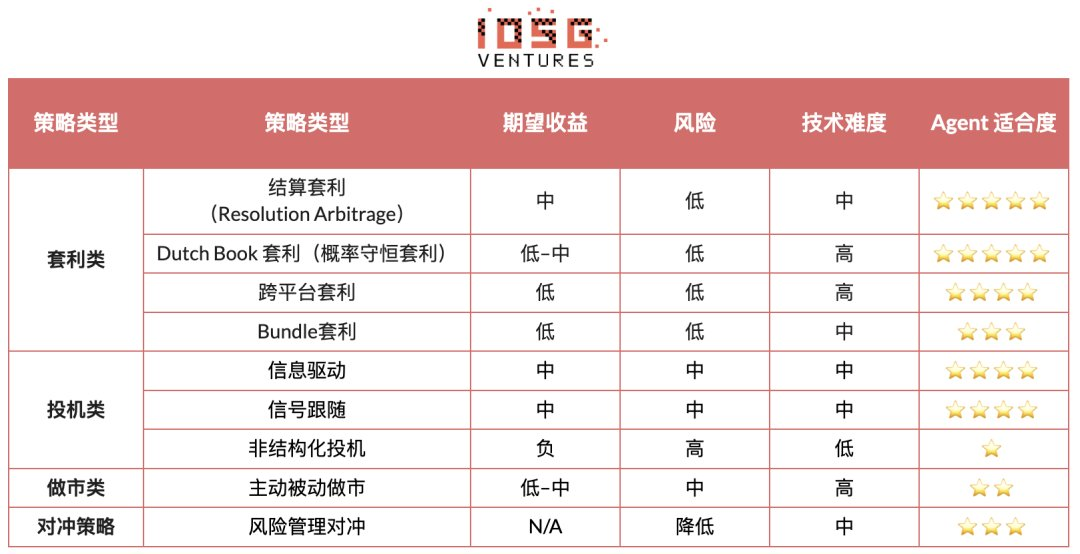
From a strategy perspective, prediction markets feature two main categories: deterministic arbitrage strategies (arbitrage)—characterized by clear, codifiable rules—and speculative strategies, which rely on information interpretation and directional judgment. There are also market making and hedging strategies, typically used by institutions with significant capital and infrastructure.
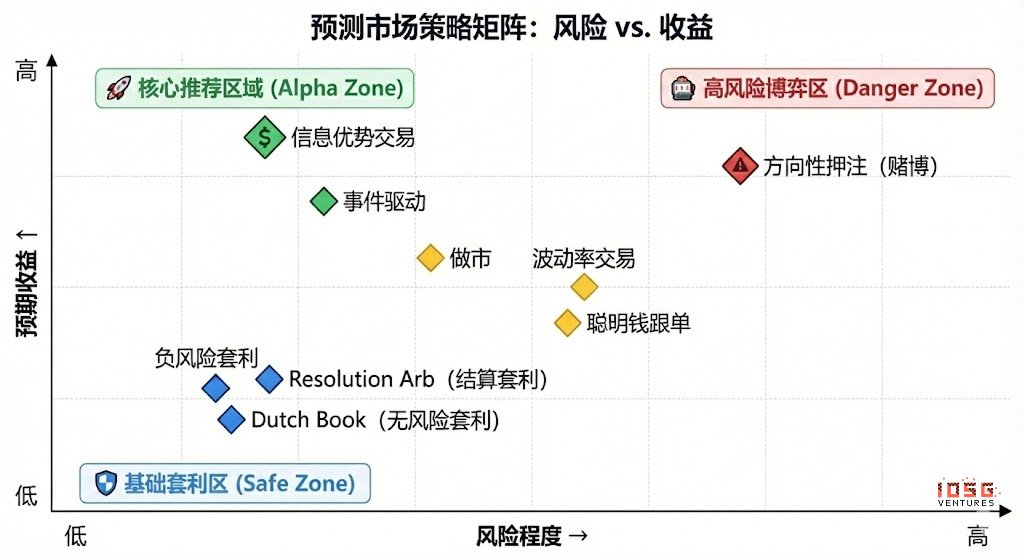
- Resolution Arbitrage: Occurs when an event’s outcome is nearly certain but the market hasn’t fully priced it in. Returns come from information synchronization and execution speed. This rule-based, low-risk, fully codifiable strategy is the core agent strategy in prediction markets.
- Dutch Book Arbitrage: Exploits structural imbalances when the sum of mutually exclusive event prices deviates from probability conservation (∑P≠1), locking in difference through combined positions. This rule-based, low-risk strategy is ideal for agent automation.
- Cross-Platform Arbitrage: Profits from pricing differences for the same event across markets. While low-risk, it demands high latency and parallel monitoring. Suitable for agents with infrastructure advantages, but competition erodes margins over time.
- Bundle Arbitrage: Trades on pricing inconsistencies between related contracts. Logic is clear but opportunities are limited. Agents can execute but require engineering for rule parsing and combination constraints.
Speculative Strategies
- Information Trading: Centers on clear events or structured data, such as official releases or rulings. Where data sources and triggers are clear, agents excel in monitoring and execution, but human intervention remains necessary for semantic or contextual interpretation.
- Signal Following: Follows historically successful accounts or capital flows. Rules are simple and automatable, but core risks include signal decay and reverse exploitation, requiring filtering and strict position management. Best used as a supplementary agent strategy.
- Unstructured/Noise-Driven: Relies on sentiment, randomness, or participant behavior, lacking stable, repeatable edge. Due to modeling difficulty and high risk, these are unsuitable for systematic agent execution or long-term strategies.
Market Microstructure Strategies: Require extremely short decision windows, continuous quoting, or high-frequency trading, demanding low latency, advanced modeling, and substantial capital. While theoretically agent-friendly, liquidity and competition constraints in prediction markets limit their practical application to a few well-resourced participants.
Risk Control & Hedging: These strategies aim to reduce risk exposure rather than generate direct returns. With clear rules and objectives, they serve as foundational long-term risk control modules.
Overall, the strategies best suited for agent execution in prediction markets are those with clear rules, codifiability, and minimal subjective judgment. Deterministic arbitrage should be the primary source of returns, with structured information and signal-following strategies as supplements. High-noise and sentiment-driven trades should be systematically excluded. Agents’ long-term edge lies in disciplined, high-speed execution and risk management.
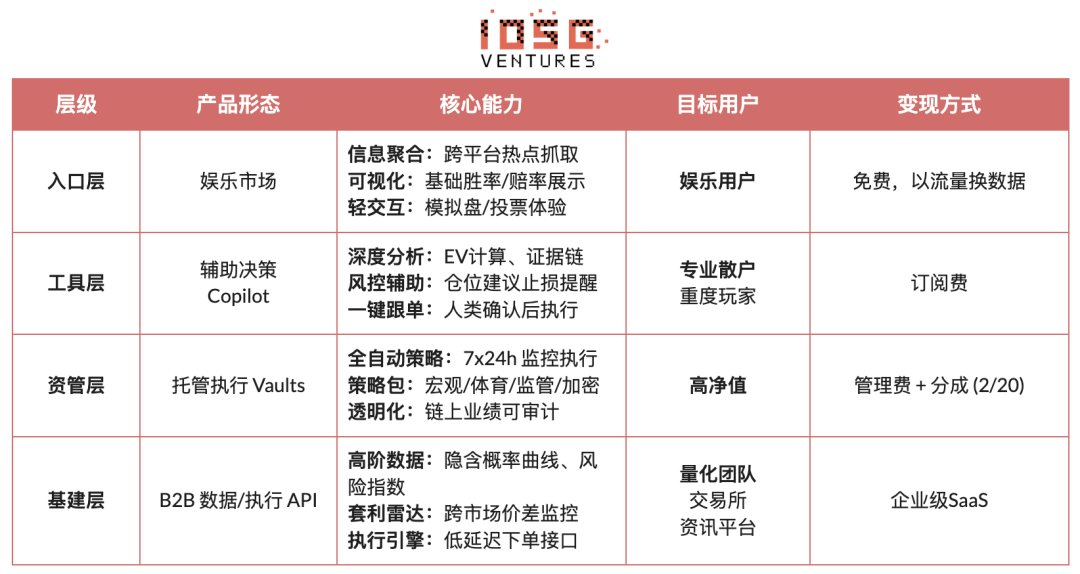
Optimal business models for Prediction Market Agents offer different exploration opportunities at each layer:
- Infrastructure: Provides real-time multi-source data aggregation, smart money address databases, unified prediction market execution engines, and backtesting tools. Charges B2B for stable, prediction-agnostic income.
- Strategy: Incorporates community and third-party strategies to build a reusable, evaluable strategy ecosystem, capturing value through calls, weights, or execution splits, reducing reliance on a single alpha.
- Agent/Vault: Agents act as entrusted managers for live execution, leveraging on-chain transparency and strict risk controls, earning management and performance fees.
Product models for these business structures include:
- Gamified/Entertainment: Lowers entry barriers through intuitive, Tinder-like interfaces, maximizing user growth and market education. Ideal for mass adoption but must transition to subscription or execution-based monetization.
- Strategy Subscription/Signals: No custody, regulatory friendly, clear rights and responsibilities, and stable SaaS revenue—currently the most viable commercialization path. Limitations include strategy replication and execution slippage, but "signal + one-click execution" semi-automation can greatly enhance user experience and retention.
- Vault Custody: Offers scale and execution efficiency, akin to asset management, but faces licensing, trust, and centralization risks. The model’s viability depends on together market conditions and sustained performance. Without long-term track record and institutional backing, this is not recommended as the main path.
In summary, a diversified revenue structure—"infrastructure monetization + strategy ecosystem + performance participation"—reduces reliance on the single hypothesis that "AI will consistently outperform the market." Even as alpha converges with market maturity, core capabilities in execution, risk control, and settlement retain long-term value, enabling a more sustainable business loop.
5. Prediction Market Agent Project Case Studies
Prediction Market Agents are still in the early experimental phase. Although the market has seen various attempts from infrastructure to upper-layer tools, no standardized products have yet emerged that are mature in strategy generation, execution efficiency, risk controls, and business loops.
We categorize the current ecosystem into three layers: infrastructure, autonomous agents, and prediction market tools.
Infrastructure
Polymarket Agents Framework:
Polymarket Agents @Polymarket is an official developer framework designed to standardize connection and interaction. It encapsulates market data access, order construction, and basic LLM interfaces. While it solves the "how to place orders with code" problem, it leaves core trading capabilities—strategy generation, probability calibration, dynamic position management, and backtesting—largely unaddressed. It is best viewed as an official integration standard, not a finished alpha-generating product. Commercial-grade agents must build complete research and risk control capabilities on top of this framework.
Gnosis Prediction Market Tools:
Gnosis Prediction Market Agent Tooling (PMAT) @gnosis_ provides full read/write support for Omen/AIOmen and Manifold, but only read-only access to Polymarket, resulting in clear ecosystem barriers. It is a solid foundation for Gnosis-based agents, but less useful for developers focused on Polymarket.
Polymarket and Gnosis are currently the only prediction market ecosystems to officially productize agent development. Other platforms, such as Kalshi, remain at the API and Python SDK level, requiring developers to build their own strategy, risk control, operation, and monitoring systems.
Autonomous Agents
Most "Prediction Market AI Agents" on the market are still in the early stages. Despite the "Agent" label, their actual capabilities fall well short of fully automated trading loops, often lacking systematic risk controls and failing to incorporate position management, stop-loss, hedging, and expected value constraints into their decision processes. These products remain immature and are not yet suitable for long-term deployment.
Olas Predict @autnolas: The most productized prediction market agent ecosystem to date. The core product, Omenstrat, is built on Gnosis’s Omen, using FPMM and decentralized arbitration. It supports small, high-frequency interactions but is limited by Omen’s single-market liquidity. Its "AI prediction" relies mainly on general-purpose LLMs, lacks real-time data and systematic risk controls, and exhibits significant performance differences across categories. In February 2026, Olas launched Polystrat, expanding agent capabilities to Polymarket—users can set strategies in natural language, and the agent automatically identifies and trades probability deviations in markets settling within four days. The system uses Pearl for local execution, self-custodied Safe accounts, and hardcoded limits for risk control, making it the first consumer-grade autonomous agent for Polymarket.
UnifAI Network Polymarket Strategy @UnifaiNetwork: Offers an automated Polymarket trading agent focused on log-tail risk: scanning for contracts nearing settlement with implied probabilities above 95% and buying to capture 3–5% spreads. On-chain results show win rates near 95%, but returns vary significantly by category, and the strategy is highly dependent on execution frequency and market selection.
NOYA.ai @NetworkNoya aims to integrate research, judgment, execution, and monitoring into a closed agent loop, spanning intelligence, abstraction, and execution layers. Omnichain Vaults have been delivered, but the Prediction Market Agent remains under development and has not yet achieved full mainnet integration.
Prediction Market Tools
Current prediction market analysis tools do not yet constitute complete agents. Their value lies mainly in the information and analysis layers, with trade execution, position management, and risk control left to the user. These tools are best seen as strategy subscription, signal assistance, or research augmentation—early prototypes of full agents.
Based on a systematic review of Awesome-Prediction-Market-Tools, we selected representative projects with initial product form and clear use cases as case studies. These cluster around four areas: analytics and signals, alert and whale tracking, arbitrage discovery, and trading terminals with aggregation sop.
Market Analysis Tools
- Polyseer: Research-focused tool with multi-agent division (Planner, Researcher, Critic, Analyst, Reporter) for bilateral evidence collection and Bayesian probability aggregation, producing structured reports. Transparent methodology, engineered workflows, and fully open-source.
- Oddpool: The "Bloomberg Terminal" for prediction markets, offering cross-platform aggregation, arbitrage scanning, and real-time dashboards for Polymarket, Kalshi, CME, and others.
- Polymarket Analytics: Global Polymarket data analytics, visualizing trader, market, position, and transaction data. Well-positioned for research and data reference.
- Hashdive @hash_dive: Trader-focused data tool quantifying traders and markets with Smart Score and multi-dimensional screeners, practical for smart money identification and copy trading.
- Polyfactual @polyfactual: Focuses on AI market intelligence, sentiment, and risk analysis, embedding results via Chrome extension for B2B and institutional users.
- Predly @predlyai: AI mispricing detection platform, comparing market prices and AI-calculated probabilities for Polymarket and Kalshi. Claims 89% alert accuracy, targeting signal discovery and opportunity filtering.
- Polysights @polysights: Covers 30+ markets and on-chain metrics, tracks new wallets, large single-direction bets, and anomalies with Insider Finder. Suitable for daily monitoring and signal discovery.
- PolyRadar: Multi-model analysis platform providing real-time event interpretation, timeline evolution, confidence scoring, and source transparency. Emphasizes cross-AI validation.
- Alphascope: AI-powered prediction market intelligence, providing real-time signals, research summaries, and probability change monitoring. Still early-stage, focused on rebalance and signal support.
Alerts/Whale Tracking
Arbitrage Discovery
- ArbBets @arbbets: AI-driven arbitrage discovery for Polymarket, Kalshi, and sports betting. Identifies cross-platform arbitrage and +EV opportunities, focused on high-frequency scanning.
- PolyScalping @PolyScalping: Real-time arbitrage and scalping for Polymarket, scanning the market every 60 seconds, ROI calculations, Telegram alerts, and filters for liquidity, price, and volume.
- Eventarb @eventarbitrage: Lightweight cross-platform arbitrage calculator and alert tool covering Polymarket, Kalshi, and Robinhood. Free, focused, and a basic arbitrage aid.
- Prediction Hunt: Aggregates and compares prediction markets across exchanges, providing real-time price comparison and arbitrage detection for Polymarket, Kalshi, and PredictIt (refreshes every 5 minutes).
Trading Terminals/Aggregated Execution
- Verso: YC Fall 2024-supported institutional-grade trading terminal, providing a Bloomberg-style interface, real-time tracking of 15,000+ Polymarket and Kalshi contracts, deep analytics, and AI news. Targets professionals and institutions.
- Matchr @matchrxyz: Cross-platform aggregation and execution for 1,500+ markets, with smart routing for optimal pricing, and plans for automated strategies based on high-probability events, arbitrage, and event-driven trading.
- TradeFox: Supported by Alliance DAO and CMT Digital, a professional prediction market aggregator and prime brokerage, offering advanced order types (limit, take-profit/stop-loss, TWAP), self-custody, and smart routing across platforms. Institutional focus, with plans to expand to Kalshi, Limitless, SxBet, and more.
6. Conclusion and Outlook
Prediction Market Agents remain in their early exploratory phase.
- Market Foundation and Evolution: Polymarket and Kalshi have established a duopoly, providing ample liquidity and use cases for agent development. The core distinction between prediction markets and gambling is positive externality—real-money trading aggregates dispersed information and publicly prices real-world events, evolving into a "global truth layer."
- Core Role: Prediction Market Agents should be positioned as executable probabilistic asset management tools, tasked with converting news, rules, and on-chain data into verifiable pricing deviations and executing strategies with greater discipline, lower cost, and cross-market reach. The ideal architecture features information, analysis, strategy, and execution layers, but actual tradability depends on settlement clarity, liquidity quality, and information structure.
- Strategy and Risk Control: Deterministic arbitrage (resolution, Dutch Book, and cross-market price spread) is best suited for agent automation, with directional speculation as a supplement. For position management, executability and error tolerance should take precedence, with tiered methods and fixed caps as the preferred approach.
- Business Models and Outlook: Commercialization is structured in three layers: infrastructure (data/execution for B2B income), strategy (third-party calls or revenue sharing), and agent/vault (on-chain risk controls for live trading, management, and performance fees). Product models include gamified entry, strategy subscription/signals (currently most viable), and high-barrier vault custody. A "infrastructure + strategy ecosystem + performance participation" model is the most sustainable path.
Despite a range of attempts from frameworks to tools, there are not yet mature, standardized products across critical dimensions such as strategy generation, execution efficiency, risk control, and business loops. The future evolution of Prediction Market Agents remains highly anticipated.
Disclaimer: This article was created with the assistance of AI tools such as ChatGPT-5.2, Gemini 3, and Claude Opus 4.5. The author has made every effort to proofread and ensure accuracy, but some errors may remain. Please note that crypto assets often exhibit a disconnect between project fundamentals and secondary market price performance. This content is for informational and academic/research purposes only and does not constitute investment advice or a recommendation to buy or sell any token.
Statement:
-
This article is reprinted from [0xjacobzhao]. Copyright belongs to the original author [0xjacobzhao]. If you have any concerns about this reprint, please contact the Gate Learn team, who will address it promptly according to relevant procedures.
-
Disclaimer: The views and opinions expressed in this article are solely those of the author and do not constitute investment advice.
-
Other language versions are translated by the Gate Learn team. Unless otherwise indicated, translated articles may not be copied, distributed, or plagiarized without reference to Gate.







