It’s the morning of February 12 in Manhattan.
You wake up in your $2,000-a-month shoebox apartment, crank up the heat, and shuffle over to your pantry to check for breakfast ingredients. Then you remember: you heated up your last pack of instant ramen last night at 3 a.m.
Just as you’re weighing whether you should continue spending 20 percent of your income on DoorDash, a friend texts to tell you about the new grocery store called “The Polymarket” on Madison Street, where everything is free. Naturally, you put on a pair of pants, shuffle down to Lower Manhattan, make it inside, and proceed to go absolutely Black Friday Feral on everyone in sight, grabbing everything you can get your indebted-ass hands on. Then, as you shuffle back to your apartment, with overflowing grocery bags of Sour Patch Kids and the first vegetables you’ve touched in weeks tucked under your arms, you pass a signpost advertisement: there’s a $50 free grocery deal — sponsored by some company called “Kalshi” — at an East Village market.
Am I dreaming? How did I get so lucky?
Congratulations, you are caught in the latest crossfire of the prediction market advertising war.
What?
Yes, that’s right. This week, the viral prediction market platform Polymarket announced its latest publicity stunt: a completely free grocery store in New York City, operational from February 12 to February 16.
Never to be beaten out, rival prediction market Kalshi preemptively launched its own grocery-themed stunt: the one-day-only, universal $50 grocery stipend at Westside Market on 3rd Ave.

This mimicry prompted one X user to muse: “Kalshi and Polymarket can’t go 24 hours without copying each other on literally everything.”
It may indeed sound strange that Polymarket and Kalshi are trying to out-market each other with free bananas, but it’s only the latest episode in a multi-year blood feud between these two platforms, which boast billions of dollars in weekly trading volume. The business model is basically: people can make outsize returns by betting on the outcomes of innocuous events like whether the US military will seize Venezuelan leader Nicolás Maduro in his athleisure jammies. (Some unknown internet sleuth who’s hopefully not Pete Hegseth did very well for himself that night!)
Anyway, throughout their short, five-year existence, these two prediction markets have always been competitors, but their rivalry hit a fever pitch in the last two years.
Polymarket, launched in 2020 by NYU dropout Shayne Coplan, is cryptocurrency-based. Bettors purchase “yes” or “no” shares by depositing dollar-equivalent stablecoin USDC on the blockchain Polygon.
Kalshi, meanwhile, was originally almost entirely based in U.S. dollars, with trades and deposits occurring through traditional bank accounts. Since its 2021 launch, it has predominantly focused on sports betting (which amounts to 90 percent of the bets placed on the site), whereas Polymarket targets geopolitics and cultural events, such as wars, conflicts, and elections, even paying U.S. influencers to promote the platform’s political content.
From 2022 through 2025, Polymarket banned U.S. users after facing heavy regulatory pressure from the Commodities Futures Trading Commission (and a $1.4 million fine), essentially giving Kalshi Inc. free rein over American traders for several years. But Polymarket’s return to U.S. operations a few months ago reignited the vicious conflict between the platforms, with skirmishes playing out on X and beyond.
To the delight of the perpetually online, this conflict mainly manifested as “competitive shitposting.”
In the sports scene, this strategy meant parodying sports announcement cards (the kind you might see on the ESPN or FOX Sports account to announce trades, draft selections, or injuries). The markets used attention-grabbing joke headlines to report sports news, such as “DICK IS GROWING,” a Polymarket pun about Toronto Raptors player Gradey Dick gaining weight, and “LOVES RECEIVING BALLS,” Kalshi’s reference to San Francisco 49ers running back Christian McCaffrey, expressing that he likes to, you know, receive passes.

But as they each fought for meme-based attention, the tactics got dirtier.
In November 2024, evidence emerged suggesting that Kalshi was attempting to pay influencers — such as former NFL wide receiver and current X personality Antonio Brown — to publish and circulate negative comments about Polymarket (see: Kalshi Paid Influencers to Target Polymarket CEO After FBI Raid). In one case, a journalist was allegedly offered $3,500 to write a hit piece targeting Polymarket (side note: if Solana paid me that much for hit pieces, I’d have Jackie Fielder impeached and removed by Monday).
The influencers Kalshi allegedly paid off had millions of followers, all told. For the last few years, they’ve been trying to chip away at Polymarket’s credibility.
Following this episode, the Trump Administration loosened regulations on prediction markets, allowing Polymarket to come roaring back to America. After months of preparation, the ban on U.S. users was officially lifted in December, and now Polymarket is attempting to claw its way back to a majority market share of on-chain predictions (at present, Kalshi holds the majority after integrating with the Solana blockchain).
One method they’ve identified for expanding notoriety is: reporting news on X. For the past several months, Polymarket and Kalshi have been pitting their timeline-dominant brand accounts against each other, attempting to gain traction through snappy headlines and eye-catching quotes from famous individuals — sometimes at the expense of accuracy or whatever. Recently, Polymarket attributed a false quote to Jeff Bezos and reported drastically exaggerated deportation statistics, while Kalshi made false claims about Greenland acquisition negotiations.
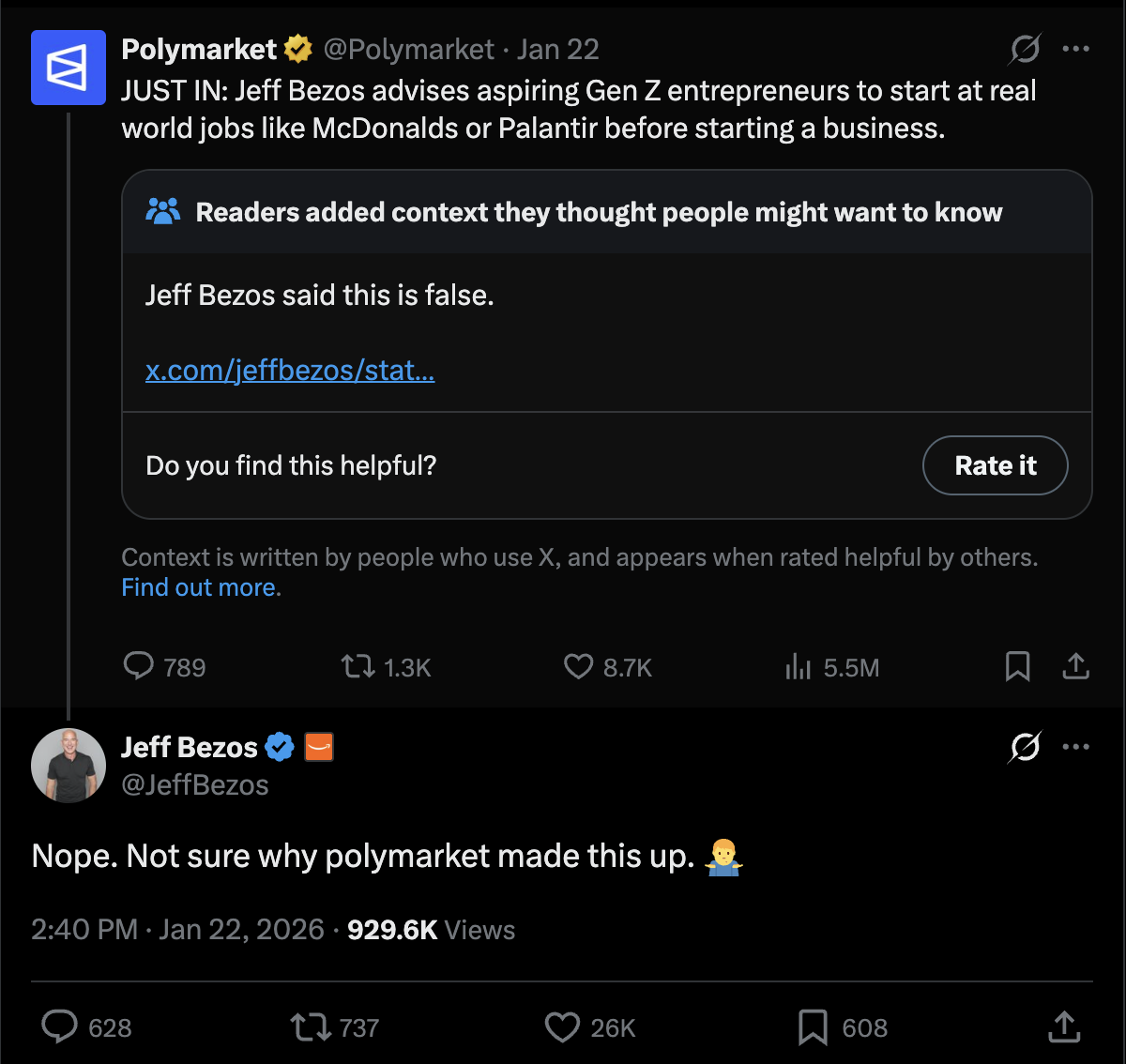
Finally, their feud has overflowed into the physical world and hopefully will continue to result in positive externalities for regular broke Americans like you. But the real point is: between stunts like free groceries and dunking on each other on X, these companies are dominant at getting people to talk about them. No matter what suspicious antics they pull to one-up each other, whether they seem disgustingly shady or strangely charitable, we keep discussing it.
And maybe that’s the point. Kalshi and Polymarket are valued at $11 billion and $9 billion, respectively — and those numbers are going up at breakneck pace. So if the dramatic stunts in this crazy war can get a few hundred more bettors to log on, or a couple more investors to buy in, it’s all worth it. A win-win for the dueling sides, if you can believe it.
—Hunter Ryerson
Disclaimer:
- This article is reprinted from [Pirate Wires]. All copyrights belong to the original author [Hunter Ryerson]. If there are objections to this reprint, please contact the Gate Learn team, and they will handle it promptly.
- Liability Disclaimer: The views and opinions expressed in this article are solely those of the author and do not constitute any investment advice.
- Translations of the article into other languages are done by the Gate Learn team. Unless mentioned, copying, distributing, or plagiarizing the translated articles is prohibited.







