In the traditional financial system, gold prices are largely determined by the global spot and futures markets, particularly through the precious metals trading systems in London and New York. The gold pricing framework commonly references the benchmark price set by the London Bullion Market Association (LBMA). As an on-chain gold asset, PAXG fundamentally derives its value from this global gold pricing system, but it is also influenced by the liquidity and trading dynamics of the crypto market.
From a digital asset perspective, the PAXG price formation mechanism depends not only on the real-world gold market but also on supply and demand within blockchain trading venues. In effect, PAXG’s price reflects both the international gold price and the trading depth and sentiment of the crypto market. Therefore, understanding PAXG’s pricing mechanism requires analysis from both the gold and crypto market dimensions.
PAXG Price Pegging Logic
The PAXG price-pegging mechanism is built on the foundation of “physical gold reserve backing.” By design, each PAXG token represents ownership of one troy ounce of a London Good Delivery gold bar. This standard, defined by the London Bullion Market Association, serves as a key benchmark in global gold trading.
When users purchase PAXG through regulated channels, the issuer Paxos mints the corresponding number of tokens and deposits an equivalent amount of gold into its reserves. When investors redeem PAXG, the tokens are burned, and the corresponding gold can be withdrawn or sold. This minting and redemption process ensures that the token supply always matches the gold reserves.
As a result, in theory, PAXG’s price should closely track the international spot price of gold. If there is a significant price deviation, arbitrageurs can exploit the difference through token purchases or redemptions, driving the price back toward the gold benchmark. This mechanism is similar to the way stablecoins maintain their peg through arbitrage, with the key distinction that the underlying asset is physical gold.
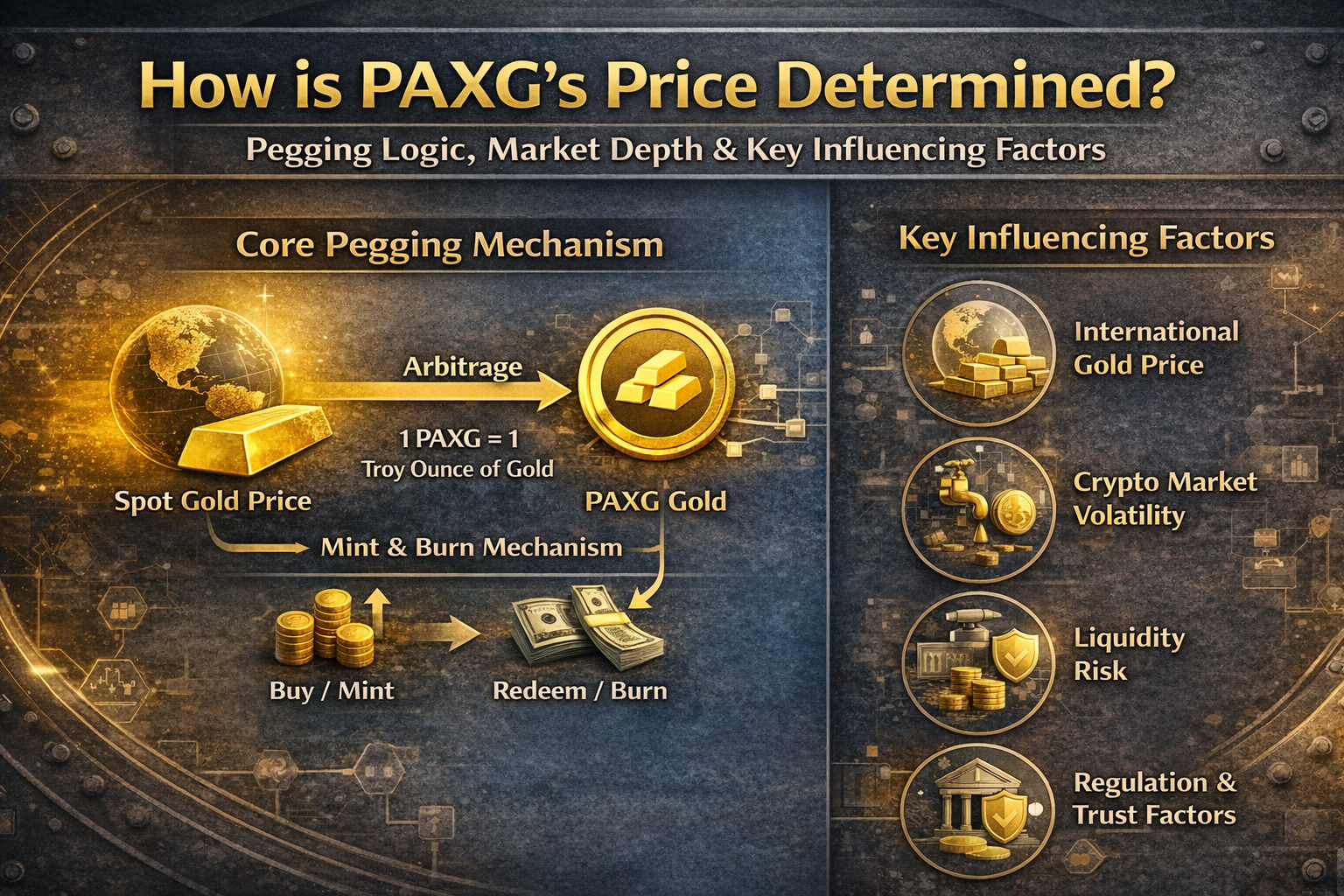
Although PAXG is backed by physical gold reserves, its market price is determined by supply and demand on crypto trading platforms. Investors can buy and sell PAXG across multiple exchanges, with prices established through order matching between buyers and sellers.
Specifically, PAXG’s market price formation typically involves the following components:
First is gold market pricing. International gold prices, set by major precious metals markets, provide the fundamental value reference for PAXG.
Second is crypto trading market supply and demand. The price of PAXG on exchanges is shaped by market buy and sell orders. If demand rises—for example, when investors seek to hedge crypto market risk with gold—PAXG may trade at a short-term premium.
Finally, there is the arbitrage mechanism as a balancing force. When PAXG’s price diverges significantly from the spot price of gold, arbitrageurs can buy or redeem gold to narrow the price gap.
Therefore, PAXG’s price is the result of the real-world asset price plus on-chain market supply and demand acting in tandem.
Key Factors Influencing PAXG Price Volatility
While PAXG is anchored to gold, its price can still be influenced by several factors.
International Gold Price
The international gold price is the most fundamental driver of PAXG’s price. The gold market is typically shaped by global macroeconomic conditions, including inflation expectations, interest rate changes, and geopolitical risks. When gold prices rise or fall, PAXG’s price generally moves in parallel.
For instance, during periods of heightened global economic uncertainty, investors tend to increase their gold allocations, which pushes gold prices—and PAXG—higher.
Overall Crypto Market Volatility
PAXG is also a crypto asset and, as such, is affected by overall crypto market sentiment. For example, during periods of high volatility in the digital asset market, some investors may shift funds into PAXG as a safe haven, boosting its demand.
Conversely, when the crypto market experiences liquidity stress or capital outflows, demand for PAXG trading may decline.
Liquidity Risk
PAXG’s price is also impacted by trading depth. If order book depth on exchanges is limited, large trades can cause notable price swings.
Compared to mainstream crypto assets, trading volumes for gold tokens are typically lower, so short-term price deviations may occur in certain markets.
Regulatory and Trust Factors
Because PAXG is a tokenized real-world asset, market trust in the issuer directly affects price stability. Paxos, the issuer, is regulated by the New York State Department of Financial Services (NYDFS), and this regulatory oversight helps bolster market confidence.
If concerns arise regarding reserve transparency or regulatory policies, PAXG’s price may also experience volatility.
Can PAXG Lose Its Peg?
In theory, PAXG’s price should remain closely aligned with the spot price of gold over the long term, but minor short-term deviations can still occur.
These deviations are generally driven by the following factors:
First, insufficient exchange liquidity. When market trading depth is low, large buy or sell orders can cause price swings.
Second, shifts in market sentiment. For example, during periods of panic in the crypto market, investors may rush to buy PAXG, resulting in a short-term premium.
Finally, differences in market structure. The gold market is a vast, traditional financial market, while the PAXG trading market is relatively small, making short-term price swings more likely.
Nevertheless, due to gold redemption and arbitrage mechanisms, PAXG typically reverts to levels near the spot price of gold over the long run.
Advantages and Limitations of PAXG’s Pricing Mechanism
PAXG’s pricing mechanism offers several advantages. Most notably, it provides value backing for the token via physical gold reserves, making it more stable than algorithmic stablecoins. Additionally, because PAXG operates on a blockchain network, it enables 24/7 global trading and high divisibility.
Moreover, PAXG can be integrated into the DeFi ecosystem, allowing traditional assets like gold to enter on-chain financial systems. This approach is considered a significant example of real-world asset (RWA) tokenization.
However, there are also limitations. For instance, PAXG still relies on centralized management of gold reserves, requiring investors to trust the issuer’s custody and audit systems. At the same time, overall liquidity in the gold token market remains lower than in the traditional gold market, which can amplify price swings in extreme scenarios.
Thus, PAXG’s pricing mechanism can be viewed as a real-asset-backed, on-chain price-pegging system, combining the stability of traditional assets with the structural characteristics of the crypto market.
Summary
PAXG’s price formation mechanism merges the traditional gold market with the crypto asset market. On one hand, the international gold price provides the core value foundation for PAXG; on the other, supply and demand in crypto trading markets determine its short-term market price.
Through physical gold reserves, minting and redemption mechanisms, and market arbitrage, PAXG’s price generally remains close to the spot price of gold. While short-term premiums or discounts may arise, over the long term, its price remains primarily determined by the global gold market.
As real-world asset tokenization advances, digital gold assets like PAXG may play an increasingly important role in the future financial system.
FAQs
Why does PAXG’s price track gold?
Each PAXG token is backed by one troy ounce of gold reserves, making its value highly correlated with the international gold price.
Where is PAXG’s price determined?
PAXG’s market price is mainly formed through buy and sell orders on crypto exchanges, but its value reference is drawn from the global gold market.
Can PAXG trade at a premium or discount?
During periods of low liquidity or shifting market demand, PAXG may trade at a short-term premium or discount, but arbitrage mechanisms typically restore the price to the spot gold level.
Is PAXG’s price entirely stable?
PAXG is not a fixed-price asset; its price fluctuates alongside movements in the international gold market.







