On January 20, LayerZero teased a major announcement for February 10. While its token ZRO climbed more than 40% from about $1.70 to nearly $2.40 after the news, the market had largely become indifferent to these “big event previews,” with little anticipation for what might actually occur.
When February 10 arrived, LayerZero delivered a series of major surprises as promised.
First, on the evening of the 10th, Tether announced an investment in LayerZero to support the development of blockchain interoperability technology. In the early hours of the 11th, LayerZero revealed that it would launch L1 Zero this fall—a new chain aiming to become the “next-generation world computer” and potentially replace Ethereum. From day one, Zero secured Citadel Securities, the Depository Trust & Clearing Corporation (DTCC), Intercontinental Exchange (ICE), and Google Cloud as partners.
Citadel Securities, a leading global market maker handling over 35% of US equity retail order flow, will explore integrating Zero into high-performance trading, clearing, and settlement. DTCC will use Zero to optimize tokenization services and collateral application chains. ICE, parent of the New York Stock Exchange, will leverage Zero to enhance trading and clearing infrastructure for 24/7 markets and potential integration of tokenized collateral. Google Cloud plans to combine its cloud infrastructure and AI capabilities with Zero to build a new economic system.
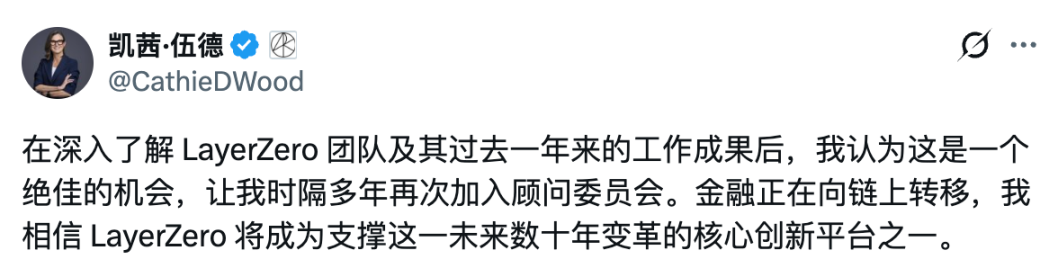
There’s more: Zero’s advisory board includes Cathie Wood, ICE Strategic Vice President Michael Blaugrund, and former BNY Mellon Global Head of Digital Assets Caroline Butler. Cathie Wood’s ARK Invest even invested directly in LayerZero, noting this is her “first time serving as an advisor in years,” underscoring the significance of her involvement.
Cathie Wood and major US financial institutions need little introduction. The only reminder is that in late February 2025, Citadel was reported to be preparing to become a crypto market maker. Afterward, Bitcoin rebounded from around $75,000 and soared past $120,000. This time, Citadel directly invested in ZRO, which then surged nearly 50%.
LayerZero Never Plays Small
Even before Zero’s debut, LayerZero stood out as a top-tier project.
In early 2022, LayerZero launched the cross-chain bridge Stargate, which reached over $3 billion in TVL in less than 10 days. By late March, LayerZero completed a $135 million Series A+ round led by FTX Ventures, Sequoia Capital, and a16z. A year later, LayerZero raised $120 million in a Series B round at a $3 billion valuation, with a16z Crypto, Sequoia Capital, Circle Ventures, Samsung Next, and others participating.
It’s extremely rare for a Web3 project to achieve a $3 billion valuation before issuing its token.
But for LayerZero, this seemed justified. Co-founder and CEO Bryan Pellegrino is a Texas Hold’em prodigy who, in 2018, developed OpenToken—a platform for ordinary users to issue tokens—which was later acquired. In 2020, Bryan and his future LayerZero co-founders created a poker AI that outperformed all competitors and several world-class professionals. Their paper on “Supremus” was later cited in game theory research published by DeepMind, Alphabet’s AI lab.

Bryan Pellegrino embodies the high-IQ founder profile investors seek, consistently succeeding in new ventures. LayerZero’s track record has reinforced this reputation.
If you still see LayerZero as just a cross-chain bridge, you might be missing the bigger picture.
As the first to introduce the omnichain concept to Web3, LayerZero’s core focus is not “cross-chain” but “interoperability.” A deep dive into LayerZero’s architecture reveals it has built a technical standard for trustless messaging across different chains. As stated in the LayerZero V2 blog: “Just as TCP/IP standardized internet development, LayerZero’s goal is to standardize all on-chain application development. This unified cross-chain development model, known as omnichain, is LayerZero’s vision for the future of crypto.”
Cross-chain bridges only handle token transfers, while omnichain enables the ability to call contracts on any chain from any other chain. Crucially, LayerZero only develops the stack to enable this functionality—token issuers or protocol developers can adjust parameters as needed. Currently, LayerZero V2 leverages a combination of Decentralized Verifier Networks (DVNs) and Executors for message passing. DVNs are networks of multiple centralized verifiers, while Executors execute validated messages. All supported chains have deployed Endpoint contracts to send and receive messages.
For example, if I issue Token A and want it to move between Ethereum, Arbitrum, and Base, I can deploy matching token contracts on each chain, integrate the LayerZero stack, and set up cross-chain operations once more than five DVNs confirm message authenticity.
LayerZero provides a unified standard for such tokens: OFT (Omnichain Fungible Token). USDT, USDC, USDe, WETH, PENGU, and others are already OFTs. For token issuers, a plug-and-play standardized format supporting nearly 200 blockchains—and automatic support by all LayerZero-enabled cross-chain bridges and DEXs—eliminates the need to establish liquidity on every chain. Why not use it?
From supporting USDT to direct investment from Tether, from reaching $3 billion TVL in just 10 days to supporting over 165 blockchains and more than $200 billion in cross-chain volume, LayerZero’s standard has driven immediate integration by newly launched tokens like Aztec and the stablecoin chain Stable. This is the power of standards.
Zero: More Like L 0.5
LayerZero says the idea for Zero began two and a half years ago, around mid-2023, shortly after its Series B funding. If the team already foresaw collaborating with Wall Street institutions, that would have been extraordinarily prescient. However, the guiding principle has remained: to replace Ethereum as the world’s computing platform.
As decentralized infrastructure for message passing between L1 and L2, LayerZero rightly calls itself “L0.” Yet, perhaps due to its infrastructure focus, Zero—a new L1 with “Solana’s speed and Ethereum’s decentralization”—is more like “L 0.5”: an L1 supporting multiple L1s.
Zero’s defining feature is simple: network transactions don’t compete for limited resources.
According to the official description, current L1s require every validator to process every transaction. This security-driven design limits efficiency to the speed at which all validators can process transactions. To boost TPS, L1s must centralize validators, sacrificing decentralization. Thanks to zero-knowledge proofs (ZKP), Zero separates block construction from validation: builders create a full block and generate a ZKP, while validators only need to verify the proof.
LayerZero claims this design reduces the annual cost of running a blockchain with Ethereum-like capacity from $50 million to $1 million, while boosting TPS to 2 million.
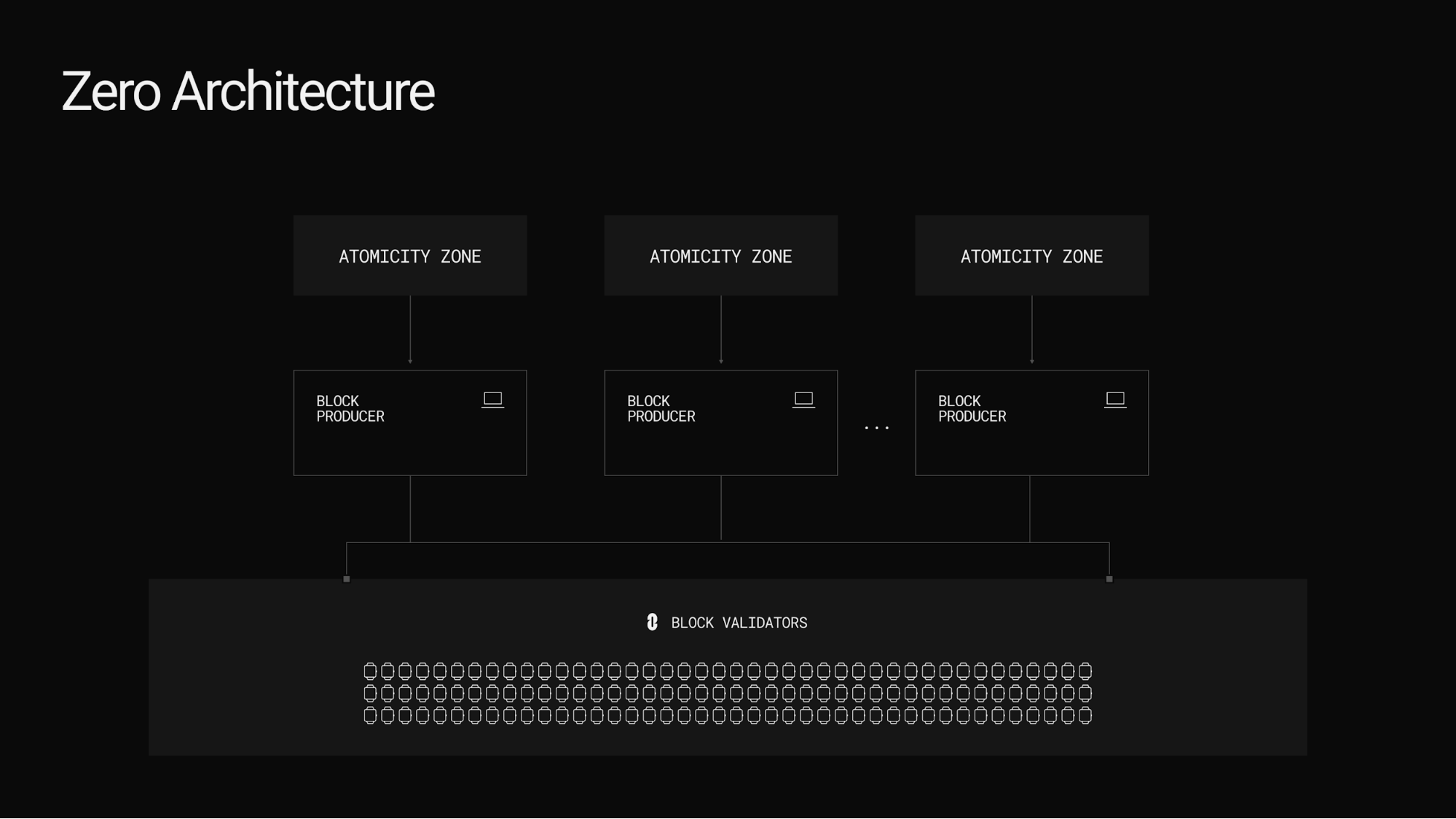
Building on this, Zero introduces the “Atomicity Zone” concept. Each Zone can focus on different use cases—high-frequency trading, payments, or RWA tokenization—with its own block producer. All blocks ultimately achieve finality on the same chain, but not all transactions compete for the same network resources.
In some ways, this design resembles L2s, which is why it’s more like L 0.5. In LayerZero’s view, this approach delivers Solana-level TPS without L2’s reliance on L1 confirmation for transaction validity. With ZKP, Zero pioneers decentralized, efficient parallel processing.
Importantly, once Zero launches, ZRO will evolve from a cross-chain fee token to the native token of the new L1—unlocking far greater potential.
What Does Wall Street Want?
Imagine thousands of financial institutions: some use Ethereum, others Solana, Base, or private chains. Token standards differ, settlement speeds vary, and cross-chain protocols are inconsistent. Even if firms on the same chain benefit from blockchain’s value, using different chains can make blockchains less efficient than centralized settlement systems.
Ideally, all of Wall Street would use a single blockchain, solving these challenges at once.
So the answer is clear: Wall Street wants “standardization.” All assets—stocks, bonds, real estate—should be traded with a unified tokenization standard. Stablecoins should follow the same model, eliminating the need to route trades across multiple chains. Zero is built for this purpose. Each Zone can have unique features, but final settlement happens on the same chain, ensuring a universal standard.
Recall that Citadel handles over 35% of order flow. If Citadel designates Zero, it could become the leader in stock tokenization. Zero also won’t exclude other chains, as LayerZero can standardize cross-chain formats.
For Wall Street, a centralized chain lacks the appeal of token issuance, while a fully decentralized chain is hard to control. Zero’s DPoS model strikes a balance: relatively decentralized, but run collectively by multiple companies or individuals. This structure offers both control and competition, making it acceptable for all parties.
Many aspire to build blockchains for financial giants, but so far, only LayerZero has found a standard solution.
Disclaimer:
- This article is republished from [Foresight News]. Copyright belongs to the original author [Eric]. If you have concerns about this reprint, please contact the Gate Learn team for prompt resolution according to our procedures.
- Disclaimer: The views and opinions expressed in this article are solely those of the author and do not constitute investment advice.
- Other language versions of this article are translated by the Gate Learn team. Do not copy, distribute, or plagiarize these translations without citing Gate.







