I. Why Most Contract Losses Originate from Risk Misjudgment
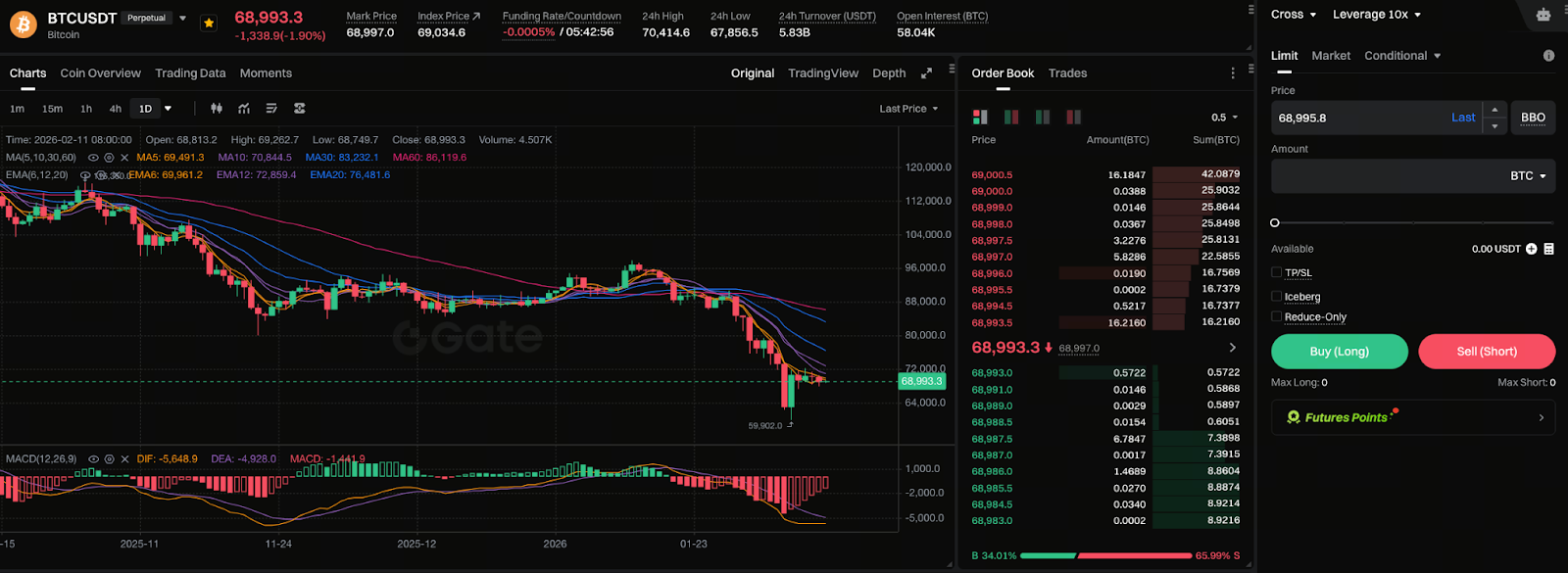
Chart: https://www.gate.com/futures/USDT/BTC_USDT
In contract trading, losses are rarely the result of incorrect market predictions. More often, they stem from a lack of understanding of risk structures.
Many beginners using Gate’s contract trading features tend to focus on:
- Leverage multiples
- Profit potential
- Price volatility
However, they overlook a fundamental question: How is the risk ratio for an account calculated? Without a clear understanding of the liquidation mechanism, any leveraged trade is essentially conducted under unknown rules.
II. The Core of the Liquidation Mechanism
Liquidation (forced closing) is fundamentally an automated risk management process. When an account’s risk ratio drops below the maintenance margin requirement, the system must liquidate positions to prevent:
- Negative account balances
- Market liquidity disruptions
- Unmanageable platform risks
On Gate’s contract trading platform, liquidation is not triggered instantly. Instead, it is determined by risk ratio calculations.
Understanding this distinction helps prevent the misconception that liquidation is “platform intervention.”
III. Gate’s Maintenance Margin and Risk Ratio Calculation Logic
Gate’s contract system uses a tiered maintenance margin framework.
This means:
- The larger the position size
- The higher the required maintenance margin ratio
This structure is a standardized approach to risk management. On the trading interface, users can monitor in real time:
- Current risk ratio
- Estimated liquidation price
- Margin changes
These figures are not mere display data—they are essential for determining whether to reduce positions or add margin.
IV. How Partial Liquidation Mechanisms Reduce Systemic Risk
Unlike full liquidation, certain Gate contract products implement partial liquidation mechanisms.
The logic is as follows:
- When the risk ratio reaches the warning threshold
- The system first reduces a portion of the position
- This lowers overall risk exposure
The purpose of this mechanism is to:
- Reduce chain liquidations during sharp market movements
- Provide traders with a buffer zone
For beginners, this approach offers a more user-friendly risk control design.
V. Risk Management Details Most Often Overlooked by Beginners
Common mistakes when using Gate’s contract trading features include:
- Focusing only on the opening margin and ignoring the maintenance margin
- Overlooking risk ratio changes after increasing positions
- Blindly adding positions when unrealized losses grow
Contract trading risk does not increase linearly—it is structurally amplified.
If you ignore the risk ratio, higher leverage means less room for error.
VI. How to Proactively Manage Risk in Gate Contract Trading
If you are new to contracts, consider the following principles:
- Select leverage based on your risk ratio tolerance, not on expected returns
- Monitor the gap between liquidation price and current price regularly
- Use isolated margin mode appropriately to control risk per position
- Avoid blindly increasing positions during periods of high volatility
The core value of contract trading is not to maximize profits, but to enhance capital efficiency. Without effective risk control, any improvement in efficiency is meaningless.