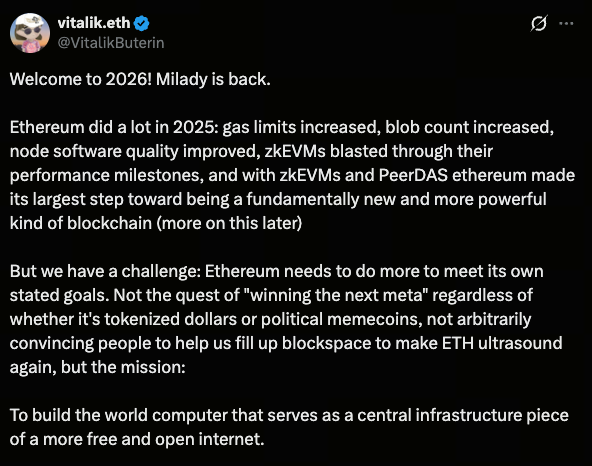
Image source: https://x.com/VitalikButerin/status/2006737662942871574
1. Ethereum’s “Rebellion” Perspective: Defining Centralization vs. Decentralization
Ethereum, as one of the world’s largest smart contract platforms, stands as an industry icon for its decentralized, blockchain-based architecture. Centralization refers to power or control being concentrated in the hands of a few entities, such as major tech giants or large server clusters. Decentralization, on the other hand, means network participants collectively maintain system operations without depending on a single authority. Recently, Ethereum founder Vitalik Buterin stated on social media that by 2026, Ethereum embodies a rebellion against “centralized overlords.” This statement resonates not only technically but also philosophically and socially.
2. Vitalik’s Latest Manifesto and Core Principles
Vitalik’s latest remarks on X are especially forceful. He observes that the internet and digital platforms are increasingly dominated by a handful of corporations, resulting in users facing risks of control and censorship in essential services like account management and content access. In some cases, users have even lost real control over their own data and digital assets. Against this backdrop, he underscores that Ethereum’s founding purpose is not profit-driven or aimed at short-term speculation, but rather to create infrastructure that genuinely resists censorship and eliminates intermediaries.
He stated: “We are building decentralized applications (dApps) that require no fraud, censorship, or third-party intervention.” This phrase encapsulates Ethereum’s 2026 vision—not just a technical roadmap but a direct challenge to centralized paradigms.
3. Ethereum as Decentralized Infrastructure
Vitalik further elaborates that Ethereum is more than a blockchain; it can serve as “civilizational infrastructure.” This concept transcends pure technical architecture, highlighting network values—censorship resistance, intermediary-free alternatives, and restoring user control. Today’s centralized platforms, such as Meta, Google, and Apple, have market capitalizations and influence rivaling major global stock exchanges. This concentration of resources and power only underscores the importance of decentralized networks.
4. Ethereum’s Technical Progress and Development in 2026
Technically, Ethereum is advancing several critical upgrades through 2025 and 2026, including PeerDAS mainnet deployment, ZK-EVM entering its alpha phase, and future plans to optimize gas fees and state structure. These initiatives are essential for boosting both performance and decentralization.
Vitalik also emphasizes that decentralization should not be compromised for convenience. For instance, the community’s “Trustless Manifesto” advocates minimizing reliance on centralized relayers and intermediary protocols, upholding blockchain’s core ethos.
5. Current Ethereum Price and Market Performance Analysis
While Vitalik’s focus is on the ecosystem’s vision, the market remains keenly attentive to price action. Recent data shows Ethereum’s price surged past US$3,100, reflecting strong market optimism around its technical roadmap and ecosystem growth. Technical indicators also signal robust momentum. However, an overheated RSI points to correction risks, and a drop below the $3,000 support level could trigger a pullback. Click to trade: https://www.gate.com/trade/ETH_USDT
This demonstrates that, despite volatility in ETH’s current price, market confidence in its long-term trajectory remains strong—bolstered by a shared commitment to decentralization among developers and the community.
6. Future Outlook: Can Decentralization Sustain Ecosystem Growth?
Decentralization is not only a technical target but also the foundation of user trust. As the Ethereum network expands its Layer-2 ecosystem and enhances wallet security and privacy features—such as social recovery wallets and privacy addresses—its appeal is likely to broaden further.
Challenges remain, including the encroachment of centralization in DeFi intermediary services and potential capital concentration in PoS networks. Striking a balance between technical and ecosystem considerations will be a central challenge for Ethereum beyond 2026.
7. Summary and Key Takeaways
Vitalik Buterin’s 2026 Ethereum rebellion is far more than a slogan—it signals a determined stance against centralization and a vision for a truly decentralized future. With technological innovation, community development, and market dynamics working in tandem, Ethereum’s future value could extend well beyond digital assets, potentially forming the backbone of a decentralized social structure. The unwavering commitment to decentralization will be critical for sustained growth across the entire Ethereum ecosystem.