As the blockchain ecosystem has evolved from a single chain structure into a landscape where multiple chains coexist, assets and liquidity have gradually become fragmented across different networks. When trading, users often need to switch between multiple decentralized exchanges and handle asset transfers between chains, which makes the process more complex and less efficient.
Against this backdrop, multi-chain trade execution has become a critical piece of infrastructure. Genius brings together routing algorithms, liquidity sources, and cross chain components to unify what would otherwise be a fragmented trading process. From an industry positioning standpoint, its core role is not to serve as a single trading venue, but to function as an execution layer responsible for calculating the best path and completing asset swaps across multiple chains.
Overview of the Basic Genius multi-chain Trading Process
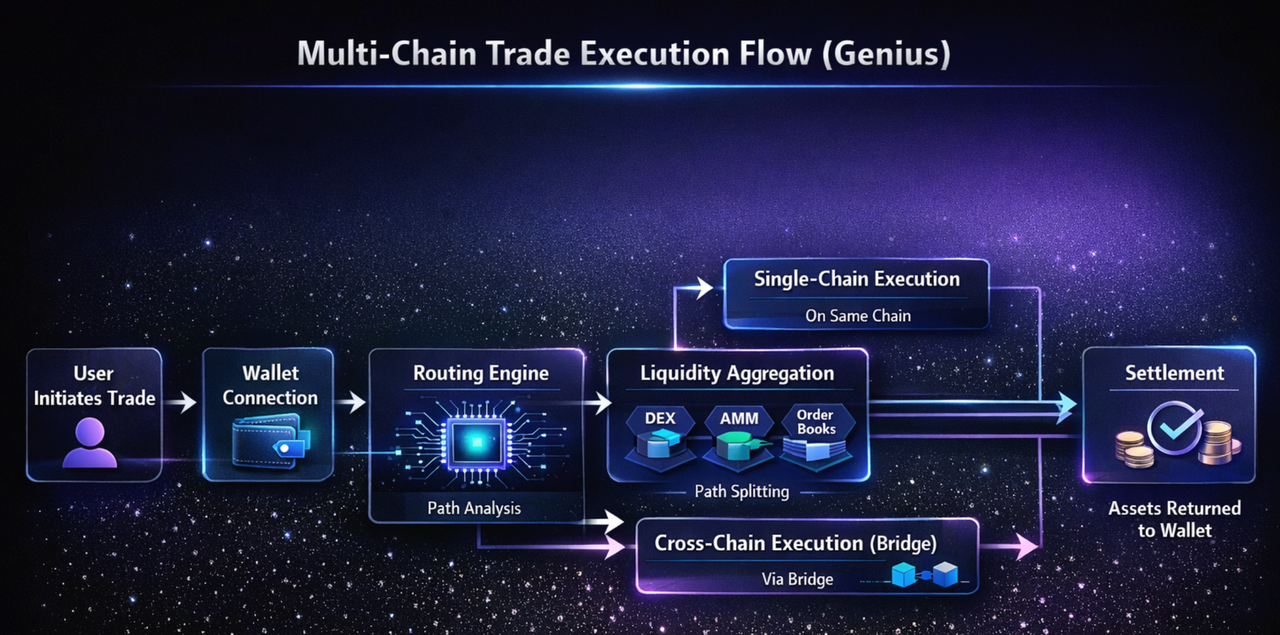
In Genius, a trade can usually be broken down into several consecutive steps. From the moment a user submits a trading instruction to the point when the final assets arrive, the system handles path calculation, liquidity matching, and execution in the background.
At the heart of this process is path abstraction, which turns complex cross chain and multi protocol interactions into a unified execution logic, allowing users to complete trades without needing to understand the underlying details.
Step 1: The User Initiates a Trade Request
The trading process begins when the user enters the trade details in the terminal, including the asset type, amount, and target asset. The user connects a wallet to the system and authorizes the trade.
At this stage, the system reads the asset information in the user’s wallet and verifies that the required balance and permissions are in place. At the same time, the interface provides an initial trade preview, such as the estimated price and fee range.
Step 2: The Routing Engine Calculates the Optimal Path
Once the trade request is confirmed, Genius’s routing engine begins to work. Its task is to choose the most efficient execution plan from multiple possible paths.
This process usually involves scanning liquidity pools, trading pairs, and market prices across different chains, while also taking into account factors such as slippage, fees, and execution success rate. For larger trades, the system may split the order into multiple sub paths to reduce market impact.
The routing result determines whether the trade will be completed on a single chain or whether cross chain execution is required.
Step 3: Liquidity Matching and Path Splitting
After the path is determined, the system connects to the relevant liquidity sources. These typically include automated market makers, or AMMs, order book based DEXs, and other aggregation protocols.
If a single liquidity pool cannot meet the trade demand, the system splits the path and distributes the order across multiple pools for execution. This mechanism helps improve execution efficiency and reduce price slippage.
In a multi-chain environment, differences in liquidity across chains also influence the final path selection.
Step 4: Trade Execution, Same Chain and Cross Chain
The execution stage falls into two cases depending on the type of path selected.
For same chain trades, the system directly calls the relevant smart contracts to complete the asset swap, such as executing through an AMM or an order book matching mechanism.
For cross chain trades, the process is more complex. The system must first move the asset from the source chain to the target chain, usually through a cross chain bridge or cross chain protocol. After that, the final asset swap is executed on the target chain.
Although these steps may appear to the user as a single action, they are still carried out in stages at the underlying level.
Step 5: Settlement and Asset Delivery
After the trade is completed, the system returns the final assets to the user’s wallet. For same chain trades, assets usually arrive after a single transaction confirmation. For cross chain trades, the user must wait for the cross chain process to finish.
At the same time, the system records trade data, including the actual execution price, fees, and path information, so users can review and analyze the transaction later.
Key Mechanisms in Genius multi-chain Trading
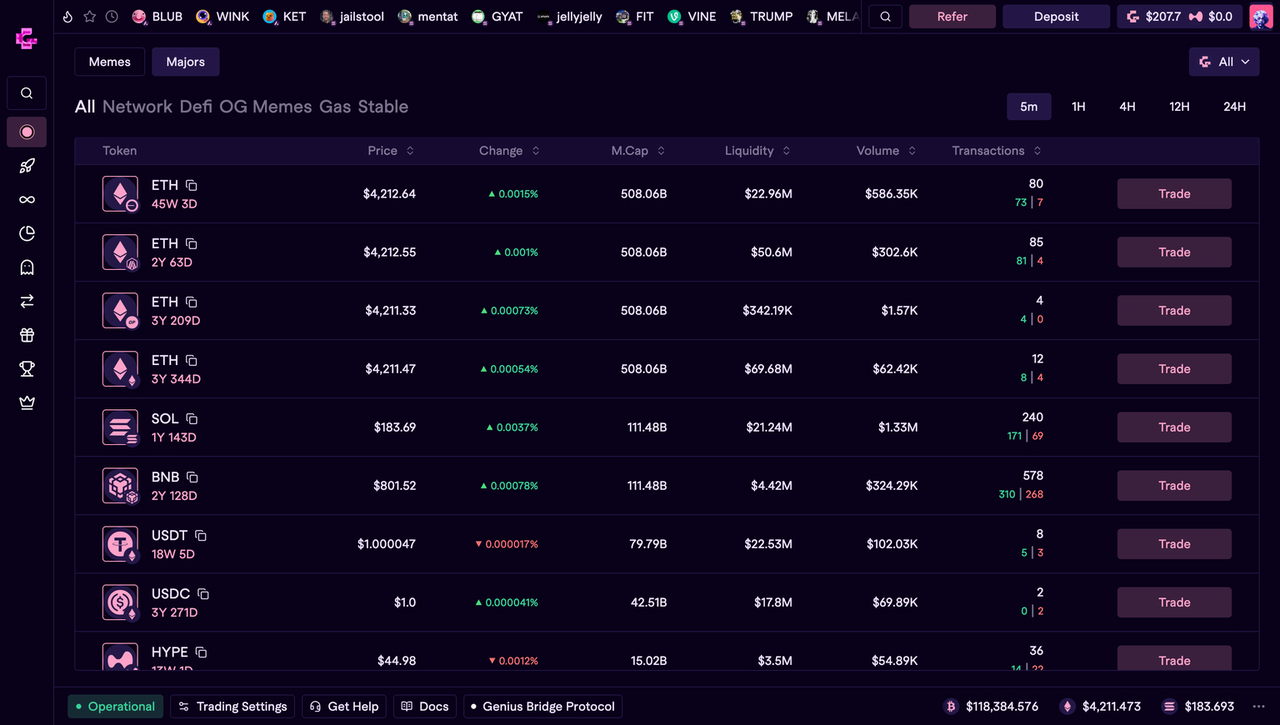
Genius’s multi-chain trading process depends on several key mechanisms working together.
The first is the routing algorithm, which determines the efficiency and cost of the execution path. The second is liquidity aggregation, which affects trading depth and slippage performance. The last is cross chain infrastructure, which determines the feasibility and security of moving assets between different chains.
Together, these mechanisms form the core framework for multi-chain trade execution.
Summary: How multi-chain Trading Is Abstracted into a Single Action
From the user’s perspective, a multi-chain trade can be completed with just one action, but inside the system, the process involves multiple stages and coordinated components.
By integrating path calculation, liquidity matching, and cross chain execution into a unified process, Genius turns complex on-chain interactions into a simple user experience. This ability to abstract complexity makes it a critical execution layer infrastructure within the multi-chain DeFi ecosystem.
FAQs
How is Genius’s trading process different from a traditional DEX?
A traditional DEX usually executes trades on only a single chain, while Genius calculates paths across multiple chains and may also carry out cross chain operations.
Why do multi-chain trades need a routing engine?
Because liquidity is fragmented across different chains and protocols, a routing engine is used to find the lowest cost and highest efficiency trading path.
Do cross chain trades always require a bridge?
Most cross chain trades rely on bridging or cross chain protocols, but the specific implementation may vary depending on the underlying infrastructure.
What is the purpose of trade path splitting?
Path splitting allows large trades to be distributed across multiple liquidity pools, which helps reduce slippage and improve execution efficiency.
Do users need to choose the trading path manually?
Usually not. The system automatically calculates the optimal path and presents the result to the user for confirmation.