As decentralized finance continues to expand into the derivatives space, trading systems must balance high-frequency matching, low latency, and on-chain security. Fully on-chain execution offers strong transparency, but still faces limitations in performance and cost. This has driven the rise of hybrid trading architectures.
Against this backdrop, edgeX represents a typical Perp DEX design. By moving the matching process off-chain while retaining on-chain settlement and asset custody, it creates a model that balances efficiency with verifiability. This approach is increasingly becoming a core direction for decentralized derivatives infrastructure.
Overview: How a Trade Works on edgeX
At a high level, a typical trade on edgeX follows six steps:
-
Order creation: The user sets price, size, and leverage, then signs the transaction with their wallet
-
Order submission: The order is sent to the off-chain matching system instead of being directly posted on-chain
-
Order matching: The matching engine pairs buy and sell orders based on price and time priority
-
Trade confirmation: The system generates a trade record and updates the user’s position
-
Risk calculation: Margin, unrealized PnL, and liquidation risk are calculated
-
On-chain settlement: The results are submitted to a smart contract for fund transfers and final confirmation
In essence, edgeX operates through a hybrid execution model that combines off-chain matching with on-chain settlement, ensuring both efficiency and security while keeping results verifiable.
Core Architecture: The EDGE Stack Execution Layer
edgeX can be understood as a layered system, where the execution layer, often referred to as the EDGE Stack, handles the core trading logic.
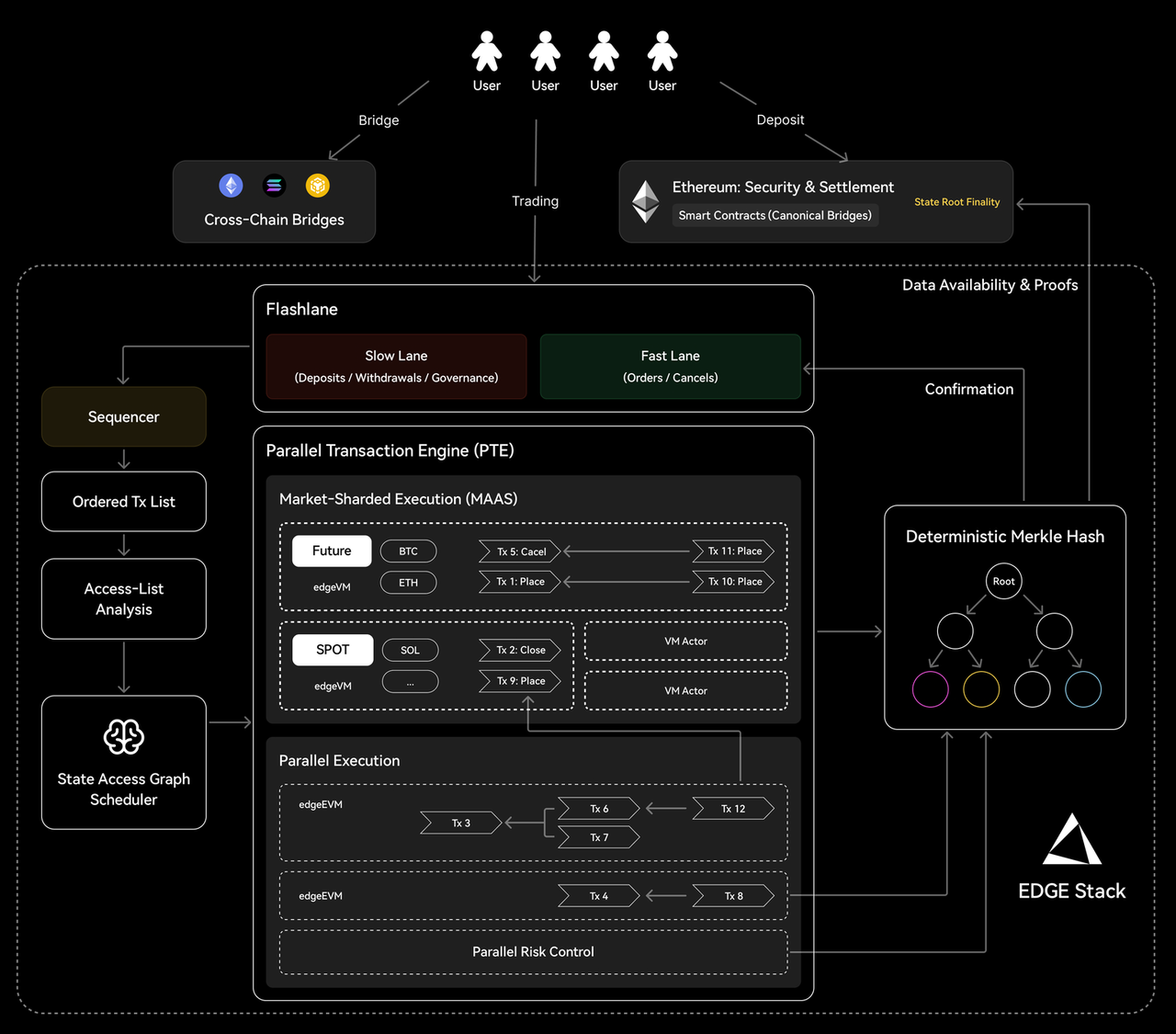 Source: edgeX Docs
This architecture consists of three main components: the user interface layer, the matching and execution layer, and the on-chain settlement layer. Users interact with the system through a frontend or API, the matching engine processes orders off-chain, and the blockchain network finalizes state changes and asset transfers.
The key idea is to move computation-heavy operations, such as matching, off-chain, while submitting critical results on-chain. This creates a practical balance between performance and security.
Order Matching Mechanism: How edgeX Achieves Efficient Execution
edgeX typically uses an order book model for trade matching. In this setup, buyers and sellers place limit orders that form market depth, and the matching engine executes trades based on price priority followed by time priority.
Because the matching engine operates off-chain, it can process orders with very low latency, achieving speeds close to centralized exchanges. This is especially important for perpetual contracts, where prices move quickly and execution speed directly impacts outcomes.
Compared to automated market maker models, the order book approach relies more on active liquidity providers. However, it offers different advantages in price discovery and slippage control.
Trade Execution and Settlement: From Matching to Final Confirmation
Once orders are matched in the engine, the system generates trade records and moves into the execution and settlement phase.
First, user positions are updated based on the execution price, along with margin adjustments and unrealized profit and loss. Then, this data is submitted to on-chain smart contracts, which handle final fund transfers and state confirmation.
On-chain settlement ensures that all results are verifiable and provides the foundation for liquidation mechanisms, such as forced position closure when margin requirements are not met. This stage serves as the critical bridge between off-chain execution and on-chain security.
How the “Zero Gas” Model Works: Understanding edgeX’s Fee Structure
From a user experience perspective, edgeX often implements a “zero Gas” or Gas abstraction model to simplify interactions.
This is typically achieved by having the platform cover on-chain transaction fees or by bundling those costs into trading fees. As a result, users do not need to pay Gas separately, even though costs still exist behind the scenes.
Overall, edgeX’s fee structure mainly consists of trading fees based on a Maker and Taker model, along with funding rates that help maintain market balance.
Liquidity Sources and Market Structure
Liquidity on edgeX primarily comes from limit orders placed in the order book by both market makers and regular traders.
Market makers provide continuous quotes, improving depth and reducing slippage. At the same time, overall trading activity influences liquidity levels, creating a dynamic market structure.
Unlike AMM models that rely on liquidity pools, the order book model depends more on active participants. This makes liquidity more flexible, but it may also lead to reduced depth during extreme market conditions.
edgeX’s Revenue and Incentive Mechanisms
edgeX’s incentive structure typically revolves around trading activity and liquidity provision.
Trading fees serve as a primary source of platform revenue, and a portion of these fees may be used to incentivize market makers or reward active users. In addition, token-based incentives may be introduced to encourage long-term participation, such as distributing rewards to liquidity providers and traders.
This design helps align the interests of different participants in a decentralized environment, supporting both market activity and system stability.
Summary
edgeX demonstrates a typical hybrid architecture by combining off-chain matching for high-performance execution with on-chain settlement for asset security and verifiable outcomes. From order submission to final settlement, the full workflow illustrates how decentralized derivatives exchange balance efficiency with decentralization.
Understanding this mechanism provides a structured way to analyze how Perp DEX systems operate and offers a useful framework for comparing different trading protocols.
FAQs
Is edgeX fully on-chain?
No, it typically uses a hybrid model with off-chain matching and on-chain settlement.
Why does edgeX use off-chain matching?
To increase execution speed and reduce latency, especially for high-frequency trading scenarios.
Does “zero Gas” mean there are no fees?
No, fees still exist but are usually bundled into trading fees or covered by the platform.
Where does edgeX liquidity come from?
Mainly from market makers and traders placing orders in the order book.
How does edgeX ensure trust in trade results?
Through on-chain settlement and smart contract execution, which make all outcomes verifiable.