As Web3 infrastructure evolves from “asset transfer” to “state computation,” Manadia addresses not just transaction challenges, but the ongoing recording and verification of long-term participation and complex data states on-chain. This sets it apart from traditional blockchain applications that depend on single, isolated interactions.
From a broader perspective, Manadia introduces a new on-chain execution paradigm by integrating the VERITAS data protocol, the AI Agent state engine, and zero-knowledge settlement paths. This architecture allows for unified handling of data trustworthiness, state continuity, and value settlement within a single system.
Manadia System Architecture Overview
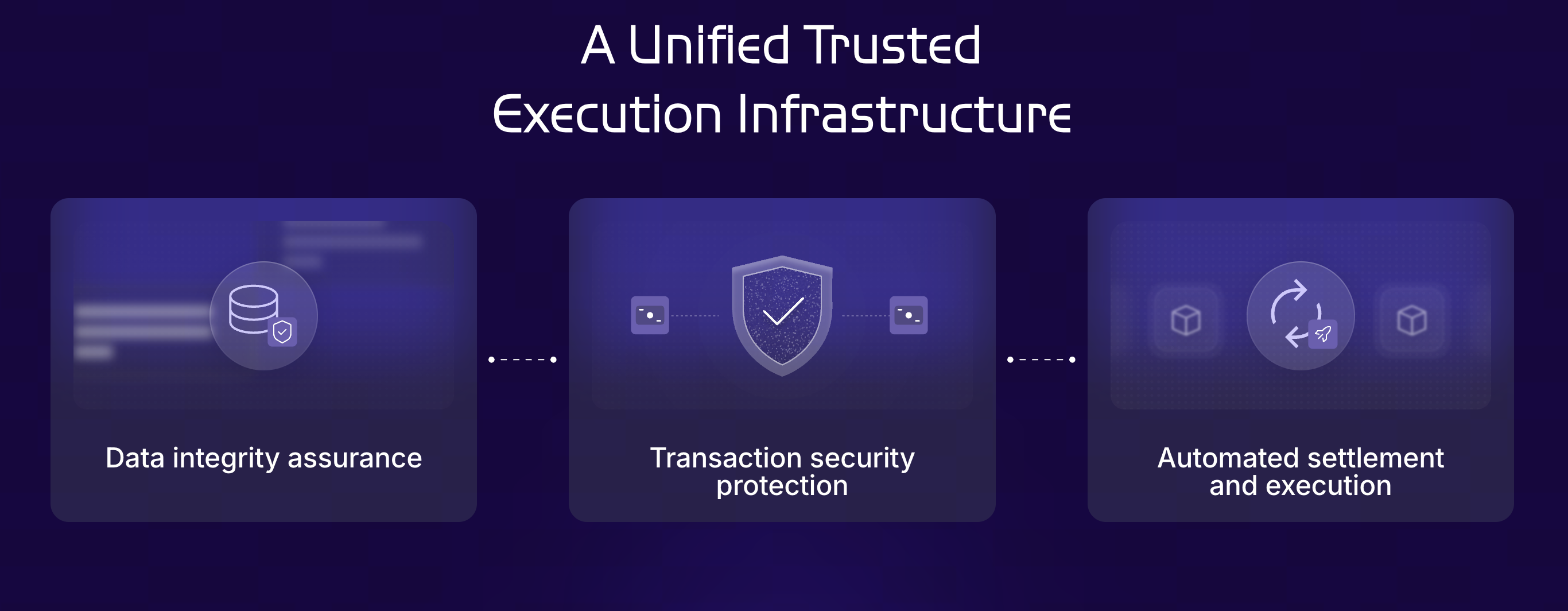
Manadia’s system architecture features a three-layer execution pipeline built on “on-chain data verification, AI Agent decision-making, and privacy settlement.” Rather than simply stacking functional modules, its core objective is to establish a verifiable, evolvable decentralized system through protocol-level constraints and feedback mechanisms.
In this framework, data originates from the real world and is injected on-chain via tamper-resistant mechanisms. AI Agents then process and make decisions based on this data, and value transfer is finalized through privacy-preserving settlement channels.
Unlike conventional Web3 applications, Manadia doesn’t rely on static data flows. Instead, it leverages dynamic execution paths and algorithmic feedback loops, ensuring each stage’s output is both verifiable and consistent. This structure lays the groundwork for future on-chain applications and long-term state management.
This model can also be extended to broader decentralized system architecture and on-chain execution pipeline design.
Source: mana.app
How Users Engage with the Manadia Ecosystem: UMXM-Driven Interaction Model
Participation in the Manadia ecosystem goes beyond simply using products. It’s a multi-role interaction framework centered around the UMXM token.
Users can contribute data, complete tasks, or provide state contributions, engaging with AI Agents or protocol modules at various stages. Every action is logged as a “state trajectory” and accumulates within the long-term state tree.
| Participation Dimension |
Method of Participation |
Role of UMXM Token |
System Recording & Feedback |
Long-Term Impact on Users |
| Data Provision |
Upload personal data, datasets, or knowledge contributions |
Pay data upload fees + earn contribution rewards |
Logged as “state trajectory” in the long-term state tree |
Boosts personal state score, unlocking higher-level data tasks |
| Task Participation |
Complete system-issued tasks, collaborate with AI Agents |
Pay task margin + earn task completion rewards |
Activity recorded and added to state score |
Expands eligible task range and increases return multiplier |
| State Contribution |
Ecosystem maintenance, governance voting, community contributions |
Stake UMXM for governance + earn incentives |
Builds a continuous state accumulation curve |
Establishes long-term identity weight, unlocking priority ecosystem equity |
| AI Agent Interaction |
Dialogue and collaboration with AI Agents |
Pay interaction fuel fees + share returns |
Each interaction creates a state update record |
Builds intelligent collaboration credit, enhancing ecosystem influence |
| Overall Participation Model |
Shift from single-use to multi-role state participation |
Payment tool + qualification credential + core incentive vehicle |
All actions accumulate in the long-term state tree |
User value transitions from one-off actions to long-term accumulation |
UMXM serves not just as a payment utility, but as the core vehicle for participation rights and economic incentives. User behavior directly impacts their state score, which determines future access to tasks and return structures.
This model transforms users from mere “users” into “state participants,” shifting value from one-time actions to long-term cumulative outcomes.
Manadia’s On-Chain and Off-Chain Interaction Mechanism
Manadia’s on-chain and off-chain components form a dynamic, collaborative execution system rather than a traditional layered architecture. These components interact continuously through protocol-level mechanisms to process data and update states.
The on-chain layer is responsible for state recording, verification, and final settlement, serving as the system’s “trust anchor.” All final outcomes require on-chain confirmation to ensure immutability and traceability.
The off-chain layer handles high-frequency computational tasks, including AI inference, data preprocessing, and complex logic execution. This design maintains performance while minimizing on-chain computation costs.
During data flow, off-chain processing structures the raw data, which is then verified and aggregated via the VERITAS protocol. The trusted results are anchored on-chain, completing the “compute–verify–anchor” loop.
Manadia’s Data and Asset Circulation Logic
In Manadia, data is not a disposable resource but a “state asset” that can be continuously verified and reused. This approach transforms data from a static resource into a dynamic economic unit.
The VERITAS protocol is central, converting external information into manipulation-resistant on-chain signals through multi-source collection, weighted filtering, and anomaly elimination. These signals inform not only financial pricing but also behavioral state and participation assessments.
Once data enters the state tree, it is permanently stored as a structured state, with the ability to be reused across time and applications. The same data can be re-verified in different scenarios without redundant collection.
During asset circulation, the system uses cryptographic proofs and state update mechanisms to ensure consistency, enabling secure data flow between AI Agents and applications and forming a scalable data network.
Manadia System Operation Process
Manadia’s operational process is a continuously evolving execution pipeline, not a one-off transaction system. Each interaction triggers updates to the state system.
First, real-world data enters the system via the VERITAS protocol, undergoing multi-source verification and structuring for reliability and manipulation resistance.
Next, the AI Agent receives the verified data and makes decisions in context with historical states. The Agent references the long-term state tree, supporting continuity in decision-making.
Finally, the system settles via zero-knowledge proofs or state channels, writing results into the state tree. Each execution generates a new state hash, forming a complete, auditable chain.
Deep Logic and Evolutionary Features of the Operation Process
At its core, Manadia’s logic is not just “data processing,” but the ongoing evolution of system states. Each execution shapes the long-term state structure.
Incremental updates reduce computational overhead by recording only changes, not recalculating all data, which significantly boosts efficiency while maintaining state consistency.
A distributed verification mechanism ensures multiple nodes confirm states, mitigating single-point trust risks. This structure resembles a “continuous consensus system,” unlike the static block confirmations of traditional blockchains.
Ultimately, Manadia’s core is not about isolated transactions or computations, but about how long-term states can continuously evolve and remain verifiable on-chain—a key distinction from traditional Web3 systems.
Advantages and Potential Limitations of the Manadia Mechanism
Manadia offers three primary advantages:
First, data verifiability—VERITAS and multi-source verification make external data resistant to manipulation.
Second, state continuity—the system records and reuses user behavior and participation over time, so value extends beyond single interactions.
Third, privacy protection—zero-knowledge proofs and encrypted settlements enable “verifiable but not exposed” data usage.
However, the system has certain limitations. Its complexity requires significant computational resources and strong node coordination. Additionally, the long-term state model depends heavily on data quality and protocol stability.
These considerations extend to the risk structure of decentralized systems and the trade-offs in complex protocol design.
Summary
Manadia’s core operating logic is to construct a sustainably evolving on-chain system through “data verification, AI Agent state decisions, and privacy settlement.”
Its primary innovation lies not in isolated technologies, but in integrating data, state, and value into a verifiable execution pipeline—binding user behavior and system operation over the long term.
Fundamentally, Manadia aims not just to process data, but to transform long-term user behavior into verifiable on-chain assets.
FAQ
What is Manadia’s core operating mechanism?
Manadia’s execution process integrates VERITAS data verification, AI Agent state management, and zero-knowledge settlement.
What is the function of the VERITAS protocol?
VERITAS generates manipulation-resistant on-chain signals from multi-source data and supports complex event and state verification.
What role do users play in Manadia?
Users are not just consumers—they are state participants whose behavior is logged long-term and impacts their equity within the system.
How does Manadia handle on-chain and off-chain data?
Off-chain modules handle computation and processing; on-chain modules handle verification and settlement. Both coordinate dynamically via protocol-level mechanisms.
What is Manadia’s core value proposition?
Its core value is transforming long-term participation into verifiable on-chain state assets, unifying data and value.